

Scabmuggers, p.1
Scabmuggers, page 1


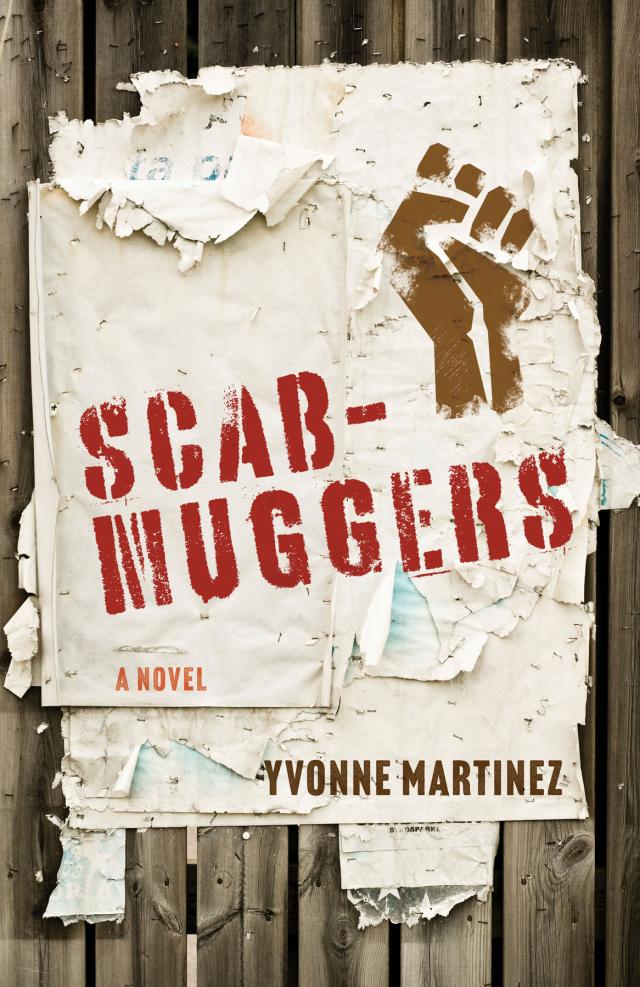
Copyright © 2025 Yvonne Martinez
All rights reserved. No part of this publication may be reproduced, stored in a retrieval system, or transmitted in any form or by any means, electronic, mechanical, photocopying, recording, or otherwise, except for brief quotations in reviews, educational works, or other uses permitted by copyright law.
Published in 2025 by
She Writes Press, an imprint of The Stable Book Group
32 Court Street, Suite 2109
Brooklyn, NY 11201
https://shewritespress.com
Library of Congress Control Number: 2025909821
ISBN: 978-1-64742-966-9
eISBN: 978-1-64742-967-6
Interior Designer: Kiran Spees
Printed in the United States
This is a work of fiction. Names, characters, places, and incidents are either products of the author’s imagination or are used fictitiously. Any resemblance to actual persons, living or dead, is purely coincidental.
No part of this publication may be used to train generative artificial intelligence (AI) models. The publisher and author reserve all rights related to the use of this content in machine learning.
All company and product names mentioned in this book may be trademarks or registered trademarks of their respective owners. They are used for identification purposes only and do not imply endorsement or affiliation.
Based on a true story
Dedicated to
Union Women who dare to fight the good fight wherever it takes them.
CONTENTS
1: Winter Is Coming. Winter Is Here.
2: Radcliffe Hall
3: Reasonable Guys
4: Bet? Bet.
5: Cultural Exchange
6: Mill Girls
7: This Is Our Shot
8: Class Speaker
9: The Great Cannoli Lockout
10: Harvard Union Women
11: The Plaque
12: Lightning Struck the Garbage Truck
13: Just Say Yes
14: Shake Your Tail Feathers
15: That’s Not Happening Here
16: Legal Seafood
17: Pennies Everywhere
18: Where Is It?
19: Step by Step
AUTHOR’S NOTE
Although this book exposes serious conflicts within the labor movement, I have always fought for unions and union democracy.
1 WINTER IS COMING. WINTER IS HERE.
I was raised by felons until I made my First Communion. My grandmother sat me between her legs and twisted my hair into the ringlets capped under my veil. She loved Shirley Temple. Our picture in front of Our Lady of Guadalupe Catholic Church in Salt Lake shows my grandmother in a black swing coat, matching heels, and a wide smile.
I studied my Baltimore Catechism while she and her sister sex workers busted up Salt Lake taverns to run out scabs. An original scabmugger, she knew how to leverage a boss. Scabmuggers were neighborhood and community women, overall strike enforcers who had ways of “persuading” scabs not to cross picket lines.
In the spirit of my scabmugger grandmother’s example, I became an activist myself. Mid-career as a labor negotiator/organizer, I was awarded the prestigious Jerry Wurf Fellowship to attend the Harvard Trade Union Program, an executive program at Harvard University for labor leaders. Jerry Wurf was one of few white men to support a Black-led strike, the Memphis sanitation strike. The strike that the Reverend Dr. Martin Luther King went to support when he was killed. That was the mantle I wore.
Heavy snow stuck like caps around the gold and teal domes of Harvard’s dorms. Sidewalks were sheets of black ice. I pulled a bulky hand-knitted wool scarf tight around my face and wore men’s black work boots that weighed my feet down and anchored me in the snow. For a counterweight, I carried a black leather backpack full of books. My classmate Ana’s long black hair gathered snow like a waterfall. She wore a wool pleated skirt over thick cable-knit black stockings and black shearling boots, her hands tight in a muff. We met at the footbridge, got to know each other the old-fashioned way, face-to-face, organizer to organizer. It was 1994; there were no devices.
“Come on,” I said. “We don’t want to be late.”
“I’m waiting for everyone else to get here. You go ahead.”
“We’re here now. Let’s go.” I pulled her elbow. “C’mon.”
Under the hundred-year-old footbridge that connected our dorms to the campus ran the ice brick Charles River. Naked trees dotted the edges, bent over, heavy with ice.
I held my hand out to her. “Can you believe this? Thirty trade unionists from all over the world, and where do they house us? At the Harvard Business School, the citadel of capitalism, right inside the belly of the beast.”
Ana took my hand.
“It’s a sheet of ice. We’ll never get across.”
“Hold on, let’s hug the bridge wall.”
We made it to the top of the footbridge. I kicked the snow off my boots.
“Okay, now all we gotta do is make it down.”
“We’ll be late for our first day at Harvard.”
“We won’t be late by much. Everybody’s got to get over this damn bridge. It’s just speeches and mingling tonight. It’ll be different for class in the morning.”
Holding on to each other, we slid down, hit the bottom, and fell into the snow. Helping each other up, we dusted off snow and walked to the crosswalk. I saw something shiny in the snow.
“Look, a penny.”
I picked it up and put it into Ana’s hand. She wrapped her fingers around it.
“A good sign. I’m amazed you could find anything in this blizzard. It’s one of the worst nor’easters we’ve ever had.”
Ana put the penny back in my hand, catching my glance.
“You know, I’m not as political as you are. I mean, I’m no big-time union rep or president of a union like you guys all are. I’m just a secretary for a teachers’ union.”
“Nobody’s just a secretary.”
“I don’t have degrees and titles.”
“A lot of us don’t either.”
“You know what I mean. I don’t even represent anyone.”
“Leaders don’t always have titles. Some of the most effective and powerful shop floor leaders I’ve known pushed a mop and broom. Your union sent you here for a reason. Trust that. You belong here just as much as the rest of us do. Where are you from, anyway?”
“We’re from Rhode Island. My dad was connected, you know, a ‘made’ man. I was driven to school every day in an armored car with a driver. I didn’t want that life, so I got out. That’s how I ended up at the teachers’ union.” She paused. “I don’t know why I’m telling you this.”
“Wow! That’s a story. Do you miss your family?”
“I still see them, but I’m not part of their world and they have respected that. What about you? Where do you come from?”
“I’m a fourth-generation Afro-Mexican from Utah, not a Mormon, a Catholic in a Mormon state,” I said. “My grandparents raised me till I was seven. My grandfather was a kingpin in the Utah weed trade in the forties. He and my great-grandmother got caught up in a sting. They did time, my grandfather at McNeil Island and my great-grandmother at Walla Walla State Pen.”
“Wow, so we both come from outlaws of some sort.”
“Yup, yet somehow they made a way out of no way and we’re here now because of it. Both of us in this underdog fight.”
Ana pulled her muff in closer.
“I’d say that evens us out a little.”
“I’d say it does.”
We arrived for the evening’s welcome at the Harvard Faculty Club. Wainscoting, footpath-grooved oriental carpets, old money, worn yet elegant furnishings. Ana and I entered the cloakroom to remove our coats, boots, and scarves. Jack, a burly, balding, red-faced Australian, was already there, wearing a tight-fitting double-breasted suit and a tropical-print tie. So was Aaron, a tall African American bodybuilder wearing a short black leather jacket, blue jeans, and leather boots. We took off our coats, caked snow falling in chunks around us, and sat on a bench to remove our boots.
Ana slid over to make room for Aaron as he unloaded his books. She whispered to me. “We weren’t supposed to bring our books tonight, were we? Were we supposed to read everything before we got here?”
Aaron dropped his glove near Ana’s foot. She reached down to pick it up. Taking her hand, Aaron stopped her and picked up the glove himself. “I wouldn’t worry about it,” he said.
Ana moved away from Aaron, so close to me we were hip to hip on the bench.
“The glove? Oh! I’m not.”
“No, the reading, I wouldn’t worry about it.”
Ana whispered to me, “I just wonder if I’ll keep up.”
“Ana, stop. You’ll be fine,” I said.
Jack eyed Ana like he could see through all her layers to below her sweater, slip, and bra. He stared at Ana, then turned to nod to Aaron. “A lot of cold and lonely nights, I suspect—aye, Aaron? In need of some late-night company, perhaps.”
Not this again, I thought. Not here!
At dusk a bed of snow covered the Harvard Faculty Club. The paned glass windows almost closed out any outside light. Elise Henri, the program director, gavel in hand, took the podium. She wore a standard-issue beige suit, perfunctory, an obligatory nod to convention.
“On behalf of Harvard University, I welcome you to the annual Harvard Trade Union Program. Thirty of you have come from all over the United States and five countries. Y
Speech over, I sat at my table and worked on my pie. Aussie Liz was tall and wore square, black-rimmed glasses, men’s draped pants, and a sport coat. She was a leader of the New South Wales Teachers Federation.
“Liz Marie, mate,” she said in her introduction to me.
“Pleasure to meet you,” I said. “Here, have a seat.”
We sat in earshot of Jack and Kirk, a tall, towheaded Midwesterner. Jack gestured with his drink to Ana and Aaron.
“What do you make of that? Looks like he’s got a hard-on for the secretary.”
Kirk shook his head.
“Never happen.”
Jack took a sip of his drink. “Don’t be so sure, mate. Wogs in this country don’t stay in their cages anymore. Not like back home where we’ve managed to sequester ours to the Outback.”
Kirk leaned back. “Wogs? Is that like a wop?”
“No, it’s our all-purpose term for non-whites.”
Kirk moved in closer. “Better watch how you use that here.”
Liz and I looked at each other. “Can you believe this bullshit?” I said.
“Indeed, mate.”
Jack took another sip. “It’s just between us, mate. Besides, it’s up to you blokes if you want wogs after your women.”
Kirk held his beer up to his lips. “It’s going to be a long, cold sixteen weeks, buddy. Twenty-four guys, just six women, and two of the women don’t count.”
Jack and Kirk looked over at us.
“Don’t look now, mate. It’s about to get better,” Liz said.
“Like I said, those two don’t count, unless you’re into converting queers and taming Amazons,” Kirk said.
“Lizzie, yeah, she’s our poofta teacher,” Jack said.
“A what?” I asked.
Jack almost finished his drink. “Poofta—our word for queer.”
“Poofta? Huh. Whatever.”
Jack pointed to me. “What about the other one? Looks like she might be outside the free-trade zone.”
“Oh, the Latin-flavor feminist? Okay, if you like missionary work,” Kirk said.
“Looks like Elise has got a little of everything here,” Jack said.
“Yeah, a regular United Nations. Japan, South Africa,” Kirk said.
“Quebec, Australia, and various shades of Americans including wogs, if you will. Hey listen, don’t you worry about the secretary, we’ll see to it that she gets plenty of opportunities to make a real choice. Consider it a Buy American campaign.” Jack finished his drink.
As Liz and I walked past them, Jack stopped us. “Liz, any luck finding the newspaper from home?”
Liz gave him a short-breathed, emphatic no.
“Right,” he said. “I’m told there’s a kiosk not far from here on the way to class in the morning. First one in brings it in?”
She gave him a shorter-breathed answer. “Won’t be you on a regular basis, I’ll bet.”
Jack’s lips went flat. “Lizzie, be kind.”
Liz left, and I started to walk away. Jack stopped me. “Jack Smith, Australian Rail Workers Federation, general secretary.”
“Simone Arroyo, public sector, Seattle, Washington.”
Jack circled his glass under my nose. “Can I get you a glass of wine?”
I looked up and down at Jack’s tropical tie. “No, thank you. I don’t drink.”
Jack ran his fingers up and down his tie. “I used to be somewhat of a chardonnay socialist myself. Now I just drink.”
“Oh, a fair-weather socialist?”
Jack twisted his empty wineglass.
“Face it, mate, that lot lost, Jack said.”
“The battle’s not over yet. Your compatriot Harry Bridges was a dyed-in-the-wool Red, led the ILWU in the historic San Francisco General Strike, forever changing the lives of dockworkers, if not the labor movement. He organized wall-to-wall whites and wogs of all stripes alike, and no doubt pooftas too. In his view labor was labor. He didn’t make distinctions like the waterfront bosses did. That’s how he beat them.”
Jack twisted his wineglass between his fingers. “Commie bloke, may he rest in peace.”
I left him standing there with his empty glass.
2 RADCLIFFE HALL
The next morning before class, I stood on a street corner in snow that cut like ice. I held a map under the dim light of an old streetlamp, turned it, and changed direction. I dragged my boots through the snow past one ancient New England church and then stopped in front of another. I walked up the church footpath to the huge, thick, dark wood–planked and wrought iron–bracketed door, opened it, and walked down to a spare basement room. I could see my breath in the cold as I took a seat on a folded chair among a circle of women. The women ranged in age from young adult to elderly. Padded down in wool scarves, shawls, gloves, and blankets, they nodded a welcome. I opened my purse to pull out a tissue to wipe my red, dripping nose and pennies fell out onto my lap. I joined in.
“God grant me the serenity to accept the things I cannot change, the courage to change the things I can, and the wisdom to know the difference.”
Meeting over, I slogged my way to campus and met my classmates at Radcliffe Hall for our first day of class. The walls were covered with embossed burgundy brocade wallpaper above the wainscoting. There were curved paned glass transoms on top of the doors, the glass fanning out like a spiderweb. The floors were wide dark brown wood planks. Crown molding, pillars, and carved molding framed the room. Curved wood and spindle banisters led up polished oak stairs. Brass sconces lit it all up with ceilings higher than any I had ever seen. Yankee New England to be sure.
John Dunlop, a Harvard professor in his seventies, wore a bow tie and an ancient shiny blue suit. He scribbled something on the chalkboard and turned to address us.
“May I have your attention, please?”
He held a pointer up like he was about to conduct a symphony and waited with a Hitchcock half-eyelid stare.
“Please limit your comments to the assigned readings and to areas about which you have direct knowledge. I am not interested in hearsay regurgitations of events with which you have no firsthand experience. You have been selected out of thousands by your respective unions to be here, so it is presumed that you have some ability to comprehend complex ideas. It is also assumed that you have some ability to cogently express your thoughts, such as you may have any, on the subjects covered in the readings. Nothing more.”
At the time, I wasn’t sure what to make of this. Was this discourse a relic of post–World War II industrial unionism? Had class warfare gotten institutionalized into economic department colloquy? I learned later that Dunlop was the old guard academic don of labor studies at Harvard. The executive program I attended was his creation. In setting it up the way they did, like a “reality” survival game, I wonder how much thought was given to the participants in the experiment they created. Why was it okay to set up abuse? I later learned that every class was set up solve some kind of crisis.
Heads down, we took notes, looked sideways at each other. No one moved to break the cold between us except Palmer, a short, portly Minnesotan with wavy blond hair. His hand went up. In an ill-fitting nondescript suit and tie that appeared to be choking him, his unwilling effort to conform to convention, he waited to be called on. We waited for an anvil to fall on his head.
“Um … Professor Dunlop, sir, Palmer Winston here, Newspaper Guild. Could you help us understand what’s on the board?”
Dunlop tapped his pointer in his hand.
“Young man, surely your many years in the newspaper industry have not caused you blindness.”
Dunlop walked over, tapped the blackboard with the pointer, and turned to Palmer.
“Nor, I trust, has your considerable skill at deciphering the printed word rendered you inept upon your arrival here. Shall we try again?”
Dunlop scribbled something else unintelligible on the blackboard. His chalk broke, and white pieces fell to the floor. Some of us tried to take notes; others just stared. The Japanese students typed furiously into their handheld PC translation devices. I whispered to Ana and Liz.


