

A brutal design, p.1
A Brutal Design, page 1


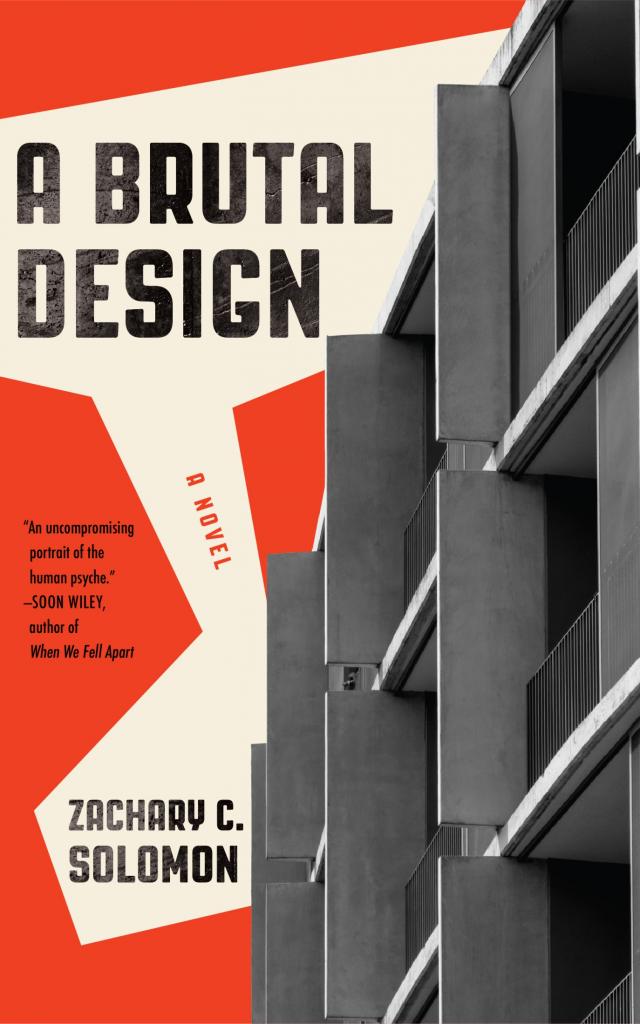
PRAISE FOR A BRUTAL DESIGN
“Part utopia, part dystopia, Zachary C. Solomon’s smart, accomplished novel wears its ambitions proudly on its sleeves. A Brutal Design is attentive to the brutalities of history even as it trains its eyes on the future. It’s an engrossing and powerful debut.”
—Joshua Henkin, author of Morningside Heights
“Through its magnetic and momentous descent into the darkness that lurks beneath the surface of the desert utopia Duma, A Brutal Design convincingly depicts the insidious way that ideological oppression can seep into the world around us. There were moments in Solomon’s novel that truly frightened me, and yet, like its narrator, Samuel Zelnik, I found myself obsessively compelled to uncover its mysteries. This is a haunting, thought-provoking novel that shows a place where the senseless meets reality.”
—Gabe Habash, author of Stephen Florida
“A Brutal Design is a deft blend of sci-fi, noir, and a dash of Sebald that examines our yearning for utopia. It is propelled by unease, yet funny and beautiful, too. Once I started reading it, I could not stop.”
—Erin Somers, author of Stay Up With Hugo Best
“With searing prose and breakneck pace, A Brutal Design delves into the terrifying and prescient intersections of art, fascism, and belief in one’s ideals. An uncompromising portrait of the human psyche and overflowing with philosophical depth, Solomon’s debut impresses and stays with you, long after you finish the book.”
—Soon Wiley, author of When We Fell Apart
“A Brutal Design is an absurdist, falling-down-the-rabbit-hole adventure packed with dark mysteries, startling images, and surreal encounters. At the same time, this book is keenly political, rich with implications for both the past and the future. Through his evocation of the ostensibly utopian city of Duma, Zachary C. Solomon deftly explores the relationships between art, bureaucracy, violence, and political control. This is an exhilarating and boldly original debut.”
—Helen Phillips, author of The Need
“With commanding intelligence and dystopian foresight, A Brutal Design secures Zachary C. Solomon’s place in the world of letters with a voice steeped in history, literature, art, and philosophy, and maturity beyond its years. His taut, elegantly written, and exquisitely bleak novel presciently pits fascism against dwindling humanity, asking: Do we value life little enough that we’d exchange it for “advancement and comfort”? This is a haunting, sinister, and brilliant debut.”
—Sara Lippmann, author of Lech
A BRUTAL DESIGN
Zachary C. solomon
PHILADELPHIA
Contents
Praise for A Brutal Design
Title Page
Dedication
Chapter One
Chapter Two
Chapter Three
Chapter Four
Chapter Five
Chapter Six
Chapter Seven
Chapter Eight
Chapter Nine
Chapter Ten
Chapter Eleven
Chapter Twelve
Acknowledgments
About the Author
You might also enjoy...
Copyright
Landmarks
Cover
Title Page
Table of Contents
Start
Copyright Page
For my mother and my sister.
ONE
I WAS ON THE VERGE when the train pulled in at half past three. For hours I’d sat with my face pressed against the glass, fogging it with my breath through the day of graceless, nauseous rocking toward the north, then far to the east, and finally south. I was tired and queasy and had been punished severely for teaching my benchmate, a mere hour into our eleven-hour journey, the English phrase long-distance telephone at her pleading. She had practiced it ceaselessly, with torturous intention, as the world changed beyond the window, grew harsher, filthier, more—then less—industrial, as we passed through the city, suburbs, exurbs, countryside, and into the infinite steppe, well beyond the cessation of electrical poles and industry markers, until, at last, the station appeared in the distance. The people in my compartment began to stir, to collect their belongings from the overhead. My neighbor swallowed audibly, straightened her skirt, and looked at me. Long-distance telephone, long-distance telephone, long-distance telephone.
I was hopeful for myself, but not for her.
We disembarked. I stood to the side, away from the rest of the travelers, breathing the sandy air and waiting for the porter to emerge by the train’s sleek, streamlined beak. He appeared through a swirl of steam and got to work unloading suitcases onto the wooden platform. I let the others collect theirs first while I looked around. The station, an imposing concrete wave, stood in a bleak expanse of dry, green brush. The air was hot, the soil red clay, fine and dusty. The others from my compartment—businessmen and businesswomen in quickly dirtying suits or jumpsuits, wearing flats—found their way inside to make their calls. I waited until only one bag remained, figuring it had to be mine. I hadn’t been allowed to do the packing myself. I’d been supplied the bag.
Down the tracks by the rear of the train, people were still cascading from the second-class cars, dropping their valises and blinking into the sunshine, a mass of threadbare gray and brown coats groping for direction. Coats in this weather meant they weren’t traveling on a roundtrip ticket. Meant they were wearing everything they owned, for whatever contingencies life might thrust at them.
I wondered why I wasn’t among them. Why I’d been ticketed a first-class berth.
A short man in a pinstriped suit and vest stood by the station holding a white sign with my name on it. He had taken pains to add serifs to each letter. No one had ever held a sign for me before. I felt exposed and quickly flushed with sweat. I nodded at him, then took out a handkerchief and wiped my brow. I was a profuse sweater and forever embarrassed by it. The porter placed my duffel at my feet. I patted my pockets for a tip.
As the driver approached, I saw that the suit he wore was made of wool and that his socks were wool, too, visible beneath pant legs that had been hemmed too high. Wool in this weather. I felt bad for him, a man who had to sweat like me. I thought about taking a stand if they made me wear a uniform like that. I reminded myself that I had agreed to come here, that I had to stand by my decision. I chastised myself for complaining. But then again, is there really a decision if the alternative is simply intolerable?
He had puffy cheeks, the driver, and a thick eyebrow that wormed when he spoke, though he was handsome, if a little haggard. It wasn’t a stretch to picture him gulping down a stein of ale or wearing overalls on some stormy quay. I placed him in his fifties. His teeth were straight and bleached.
Though I tried to resist, the driver took my bag and placed it gently in the trunk of his car, a functional, sexless hybrid that had seen cleaner days. He then opened the back door for me, but I sidestepped him and went to climb into the passenger side in front. He rushed to open that door too, the two of us doing an awkward dance of decorum. He was intent on following the instructions of his position and I was intent on showing him that I wouldn’t be a burden. I sensed little room for improvisation in his life, even the kind of friendly corner-cutting a bureaucrat might do for a friend he sees in the back of the line. He introduced himself as Henry and apologized for the mess. Cassettes and maps and lighters and a gold-plated tire pressure gauge lay in the footwell. But no dust.
We pulled out of the station parking lot and joined up with the highway. In the side mirror, I glimpsed a few of the second-class passengers piling into a big, industrial van. I thought maybe they would be taken where I was being taken—but if that were the case, why no signs for them? I couldn’t shake the feeling that if it weren’t for some unfair advantage, I would have been among them. The hybrid struggled to catch up to cruising speed and cars overtook us viciously, each one sending our little car bobbing. Earth spread out on either side in a crenelated landscape, farms demarcated by rolling hills, grain elevators, water towers, windmills chopping air. It was easy to see from the elevated road the plan of the countryside, the towering housing blocks with curved balconies arranged in clusters around airy plazas, the brutalist municipal structures, the fountains and playgrounds and regional flags—architecture not so different from home. Stunning to see so many people at once, or the evidence of them. It was like I could feel the presence of hundreds of thousands of lives as we bumped up the road to the south.
I was trying to figure out whether it would be impolite to ask Henry a question when he spoke.
“You’re going to like it,” he said. “You’re going to like everything about it.”
I wasn’t sure if he was referring to the country, the region, or our destination. He drove carefully, hands on twelve and two, his eyes darting up to the rearview every ten seconds. We passed tailgaters whose cars sported bumper stickers written in a language I couldn’t identify. Muzak drifted through the car’s tinny speakers, a reedy, vaguely melodic vamp.
“There’s a particular kind of genius to it,” he continued. “An actual brilliance.” He tapped his right temple with a pointer finger, as if to show where the brilliance was kept. “You’ll see. When you walk around the campus, how easy it is to navigate. To find your office, groceries, to get to the athletic complex. Intuitive geography. You know where to go without knowing where to go. You’ll see. It’s very simple. Elegant.”
I asked how long he’d lived in Duma.
“Since the start. Since it was a little baby settlement. And now it’s all grown up. When I first got to Duma, there was only a handful of concrete blocks in a circle in the middle of the desert.”
“What made you come out here?”
“It was so long ago I can’t remember. I’ll let you know if I do.” He smiled, glanced at the rearview, adjusted the angle. “So what’s your preference?”
“For what?”
“What you want to do. What you’re hoping for. You know, a job.”
Henry was requesting a level of transparency from me that I wasn’t entirely comfortable with. I was exhausted, bled utterly dry by the long journey, my senses dulled to nubs. I decided I would just repeat what I’d been told.
“They said they needed an architect.”
Henry risked a glance at me and the car drifted a bit onto the shoulder. I squeezed the armrest. I hated driving, or being driven, or really any kind of locomotion. I’d get carsick, seasick, airsick. I got dizzy on sidewalks.
“Very unusual,” said Henry. “Good for you. But don’t get your hopes up.”
“Why not?”
“I was a dentist before I got here. Great, they said, we could use a driver. Now I’m a driver.”
“They specifically told me I’d be designing buildings,” I said. “I’m doing my graduate studies in architecture right now. My uncle already lives in Duma, as a chemical engineer.”
“Oh, yeah? How do you know?”
“He sent me a letter.”
Henry roared with laughter. “Good luck with your studies,” he said.
His dismissal made me despair. I closed my eyes to the sunlight that strobed through an oasis of trees and thought about how I would fight back against the bureaucrats. I had been told—and this had been corroborated by Uncle’s letter—that I would help design buildings necessary for the growth of Duma. I was told the settlement was nearly ready to enter a new phase, that it would be expanding infrastructure to accommodate an increased population, that the experiment was showing signs of success. If the ethos behind this place was a progressive one, and if it truly was an attempt at communal, collaborative, socialist living as I’d been told, then I wanted to contribute. I wanted to help prove that the man my parents had raised me to be could find purchase in a kind and fair society. And I wanted to do it through architecture. To show that buildings, like governments, could be democratic: bastions of equality, dismantlers of hierarchies.
I wondered how Uncle V. was getting along out here without Mela and Elam to take care of him. Without me to push around. I listened to the car radio and remembered a time, not so long past, when I was working at the kitchen table in our house on Alizabet Street. That horrid table. One leg two inches shorter than the other three. That table was the totem at the center of our poverty. We were poorer than we’d ever been, our meal tickets yielding less and less, and our house was haunted by the mysterious stench of eggs despite the citywide shortage. I sometimes wondered if the odor emanated from Uncle V. himself, given that he had stopped bathing some time before—in rueful protest, I supposed, of the continuation of his regrettable existence. He had been back from jail for a few weeks by then and had not recovered any of his character. I had yet to learn why he’d been to jail in the first place. He would tell Mela and Elam the story shortly thereafter. I would learn it from them shortly after that.
About that table. For a time we used dried newspaper pulp to prop up its stunted leg. The pulp lasted a week, maybe nine days, then Mela or Elam would deliver a bit more of the stuff. They got it from the local paper crusher, in exchange for who knows what. They were always taking care of us—of you, Uncle—for reasons that escaped me for a long time. I didn’t know then what I know now: that I owed you a debt of gratitude as immense and imposing as the perilous Mount Elbrus—and as proficient at claiming souls.
They were over, both Mela and Elam, that day I was working at the table. At least one of them was at our house on any given day, typically to remind you to bathe and eat, to be nice to your nephew. I couldn’t take care of you. I didn’t want to. You had always made it clear that it was you who had to take care of me. And that I should never forget it. And that I should always feel a responsibility for it.
You had come in from the outside and stood in the open doorway, watching me. Behind you, the street glistened from a morning rain shower. The smell of sulfur wafted in. My plans were scattered about me on the tilted table, my drafting pencil rolling over and over to the edge. The humidity was turning my tracing paper to mush.
“The immigrant toils and toils,” said Uncle. “He toils forever and never sees nothing for his efforts.”
“Not you,” I said. “You don’t toil and toil.”
“I’m not an immigrant. I was born here. In this very house.” He spat dryly onto the wooden floorboards, eliciting a reprimand from Mela.
“I’m not an immigrant either,” I said.
“Stop your working, then. Your time is almost up.”
“Our time,” I said.
“What is it you’re working on anyway? So diligent and studious.”
I was in the fourth and final year, I hoped, of my graduate studies in architecture. My thesis lay before me on the crooked table. But I wouldn’t show him. He would never understand. In fact, he would be angry with me for it, furious even; he would find it indignant, pretentious, a futile attempt to make meaning out of a meaningless past. I didn’t want him to blemish it, or worse. Tracing paper was hard to come by.
“Leave him be,” said Mela. “Let him hope.” She meant it as a positive reinforcement but it came out like something you would say around a naïve child.
“I bet you,” said Uncle. “Watch: your university gates will be closed to you by month’s end.”
I couldn’t afford to think that far ahead. I had to deal with what was in front of me. And my thesis was in front of me. I kept drafting, using my set square and my French curve in equal measure, chasing equilibrium between right angles and curves. I heard him coming closer and instinctively covered my papers. But instead of poking his nose in, he let a few sticky cheese pastries fall onto the table.
Elam rushed over. “How?” He plied one with his thumbs, sniffed the glucose. “They’re still fresh?” A string of sugar thinned and then broke between his fingers.
Uncle shrugged. “I have a method.”
“Theft? Theft isn’t a method. Recklessness is your method.”
He showed his teeth, still maddeningly white.
“You’ll go back to jail,” said Elam, but Uncle was already halfway toward his bedroom.
The three of us each ate a pastry, but there was no enjoyment, since the food was tainted by Uncle’s parlor trickery, his fake kindness that came at his own expense, so that we had to feel guilty about the happiness he gave us. He wanted us to be pleased by his actions, though they were the actions of a villain. No one asked him to martyr himself, yet he chose that path anyway. And since he’d stepped in to raise me when no one else would or could, I had no choice but to be thankful to him.
Henry cleared his throat, pulled his collar away from his neck, and grimaced.
“Did you ever take those vocational tests?” he asked me. “Or are they before your time? The ones where you filled out a questionnaire and then a machine would tell you what you should be when you grow up.”
“Did yours say ‘driver’?”
This time, when Henry laughed, his shoulders pumped up and down and his head shrank into his jacket. “It told me I was going to work in finance.” He chuckled again. “Me. Finance.”
“Are you bad at math?”
“Are you kidding me? I’m great at math. When I was a kid, I was the top of my class. Algebra, geometry, trigonometry, physics, calculus. Name it, I solved it.” Henry shifted in his seat to unstick the shirt from his back. I could see the shadow of sweat the seatbelt had left across his chest.


