Dead and alive, p.1
Dead and Alive, page 1


By the same author
Fiction
White Teeth
The Autograph Man
On Beauty
NW
The Embassy of Cambodia
Swing Time
Grand Union
The Fraud
Non-Fiction
Changing My Mind: Occasional Essays
Feel Free
Intimations: Six Essays
Plays
The Wife of Willesden
Penguin Press
An imprint of Penguin Random House LLC
1745 Broadway, New York, NY 10019
penguinrandomhouse.com
Copyright © 2025 by Zadie Smith
Penguin Random House values and supports copyright. Copyright fuels creativity, encourages diverse voices, promotes free speech, and creates a vibrant culture. Thank you for buying an authorized edition of this book and for complying with copyright laws by not reproducing, scanning, or distributing any part of it in any form without permission. You are supporting writers and allowing Penguin Random House to continue to publish books for every reader. Please note that no part of this book may be used or reproduced in any manner for the purpose of training artificial intelligence technologies or systems.
PP colophon is a registered trademark of Penguin Random House LLC.
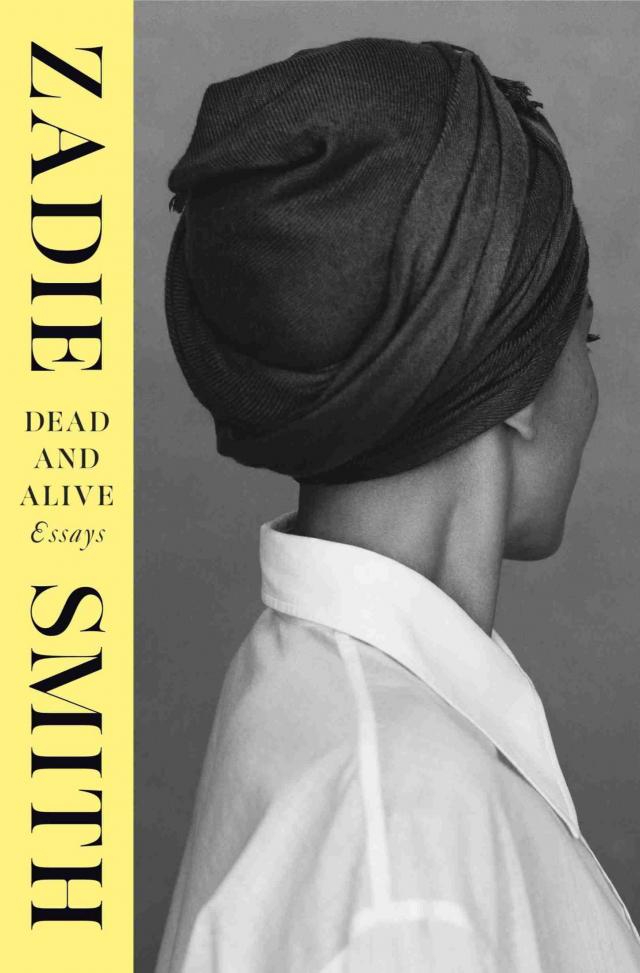
Cover design: © gray318
Cover photograph: © Inez and Vinoodh/Trunk Archive
Picture credits appear on this page and text permissions on this page.
library of congress control number: 2025038436
Hardcover ISBN 9780593834688
Ebook ISBN 9780593834695
First published in the United States of America by Penguin Press, an imprint of Penguin Random House LLC, 2025
Published simultaneously in Great Britain by Hamish Hamilton, an imprint of Penguin Random House UK, 2025
The authorized representative in the EU for product safety and compliance is Penguin Random House Ireland, Morrison Chambers, 32 Nassau Street, Dublin D02 YH68, Ireland, https://eu-contact.penguin.ie.
prhid_prh_7.3_153692908_c0_r0
Contents
Dedication
Foreword: On Hospitality
Part I: Eyeballing
European Family
The Muse at Her Easel: Celia Paul’s Self-Portrait
Toyin Ojih Odutola’s Visions of Power
The Instrumentalist: On Tár
Stormzy at Glastonbury: King Michael Wears His Crown
Part II: Considering
Fascinated to Presume: In Defence of Fiction
Under the Banner of New York
Egypt: Laughter in the Dark
Some Notes on Mediated Time
Part III: Reconsidering
Black England
Black Manhattan
What Do We Want History to Do to Us? On Kara Walker
A Speech for the Kenyon Review
The Tufton Pragmatists
Ruination
Shibboleth
The Dream of the Raised Arm
Trump Gaza Number One
Part IV: Mourning
The Opposite of Magical Thinking: On Didion
Daughters of Toni
A Writer All the Way Down: On Philip Roth
Martin Amis: England’s Only Living Writer
What Lodged in Her Mind: Remembering Hilary Mantel
Part V: Confessing
The Realm of the Unspoken
Agelessness
The Fall
On Writing The Fraud
Some Questions from El Cultural
Conscience and Consciousness: A Craft Talk for the People and the Person
Kilburn, My Love
Acknowledgements
Pictures
Picture Credits
Permissions
Index
About the Author
_153692908_
These essays are dedicated to the memory of Sekeena Gavagan
Foreword: On Hospitality
You have in your hands a book of essays on many different topics. A tricky proposition. Where to begin? You might start from the first page and just plough through. Or look for a subject that interests you in the Contents, and begin there. You could revisit one you’ve read before, and see how you feel about it now. Or seek out the one you’ve heard about, and see what you yourself make of it. Whichever route you choose, you are welcome. Feel free.
Rereading these essays, I notice how many of them begin with me walking into real and/or conceptual spaces and basically encountering something. I arrive as a guest (of the gallery, the book, the movie, the country, the protest, the idea). But as I try to describe what I am looking at or thinking about, I end up being a kind of host, too. Which can also be tricky. In life – as we all know – sometimes it is pleasant to be shown around by your host and sometimes it is annoying or oppressive. As they guide you round, they will inevitably influence the way you experience whatever-it-is, and sometimes you don’t want to be influenced: you want to look at the painting or song or situation through your own lens. But this is where books come into their own. For no one will be surveilling you as you enter this book, nor notice when you leave. On this particular guided tour, I won’t spot you hovering on the edge of the group, annoyed by the guide with her little flag and digressive way of talking and thinking. This book cannot scrub its history as the ground shifts beneath it, nor can it be everything, everywhere, all at once. It is not being written by an infinite and eternally unscrolling artificial intelligence, but by a human being in a particular moment; one who will never know how eager you were to move on to the next location. Which is all to say: within the covers of this book, you have freedom of movement, and this freedom is absolute.
Another thing people sometimes fear about essays is that they will be too academic, or full of obscure references, which can make a reader feel like she is on the outside of something, or as if she is not welcome. (I experienced that a lot myself as a young reader, especially before the age of the search engine.) With this in mind, I have employed footnotes, introductory notes and postscripts as a necessary evil, but feel free to ignore them if you’re the type of person fortunate enough to already know most of everything. I leave the doors to these essays as wide open as possible, by using language that is, for the most part, as clear as I can make it. The house of an essay may sometimes be strangely shaped or have a complicated floor plan – but the door is open.
Finally, if you are wondering why this foreword is called ‘On Hospitality’, well, that is a nod to one of my favourite philosophers, Jacques Derrida, who wrote a great book with the same title, in which he thinks about how we humans might make space for each other, ideally, in this world.[*] It is also a very good practical description of the relationship between writers and readers:
Absolute hospitality requires that I open up my home and that I give not only to the foreigner (provided with a family name, with the social status of being a foreigner, etc.), but to the absolute, unknown, anonymous other, and that I give place to them, that I let them come, that I let them arrive, and take place in the place I offer them, without asking of them either reciprocity (entering into a pact) or even their names.
Reader, I do not know your name – but you are welcome.
Zadie Smith
North-West London
March 2025
Skip Notes
* Actually, a collection of seminars that Derrida delivered towards the end of his life, in which he considers the question of the ‘foreigner’, and what an ‘unconditional hospitality’ might look like.
Eyeballing
European Family
Sometime around 2013, in the middle of a stage interview, a literary critic had an interesting question for me. Why had I begun to write more about the visual arts? And less about books? Answering his own query, he began to muse about the visual turn in the culture, the emergence of the black body as a site of enquiry, the rejection of the white male gaze…And kept talking. I nodded and smiled, doing my best to follow, though I hadn’t slept properly in a while and he was using a lot of jargon. Later that evening, much later – whilst propping myself up against a wall with one hand and swinging a Moses basket with the other – I thought: there should be a more practical arm of literary theory, one that takes into account the realities of women’s lives…
I had my first child in 2009. It didn’t take long to figure out that looking at art requires neither both your hands nor silence. That it can be done swiftly, between playground and naptime, and that you can be very tired, looking at art. Sometimes a fugue state even helps! Whereas, if you are trying to breastfeed your baby to sleep, any attempt at simultaneous page-turning will wake them. Even if you transition to a silent Kindle, the contrast between the piecemeal, necessarily time-consuming practice of reading, and the all-encompassing, instantaneous moment of looking, will be stark. All of that is over now, though. No more playgrounds, no more naptimes. And no more teaching. No more marking essays on the soft-top of a buggy. But I still retain the old habit of dashing in and out of galleries like a criminal, especially, for some reason, the Musée du Luxembourg. I love that museum. Small enough to walk around in an hour, even with a screaming child strapped to your torso. I used to teach in Paris, every summer, a nd each time I dashed in and out of the Luxembourg I would emerge with an idea for an essay. Even if, in the final analysis, I never got round to writing it.
Fast forward, many years. Finding myself in Paris once again, not teaching – and temporarily childless – I hurried from the gardens into the gallery, then reminded myself that the emergency is over: take your time. The show was called Miroir du Monde. It consisted of about a hundred paintings and objets d’art from Dresden’s legendary Cabinet of Curiosities, or Kunstkammer. Collected over two centuries – by the Prince-Elects of what was once Saxony – the Kunstkammer can be thought of as a kind of one-stop-shop, intended to bring together in one place representative examples of the many art treasures to be found upon this earth. A mirror of the world, exactly. At this point you may be thinking (as I did), but surely it all went up in flames, with the rest of Dresden? In fact, the Kunstkammer was mostly relocated to a fortress on a hill for the duration of the war, and the bulk of it has survived. Now here were some of its marvels right in front of me, magnificent to behold, and yet also somewhat penned in – like one’s true thoughts during a literary interview – by the banal framing of somebody else’s words. In this case, a curatorial description:
This exhibition places an emphasis on the artistic quality and provenance of the works which not only reflect the many global relationships and cultural exchanges, but also the Eurocentric world view they embody. A few historical objects are arranged so as to mirror works by contemporary artists, putting these historic collections into perspective through the key issues of our time.
The key issues of our time turned out to be basically the one issue, that pesky white male gaze once again, a critique impossible to argue with – as far as it went. Take, for example, Moor with Emerald Cluster by Balthasar Permoser, circa 1724. About fifteen inches high, he is a muscled youth, a noble savage type, and therefore, yes, for sure a familiar Eurocentric cliché. Carved from pear wood, lacquered a very dark brown, he is depicted half-naked, multiply tattooed, wearing gold cuffs, gold necklace, a feathered and bejewelled headdress, and holding a platter of emeralds – all while grinning like a figure from the commedia dell’arte. The museum had helpfully put him under a spotlight in his own corner, presumably so that we might all focus our Eurocentric gazes upon him, and dutifully note what a perfect example of exoticization he was, and fetishization of same. Still, he was beautiful.[*1] Far more egregious were two laughing ‘Chinese’ porcelain busts, 1732, produced by the Meissen factory. These gargoyles managed to combine the physical clichés of Asian physiognomy – as caricatured by European artists[*2] – with a wild, near total ignorance of traditional Chinese dress, as if the artist did not even know enough of the truth to satirize it. The woman – who seemed to be kitted out like a Dutch milkmaid – wore a fantastical hat that turned up at each end and featured a lot of incongruous bobbles and tassels, while the man’s hat looked no more Chinese than the baseball cap upon my own head. Fictional creations, these two, from a nowhere place called ‘Foreign’. Looking at them I realized I felt a little sorry for the much vaunted, much dreaded, ‘Eurocentric world view’. Supposedly all-powerful, and yet so incredibly ignorant! It does not know what it does not know. It conjures up a beautiful Moor – carrying emeralds stolen from the New World, to be presented to the Old[*3] – but then dresses him incongruously, borrowing his costume from a series of contemporary images of sixteenth-century America.[*4] That’s how he ends up tattooed like the Native Americans of Florida, and in their ceremonial costume, too. His feathered headdress meanwhile is drawn from an even stranger source: Montezuma II, the ninth Aztec emperor of Mexico. Eurocentric. The word itself began to feel a little too self-regarding. Euro-blindness? And besides, shouldn’t there be another, more specific word to describe the act of plunder and purchase, into which category at least a third of the objects in the Kunstkammer truly belong? Such objects embody no ‘Eurocentric world view’ – how could they? They are not the product of Europe at all. And how dazzling!
An engraved ivory horn from Senegal.
A painted Japanese teapot.
An Iranian scimitar, encrusted with precious jewels.
All exotic from the perspective of Saxony, but never exotic in and of themselves. Rather, they sit at the very centre of their own worlds, conceived and constructed by master craftsmen, whose skills and materials were – like Chinese porcelain – sometimes copied and poached by Europeans, but whose roots lay elsewhere. And yet, of course, once contact is made, and those ‘cultural exchanges’ noted by the curators occur – between Old World and New, ‘indigenous’ and ‘civilized’ – at that very moment, an impure and ungovernable channel of influence inevitably opens up, through which ideas will pass back and forth, until the category of ‘exotic’ begins to look like a moveable feast. For who, exactly, is exotic to whom?
In the Luxembourg Museum there was only one possible answer to that question. It was as if the curators, in their wisdom, had decided to take power – especially colonial power – at its own word. That is, as all-conquering. As eternally and uniquely capable of labelling and locating the exotic ‘other’ in the colonized, the subjected, the indigenous. As not only militarily and economically triumphant but also aesthetically and psychologically. In fact, by some perverse circularity of logic, the ‘Eurocentric world view’ was basically being re-presented to me in more or less the same terms in which it had once fondly thought of itself, nearly three hundred years ago. This self-belief in Europe’s own prepotency is, of course, a part of the Kunstkammer’s history – a large part. But it is not and can never be the whole story. Power dominates, but art proliferates – and not always along the lines that power dictates. For art, unlike power, can never be wholly unidirectional, artists themselves being at once too voracious and impure in their methods. Whether members of dominant or subjected communities, they will prove capable of appropriation, hybridization, adaptation. To put it another way: while the master isn’t looking, many interesting things will be made with his tools. As for his notorious gaze – however powerful it might be – it can never completely stop him from being seen, by others, for what he really is. Even colonial subjects have eyes.
I left my spotlit Moor where he was – patiently holding his tray of gems, awaiting the fresh pity and ready-made critique of another busload of European tourists – and walked on. Onwards, into the second room, where I spotted an object that stopped me in my tracks. It was far less spectacular than the Chinese heads or the Moor, and sat half-ignored under Perspex, poorly illuminated, easily missed. Just a little piece of Chinese porcelain called European Family – but it made me laugh out loud. I couldn’t help but think of the Chinese artist who had made it. Was it a commission or simple curiosity that had led him to his subject? Had he[*5] ever seen a European family? Perhaps he had seen the many portraits of them and wondered at them, there being much to wonder at. Why, for example, did they tend to depict themselves in such a pitiful, meagre, nuclear fashion: father, mother, kids? Where were their ancestors? Where were their dead? And why so many mangy dogs? Were dogs more important to European families than ancestors? Sometimes they even brought in a monkey and depicted him as a funny little thing – as a pet! As if a monkey were not a god! Also: what is with the headwear? Very large and yet also sort of non-functional? Like literally what is the point of it? Does it keep off the sun or the rain? Feels like it would instead direct rain through a funnel back into your face? And is it the Spanish ladies that wear the dome-like veil things? Or is that the English? The Catholics or the other ones? Does it matter? Are there, like, even any important differences between the Spanish and the English? Not really?
He may not be quite clear on all the local details, but I really like the things our Chinese artist has correctly surmised about the ‘Other’, and sees fit to include in his idiosyncratic vision. The weirdly vulgar way, for example, that European man likes to man-spread, lifting one leg at a right angle to the other, exposing his genital area, and thereby using twice the lateral space that sitting with his legs neatly together would have taken up. Also, the fact that, within a European family, people can often seem quite distant the one from the other, to the point that sometimes, in their portraits, it looks as though they have never really even met. Their food looks – how to put this? – unappetizing. And maybe not that flavoursome? A boiled chicken leg. Some cabbage. And why are their dogs allowed so close to the food? That doesn’t seem right. And oh boy do these Europeans love buttons. Chinese buttons are also a thing of course but the artist might be forgiven for feeling that the buttons of his own people are more functional and discreet. Here we have just so many buttons on everything. Big shiny metal buttons that seem more for show than for use, and also there’s the silky neckerchiefs and cravats, and stockings and garters, and just a surprising amount of florid and apparently unnecessary decoration on these European men who, in other realms of life, seem to take themselves so very seriously. Finally, European families drink. A lot. Drink seems to be central to the whole escapade of being a European family. Unclear why. Maybe it’s the only way to survive one? Look how they grasp their goblets with a strange tenacity, as if it is very important to them to keep the beer and/or wine or whatever it is they drink flowing and on hand at all times, perhaps because it muddles the mind, calms dark thoughts, eases guilt, renders one forgetful and self-aggrandizing, and lets you go to sleep as soon as your head hits the feathered pillow, like a man with a clear conscience.