

The proxy bride, p.1
The Proxy Bride, page 1


PRAISE FOR THE PROXY BRIDE
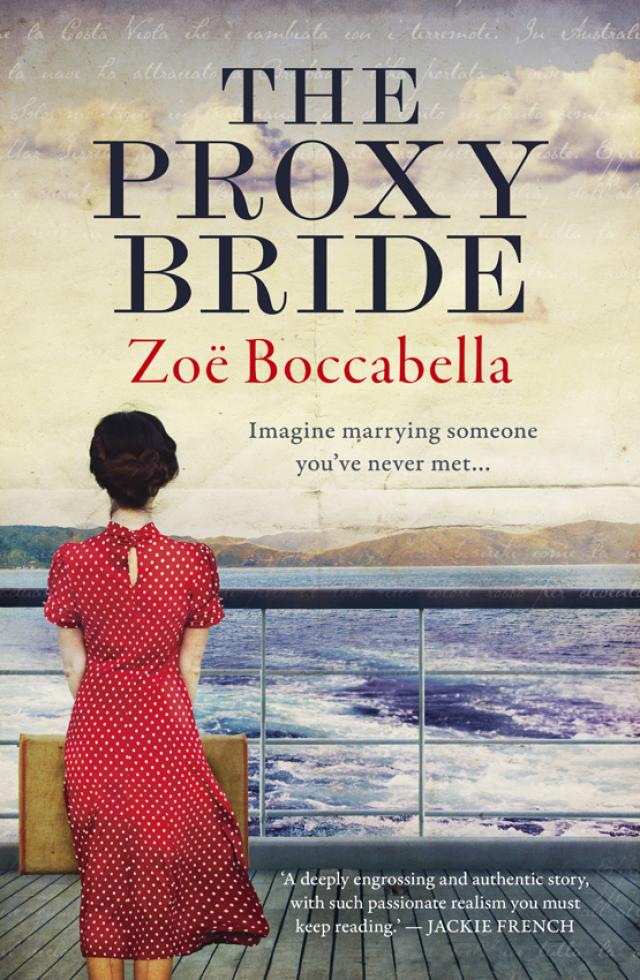
‘A deeply engrossing and authentic story, with such passionate realism you must keep reading.’
Jackie French AM, award-winning author and historian
PRAISE FOR MEZZA ITALIANA
‘This is a memoir with a difference. Zoë Boccabella’s story of her embrace of her Italian roots culminates in a dramatic event that brings into focus her entire family history. She’s a charming and thoughtful writer with a vibrant story to tell.’
Frances Mayes, author of Under the Tuscan Sun
‘Wonderful descriptions of relatives and other villagers, the countryside and the food … This is a beautifully written memoir full of characters and places, which will appeal to the literary traveller, to people who already love Italy and to all those intending to visit.’
Chris Harrington, Bookseller+Publisher
‘I loved this book! Zoë Boccabella has a vastly different story to the foreigner who falls in love with Italy. She has Italian blood running through her veins as the granddaughter of Italians who immigrated from Abruzzo … There is much to love about this book. The wonderful characters, her fabulous Italian grandfather who takes his love for all Italian traditions to Brisbane and cherishes them till he dies. Her boyfriend who becomes the poster boy for all things Italian and the people of Fossa, a village tucked away in Abruzzo. I can highly recommend Mezza Italiana.’
Carla Coulson, author of Italian Joy
‘This is a delightful book that is part travel story, part a very personal narrative of self-discovery, that the author Zoë Boccabella (beautiful mouth in Italian) shares with us … It has everything – romance, drama, pathos and tragedy as well as many humorous anecdotes. A lovely tale that I can warmly recommend.’
Karen Brooks, author and academic
PRAISE FOR JOE’S FRUIT SHOP AND MILK BAR
‘The strength of the book is the effective simplicity of the writing and the poignant immediacy of its images – old glasses, folded sheets and milk bar signs from another age that conjure the past so clearly for the author and the reader.’
Steven Carroll, Sydney Morning Herald
‘The manner in which this book is written is absolutely beautiful … a wonderful read.’
David Curnow, ABC Brisbane
‘Writer Zoë Boccabella has delved into her family’s own rich story … pieced together from listening to three decades of her grandparents’ incredible stories … A great story that will connect with so many people.’
Natasha Mitchell, Life Matters, ABC Radio
‘Zoë Boccabella has written a beautiful book … it’s a universal story and one that resonates across the extraordinary Italian communities.’
Jon Faine, The Conversation Hour, ABC Radio
ZOË BOCCABELLA is an Australian author of both fiction and non-fiction. Her books have been much acclaimed, selected for literary and popular awards and sold internationally. Zoë’s migrant ancestry and handed-down recipes influence her writing, along with subtropical Brisbane, where she was born and lives, as well as travels in Europe and Australia. With a degree in literature, communications and sociology and a Master of Philosophy, she’s worked as a researcher, writer and media advisor for several levels of government, the police service, universities and freelance. Zoë also loves to cook, especially dishes from generations of women and men in her family and their varied cultural pasts, ingredients and spoken stories shared over the kitchen table.
zoeboccabella.com
Also by Zoë Boccabella
Mezza Italiana
Joe’s Fruit Shop and Milk Bar
www.harpercollins.com.au/hq
To my great-uncle, Vince,
with thanks for his gentle stories,
last of those from the Solano
family’s Applethorpe orchards.
~
And for Soccorsa Misale, Antonio Carozza,
Francesca Rizzitano and Vincenzo Solano,
my trisnonni who, almost a century ago,
accepted with modest grace in hard times
that once Francesca and Domenico left
Palmi, Calabria, to migrate to Australia,
they could never see their children again,
or know their grandchildren.
Contents
Praise
Also by Zoë Boccabella
The Match
Mauve Sea
Angry Spaghetti
Tutto nel Dente
The Bride Ship
Chilli and Liquorice
Quart Pot Picnic
Caponata
Stone by Stone
Time Falls
Creamy Soda and Musk Sticks
It Lives and Falls
Pizzette Fritte
Within the Fray
Summer Storm
Frost Fires
Always Ever
Fire and Brimstone
Mixed Grill and Egg Flip
Fragments of Shadow
In Hurrying Days
Unravelling Light
Of the Divided Night
Pesche con Crema
In Gathered Quiet
From Sharper Dark
All That Is After
Coolangatta, 1952
Shifting Dawn
La Luna
Returning
Notes
Recipes
Angry Spaghetti
Moonstruck Eggs
Melanzane Fritte
Caponata
Crostoli in Cioccolato
Pizzette Fritte
Baccalà alla Calabrese
Mixed Grill
Egg Flip
Pesche con Crema
Lasagne con Melanzane
Zippuli
Amore, dolore e peperoncini
non possono essere tenuti segreti,
presto si tradiscono.
Love, pain and chillies
cannot be kept secret,
soon they betray themselves.
southern Italian proverb
The Match
1939 ~ Palmi, Calabria, Italy
Clasping her father’s arm at the church threshold, Gia looked down the aisle to her younger brother, Salvatore, waiting for her at the altar. The priest gave a nod and with gentle fluster the few wedding guests in pews stood up, her mother, Nonna, Taddeo’s parents and family. Wall-candelabra smoke ghosted up the plaster, and the seventeenth-century crucifix behind the altar watched from its blood-red backdrop. Gia thought of Taddeo and what he might be doing in Australia just then. Yet it was impossible to conjure much substance of him or Australia from the still pictures she’d seen.
Angelo went to step forward but she baulked. ‘Come,’ he murmured, with his usual fatherly gentleness. ‘Who falls in water doesn’t drown, but who falls badly will.’
She squeezed his arm and let him lead her onward, knowing she’d miss her father’s quaint way of talking in verse and proverb, an unfulfilled storyteller who hadn’t had the opportunity to learn to write.
Salvatore, as Taddeo’s proxy groom, looked so swamped in their father’s old wedding suit that Gia almost let out a nervous laugh. Drawing up close to him, she smelt the minty, sage waft of wormwood bunches their mother had stored with the suit to guard it from moths. His eyes met hers. There was a sheen on his forehead. Her own hands felt moist. She turned as Angelo stepped back. The bobby pins her mother had used with zeal to keep the veil circlet on Gia’s thick curls prickled her scalp. Many girls marry this way now, she reminded herself. And they did, with so many young men gone.
The priest began and she stole a glance at her mother. If Gia had hoped for reassurance, Rosaria only gave her a pointed stare, directing her to concentrate on what was at hand. She didn’t look over to Taddeo’s mother but she knew the two women behind the arrangement would only be at ease once the nuptials were complete and she was on a ship to Australia. Marked out as old at twenty-three, she wasn’t sought after for marriage. But neither was Taddeo with his shyness and the purple birthmark on his face. Not that Gia recalled him or the birthmark too well – he was five years older than her, and she had still been at school when he’d left Italy a decade ago.
Despite the sunny morning, she felt the coldness that the echoey interior of Santissimo Crocifisso still held from the night before, heard the scrape of stone dust when she moved her feet. Through the open church door drifted passing voices followed by a cart on the road outside. At once she felt a part and yet apart from it all. And as Salvatore awkwardly edged the plain ring onto her finger, they heard Nonna blow her nose loudly and Gia felt herself already separating from her life in Palmi.
Back out front of the church in the little square, Piazzetta dell’Annunziata, she was momentarily blinded by sunlight bouncing off the pale paving stones.
‘Congratulazioni, Giacinta.’ Rosaria kissed Gia’s cheeks. ‘You are Signora Poletti now …’ and before Gia could digest this, Nonna, still crying, pushed forward for her turn.
‘Tante belle cose,’ she wished her, many beautiful things.
Taddeo’s mother was next. ‘Look after my son well and be sure he is content.’
Gia felt the ring on her finger, the slim gold band delicate but unyielding. Her gaze swept the small piazza hoping to see a few of the schoolchildren she helped teach, but of course at that hour they were in their classroom, as she usually would have been as well. Those passers-by who did happen to look over tarried between errands to watch the two families arrange themselves around the proxy bride for a photograph.
; Gia wore her best dress. It was linen, a shade between summer sky and the mauve of the Tyrrhenian Sea their town sat beside. Apart from tiny embroidered flowers around the neckline, it was quite plain, fastened down the back with covered buttons so small they were almost impossible to the fingertips. The long skirt hung straight, slightly crushed.
Taddeo would tell Gia much later that at about the time she’d been in the church, he’d been sitting on the back stairs of his farm house in Stanthorpe unlacing his work shoes. His shirt sagged, sweat-dampened, and the dusk insect thrum promised early summer and the peaches ripening before they usually did. In socks, he’d begun up the steps of his timber house on stumps as a utility truck bumped along the track into the property. Alfio drove and there were several fellows on the tray singing a Calabrian wedding song.
Pino, Taddeo’s closest friend whose own orchards neighboured his, stuck his head out the passenger window. ‘We couldn’t let your wedding day go by without a bit of celebrating.’
And despite his worries, Taddeo smiled. He’d been content in his own company that evening but as Alfio got out a crate of tinkling bottles and Pino carried in a boiler pot, he knew they were right to mark the occasion. The stark kitchen felt cheerier as the men bustled inside.
‘I’ll just clean myself up.’
‘Wait, let’s do a toast.’ Alfio wanted to get started on the table-grape wine he’d made.
Pino put the boiler of rabbit passata on the stove to reheat and fetched Taddeo’s clean jars he used as glasses in the manner of one at home in the house of his friend.
‘To the groom.’ Pino raised his drink before Alfio could and the others clinked it.
Alfio, who’d married in Italy and brought his wife, Josie, with him to Australia, looked from the bare shelves to the living room’s one easy chair. ‘And not a moment too soon.’
One of the others laughed then halted.
In the bathroom, Taddeo splashed water on his face and stared in the mirror. He was married. To Giacinta, who he hardly knew. He blinked. Yet their situation wasn’t so unusual, he strove to console himself, with so many more Italian men than women in Australia. He watched a trickle of water run down the side of his face. Immigration had allowed him and Pino entry permits as ‘white aliens’, non-British European migrants, because Pino’s uncle in Ingham had nominated them and had cane-cutting work awaiting them both. It was only possible for Giacinta to emigrate because she’d be reuniting with kin. Him. Taddeo blinked again.
He thought of the Stanthorpe church socials and sixpence dances at the Oddfellows’ Hall that he and Pino had attended in the hope of meeting someone. The smell of the raw timber, tobacco and ladies’ talc, and his own sweat. Pino’s smoothness compared to the awkward way he held himself, conscious of his birthmark, neither of them having much luck with the Australian girls, who’d been warned off foreigners. Just one local Australian woman and Italian man had married. In town one day, Taddeo saw them being jeered at by both Italians and Australians.
‘Look, we each have a house and farm now,’ Pino had pointed out to Taddeo, as they’d driven home in Pino’s horse-drawn cart, axle lantern swaying, after yet another dance. ‘A girl and her parents hope for that. Let’s make a pact to write home and see who might be interested in marriage.’
For, like Taddeo, Pino was unable to afford a trip back to Italy and most Italian families wouldn’t let their daughters travel out alone and unmarried. This had left them with their only option being a proxy wedding, their brides, who they wouldn’t really know, to marry stand-in grooms at ceremonies held in Italy while Taddeo and Pino remained in Australia. Pino’s had gone ahead a fortnight before Taddeo’s. His wife Serena, also from Palmi, was to travel to Australia on the same ship as Gia. Taddeo rubbed his face hard with the rough towel. The thought of Gia soon getting on a ship and coming closer and closer made him break out in more nervous sweat.
Buttoning on a clean shirt, he wondered if she’d had any second thoughts, knowing how pushy both their mothers were. The first real test of his promise to marry from afar was staying dedicated through the baffling torrent of paperwork required by Italian and Australian churches and governments. But now the wedding had gone ahead, it suddenly felt very real.
‘Here he is.’ Alfio raised his wine before Pino this time as Taddeo returned to the kitchen, foggy with cooking steam and tobacco smoke. ‘And here’s to his bride!’
Propped on the table was Taddeo’s only photograph of Gia. It had come with one of his mother’s letters in which she’d told him Gia’s mother had organised to have the portrait taken. They all drank again, Taddeo’s eyes staying on Gia’s face. The studio photograph showed her smooth skin, hair held back tight in a net, face serious, but he discerned a fervency to her dark eyes.
Pino cuffed his shoulder. ‘Take heart, Taddi, all will be well.’
Taddeo forced a smile, thinking of the portrait he’d sent to her. How the Stanthorpe photographer had kindly directed him to pose side-on to veil the birthmark. On impulse, Taddeo had also bought one of the local-area photographs the studio sold. It was of an attractive brick house with portico arches, its garden a mass of roses. Nothing like his actual modest timber farmhouse on stumps. Perhaps anxious about his birthmark or his mother’s need to boast of his success, when he’d sent his portrait to Gia he’d also slipped in the photograph of the better house.
Mauve Sea
Gia rolled out the last dough with her nonna’s two-foot rolling pin and waited as her mother cut it into thin ribbons of linguine. Rosaria gave a nod – ‘Well, that’s the end of it’ – and turned away, hiding tears, for it was Gia’s last day making pasta with them, her last day in Palmi. In the morning, Angelo would take her on the train to Naples and from there she’d board the ship to Australia. Gia glanced over to where Nonna sat, head bent as though nothing was different while she went on mending one of Gia’s shirts before it was packed in the luggage, but as she sewed her usually steady hands faltered, giving her away.
For all their sakes, Gia pretended not to see their damp eyes, just as she pretended not to have heard the neighbourhood whispers about her being a proxy bride, and the way it marked her out from those who’d had what they called a ‘love marriage’. And as much as Gia wanted to raise her voice, she kept silent, for the sake of her parents and Nonna, and also Salvatore, who in his role as proxy groom had had even less say on her wedding day than she.
‘The sea is giving a good breeze,’ was all she felt able to respond, and, gathering up the linguine in flour-dusty hands, Gia carried it outside, as she had since she was a young girl.
All along the lanes, just outside doors, racks of pasta hanging to dry captured the salty currents funnelled from the sea up between the stone houses. She hung the last strands on their rack, spacing them evenly, and then stood for a moment feeling the gentle breeze in her hair, her curls damp from the muggy kitchen. Gia’s gaze moved beyond the terracotta rooftops to the olive tree forest and mountain, Sant’Elia, to rest, as always, on the sea.
Water and sky melded hazy mauve. Costa Viola, they called it, the violet coast. Its jagged shores nestled between sea and steep slopes. In the distance, across the Strait of Messina, rose the spectre of Mount Etna, the volcano haloed by its faint cloud. The sea between was demure just then but Gia knew their Calabrian coastline had borne violent change where earthquake and tidal wave had gulped chunks of it just two decades before. Her father said old-time sailors barely recognised it.
She scanned the shore for him and Salvatore. Swordfish hunting season was over but she knew they’d be sitting mending the hemp nets they used for other catches like tuna and mackerel. The boats bobbled at shore anchor, distinctive with their forty-foot masts atop which a man would look out for the swordfish and steer, while below, out on a lengthy bow platform, another aimed a harpoon. Angelo held neither position – he was one of several who hauled the impaled swordfish onto the boat, and then its mate, for the fish usually swam in pairs.
‘Signorina Giacinta …’
Gia turned to see a girl from the little school. ‘Why aren’t you at class?’


