Inheriting edith, p.23
Inheriting Edith, page 23


I exited the car with the baby, thinking about Maggie. At that point she was a writing student of Liza’s: a thirty-something freelancer who was just lucky enough to be mentored by a bestselling author. She was lost but not in any tangible way. There was no why, she just was.
In the park, my family and I scurried along the dirt path, our eldest pointing out sticks and plants, squirrels and precarious surfaces from which to jump. Another boy appeared, a bit bigger than mine, setting the tone for play in the way that older kids do. In the shade of an enormous oak tree, his mother, a friendly woman who asked us about the baby, joined us and introduced us to her son.
We began to make the kind of parenting small talk you make when you’re at a park: “Boy is it hot, where is he in school?”, and in the case of summer in the South, “Do you belong to a pool?” They did, she said, and then somehow she ended up telling us a story that turned another key: the key to Maggie, in as little as the maybe ten minutes it took her to tell it. Really, it was that fast.
She gave swim lessons in her spare time, she said, a fact that excited me because I grew up doing the same. We swapped war stories for a moment or two, and then she casually mentioned that she had been a very good swimmer as a kid, good enough to qualify for the Junior Olympics. “That’s amazing,” my husband and I replied, because it is amazing; to show that much promise so young.
She shrugged her shoulders. “Yeah,” she said, “I guess.” She paused before continuing. “But you know, I had the ultimate Tiger Mom. I came in fourth and she took me out of swimming forever. I never competed again.” She was laughing, but her eyes were sad.
“Oh my God,” I said, my jaw hanging open. “Why? Why would she do that?”
“Saving face,” she explained. “Fourth was an embarrassment.”
At that point, the conversation switched gears, one of the children needed us I’m sure, but I was deeply affected by her story. My goodness, the repercussions of such a thing! To be taught as a kid that if you weren’t the best, you shouldn’t even bother? That personal enjoyment was a nonissue? It blew my mind.
All day long I thought about her. I thought about my own childhood; my own parents. I thought about myself as a parent and if I was inadvertently sending the wrong kinds of messages to my sons. I thought about Maggie. What had her parents been like? Were they the reason she was so complacent? Why?
I sat down to write early that next morning while the kids were asleep; tiny windows of insight opening in my brain as I reimagined her. Part of her problem was the whole former student of Liza’s angle. It was too easy; too flat. How could Maggie gain insight into Liza in an unexpected way? I wondered, frowning at the dust bunnies clustered around the legs of my desk. I need to clean, I thought, sighing. Clean. Clean! Could Maggie have been Liza’s house cleaner? Yes! I returned to my keyboard, typing at the speed of light. And if Maggie was Liza’s housecleaner, why?
Why would a college-educated girl in her twenties, in New York City no less, become a housecleaner? Where was her ambition? Had she had a Tiger Parent who had stripped her of it? No, I thought at first. Well, maybe just a little Tiger. Tiger Light. And what was the other parent like? Like Liza, perhaps? Depressed as well, so that the disease was familiar to Maggie?
I wrote and wrote—nothing that would make it into the novel itself, but just a character sketch for myself. Why Maggie was the way she was, and whether she was bothered by it or not. Because that was a huge part of Maggie’s character, too, her level of self-awareness.
Once I had her figured out (at last!) the rest of the novel came together for me. Plot points had motivation; my characters’ realizations felt authentic and hard-won; and even Edith, who I thought I had figured out from the get-go, became more compellingly complicated.
I was like a spider, reweaving the web of my story thanks to one unexpectedly motivating morning on an otherwise ordinary day. From nothing: something. Or in Maggie’s case, someone.
Reading Group Guide
1.In a lot of ways, housecleaning is therapy for Maggie, even if she isn’t fully cognizant of this. Are there any tasks in your own life that provide this sense of solace?
2.As parents, we blame ourselves for so much of our children’s trouble. Edith is no exception, especially in the wake of Liza’s suicide. Do you think we’re culpable, or that people are just born the way they are, destined for their own story lines despite our best intentions?
3.Inheritance is such a complicated concept. Even if we are gifted with the good, it usually comes with a catch. If you were Maggie, would you have taken the house knowing that it came with Edith? Are you the kind of person that sees the glass as half full in this type of instance or half empty? If so, why? Is it a trait you’ve inherited or have you learned through experience?
4.Edith shares her secret with Maggie only when her memory of it is threatened. If you were to find yourself in Edith’s shoes, is there something you would feel compelled to resolve? How would you go about resolving it?
5.Liza is bipolar, but chooses to forego her medication because it doesn’t make her feel like herself, a common complaint about antidepressants in general. Have you or anyone you know been faced with such a dilemma?
6.Maggie wonders whether Liza’s decision to bequeath her home to her is her way of apologizing for stealing her story line. What do you think? Was she sorry underneath the bravado of claiming artistic license? Why do you think Liza leaves the house and Edith to Maggie?
7.In the limo on the way home from Arthur’s, Maggie tells Edith that Liza’s decision to keep her friendship with Arthur a secret was not steeped in malicious intent, but instead a show of respect for her mother. Do you think Maggie’s theory is correct? And do you think Maggie believes her own words or that it’s merely to soothe Edith? Does it matter?
8.Maggie comes to realize that it wasn’t about the “stupid detective” at all in terms of her anger towards Liza; that it wasn’t anger at all really, but a deep-seated hurt at her betrayal of Maggie’s trust. Have you ever experienced the same sort of realization in your own life? How were you able to get to the root of it?
9.There’s so much about loss in this novel—Alzheimer’s, suicide, Maggie’s parents. Do you think that memory eases or intensifies the pain of loss?
10.Liza doesn’t leave a note, but if she had, what do you suppose it would have said?
Read on
Favorite Recent Reads
Astonish Me, Maggie Shipstead
We Are All Completely Beside Ourselves, Karen Joy Fowler
The Middlesteins, Jami Attenberg
Swamplandia, Karen Russell
Where’d You Go, Bernadette, Maria Semple
After Birth, Elisa Albert
Have You Read?
More by Zoe Fishman
DRIVING LESSONS
Sarah has had her fill of the interminable hustle of the big city. When her husband, Josh, is offered a new job in suburban Virginia, it feels like the perfect chance to shift gears.
While Josh quickly adapts to their new life, Sarah discovers that time on her hands is a mixed blessing. Without her everyday urban struggles, who is she? And how can she explain to Josh, who assumed they were on the same page, her ambivalence about starting a family?
It doesn’t help that the idea of getting behind the wheel—an absolute necessity of her new life—makes it hard for her to breathe. It’s been almost twenty years since Sarah’s driven, and just the thought of merging is enough to make her teeth chatter with anxiety. When she signs up for lessons, she begins to feel a bit more like her old self again, but she’s still unsure of where she wants to go.
Then, a crisis involving her best friend, Mona, lands Sarah back in New York—a trip to the past filled with unexpected truths about herself, her dear friend and her seemingly perfect sister-in-law . . . and a surprise that will help her see the way ahead.
SAVING RUTH
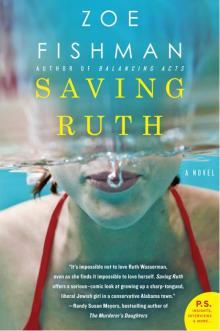
When Ruth returns home to the South for the summer after her freshman year at college, a near tragedy pushes her to uncover family truths and take a good look at the woman she wants to become.
Growing up in Alabama, all Ruth Wasserman wanted was to be a blond Baptist cheerleader. But as a curly-haired Jew with a rampant sweet tooth and a smart mouth, this was an impossible dream. Not helping the situation was her older brother, David—a soccer star whose good looks, smarts and popularity reigned at school and at home. College provided an escape route and Ruth took it.
Now home for the summer, Ruth’s back lifeguarding and coaching alongside David, and although the job is the same, nothing else is. She’s a prisoner of her low self-esteem and unhealthy relationship with food, David is closed off and distant in a way he’s never been before, and their parents are struggling with the reality of an empty nest. When a near drowning happens on their watch, a storm of repercussions forces Ruth and David to confront long-ignored truths about their town, their family and themselves.
BALANCING ACTS
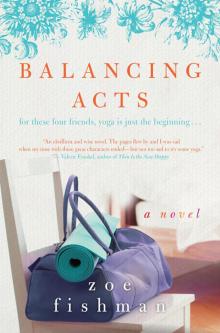
With beauty, brains and a high-paying Wall Street position, Charlie was a woman who seemed to have it all—until she turned thirty and took stock of her life, or lack thereof. She left it all behind to pursue yoga, and now, two years later, she’s looking to drum up business for her fledgling studio in Brooklyn. Attending her college’s alumni night with fliers in tow, she reconnects with three former classmates whose post-graduation lives, like hers, haven’t turned out like they’d hoped.
Romance book editor Sabine still longs to write the novel that’s bottled up inside her. Once an up-and-coming photographer and Upper East Side social darling, Naomi is now a single mom who hasn’t picked up her camera in years. And Bess, who dreamed of being a serious investigative journalist a la Christiane Amanpour, is stuck in a rut, writing snarky captions for a gossip mag. But at a weekly yoga class at Charlie’s studio, the four friends, reunited ten years after college, will forge new bonds and take new chances—as they start over, fall in love, change their lives . . . and come face-to-face with haunting realities.
Discover great authors, exclusive offers, and more at hc.com.
PRAISE FOR INHERITING EDITH
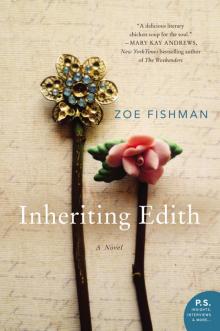
“Zoe Fishman’s Inheriting Edith is a tragicomic delight, pairing single mother and professional housecleaner Maggie with prickly, resentful, eighty-two-year-old Edith, thrown together in a Sag Harbor beach house after Edith’s famous author daughter, Liza, takes her own life and bequeaths the house and her mother to Maggie, her former friend and employee. Fishman deftly explores the intricate territory of mother-daughter relationships as well as the haunting specter of an Alzheimer’s diagnosis for famously independent Edith. Throw in winsome toddler Lucy, the hilarious meddling of best friend/yenta Esther and an intriguing potential suitor in the form of a local toy store owner, and you have a delicious literary chicken soup for the soul.”
—Mary Kay Andrews, New York Times bestselling author of The Weekenders
“A beautifully crafted story about second chances and life’s big surprises. Warm spirited and emotionally rich, Inheriting Edith celebrates the fine line between friendship and family. These characters will tug at your heart.”
—Jamie Brenner, author of The Wedding Sisters
“Inheriting Edith is a beautifully written story about what it means to remember and what it means to forget. Fishman masterfully portrays both a single mother and an older woman with Alzheimer’s, as they are both struggling to come to terms with their pasts, their futures and each other. I loved this compelling and achingly real novel about friendship, family and second chances.”
—Jillian Cantor, author of Margot and The Hours Count
“A heartbreaking story about life, love and friendship that you’ll want to devour in one sitting.”
—Erin Duffy, author of Bond Girl and Lost Along the Way
ALSO BY ZOE FISHMAN
Driving Lessons
Saving Ruth
Balancing Acts
CREDITS
Cover design by Elsie Lyons
Cover photograph © Cristina Mitchell / Arcangel
COPYRIGHT
This book is a work of fiction. The characters, incidents, and dialogue are drawn from the author’s imagination and are not to be construed as real. Any resemblance to actual events or persons, living or dead, is entirely coincidental.
P.S.™ is a trademark of HarperCollins Publishers.
INHERITING EDITH. Copyright © 2016 by Zoe Fishman. All rights reserved under International and Pan-American Copyright Conventions. By payment of the required fees, you have been granted the nonexclusive, nontransferable right to access and read the text of this e-book on-screen. No part of this text may be reproduced, transmitted, decompiled, reverse-engineered, or stored in or introduced into any information storage and retrieval system, in any form or by any means, whether electronic or mechanical, now known or hereafter invented, without the express written permission of HarperCollins e-books.
FIRST EDITION
ISBN 978-0-06-237874-3
EPub Edition October 2016 ISBN 9780062378750
16 17 18 19 20 OV/RRD 10 9 8 7 6 5 4 3 2 1
ABOUT THE PUBLISHER
Australia
HarperCollins Publishers Australia Pty. Ltd.
Level 13, 201 Elizabeth Street
Sydney, NSW 2000, Australia
www.harpercollins.com.au
Canada
HarperCollins Canada
2 Bloor Street East - 20th Floor
Toronto, ON M4W 1A8, Canada
www.harpercollins.ca
New Zealand
HarperCollins Publishers New Zealand
Unit D1, 63 Apollo Drive
Rosedale 0632
Auckland, New Zealand
www.harpercollins.co.nz
United Kingdom
HarperCollins Publishers Ltd.
1 London Bridge Street
London SE1 9GF, UK
www.harpercollins.co.uk
United States
HarperCollins Publishers Inc.
195 Broadway
New York, NY 10007
www.harpercollins.com
Zoe Fishman, Inheriting Edith