

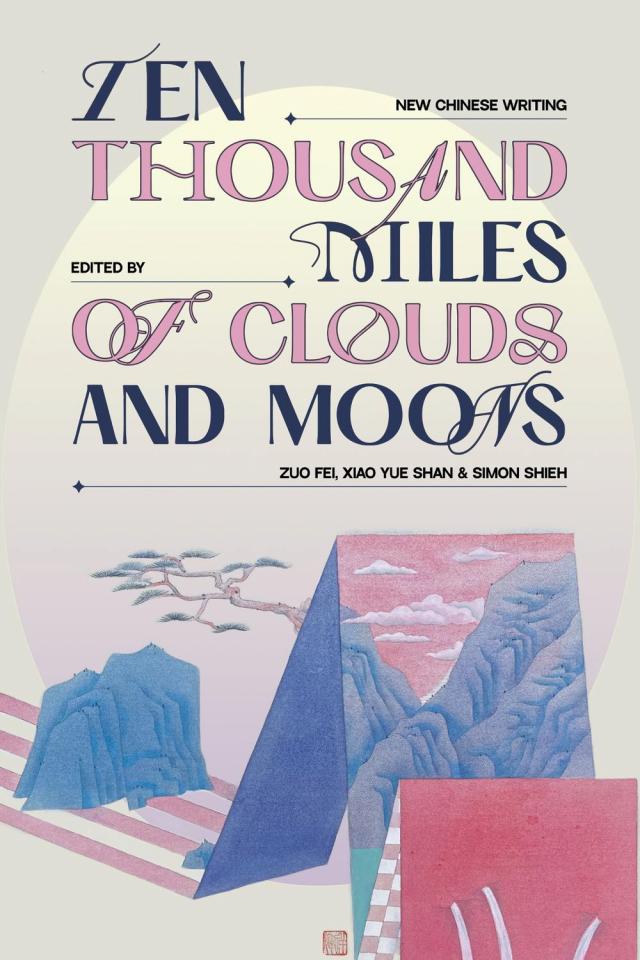
Ten thousand miles of cl.., p.1
Ten Thousand Miles of Clouds and Moons, page 1


CONTENTS
TITLE PAGE
EDITOR’S LETTER
MASS IN DREAM OF THE RED CHAMBER
Chen Chuncheng
translated by Xiao Yue Shan
A CATCHER IN THE RYE
Da Tou Ma
translated by Sean Toland
THREE POEMS
Jiang Li
translated by Shangyang Fang
LADY WEI'S DREAM
San San
translated by Michael Day
NO ONE SEES THE GRASSES GROWING
Mao Jian
translated by Yiqiao Mao
THREE POEMS
Du Lulu
translated by Dave Haysom
STELLAR CORONA
Huo Xiangjie
translated by Bernie Feng
THREE POEMS
Fu Wei
translated by Austin Woerner
THE LARGE MOON AND OTHER AFFAIRS
Lu Yuan
translated by Ana Padilla Fornieles
THREE ESSAYS
Hei Tao
translated by Simon Shieh and Irene Chen
THREE POEMS
Tan Lin
translated by Aiden Heung
PULLING THUNDER
Li Hongwei
translated by David Huntington
THREE POEMS
Jia Wei
translated by Liuyu Ivy Chen
MAN AND WIFE
Suo Er
translated by Zhi Hui Ho
HISTORY IN BOMI TIME
Li Jiayin
translated by Helen Lei Jiang
THREE POEMS
Ma Xu
translated by Zuo Fei and Jennifer Fossenbell
AUTHORS
TRANSLATORS
COPYRIGHT
EDITOR’S LETTER
In China, writing is a calling. We go where the language goes. Literature is the means of our discovery, our determination, and our desire. As the nation tangles with currents of rapid change, hurried now by intelligent technologies and pursuits of economic development, it is important to remember that the dedications of its writers are ancient. They say to us: as long as there is the impetus to put a mind into language, there is someone to hear those words—across time, across demarcations, across divides. This anthology is the acknowledgment that the world is listening.
To select from the Chinese language’s vast repositories… Well, it’s anything but simple. For as long as it has existed, literature in China has always been something of a grand occasion, with each of its innumerable contributors an essential element (imagine an ocean being separated into droplets). In our past curations, we’ve faced this vastness with equal parts reverence and trepidation, knowing that at any time, an extraordinary voice could be emerging amidst the canals and rivulets of the literary landscape. As the saying goes, masters are hidden amongst the masses. So in addition to lauded authors, we also read widely in search of singular, independent approaches to the Chinese language—artisans who work in the exquisite methods of gemstones, porcelain, silk. This is the wishful thinking we indulge in as editors, but also as readers and intimates of letters.
For this compilation, we only set ourselves a few guidelines. The work had to be excellent; the writer had to have a point of view that is under-explored in the Anglosphere; there had to be a balance of genders; and the language must be so special that it has the potential to torture translators. This final aspect came only from our love for the Chinese language—which, like all languages, has a singular soul, a force drawn from its age and its malleability throughout time. The more a writer is able to tap into that soul, the more difficult the piece would inevitably be to translate. We loved the lines that made us think: “How could this ever be said in English?” We looked for voices that made us consider Chinese in its ever-changing, ever-individualizing forms, because that is how writing transcends textuality to present itself as a wonder of the mind, emerging in such surprising forms… Also, we knew our translators—themselves writers, poets—would be up to the task.
We considered what would be the most impactful, surprising, or moving for the purveyors of world literature. Admittedly, we wanted to change the way that English readers approach Chinese writing. Beyond the expected stories of revolutionary tragedy, soulless oligarchy, or oriental romanticisms, we set our focus on choosing works that embody the contemporary spirit of experimentation and stylistic flair, intending to introduce textual inventions that indicate towards the nation’s sheer variety and polyphony. And to tell you about these pieces…
It must be acknowledged that every writer working in the Chinese language is held to account by the vast annals of history, and the three who have taken this task to heart are San San, Chen Chuncheng, and Li Hongwei. San San’s period piece, “Lady Wei's Dream,” seems at first typical of a classic work, but soon cracks open to reveal a treatise on destiny and a formidable account of feminine strength, drifting from lush poeticisms to startling revelations. On the opposite side of time, Chen Chuncheng has his eye cast on the future. In his story, “Mass of Dream of the Red Chamber,” he poses a hypothesis: if the most cherished tome of the Chinese canon were to be destroyed, what would happen to us? Elements of science fiction and fantasy are used to deconstruct and reconstruct the reverberations of iconic works, building an enthralling narrative of epistemological and political conquest. As for Li Hongwei, his piece, “Pulling Thunder,” ranges across the tenets of Daoism, Buddhism, and divination in a story of mystical technique; this profound story questions the role of human life amidst the uncertainty of magic—which is perhaps something we've invented only to extend our own curiosities.
Our stories must rest just above or beneath reality, without mimicking its contours exactly. What one expects from literature is a degree away from direct experience, a distance by which we are given some room for discovery. The excerpt from Huo Xiangjie’s novel, Stellar Corona, recounts the tale of a southern family and their development across generations, from the first colony to the latter half of the nineteenth century, when Chinese culture experienced tremendous shifts with the influx of external influence. Through his incantatory prose, the intricacies of an enormous, interconnected world are forged through a single clan’s ancestral presence. Similar complexities also appear in the excerpt from Lu Yuan’s novella, The Large Moon and Other Affairs, which sees a new world held within the apocalypse; celestial phenomena merge with dreamy phantasmagoria to portray a global collapse that is, despite its strangeness, still all too vivid in our era of climate devastation and international crises. Lastly, in “History in Bomi Time,” the young writer Li Jiayin constructs a narrative around the fictional Bomi tribe, applying anthropological methodology with the micro-histories of independent invention, reflecting the contradictions within our contemporary evaluation of history.
Daily life often finds its way into surrealism and absurdity, and the two writers who most closely approach this chaotic tableau are Suo Er and Da Tou Ma, exemplifying their profound ability to soar unimpeded across narrative boundaries. While it initially appears to be describing the pedestrian routines of a married couple, Suo Er’s “Man and Wife” veers in its latter half; turns out that the young people trying to make a living in the city are still harboring nostalgic thoughts of a profound, rural order. As for Da Tou Ma, the young, tired characters of “Catcher in the Rye” are similarly awash in the urban tide, attempting to find some enduring meaning amidst the nihilism of spectacle. Salinger’s presence in the title is part of a greater puzzle in the author’s 2020 collection, Nine Stories, in which she takes on the themes of nine Western literary works, intuitively rendering a collision of cross-cultural themes.
As for the six poets we’ve selected, they range across four generations of writing. The first is Ma Xu, born in the late fifties, who has applied his incisive consciousness to avant-garde poetics for the last forty years. Guided by his distinctive style, readers can pass through the lines to arrive at the center of his thinking, which, in the topography of poetry, is also a peak by which to look over the linguistic vistas. Representatives from the next generation—poets born in the seventies—are Jiang Li and Du Lulu. Jiang expresses a clear dialectical intelligence in his pieces, cohering imagery with philosophical practice. Du, who has been active in many channels of Chinese-language poetry, writes of the deceptively true paradoxes of contemporary life, substantiated through her presence as a proud woman poet. Fu Wei and Jia Wei are born in the nineties, and as such, their elegant, surprising work characterizes both a deep immersion in poetic tradition and the urge of any contemporary writer to free themselves from past convention. As for the mysterious poet Tan Lin, when we felt the need to incorporate a poet who writes in form—someone approaching modern aspects with the ancient temperament of ephemerality, precision, and perfection—he came immediately to mind.
Additionally, we’ve included two essayists in this volume. Mao Jian has long been renowned for her cultural and film criticism, and in her moving memoir, “No One Sees the Grasses Growing,” she recalls the eighties and nineties, a time of unconstrained artistic prosperity for both the nation and the author, then a university student in Shanghai. As for the writer Hei Tao, his pieces are paintings of Jiangnan’s dense and vivid hues. Since its very beginnings, China has distinguished between its northern and southern regions, and here, Hei draws our attention to the warm valleys and waters that raised him, the residences, courtyards, tools, plants, relatives
In bringing all of these writers to the page, we are profoundly grateful to our translators, who have worked tirelessly to untangle images from their representations, emotions from their grammatical constraints, and philosophy from that strange liminal space between the word and the ineffable. Their effort indicates a truth that literature can learn from physics: nothing is ever destroyed—it simply changes forms.
Perhaps to absolve ourselves from what Baudelaire called the ennui of modernity, there is only literature—its creation, its translation—because this work still requires equal parts passion and intelligence, dedication and discovery. It demands that its practitioners draw harmony in isolation, negotiating between the mind and some kind of light in the distance.
The human ability to bring forth pasts, futures, visions, dreams, alternative realities, and unconquerable landscapes… Well, it used to be a power belonging to the gods, and here we do it with only words.
MASS IN DREAM OF THE RED CHAMBER
PRELUDE
On a spring night in the fourteenth year of the Wanli Era, something strange happened in the palace. Emperor Shenzong dreamt of a white crane landing beneath the sophora tree in the courtyard’s northeastern corner. There, it turned into a crippled old priest and circled the tree once before seeing a spot on the ground, upon which he exclaimed, There it is! Then he bent down and began digging at the dirt with his hands. The emperor saw him from the shadows and shouted: Who’s there? The priest looked to him with a smile, then turned back into a crane and flew away.
When the Emperor woke up the next morning, he felt the dream lingering, and ordered his attendants to dig up the ground by that same sophora tree in the northeastern corner. What they found was a case made of stone, with a jade cup inside. Exquisite. Prismatic. Smoke whirling within it, as if from another realm. When Shen Shixing, a scholar from the Wenyuan Pavilion, was summoned to examine the object, he said that during the Hongwu Era, Timur had sent his envoys to the capital with a cup as tribute. Named the Cup of Worldly Illuminations, it holds a penetrating light, and if a saintly person were to take hold of that radiance, they would know the world. It had been hidden in the palace and eventually lost—but perhaps this was that Cup. Shenzong was smitten, he couldn’t put it down, night after night he fondled it under the moonlight until suddenly, he glimpsed in its depths some mirage, and came to realize the truth of all creation.
In the following decades, he persevered with a tireless neglect to unsettle the empire’s foundations, opening the Ming Dynasty to utter decline. To quote directly from the history books: “The Ming Dynasty perished by way of Shenzong.” On his deathbed, the emperor hallucinated countless figures of foreign calvary swarming in through the breaches of his empire, and the face of a man—whose name was Cao—blinked briefly amidst the crowd. He then knew that the secret mission of his life was complete, and he died in peace.
I
After a perfect victory, a prison inside Taozhi Mountain was discovered by my troops. Over half of the peak had been hollowed out by this structure, but its entrance was well-camouflaged. In Jiao Datong’s time, the fortress held detainees while they awaited trial, and when the doors of hundreds of caves were pried open one by one, it was discovered that most of the inmates had long perished. On an autumnal afternoon of November 4876, I received instructions to leave my formation in the peace parade and fly my plane eastward. By the time I arrived at Taozhi, it was sunset, and the peachy walls of the cavern had been dyed a deep rust by the dying light. The grasses languished in the wind. The land languished within itself. After leading me into the reference room, the officer in charge handed me the relevant documents, and after dinner, I went through the prisoners’ papers. One particularly thick file, labeled “HXH,” caught my attention. The name of the prisoner had been redacted, and his year of birth was marked as 1980. Assuming this wasn’t some bureaucratic error, that birthdate would make him the longest living creature on earth. I thought of an old rumor: around sixty years ago, in a museum, an ancient man named Chen Xuanshi suddenly woke up from his vegetative state. Afterwards, he wrote a novel dedicated to the then-global president, Jiao Datong. Jiao gave the work high commendations, and the news reported of people trying desperately to get their hands on it. I did a bit of research to see what had really happened, discovering that the text had only gone through one edition, and most of the copies were forcibly distributed to students. It was not held in high regard, and has since disappeared from circulation. There hasn’t been any word on Chen Xuanshi since. When I checked the publication date of that book, it was only two weeks before the day that this unnamed prisoner entered these confines.
In a dim, musty room of stone, I met that ancient prisoner. His large face was mostly buried beneath a filthy mound of hair, and he was nearly blind. Still, I hoped that he would feed me some long-lost pieces of the past. He was dazed and took a while to issue his responses, as if he had just wandered back into his body after a lengthy escapade, but still, he spoke smoothly. It didn’t seem like he had been alone for so many years, but perhaps he was simply accustomed to his own company. He told me: My memory is getting worse and worse, and now I only remember two stories—my life, and that of a novel. The first is unremarkable, worn out by the years, and passes in a blur; the second is incomparable, growing ever-longer in the dark, and has yet to come to a close… Rather than that unnamed novel, I indicated that I'd like to hear the story of his life. Our conversation, interrupted several times by his physical condition, lasted seven days. The following is the transcription of what he said to me, and in order to maintain its original form, no errors, omissions, or temporal inconsistencies have been corrected.
ONE
After breakfast, a well-mannered young man came by my bed to see me. He gently asked how I was doing, and if it was a good time to answer some questions—they wanted to understand some things about our generation. I said it was fine, and followed him out of the patient room, heading towards the door at the very end of the hallway. The lights glinted all silver, and the ornaments along the walls seemed technologically advanced, like we were inside a spaceship. No windows. I walked and thought of what I would say. I could sing some old songs that were popular in my day, or talk about that one time I met Eason Chan, or even recite the names of over two hundred Pokémon. That last one might be of some value, I thought, because when I woke up in the gallery of objects from the twenty-first century, there was a Pikachu figurine in the display case next to me. Maybe it’s become a kind of divinity, like the qilin. Besides, I knew nothing of the turbulent international relations or the socio-economic developments of my era. Maybe I could put on a Tang Lusun impression, and talk about the food we ate back then.
There were two reasons that the room shocked me as soon as I entered it. First, it was clearly an interrogation room, and second, interrogation rooms apparently have not changed for thousands of years. A large mirror took up nearly an entire wall, and I knew that behind it, someone was studying me. The walls were made of soundproof materials, and there was an extremely bright lamp on the steel tabletop. They asked me to sit—a few faces submerged in brightness. They were piercing. I turned my head, and saw a skinny man looking back at me from the mirror. I used to be fat, but they said that I had shed all the weight in my sleep. It all felt like an illusion, like watching a film starring someone else. The nightmare of not knowing what would happen next. A voice coldly asked:
Have you ever read Dream of the Red Chamber?
Huh? Yes.
How many times?
Once or twice.
Is it once or is it twice?
Once in high school. Then re-read some chapters in my second year of university.
They seemed to get worked up. One of them hurried out, not even bothering to fully close the door, and I thought I could hear the low sounds of cheering. The same young man who had led me here asked with great gravity: Can you repeat it? I thought he wanted me to repeat what I just said, but he interrupted me. Then I understood: they wanted me to repeat Dream of the Red Chamber. I told them that this was impossible, that it's a story with a great many intertwining narratives, and anyway, so much time has passed. They seemed to be prepared for this response. A few of them came and held me down, fitting some kind of machine on my head. An electric current passed through my temples, and it was as if a million little golden snakes were darting around my brain. This will help you remember, they said. I was screaming from the pain. They were shouting in unison: Focus your energies, think of Dream of the Red Chamber! And with that I could almost see towers and pavilions, suspended in cloud-smoke, a group of men and women walking in the gardens, they were laughing, sighing, cursing, reciting beautiful lines of poetry, anxiously weeping, then disappearing into a flurry of snow… I managed to spit out a few words: Nüwa, daoshi, Jiayu Village, stone, a serene and wealthy village… And then I lost consciousness.


