

Valhalla, p.1
Valhalla, page 1


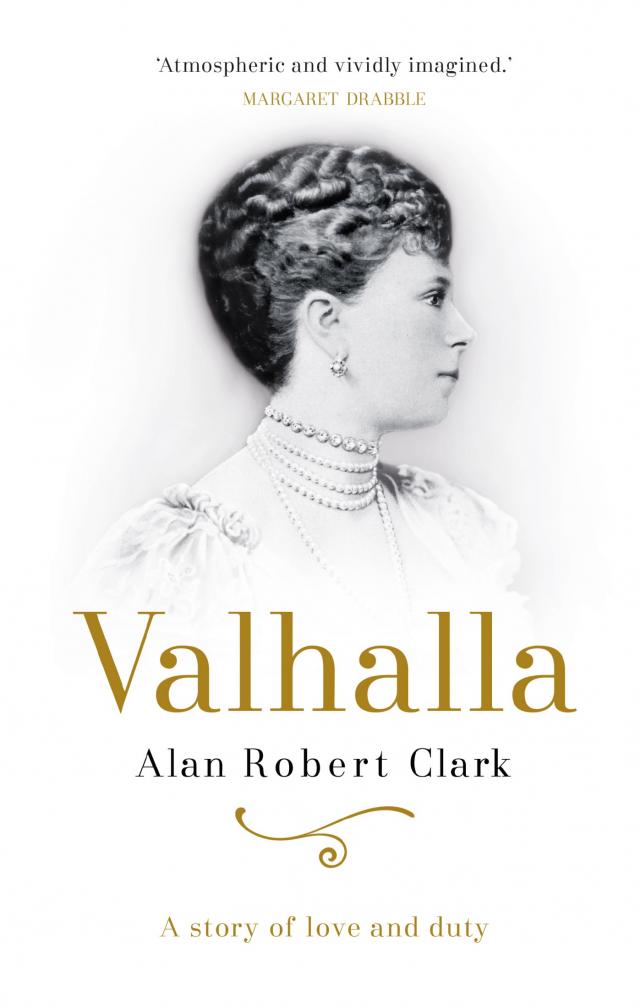
Valhalla
Alan Robert Clark
Fairlight Books
First published by Fairlight Books 2020
Fairlight Books
Summertown Pavilion, 18–24 Middle Way, Oxford, OX2 7LG
Copyright © Alan Robert Clark 2020
The right of Alan Robert Clark to be identified as the author of this work has been asserted by Alan Robert Clark in accordance with the Copyright, Designs and Patents Act 1988.
All rights reserved. This book is copyright material and must not be copied, stored, distributed, transmitted, reproduced or otherwise made available in any form, or by any means (electronic, digital, optical, mechanical, photocopying, recording or otherwise) without the prior written permission of the publisher.
A CIP catalogue record for this book is available from the British Library
1 2 3 4 5 6 7 8 9 10
ISBN 978-1-912054-19-0
www.fairlightbooks.com
Printed and bound in Great Britain
Cover designed by Emma Rogers
In memory of Isabel and Robbie Clark and of Stephen Speed, pupil of the Royal Ballet School, White Lodge.
Contents
Principal Characters
I
II
III
IV
V
VI
VII
VIII
IX
X
XI
XII
XIII
XIV
XV
XVI
XVII
XVIII
XIX
XX
XXI
XXII
XXIII
XXIV
XXV
XXVI
XXVII
XXVIII
XXIX
XXX
XXXI
XXXII
XXXIII
XXXIV
XXXV
XXXVI
XXXVII
XXXVIII
XXXIX
Afterword
Author’s Note
Acknowledgements
Select Bibliography
Principal Characters
May, Born as Her Serene Highness, Princess Victoria Mary of Teck. Later Duchess of York, Princess of Wales and eventually Her Majesty Queen Mary.
The Duchess of Teck, May’s mother. Her Royal Highness, Princess Mary Adelaide of Cambridge. Granddaughter of King George III, first cousin of Queen Victoria.
The Duke of Teck, May’s father. His Serene Highness, Prince Franz of Teck, from the German royal house of Württemberg.
Georgie, May’s husband. His Royal Highness, Prince George of Wales. Grandson of Queen Victoria, younger son of Bertie, Prince of Wales, and Princess Alexandra of Denmark. Later King George V.
Aunt Queen, Queen Victoria, May’s second cousin, but known to her from childhood by this name.
Madame Bricka, May’s tutor, friend and confidante. Later tutor to May’s own children.
Harry Thaddeus Jones, An Irish-born portrait painter.
Liko, His Serene Highness, Prince Henry of Battenberg, scion of a minor German royal house. Married to Beatrice, youngest daughter of Queen Victoria, thus an uncle by marriage of May’s husband, Georgie.
Eddy, May’s first fiancé. His Royal Highness, Prince Albert Victor of Wales, Duke of Clarence. Elder son of Bertie, Prince of Wales and Princess Alexandra of Denmark.
Bertie, His Royal Highness, Prince Albert Edward of Wales. Eldest son of Queen Victoria and Prince Albert. Later King Edward VII.
Alix, Her Royal Highness, Princess Alexandra of Wales, wife of Bertie. Daughter of King Christian IX of Denmark. Later, Queen Alexandra.
The Little Prince, His Royal Highness, Prince Edward of Wales. Eldest son of May and Georgie and later King Edward VIII. After a reign of less than a year, he abdicated in December 1936 to marry the American divorcee Wallis Simpson, thereafter becoming Duke of Windsor.
I
Winter, 1952
The old woman, mummified in mourning black, stands in the vestibule of her great mansion. The thuggish wind that shoulders its way through the half-opened doors does its best to ruffle her hair, but the golden curls of her evening wig cling like barnacles to her skull. Her coiffure has rarely been out of place in eighty-five years and, like her, it will not behave differently now. She hates the wind. She always has. The damnable disorder of it. If anything gets her in a temper, it is the wind.
A little blizzard of leaves has blown in through the doors and drifted up against a wall. She looks down at them; shrivelled, dry as dust, like ancient artefacts in some botanical museum. How odd that nobody has brushed them up, but nobody in Marlborough House is quite themselves today. Strange too there should be dead leaves anywhere in February, the branches long since bare. What do her gardeners think they are doing? Heaven help them if her husband had still been master here. Or perhaps, she thinks, there is some defiant tree which has clung to the last vestiges of autumn glory and refused to bow to the natural order of things. And now, on this bleakest of days, it has abandoned the struggle and let the wind do its worst. The old woman knows how it feels. Tonight she is the tree. Tonight is the closest she has ever come to giving up.
The car is waiting, the engine already purring, its sharp black lines smudging into the darkness of this God-forsaken night. Beside it, a figure stands to attention, a cashmere rug draped over an arm, gilt buttons flashing beneath the long pendant lamp in the porch.
‘I can still see Papa up there in the gallery,’ he says suddenly, ‘shouting at us to wipe our feet and not to run indoors.’
It is said without levity or nostalgia for some golden childhood. The tone is not lost on her.
‘Papa never meant to be unkind,’ she replies.
‘Oh well,’ he says. ‘No more running for my poor brother now.’
‘No indeed.’
‘You shouldn’t have come downstairs, Mama. We don’t want you catching cold.’
‘People complain that this house is a refrigerator,’ she replies, ‘but I never feel it myself. Isn’t that rather rum? Don’t they say that those close to the grave feel the chill of it approaching? But I am always perfectly warm.’
‘Perhaps you’re going to hell instead, Mama.’
She knows it is a careless joke. He is not trying to hurt her. The shock of sixteen years ago, when he abdicated from all that she believed in, is long since passed; only empty echoes of it now remain. But still the joke nips her. She wants to say that, thanks to him, she has been to hell already but, as is her way, she pretends not to hear.
‘I always come down to see people off,’ she says. ‘A hostess must take proper leave of her guests.’
Now it is she who has said the wrong thing. She realises it as soon as the words have left her lips. Her guest, not her child. She catches the look on his face, the silent sigh in his eyes. She has seen that sigh so many times before. Once again he is wishing she were not as she is. Today has hardly been a social occasion, after all. They have just buried his younger brother. His poor, exhausted brother. Three of her five boys have gone now and the one standing beside her exists in her mind in a kind of limbo; a ghost-son, neither dead nor yet quite alive. These past days she has been asking God if it is her punishment to lose so many children. What has she done that He should take them from her? God has not yet replied.
She insists on going right outside to the purring car. Her woman comes and fusses, drapes a coat across her shoulders. He offers his arm again as they shuffle forward into the winter night.
It is the stoop she hates the most. She was prepared for the wrinkles and the lines, the bags below the eyes, the melting of the jaw-line, but she didn’t reckon on the stoop. One morning, when they were dressing her, she noticed it in the cheval mirror and felt it like a punch. All her days, she had been straight as an infantryman. Had it not been said that no queen ever possessed such majesty? But now she is aware that she no longer looks at people with a level eye. Now her gaze falls on their chests or even, on a bad day, their bellies. Now she has to raise her head and peer upwards at their faces, like some hideous old tortoise. God, how she hates the bloody stoop.
Under the porch light, he kisses her on both cheeks. She feels a prick of irritation. Since the nursery, the ‘little prince’ has always needed to be different from the rest of them. A simple, no nonsense English kiss on one cheek would have been quite sufficient. But no, not him. Always trying to be so chic, so cosmopolitan, so different from his dull as ditchwater family.
‘Well goodbye,’ she says. ‘Please give my regards to your wife.’
She sees him swallow, choking on what he no doubt considers her hypocrisy. Yet, to the old woman, it is no more than the proper thing to do, to send a polite greeting to the person who is married to her son. Legally married and in the eyes of God, though heaven only knows what, sixteen years ago, He made of that cut-price spectacle. That this person had shaken her life like a terrier with a rag-doll is immaterial. There are ways to behave. Let others transgress them in this strange modern age, but she will not.
‘Wallis will be delighted, Mama.’
The name, she finds, still grates on her, even after all this time. It is a name for a butler, not for a woman. Not that the witch-wife looks much like a woman. All straight lines and sharp angles like a geometry set. All calculation.
At the open door of the car, they are not alone. Not just the chauffeur, the footmen and the fussy creature who brought the coat, but those other faces who jostle their way into her mind’s eye. The witch-wife of course, who waits now in New York, high in a glittering tower above Park Avenue. Her husband and his father, the long-gone ruler of both their lives. But today, above all, the brother taken years too soon. The second-best king will always loom between them now, fragile as a butterfly but brave as a lion, the one who sacrificed himself when the ‘little prince’ would not.
‘Like your Papa, I’ve never meant to be unkind either,’ she hears herself whisper. ‘But I’m too old to change now.’
He looks hard into her eyes, as if searching for something, then swiftly turns away, curling himself into the cushioned womb of the car.
She refuses to go inside till the tail lights disappear into Pall Mall, taking him to the airport, back to the glittering tower of the Waldorf Astoria. For a moment, she stares at the empty space where the car has been. A black cat appears out of the darkness, stops in the beam of the porch light and stares back at her before scooting away again into the shrubbery. Oh look, she thinks, the witch-wife has come to see how they’ve been getting along. Suddenly the sciatica shoots down to her ankle. Bugger this leg. Can’t it leave her alone even today? Does it have no finer feelings?
Her woman guides her to the foot of the staircase. This was the great general’s house once, its painted walls trumpeting his triumphs at Blenheim, Ramillies and Malplaquet. When her body began to disobey her, this staircase became her battleground too. She would damn well climb those black marble steps as she had always done, no matter how long it took. But in the end it vanquished her.
The first time she travelled in the tiny lift she found herself with tears in her eyes. They tried to make it nice with a rose-red carpet and a little seat covered in matching brocade, but she hates that lift like she hates the stoop. And it is now, in the blasted lift, she forces herself to face the truth that she has denied for these sixteen years. As if it has pushed itself into the tiny space and is pressing her against the wall. Despite the face she gives to the world, she is no stranger to strong emotion. Joy, sorrow, hope, fear, rage, even desire, she has known all of these in her time, although she has learned to keep them to herself, like a group of unsuitable acquaintances. But she has never encountered the feeling that invades her now and quite takes her breath away.
Her woman waits on the first floor, ready to push open the folding grille.
‘Goodness Ma’am, you look quite worn out.’
She does not answer, does not argue, lets herself be helped along the corridor to her apartment. In the sitting room, the door that leads through to the bedroom is open. As always, her dresser is waiting. The bed is turned down, the pillows puffed and inviting, her lawn nightgown with its pale-blue bows splayed out across the moss-green quilt, as if it has retired before her. How pretty it looks, she thinks. All her life, she has sought the consolation of pretty things. If there is prettiness around then, no matter how life seems, it is possible to convince oneself that all is fine and dandy.
She feels hungry. She ate next to nothing at supper. They sat mostly in silence; the only sounds the ticking of the ormolu clock and the spongy footfalls of the servants. When they spoke it was of trivialities; how long it would take to fly back to New York, the difficulty of finding a chef in the Waldorf Astoria able to cook a decent Yorkshire pudding. Now she orders more coal for the fire, a ham sandwich and coffee.
‘But Ma’am, you’ll never sleep.’
‘Oh my dear, how could I sleep tonight?’
The dresser means well, though she is a little Hitler; there is even a hint of the moustache. How they all bully her now, in a way they once would not have dared, but tonight she will not be bullied. She allows her wig to be removed and put on its wooden stand but surely, she says, she can take off her own clothes just this once? It won’t kill her. She’s not quite helpless yet. Don’t make a fuss, there’s a good girl, she tells Hitler.
The feeling that came in the lift stays with her, only it has moved south now and settled in the pit of her stomach. But, she wonders, is the thing not a presence but an absence? Is that why she feels hungry? Is something needed to fill the void? She wonders too if it is a portent. Are we forced to face up to ourselves only at the end, as the scythe is being sharpened?
She eases herself down at the writing desk that stands in the middle of the room. As the world has closed in on her, the desk has become the centre of her orbit. A great slab of satinwood, topped in scarlet leather. The housemaid whose job is to dust it told her wearily there are exactly ninety-six items upon it. Yet there is no disorder, no confusion. The old woman knows precisely where even the smallest object lies: her books, her papers, her letters and the catalogues she loves to compile of all those pretty things she has collected. In gilt frames are photographs of almost everyone who has mattered to her. How could her children think she does not care for them, when she looks into their faces twenty times a day? How could her eldest son believe, as she is quite sure he does, that there is ice in her veins? But how pointless, she reflects, to ask yourself a question when you already know the answer. She has never been able to tell them that she loved them; she who was once so full of love. Now she could no more do so than fly through the air.
The coal for the fire comes, the ham sandwich and the coffee pot. She orders the lamps switched off, except the one on the desk. They leave her alone with the crackling of the flames and the feeling that has settled in her stomach.
It occurs to her that, in truth, her children know so little of her. As children grow, they are focused on their own emergence into the world; they have scant curiosity about how their parents did the same, way back in the dreary mists, in a time so very different from their own. How can she blame the ghost-son for not understanding her, if she has never made any attempt to explain herself, to tell him her story? It may well be too late to change now, but could she not at least make him understand how she came to be as she is and that she was not always so? But how on earth could she do that? Across all these years, across an ocean, across a gulf of empathy surely impossible to bridge?
She ignores the ham sandwich and lights a cigarette. To hell with the doctors; surely she can have at least one on a day such as this? Her glance falls, as it so often does, on the watercolour that hangs over the chimney piece. She is just seventeen, sitting in a garden in Italy, in a dress of creamy muslin and a Tuscan straw hat with two long red ribbons dancing down her back. A tumble of violets lies in her lap. She remembers how she had instinctively bunched the flowers together, but the artist had demanded that they must be loose, disordered. She remembers too how handsome he was, how he made her heart race. She can still see him as clearly as if they had met last week. Dead now of course. They are all dead. All the ones who mattered most. Well almost.
In the portrait, she is smiling slightly, her lips apart. Her eyes, china-blue, pierce through the canvas, wide open, ready for life. Georgie had never liked it.
‘It’s just not you, May,’ he had said, in that manner which brooked no discussion. ‘Just not you at all.’
In the forty-two years of their marriage, that had always been the way of it. No discussion. Words spoken aloud had always frightened Georgie. Such dangerous things, words. Far better to employ them sparingly or, if possible, to avoid them altogether. For forty-two years, so little had ever been said.
But soon after Georgie had gone, she rescued the watercolour from its distant cupboard and put it where she could see it every day. A comforting reminder that she had not always been an ugly old tortoise. Tonight though, it suddenly becomes a darker object. Tonight, it becomes a reproach.
She sips the coffee and nibbles at the ham sandwich. Her gaze stays latched onto the portrait, remembering the people, the places and the dreams that once existed, just outside its frame, in the springtime of her days. Would any of the hazy, long-lost faces who had strolled in the garden by the Arno recognise her now?
After a while, the old woman is conscious of rain spattering against the window where she sat this morning to watch her dead child’s funeral procession pass by. She had not been able to face the Abbey. Rarely in her life had she shirked any duty, but she had shirked this. Surely, they could not expect it of her? Surely, every mother would understand? She pulls herself across the room and peers out into the night. It is pelting down. The light of the street lamps diffuses the rainwater into hundreds of droplets, like handfuls of tiny diamonds thrown against the glass. She can just make out the regiment of black banners hanging from the lampposts. This morning they flapped noisily in the wind; his last applause; a compensation for the respectful silence of the crowds. But now the breeze has suddenly dropped and, motionless, the banners droop in the downpour, as weary as herself.


