

Unidentified funny objec.., p.22
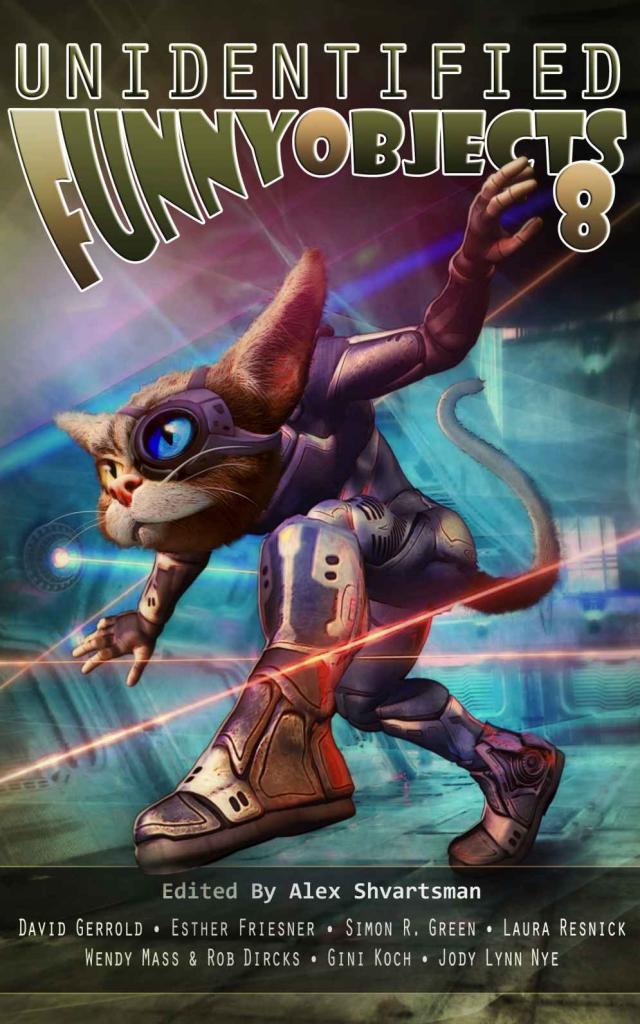
Unidentified Funny Objects 8, page 22
part #8 of UFO Series


Daphne twirled pasta on her fork, and sighed. “I’m sorry, sweetie. I should have known better than to mess with cats and physics. Now I understand why that line of study was so heavily discouraged back home.” She shook her head, ruefully, before brightening again. “Of course, I ended up studying Trans-Dimensional Physics, and we saw how that turned out ...”
“Living with a girlfriend who inexplicably loves you even if you violate causality and sanity on a regular basis,” I agreed. I stabbed a meatball with my fork, and lifted it to my mouth, while F3, F8, F9, and F12 all stared from their various vantage points around me. F12, who was precariously perched on the arm of my chair, lazily reached out a paw as if to help himself. “Not even, furball,” I said, giving him a shove so he was forced to leap down. “By the way, I caught six of them working together to get into the cupboard where we keep the treats.”
Daphne blinked, and hastily swallowed her mouthful of pasta. “Oh no,” she said. “They’re forming a collective.”
“A clowder,” I replied. “It’s a clowder of cats.”
“No, no, no,” she shot back, standing up. “This could be bad. I mean, okay, they’re all technically the same cat, right? But they act like individuals. We basically have a dozen or so versions of Mr. Farnsworth. But if they’re working together, linking up, we may be at risk of them developing a unified consciousness, which could lead to heightened intelligence ...”
“So, our cat becomes smarter,” I said. “Is that bad? Maybe then we could teach him to be more useful.”
Daphne’s eyes grew wide, and she shook her head. “Imagine a cat with human intelligence and multiple bodies. This would be worse than the time I artificially augmented an octopus.”
I shuddered, remembering the way Daphne had inadvertently sowed the seeds of an octopus uprising. Sooner or later, that one was going to come back to bite us. “Okay, so how do we stop this?” I asked.
Daphne frowned. “I’m not sure. I’ve been working on several theories on how to reverse the process, but so far, no luck.” F5 stropped her legs, meowing, and she bent down to pet him. Immediately, F2 and F11 joined the swarm. “Easy guys, I only have two hands. Wait your turn.” She laughed.
I stroked F13, who’d curled up in my lap during the discussion. “We’re not going to have to shoot them into space, are we? Because we can’t keep getting rid of our problems that way.”
She shook her head. “Not an option,” she reassured me.
“Good. I’d feel bad, inflicting our cat upon the universe.”
After dinner, Daphne returned to the lab, to study the original—F1—under controlled circumstances. I went to work on my latest cosplay outfit—a version of Entrapta from She-Ra with remote-controlled hair—and found it difficult indeed with eight cats all trying to help, all batting at my tools, trying to steal important components, and generally being nuisances. “Give that back!” I screeched at F4 after he pounced a piece of wiring. I prayed Daphne’d find a solution soon, before all hell broke loose.
That night, all hell broke loose.
We were both ripped out of sleep by blood-curdling screams, crashes, thumping, and shattering glass. “Oh shit, it’s the airship pirates!” yelped Daphne, sitting straight-up, hair frizzled every which way. “To the escape pods!”
Someday she was going to have to elaborate on these airship pirates... . I blinked blearily. “No,” I moaned, “it’s just cats.” And I was right. We exited the bedroom to find that the common room was now a wreck. “What even?” I asked. The cat tower had fallen over, the couch was a shambles, the television was on the floor and shattered ... and every single one of our fuzzy bastard, all fifteen or so by this point, was fully poofed and bottle-brushed, glaring at each other and growling.
“A cascading failure of diplomacy, I’d say.” Daphne sighed.
“Typical cats,” I grumbled. “Fix this, or the next failure of diplomacy will be mine. I’m about ready to start rounding them up and shipping them to every cousin and distant friend I haven’t spoken to in years.”
Daphne frowned. “I ... don’t know how to say this, love, but ... I’m out of ideas. I’ve tried everything from quantum disentanglement to temporal compression, and they just won’t go back to where they’re supposed to be. I’m honestly wondering if Mr. Farnsworth doesn’t want to be fixed.”
“You’re saying he can influence the process?” I asked, furrowing my brow. “How’s that possible?”
“How is any of this possible? We’re talking about cats here! And not just any cat, our cat! He’s already been exposed to exotic radiation, experimental cat food, and stray elements in the atmosphere, and I should have taken all that into consideration before doing anything like this! I’m sorry, Camille, I screwed up and I don’t know how to fix this one.” Daphne threw up her hands in dismay, blue eyes wide and watery with the beginnings of tears, and it startled me. I’d almost never seen her lose her composure to such a degree.
I reached out, fingertips on her arm. “It’s okay, hon. We’ll find a solution.” All around us, cats were slowly relaxing, fur returning to its normal level of fluffiness, tails lowering, growls dying down. Something struck me. “Maybe we’ve been going about this all wrong. We’ve been encouraging them, giving them reasons to multiply—food, attention, love. Mr. Farnsworth’s been getting fifteen or so cats’ worth of pampering, and he’s soaking it up. What we need to do is encourage him to reintegrate himself.”
Daphne unconsciously leaned into my touch, untensing even as she looked thoughtful. “So ... ignore the extras, spoil the original?”
I nodded. “Round them up, shove them all in the same space, and show Mr. Farnsworth the benefits of being an only cat again.”
“But won’t that reinforce his sense of superiority?”
I arched an eyebrow. “He’s a cat, what do you think?”
Daphne nodded. “Good point, it’s not like it can get much worse. He already thinks he rules the place.”
So that’s what we did. We herded F2-F18 into an enclosure in Daphne’s lab—and I’ll gloss over the details about that process, which took several hours, and cost us both remnants of our sanity.
At long last, we let F1, the first, the original, the baseline, out to roam the apartment, sole king of his domain. And he prowled, and yowled piteously, calling for his other selves, and they yowled back like a chorus of the damned, and we did our best to ignore those yells, giving them a little food and water because we weren’t monsters, after all.
“Can’t I go pet them?” Daphne begged. “I feel so bad!”
“No,” I insisted. “Not unless you want a Farnsworth collective capable of conquering the world.”
Instead, we spent the next few days spoiling the hell out of the one cat, giving him good food and lots of love, forcing him to stay in the moment, and finally—
Pop!
Just like that, Mr. Farnsworth pulled himself back together, swished his tail, and stalked off toward the litterbox. He’d had quite enough of this whole mess, and enough of us, thank you very much.
“That went well,” said Daphne after a moment.
“And what have we learned?”
“No more experimenting on the cat.”
“And if we want another pet?”
“Adopt, don’t shop?”
“I’ll allow it,” I said. I gave her a kiss. “But let’s be happy with the one we have for the time being.”
The lasers in the litterbox flashed as Mr. Farnsworth finished his business and exited. Then there was a soft buzz, and a red light came on. “Containment breach imminent ...”
“Oh, no,” we both said in unison.
But how we averted that crisis was another story, and another reason for which I will someday have to apologize to yet another government agency.
Michael M. Jones lives in southwest Virginia with too many books, just enough cats, and a wife who keeps encouraging him to get more of both. He has edited several anthologies, including Scheherazade's Façade and Schoolbooks & Sorcery. Camille and Daphne have also appeared in respectable venues such as Broadswords & Blasters, Mad Scientist Journal, and Robot Dinosaurs! where they have never destroyed the world. Yet. For more, visit www.michaelmjones.com, or find him on Twitter as @oneminutemonkey.
The Punctuation Factory
Beth Goder
Bernice clocked in at exactly 8:00 A.M., using the correct amount of cardinal numbers, capital letters, periods, and colons. She had worked at the Godwin Punctuation Factory for twenty-two years, starting out on the factory line producing commas, working her way up to floor manager, then office manager doing quality control for hyphens, until she had been promoted to the illustrious position of head of the Exclamation Department.
She thought today she might finally quit.
Bernice found Albert slumped over his desk, forlornly poking at wilted exclamation points.
"Did you see the memo?" he asked. She could hear the droop in his question mark, appended to the end of his sentence as an afterthought.
"Which one?" She kept her question mark crisp, as a point of pride, but she couldn't hide the tired lines under her eyes. Her blue scarf hung down like an exclamation mark without its point. Bernice herself looked somewhat like an exclamation mark: narrow legs encased in black slacks, arms boxed into a grey jacket, hair a black bob.
"Stewart left us to join Swindon's Grammar. He's already gone."
Bernice groaned. Stewart was the last employee in the Preservation Department. He made sure the punctuation marks were free of rot, degradation, and ink ticks. It was going to be difficult to get along without him, but Bernice supposed they would manage until someone else could be hired. She said as much to Albert, but Albert shook his head.
"They aren't planning on hiring anyone else," he said.
Bernice let out a sound best described as: !
Albert let out a sound best described as: ...
"Who do they expect to do all of Stewart's work?!" She was distraught enough that an interrobang just slipped out. She paced in front of Albert's desk, knocking over some stray commas.
"The idea is that we will all become generalists. There will be no individual departments. Instead, we will exist in a utopian efficiency."
"You mean, our director thinks we are going to magically acquire the specialized skills of all the departments, without hiring anyone who actually has the requisite knowledge or experience?"
"So it appears," said Albert.
"Great," said Bernice, wishing there was a punctuation mark to convey sarcasm. She jotted down a note to bring up a sarcasm mark at the next quarterly meeting, but then she remembered she was quitting. Probably.
As she made her way to her desk, she noticed the lid on a container of semicolons had come loose. Again. The Preservation Department oversaw the containers. There would be no one to fix it now.
Bernice pushed the lid, trying to force it closed, but the darn thing was stuck. Inside the container, semicolons hummed. Carefully, she pried the lid up, putting her hand over the opening. The semicolons tickled her palm like nibbling guppies. As she maneuvered the lid, her hand slipped. The box clattered to the floor, unleashing a flood of semicolons.
It had happened again; the semicolons were on the loose. Bernice buried her head in her hands; this was just what she needed today. A horde of semicolons made their way across the office; jumping; sliding; gliding. Onto papers; into mouths. They ran like ants; the floor was black and swirling. Chaos; chaos; chaos.
Bernice made a sound best described as: #@$&*!
The director stormed out of his office. "Who let the semicolons out?!?!" he roared. The director always used more punctuation than was needed. It bothered Bernice to no end.
It took her the rest of the afternoon to round up the semicolons, and eight were still missing.
She took out a blank sheet of paper and wrote, "I QUIT," using an obscene amount of capital letters. From her desk, she drew out a fine exclamation point she had been saving for just such an occasion, the black lines crisply drawn, almost glimmering.
When she looked down at her paper, it read:
I QUIT;
A semicolon had snuck onto her paper!
She couldn't leave her message incorrectly punctuated. She wasn't the director, for goodness' sake.
She appended: at least we all tried our best.
It was true. The Godwin Punctuation Factory was full of dedicated workers who knew the value of a job well done. Full stop. It wasn't their fault that the leadership couldn't tell the difference between an em dash and an ellipsis. She wished them all well.
Never one to slink out, Bernice strode into the director's office and handed him the paper. "It's my official resignation."
"After all of these years. What about job loyalty—or dedication—or at least the decency to not spill a crate of semicolons on your last day!?"
The director's proclivity for dashes made Bernice want to cover her ears. It was like listening to a violin bow scratching against strings. "Did you know we have a very excellent comma department?" she said.
The director, oblivious, went on. "I suppose it doesn't matter. The Exclamation Department will be reorganized shortly." He often used the passive voice to avoid responsibility. "Don't tell me that you're going to Swindon's Grammar." He said that last with particular venom. They'd lost a lot of employees to Swindon's.
Bernice hadn't thought much about what she'd do next. Maybe she would travel. She'd always longed to see the use of Spanish exclamation marks. What would the weather be like in Chile this time of year?
After, perhaps she'd see if Swindon's had an opening.
"Watch out for those semicolons," she said.
The director grimaced, revealing that he had a semicolon stuck in his teeth.
Before leaving, Bernice put the excellent exclamation point on Albert's desk, the crisp lines gleaming. She hoped he would find some use for it.
She walked through the doors of the Godwin Punctuation Factory for the last time, her smile like an upturned parenthesis.
Beth Goder works as an archivist, processing the papers of economists, scientists, and other interesting folks. Her fiction has appeared in venues such as Escape Pod, Fireside, Flash Fiction Online, and Rich Horton's The Year's Best Science Fiction & Fantasy. You can find her online at bethgoder.com.
One Born Every Minute
C. Flynt
My brown-bag lunch was the most exciting thing to happen on that sleepy Moonday morning. I'd just taken the first bite of my sandwich when my orb flared.
"New client," she announced.
I dumped the sandwich into an empty drawer and straightened my nameplate. It read Hieronymous Glyph, Alchemist at Law in discreet purple flames floating above an emerald-green crystal.
I smiled as a young woman slid into the room. "Good afternoon, how can I help you?"
She twisted her brown hair around a finger and glanced left and right. I guessed her age at sixteen, but the woeful expression on her face made me raise the estimate a few years. I seldom see a happy face—people only visit alchemists when they have problems—but hers was particularly despondent.
"I think I need a will," she whispered. "Right away. Today, if you can."
I raised an eyebrow. Kids her age don't usually worry about wills.
She took a deep breath. "I heard a banshee cry last night. This morning there were buzzards in the tree outside my window. I told the guys at work, and my foreman said to get a will as fast as I could."
"Banshees and buzzards are certainly dire portents," I agreed. Given her age, I doubted she had anything to protect. "Do you have a list of assets and beneficiaries?"
She shook her head. "I just graduated and moved here. This is my first job, and I haven't even gotten my first paycheck. I can't pay you." She raised her eyes hopefully. "But, I can will you my first paycheck, if that's enough... ."
Her voice trailed off as she sniffed. I was afraid she was going to cry, but she pulled back her shoulders, thrust out her chin and looked me in the eye, displaying bravery in the face of impending doom.
I took pity on her.
"I'll tell you what, I'll witness a generic will for you. Bake me some cookies after you get paid."
My orb floated in and buzzed. "Name, please."
The girl spun and smiled at the orb. "Lizzie Islingtin."
The orb pulsed and a sheet of paper materialized on my desk. Lizzie glanced at it and signed while the orb hovered overhead. As I counter-signed, I noticed how she dotted each "i" with a cute little heart.
My orb announced, "Recorded and filed," as the paper faded away.
That was that. I never expected to see Lizzie again.
On Tiwsday, she was back, once more interrupting my lunch.
"I'm really sorry, but I need to buy a life insurance policy and I don't know who to talk to," she said. "The foreman told me I should have done that yesterday, instead of getting a will. He says insurance companies never pay a benefit until you've paid them more than you'll get. They'd go broke, otherwise. So, he says an insurance policy will protect me from the banshee and buzzards."
I swallowed the bite of sandwich I'd been chewing and slid the sandwich into the drawer. "You still don't have any money, right?"
She stared at the floor, twisted her fingers and peered up at me through her bangs.
"Um, can I make you the beneficiary? So you'll get paid after I die."
I tapped my nameplate. Today it was a black obelisk. Below my name it read Providing Legal and Financial Services including Wills, Contracts, and Insurance.
"I represent Mutual Life Assurance. They offer a no-questions-asked policy with a one-month grace period for the first payment. I suggest the minimum coverage. You can expand it when you need more protection."


