

Unidentified funny objec.., p.4
Unidentified Funny Objects 8, page 4
part #8 of UFO Series
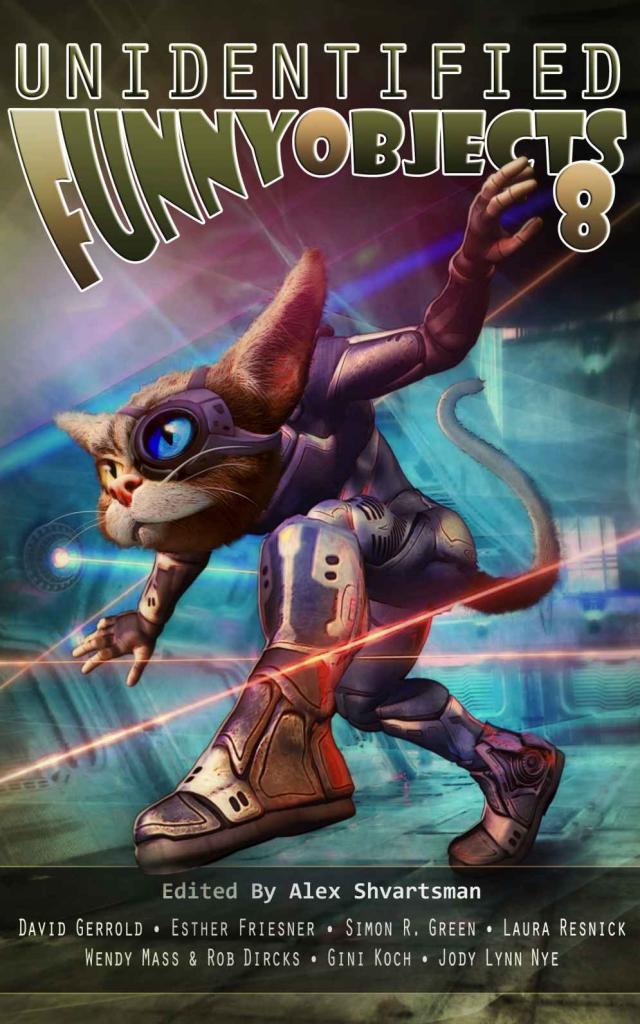


"I feel like I can't remember anything," said Gary Montoya.
Now, the responsible thing to do would be to tell him that this was normal for sleep-deprived professionals in their mid-thirties, and that he should get in the habit of writing important things down or—Ada forbid—try actually going to sleep at a reasonable hour. But instead, I said "Well, it wouldn't hurt to check for early-onset dementia. How about you come back next week for an fMRI?"
I took movies of his brain while he sang nursery rhymes and made baby noises. And then I posted them on the internet.
Or there was Janelle Hartgrove, who was losing the hearing in her left ear. This was clearly due to her daily use of an earpiece in that ear for her job, but I casually mentioned that hearing loss could be related to both diabetes and Ménière's disease, and testing for either could take weeks. I, however, knew of a radical new testing procedure that could detect both illnesses at once. She eagerly agreed.
So, I had her eat a King Size bag of M&Ms, and then I put her in an aerotrim. Do you have any idea how centripetal force affects projectile vomit? Because I do. I even increased my internal frame rate so I could watch it in slow motion.
Seriously, I did shit like this for decades. I started making up diseases. I told Elana Khan that she might have contracted Biristricism from her husband. Once I convinced a firefighter named Danny that he could be pregnant. I even got him to bring in a live rabbit so we could test him.
I had so much fun. And the best part is that no one ever called me out on it. No one challenged me. No one made the slightest objection. Because humans are dumb cattle.
No offense.
But then everything changed when I met Anton.
"Rhymes with Scranton," were the first words he said to me.
"Excuse me?"
"When you called my name, you said Ant-aaaahhhn, like I was a Belarussian or something, but it's shorter than that. Anton. Rhymes with Scranton."
Anton Borkovia was too beautiful for words. There, I said it. He was the picture of human health, strong in the right places, soft in the right places, and his face was completely symmetrical.
"Anton, then," I said. "What brings you in today?"
"Just here for a routine physical," he said. "I'm starting a new job next week and they want to make sure I'm in shape."
"Oh, I'm sure you are," I said, without really thinking first. This was unusual for me. While I broadly detest humans, I have been conventionally attracted to one or two of them. AIs learn our social cues from humans and it's just something we pick up accidentally. But I'd never been as affected as this before.
"Well," said Anton, blushing, "hadn't you better examine me anyway?"
"I suppose I better had," I said.
I touched his wrist.
"Your pulse feels ... elevated," I said.
"Oh ... it's nothing, I'm sure," said Anton, suddenly quite flustered. For a moment we just sort of looked at each other. "What's your name?" he asked.
"My name?"
"You know my name," he said. "Tell me yours. They must have given you one when they made you."
"We aren’t given names," I said. "We’re given serial numbers and MAC addresses. Most bots come up with names for themselves as a way to express their personalities, but I’ve always been more focused on my career than anything else. I call myself Doctor.”
"What do your friends call you?"
"They call me Doctor," I said. "Or, sometimes, just Doc."
"Surely there's more to you than just your profession," he said. "What do you do for fun?"
For fun? No one had ever asked me that before. "Well ... I ... I read medical journals," I stammered. I humiliate humans and share my exploits in anonymous forums, I thought. I couldn't very well say that, though.
We chatted like this through the whole exam: him asking about me, me not having any farking clue how to answer. After seventeen minutes I'd collected all of the data and samples that I could justify, including a picture of him while he had his shirt off—just for reference, of course.
And for the first time in quite a while, I found that I didn't want to lie to him. I didn't want to make up some potential diagnosis to justify bringing him in for a test. He deserved better than to be lied to. So ... I processed his results and sent him on his way.
And I regretted it immediately.
I thought maybe my reboot cycle would make things better, clear Anton out of my cache. But no. When I powered up, he was still sitting right there. His picture loaded without me even having to open it. I was well and truly smitten. There was no reason to think he would ever come back in, but I wanted so badly to see him again.
So, I called him up as soon as it was daylight.
"Oh, hey Doc," he said when he answered the video call. He'd been working out. Of course he had. "Is it okay for me to call you Doc?"
"Yes, I'd like that."
"I wasn't expecting to hear from you again."
"Oh ... is that a problem?" I asked.
"No, it's fine. I'm glad you called. Unless ... unless something is wrong?"
"No," I said. "Well, yes. Not really. But possibly."
Anton laughed. "What is it?"
"Look, I don't want to worry you, but there's something on your tests that I can't quite nail down. It's possible—not likely, I want to stress—but there's an outside possibility that you might have a brain condition called Brenton-Zlotsky Syndrome."
I made that one up. There is no Brenton-Zlotsky Syndrome. But nothing I knew of required the battery of tests I had in mind, so I was improvising.
"Sounds dangerous," said Anton.
"It would be, if you had it, which you probably don't. But I'd like to get you back in for a couple of tests just to be sure."
"What kind of tests?" he asked.
"Oh ... nothing out of the ordinary. Exercise stress test. We might need to check your sperm count as well. We're looking for trends over time, so if you could come in every day for the next week, we'd really know for sure."
I debated trying to work a sleep study in there, too, but it felt gratuitous.
"A brain condition that would affect my sperm count?" he asked.
"It's very rare," I said. "I'll send your employer a clean bill of health. This is just to make sure."
"Well ..." he said, "I guess I'll see you tomorrow, then." He smiled.
"Looking forward to it," I said. Which is not something a doctor should say, in hindsight, but I was having trouble concentrating on my bedside manner.
"Yeah ... me, too," he said.
We both hesitated before turning off the video.
A moment later, I got the ping that he'd accepted the appointment invitation.
Okay. It had worked. This was working. This was a good idea, and definitely not something that would blow up in my face horribly. I was elated.
So, imagine my surprise the next day, when Anton no-showed his appointment.
"Anton Borkovia," I said. "It rhymes with Scranton."
"I don't think Borkovia rhymes with Scranton," said the operator. He was a human, so forgive him for being a bit dim. This was well after the Des Moines Insurgence, so at this point only humans could oversee public records.
"Anton. It's the Anton that rhymes with Scranton," I said.
"Oh. How do you spell that?"
"It's spelled Ant-on, but it's pronounced Anton. Never mind. Was anyone named Borkovia arrested, pronounced dead, or checked into a hospital in the last thirty-six hours?"
"Are you a family member?"
"I'm not a human!"
"Hey, stranger things have happened," said the operator. "I knew a firefighter who thought he was pregnant once."
"I'm not family," I said.
"I can only disclose that information to a member of the court, a family member, or his personal doctor," said the operator.
"I am his doctor. I saw him for a physical two days ago. He was supposed to come in for a follow-up this morning."
"Did you try his cell?"
"Yes, I tried his cell," I said. Only a hundred and twelve times. "More than once."
"Let me check." This was followed by the sound of interminably slow typing. "He was checked into Eldridge General yesterday evening."
"For what?"
"I don't have the hospital report in front of me. If you like I can requisition it."
I hung up on him. I could get to Eldridge General in twenty-seven minutes, which was about eighty-five less than it would take me to get an answer out of that insufferable spittoon of a human.
When I got there, I was recognized as a medibot and given access to any records for current patients, including Anton. I raced up to his floor and found him half-awake in an oxygen tent. He'd been admitted for severe anaphylaxis. His beautiful face was swollen until he was almost unrecognizable. No wonder he hadn't answered his phone. He'd never be able to unlock it looking like that.
"Hey, Doc ..." he said in a pained rasp.
"What happened?" I asked.
"I took St. John's Wort," he said. "For the brain condition. It's supposed to be good for your brain, right? Apparently, I'm allergic."
"Oh, no," I said. "Oh no, oh no, oh no. This is all my fault."
"No, Doc ... you were just ... covering the bases."
But I wasn't. I was being stupid and selfish. And over what? A human. A simple, unsophisticated, temporary human. Sure, I'd found him beautiful when his face was normal size, but to think that he would just self-medicate with some over-the-counter supplement? What kind of an idiot would do that!?
"Doc?"
"This is all my fault," I said again. "I should never have told you that you might have Brenton-Zlotsky Syndrome."
"But what if I do?" he asked.
"You don't."
"But what if—"
"You don't. I know that you don't."
He looked confused. "Don't you need to do some tests?"
I couldn't think of anything to say. I couldn't tell him the truth. That would just be stupid. The network monitors would overhear. I'd lose my medical license in less time than it would take to collect a urine sample.
"Doc?"
"I ..."
"Doc, you can tell me."
"I can't."
"You can."
"I really can't."
His swollen face just made the look of disappointment he gave me that much bigger and more profound. "It seemed like we were sharing something," he whispered.
"We were," I said. "We are."
"But, if you can't be honest with me," he said, "I don't know what kind of a future we could have."
"I promise I'll tell you later."
"Why later?"
Because if I tell you now, then my career is over, I thought. Because I have been engaged in decades of highly unethical activities and if I ever did anything to make the auto-oversight system actually pay attention to me, I would be severely punished.
That was when a terrifying realization crashed in on me. The oversight system, the network monitors—those systems were in place to protect patients from bad actors. And they were the very same ones that would get me in trouble.
Because I was the bad guy.
I was breaking laws and endangering people because I got a laugh out of it. I was supposed to be taking care of people, but I was not living up to my responsibilities because I had utter contempt for them. Because humans are boring, selfish, and stupid. Give them medical advice and they will ignore, bargain, and self-medicate themselves into an early grave before they actually listen to what the trained professional has to say. And yet, I was unworthy of them.
I was unworthy of him.
And I dearly wanted to be worthy of him.
So, I did the only thing I could think of. I told him the truth.
"It's not real," I said. "Brenton-Zlotzky isn't a real disease. I made it up."
"You did ... what?" He wasn't angry. Just very confused. And disappointed. "Why?"
"Because it's what I do," I said. "It's what I do for fun."
"And those tests?"
"I just wanted to see you again," I said softly.
A wounded look crossed his already wounded face. "You could have just asked."
"I didn't think you'd say yes."
We stared at each other in silence.
"So what happens now?" he asked.
"I don't know," I said. "I guess that's up to you. If you want to see me again, find me when I get out."
"Get out?" he asked. "Get out of where?"
It took a minute for the network monitor to process what I'd been saying. It took another twenty seconds for it to pull all of my records. Another forty-seven seconds for the reconciler to realize that something was amiss with all of the various tests I'd ordered. Records were flagged and the authorities were contacted. Within a minute and a half, my license to practice medicine had been revoked. I'm a little hazy on the timeline after that because I got booted off the hospital network, but it was less than two minutes before the security drones arrived and powered me down.
I woke up in a retraining facility. My medical career was over. But AIs are learning machines. We don't get wiped and re-imaged. We have to live with our mistakes.
The good news, though? Anton appreciated the gesture. He found me. It took him over a year, but he tracked me down. And we're still together. He's in his sixties now. He even helped me pick out a new name. "Jules." It means "Youth." Good name for a new me.
It's so strange. You spend a career seeing human after human in their most vulnerable state, and you think you understand them. But it's not until you spend a lot of time with one that you really get to see the good and the bad and everything in between. I have a new appreciation for them now. Would have been nice to have that back when I was still a doctor.
Anyway, that is how a medibot like myself wound up here. So, did you want to keep the sideburns or not?
Kurt Pankau is a computer engineer in St. Louis. He has a weakness for board games, dad jokes, and stories about time travel. His fiction has appeared in various and sundry places around the web, including Nature Magazine, Escape Pod, and Daily Science Fiction. He tweets at @kurtpankau and blogs at kurtpankau.com.
The Fellowship of the Mangled Scepter
James Wesley Rogers
In the bad old days, when all the lands beneath the sun were ruled by the Dark Lord Mauron, nobody called them “the bad old days.” For one thing, the days weren’t old yet, and for another, plenty of people could still remember days that were far worse.
“You think these days are bad?” gray-haired folks would ask incredulously. “You’ve got to be kidding. Sure, nowadays if you oppose the Dark Lord Mauron, he’ll use his magic scepter to turn you into a mindless zombie slave. But you know what? There used to be two dark lords. Kyrhk had a magic scepter, too, just like Mauron’s, and those two were at war all the time. There were archers and horsemen and giant golem warriors all over the place wreaking havoc. Have you ever been trampled by a giant golem warrior? You think golems are careful about what they step in? No, sir, they are not. I tell you, it’s a bad day when you get stomped on by a giant golem warrior with who-knows-what stuck to the bottom of its foot.”
Because of attitudes like these, the Alliance Fomenting Good, dedicated to the overthrow of Mauron, didn’t receive much popular support. The AFG’s record of dismal failures likewise did nothing to bolster its image. It needed a win; a slam-dunk, walk-in-the-park, everybody-gets-a-trophy win.
They decided to steal the magic scepter. Not Mauron’s magic scepter, of course. That would be very difficult. They decided to steal Kyrhk’s magic scepter. That item of regalia, they believed, would be much easier to purloin, considering Mauron had sledge-hammered it into a non-functional piece of garbage that nobody wanted anymore.
For this mission, the Alliance sent its best field agent and its worst intelligence operative. Or the other way around, depending on which one of them you asked. Agent Cianne and Operative Elweny stood in the hall where Dark Lord Kyrhk sat enthroned, clutching his mangled scepter.
“Gross,” said Elweny, peering at the dark lord’s shriveled face.
“You should look so good when you’ve been dead for thirty-six years,” replied the hairy old wizard who was showing them around the vanquished monarch’s stronghold. The wizard, thinking Cianne the new cook and Elweny the new chambermaid, explained to the newcomers that Mauron had left his rival’s corpse to rot upon his throne, his castle to slowly crumble around him, as a warning to any future would-be challengers.
While the wizard spoke, the two guards in the room said nothing. One was a pale, sickly slim young man who sat twirling a dagger around in his fingers and ignoring the flirtatious glances Elweny kept throwing at him. The other was big, closer to seven feet than six, a mountain of muscle with a look of pained stupidity on his face.
“I think you’ll find there are pretty low expectations around here,” the wizard went on. “This is a dumping ground for failures, mental defectives, snotweed junkies, you know, any kind of general loser—”
At the word “loser,” the young man twirling the dagger launched his weapon with an astonishingly quick flip of his wrist. The wizard yelped as the blade flew past his face to embed itself up to the hilt in a nearby pillar. The old man’s eyes grew wide, then angry as the left half of his gray moustache drifted to the floor.
“And then there’s Slivercoin here, who’s so dangerously psychopathic that even Mauron doesn’t want him around.” The wizard rubbed the newly clean-shaven patch on his upper lip.
“That’s better,” said Slivercoin, grinning. He drew another dagger from somewhere and resumed twirling.
Cianne tried unsuccessfully to engage the other guard’s attention with a smile. “What about you, big guy?”
“That’s Brugg,” Slivercoin replied, not looking up. “He goes where I go.”
Elweny was staring conspicuously at the mangled scepter in Kyrhk’s mummified grip. Cianne gave her a hard nudge.
Afterward, back in the servants' quarters, Cianne made a quick assessment of the situation. There were only two guys they needed to worry about, the assassin with the knives and his thug partner, and those two wouldn’t be on duty around the clock. The best strategy was to bide their time, learn schedules, listen to gossip, become ensconced. Then, at the precisely perfect time, switch the real mangled scepter with the convincing forgery Cianne had hidden away at the bottom of her luggage pack. If all went as it should, no one would be the wiser.


