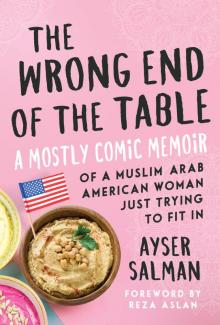
The wrong end of the tab.., p.14
The Wrong End of the Table, page 14


I was no stranger to depression, having suffered mild bouts throughout my early teens and into my twenties. They were usually hormone-related and only lasted a day or so. I would “grit my teeth and bear it,” until the black cloud lifted. But now they were getting worse. I was suffering from an intense melancholia that could last for weeks. And nothing would help. Audrey Hepburn’s character in Breakfast at Tiffany’s, my favorite film, called it “The Mean Reds”: “Suddenly you’re afraid and you don’t know what you’re afraid of.” I’d never experienced such a heavy emotional toll to this degree. As an Arab American firstborn female who was raised to be strong and authoritative, it made me feel weak.
And why was it happening now? I was thirty years young and properly independent for the first time in my adult life. I should have been celebrating my independence, freedom, and “Me Time,” unencumbered by a partner, kids, pets … plants.2 I was in my prime physically. I had a great job. I could pay my own bills easily. So why couldn’t I appreciate what I had?
I had constant panic attacks, thinking that time was running out—for what, I’m not sure. I didn’t have a biological imperative to have a baby like other friends my age. I believe I was simply feeling societal pressure to “get on with it” from both sides—all my Western friends were getting married and having babies, while my Arab friends had already done that back in their midtwenties; some were even already getting divorced.
Me? I had no life events to claim, unless you count working for a (then) respected mini-major film studio. I was completely out of sync, had no tribe to identify with, and felt rudderless, sad, and ashamed for not being able to feel gratitude for what I had. What did I have to be upset about? What if I was in the position of some of my distant relatives who had been left behind in Iraq? They had to fight for simple things like clean water. I was one of the “lucky ones”; I was living in America, land of the free.
Back then, because I didn’t have a better understanding of depression as a mental illness, I simply felt like I couldn’t afford to be depressed.
During those early times, I tried to will myself out of a mood and use the psychology my strong Arab mother might employ:
“Do something productive and snap out of it.”3
“Count your blessings. You could still be in Iraq fighting for uninterrupted electricity in your home.”4
“Maybe Los Angeles is too much for you. Move back in with us in Austin.”5, 6
I told no one about my emotional state, especially not Mom. Back then, it wasn’t commonplace to talk openly about suffering from depression, especially not in Arab culture. Even my Western friends didn’t quite understand why I was sad. Out-of-town friends lamented that they wished they could live a glamorous Los Angeles life, and one male friend even told me I was “too cute to be so upset.” I wanted to punch him in the throat.
But I was frustrated because, deep down, I agreed with them. Again, I (erroneously) believed I had no real reason to be sad, which only served to worsen the sadness. I even tried turning my blues into a game to diminish its importance. I bought a small calendar and recorded my mood three times a day using a smiley face or a frowny face to denote happiness and sadness, respectively. If I felt neutral, I drew only eyes with no mouth to denote nothingness.
Most days began with a frowny face and ended with a neutral face.
When you suffer from depression, you’re looking for anything to chase the sadness away. For me, that meant engaging in bad habits and bad decisions. I didn’t turn to alcohol, but I developed a longstanding crush on a bad-boy director from work and picked up smoking to bond with him. Luckily, nothing horrible came out of this except for the sixteen months I wasted on someone for whom I constantly made excuses: “He’s just misunderstood”; “I can save him”; “He didn’t mean to get his former girlfriend pregnant after telling me he wasn’t seeing anyone else.” You know, the lies women sometimes believe.7
I was so embarrassed about this chapter of my life that if you went through my stack of journals (which I still have, beginning from age eleven), you’ll find this period conspicuously absent. Not because I didn’t keep a journal, but because I burned all three and flushed the charred remains down the toilet. I wasn’t keen on keeping a record of my days of smoking, being in love with an unavailable guy, battling depression, and bouncing among therapists (I would quit whenever they told me something I didn’t want to hear—mostly that all problems stem from our mothers).8
My self-absorption caused me to lose friends. I had become a completely different person from the one I was one year prior. I remember thinking that if this was what Hollywood “success” looked like, fuck it, I’d go back to Kentucky. Or marry rich and become a housewife. Or chuck it all into the trash can and open a bakery in a small town. How do you go from having a near-perfect relationship with your soulmate9 in your twenties to being an educated, professional thirty-something living for late-night work sessions because it meant more smoke breaks with Stuart and a chance that you could meet up later?? Aren’t you supposed to do those things in reverse order?
Eventually, I did tell my mother (about the depression, not the guy; I wasn’t that crazy). Being the consummate pharmacist that she is, Mom told me that perhaps the depression I had was the “newly discovered” PMDD (premenstrual dysphoric disorder),10 which was basically PMS turned up thirteen notches. From my smiley-face calendar research, I discovered that the blues would hit me two weeks out of the month, usually around my period. It was an extreme sadness, the kind that made you apathetic and not want to get out of bed. During the other two weeks, I’d be fine.
But two weeks out of the month was basically half of my life. I didn’t intend to spend half of my life in bed.
I took Mom’s advice and got a prescription for Sarafem, a rebranded Prozac at the time. Though I was worried that my personality would change, I was ready to try anything. My doctor informed me that it would merely give me a platform until I got my land legs back, and I really needed my land legs. I was tired of going through the motions. I wanted to find joy in simple things again—like a cup of hot coffee in the morning. I filled the prescription, and slowly it got better. My daily calendar faces turned into mostly smileys with a few neutral no-mouth faces. The frowny faces decreased.
I was so grateful. I felt myself getting back to my center and finding joy in life again. I snapped out of my trance and left Stuart behind. I stopped smoking and took a trip to Europe with a gal pal, my first in years.
It was the spring of 2001, and I was the happiest I’d been in a long time. I’d learned to find joy again after that period of darkness, and it felt amazing. I was optimistic about what life would bring next.
Then, several months later, the unspeakable happened.
Two planes crashed into the World Trade Center, killing nearly three thousand people and changing everything as we knew it.
_______________
1 Look, Ma! I’ve succeeded!
2 I couldn’t even keep mint plants alive, and those grow like weeds.
3 It goes without saying that telling a depressed person to “snap out of it” is the same as telling someone with a broken leg to “just get up and walk.” It’s not helpful.
4 This, too, is not helpful. It only makes a depressed person feel worse. Depression is an illness that can strike anyone—whether they live in a country under siege or in, well, America.
5 Yeah … my folks had moved yet again and were now living in Austin.
6 That last one was enough to send me into an increased depression. And it missed the point.
7 Ladies, you know what I mean; and if you don’t, you’re lucky … or lying.
8 In spite of their best intentions, moms can mess us up. But let’s move on and take responsibility of our own adult lives, am I right?
9 I.e., Tony
10 PMDD was just a way for the pharma industry to rebrand what I had been experiencing since my teens.
23
A Dark Period
September 11, 2001.
I don’t think I will ever not feel a shudder when I see this date in print.
I’ll never forget that morning, waking up in my apartment to a call from Tony, who told me to turn on my TV. I had a fax machine in my bedroom, which also served as an office, and I used the attached phone as my landline. When I recall images from that day, I keep seeing the caller ID on that fax machine with Tony’s name scrolling by …
A group of ten friends and I gathered at our buddy Mike’s house and remained glued to the television until dinnertime, taking breaks to play board games to distract ourselves. No one wanted to go outside. It didn’t matter that we lived in a quiet neighborhood in Pasadena, where we were quite safe from a terrorist attack. The rules had changed. If someone could commit such a horrific act, such as deliberately flying a plane into two skyscrapers, who was to say any of us were safe? I’m lucky in that no one close to me lost anyone in those attacks, but the fact remained that America, our America … my America, was permanently broken and would never be the same.
For weeks after, I avoided going to restaurants not out of fear for my safety, but because it seemed frivolous to have sushi in the aftermath of horrific tragedy. Same thing with Starbucks; I could get my caffeine fix at home. As the weeks went by, I gathered with friends and coworkers to attend group counseling sessions and interfaith prayer services in nearby churches, all to try to make sense of what had happened on US soil, and to allay feelings of vulnerability, powerlessness, and fear. Those sessions helped.
But then I began feeling something different—the isolation of being a Muslim.
Initially, I was reassured when leaders, Muslim and non-Muslim alike, condemned the actions of Al-Qaeda, the terrorist group that took responsibility for the attacks. President George W. Bush made it clear that the Western world was not at war with Muslims, but rather at those particular individuals. I waited for public figures and officials to continue the dialogue and actively engage in outreach and education in hopes that, somehow, some good could come from a horrific thing. I waited for more declarations that terrorism is not religion nor should it ever be considered religion. I heard a bit of this sentiment, but what I heard more of was “Don’t judge an entire population by the actions of a few.” It was an accurate and valuable statement, to be sure, but it didn’t go far enough for me.
I began feeling paranoid and uneasy.
Would my coworkers and acquaintances suddenly start to suspect me? I thought back to the few folks at work who’d previously joked about me being a terrorist.1 I wondered deep down if they really thought I might be one. I was too afraid to confront them. What if they said, “We weren’t so sure about you a year ago—you seemed nice enough—but now we can’t even look at your face because it makes us uneasy”? I wasn’t emotionally ready to handle this kind of information.
So I overcompensated by being especially nice to the people around me. If someone complained that I’d rolled my eyes or looked at them in a negative way, I took their criticisms to heart. I didn’t want anyone thinking I was harsh, antagonistic, or swarthy-looking. I didn’t want anyone thinking I was like those people. For the first time since high school, once again I longed to be blonde-haired, blue-eyed Paige who was mellow and even-keeled, instead of dark-haired Ayser who tended to be volatile. When during an argument my friend Scott asked why my people were so angry all the time, instead of calmly calling him out on his racism, I shut down and avoided him for a week. What if he was right about me?
I began pushing down anything that I thought was too “big” about myself. After a decade of embracing my uniqueness, I found myself swinging back to my prepubescent introversion. I toned down anything colorful—clothing, manner of speech, opinions. This time I was doing it not to be accepted into the cool-kid clique, but so that strangers wouldn’t get that look of fear in their eyes when they saw me (accidentally) leaving and walking away from a large package of bourbon chocolate balls at the airport in Lexington. Calm down, blue-blazer-and-sneakers guy, I paid good money for those bourbon balls, and I’m not about to leave them behind on purpose!
It was a surreal time, and I tried adjusting to my new normal. And if I had a hard time as an Arab woman, you can imagine how it was for the male members in my family. My brother gave up on flying for the rest of that year because he was hassled so much during the first few months after the attacks. Luckily, I was living in Los Angeles, which was a bit more cosmopolitan than Austin, Texas, where my parents were now living. They were left alone for the most part, aside from some well-intentioned but ignorant questions:
“Why do Muslims hate us?”
“Do you know Osama Bin Laden?”
“Does it bum you out that you can’t eat pulled pork?”
Seemingly innocent rituals like Halloween became opportunities for paranoia. When it came time for trick-or-treating, my parents’ Iraqi friends in Austin darkened the lights and pretended not to be home. They refused to participate because what would happen if some kid accidentally ate bad candy and got sick? Would people immediately assume it was terrorism? Would the FBI come knocking on their door? So, they hid out of fear with the intention to protect themselves. But this had negative effects, causing even more isolation and alienation from the community.
The abominable terrorist act had also suddenly made me an unofficial spokesperson for my religion. I had two choices: to withdraw like those Iraqi families at Halloween and hide that part of me so no one knew I was Muslim, or to speak out and, in my own small way, bring awareness to my immediate circle. I chose the latter. I had an opportunity. I responded to every comment, no matter how stupid, like: “Do Muslim women wear the hijab to hide their horns?”
… Okay, maybe not that stupid. But I did have an open-door policy when it came to Q&A on what it meant to be Muslim. Go on, I invited the people around me. Ask me anything.
Was I unfairly shouldering the burden of proving that terrorists do not represent what the majority of Muslims stood for? Sure, I was. But I tried my best in this new, uncharted territory. I became actively involved with public advocacy groups such as The Muslim Public Affairs Council (MPAC) and did whatever I could to educate and enlighten the public. The silver lining was striking: for the first time in my life, I was actively reaching out to Muslims with the intent of becoming part of a community, something I’d conscientiously avoided in my younger years, which my parents had lamented. It’s sad that it took such a heinous act to propel me to get involved in my community. But don’t we all turn to our “tribe” when the world gets to be too much? Unfortunately, it takes bad shit happening to get the dialogue going.2
Hanging around people who were like me kept me from isolation and going back into my depression. I made some really good friends during this period. Being involved with MPAC saved me.
I started believing that maybe things could be normal again. At least, I had hope.
_______________
1 This was before 9/11, when it wasn’t as politically incorrect to say that … wait, what am I saying? Joking about Arabs as terrorists is at its least always politically incorrect and at its most racist.
2 When people are busy being happy during times of peace, the only polarizing thing is whatever has last come out of Kanye West’s mouth. Frankly, I would prefer to live in a world where people are polarized by only Kanye West.
24
#WhenWeSpeakUp
While we’re on the subject, let’s talk about prejudice against Muslims.
The same issues I had to contend with back in 2001 continue to come up today, such as during a night out with my best friend, Karen, fifteen years later. We were at dinner, discussing what had depressingly become the norm over the past few years—another attack on US soil where the perpetrator invoked religious fanaticism. This time it was the June 12, 2016, attack on the gay nightclub, Pulse, in Orlando, Florida. The perpetrator, Omar Mateen, was Muslim, and during his siege, he made a 911 call to pledge allegiance to the extremist terror group ISIS.
KAREN: Islam has enough problems without this asshole coming in and fucking things up.
ME: I don’t think what this guy did can exactly be considered Islamic …
KAREN: I’m just saying the religion doesn’t need him using it to further his agenda.
ME: He claimed allegiance to ISIS.
KAREN: Exactly.
ME: … which is not a religion. It’s a militant cult.
KAREN: A cult that claims the teachings of Islam as a springboard.
ME: Sure … but I don’t think people confuse cults with the beliefs of the average person of the faith, do they?
KAREN: … Damn that’s hot.
ME: What?
KAREN: Her boots.
Karen jutted her chin, and I realized her attention was now on Charlize Theron, who was leaving our restaurant wearing badass black side-buckle boots.1 The moment was gone.
As I was driving home, I started to wonder whether my good friend of eight years really could not make a distinction between a terrorist and a practicing believer of the Muslim faith. To be fair, my Muslim identity is not one that’s traditionally visibly apparent—I don’t wear a hijab,2 I’ve acquired a taste for Woodford Reserve, and I can’t claim the excuse of doing my Maghrib prayers3 whenever I am late to dinner.4 As one casual acquaintance pointed out, I don’t “act Muslim.” As subtly racist as that sounds, I try to give them the benefit of the doubt—when something is hard to put in a box, it might be easier to misunderstand. But as I told this particular individual, don’t question my allegiance to my religion just because you can’t see it.5
Still, in today’s post-9/11 world, with all the awareness and dialogue going on, I prefer to hope that people are able to make the distinction between a believer of the faith and someone who subverts its teachings in order to carry out heinous acts of terrorism. After all, few would say that the Ku Klux Klan gives Christianity a bad reputation, despite the fact that KKK members pledge to uphold Protestant Christian morality. Almost every Christian denomination has denounced the KKK, just as Muslims have repeatedly denounced ISIS. Why was there a difference?