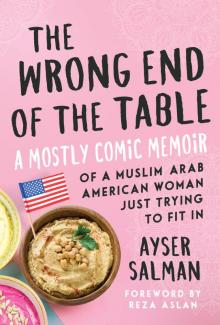
The wrong end of the tab.., p.17
The Wrong End of the Table, page 17


MOM: Egyptians eat a lot of fava beans, which is a natural serotonin booster. Ask your father.
DAD: (jumps on the line, as if on cue) Hi, Ayser!
MOM: Baba, talk to your daughter about why Egyptians are so happy.
DAD: The fava beans. They contain high amounts of levodopa, which helps regulate your mood. I found an article on this yesterday. I will read it to you.
ME: Dad, can you just send me the link? I can’t talk long. I have to go to Pilates.
DAD: I can’t talk long, either. We, too, have plans.
ME: Yeah? Where’re you going?
MOM: Ayser, by the way, if you ever want a nose job, we would support you. (Adding quickly) I’m not saying you need one. Just that you have our blessing.
She hangs up, leaving me momentarily speechless, which is a common side effect of a phone call with my mother.
DAD: Your mother is very supportive. Is there anyone like her?
ME: “Supportive,” yes. So, Dad, where are you going?
DAD: Cafe Darband.
I practically drop the phone.
ME: That’s a hookah bar!
DAD: Yes, but they also serve a fantastic Turkish coffee that your mother loves, and I love their falafel. We are going to meet Abdul Qasim and his family.
I was stunned. With that comment, my dad had outed my prejudice and shut it down. Sure, hookah bars at first glance are ridiculous, but if they bring together families to socialize and foster a sense of community, why was I so cynical? I had to stop looking at the surface; I needed to go deeper.
As I drove home, I meditated on my encounter with Ali and the conversation with my parents. I realized I had been exclusionary. A total snob. And that itself is a form of racism: focusing on a small surface detail and blowing it up to become the bigger picture, however detrimental. I vowed, then and there, to do better. To be better. To work toward fostering community.
Yeah, maybe Ali wasn’t my guy, but meeting him certainly opened me up to meeting a future Ali, or Juan, or Nigel. Who cares who he is? As long as he shares my values, I’m open.
_______________
1 In case some moms read this (mine), and also because it’s the truth.
2 Also because I was having zero luck on the dating circuit with non-Arab men. More about that soon.
3 Apparently, she still claimed it was an overcharge because the jumpsuit was missing one button.
4 I have a thing for hands, especially when the thumb kinda bends out.
5 Okay, he was not wrong about that. And hadn’t I kinda done the same thing with Arab men up until now? So I let that one go.
6 A backhanded compliment if I ever heard one. I looked down at my snazzy white New Balance sneakers, which I’d deliberately paired with a fancy silk top and slouchy jeans. It’s called fashion deconstruction, buddy. Look it up!
29
Iraqis Take Forever to Say Good-Bye
After my date with Ali, I was more determined than ever to work toward breaking down any stereotypes I saw both within and outside of the Arab community. I wanted to foster inclusion and awareness. I was going to be the poster child for Arabs, debunking all of the stereotypes that existed about us, thus being a hero among my people. I went to bed dreaming of the accolades I would receive.
Finally, I had a purpose that didn’t involve finding a husband.
I decided to enact my game plan the following week when I visited my parents for my dad’s birthday. Mom had planned a party for their close friends, most of them Iraqi. Almost immediately, I failed to break down any stereotypes; if anything, the opposite happened. Because, as I discovered on this visit, there is one stereotype that is absolutely true about Iraqis:
Iraqi people take forever to say good-bye.
I’ll spare you the details I had to go through to get to this observation and instead give you a primer, should you ever find yourself speaking to an Iraqi on the phone or standing next to one at a social gathering.
You can’t just simply say “good-bye” to an Iraqi and leave.
Well, you can. But there are stages.
STAGE I is where you stand up, thus signifying the end of the gathering. Then, one by one, everyone else stands up.
In STAGE II, you go for a hug or handshake with the host or the most important person in the room. This is when you say how great it was to see everyone. How the dinner was the most delicious food you’d ever tasted. Where do you find the time to roll such perfectly tight dolmas? Etc. When you’re finished with your compliments, the rest of the group will follow suit. When everyone has completed that activity, the group migrates slowly to the door.
You have now moved to STAGE III. This is where, if you’re lucky, you’re able to make your way out while smiling and waving, get into your car, and drive away.
If this is you: congratulations, mazel tov, mabrook, and good on ya! You have managed to say good-bye in less than ten minutes. You must be really skilled at this. Or, not actually Iraqi.
If, on the other hand, you’re really Iraqi, you will linger with the group at the door and make small talk, things you didn’t touch on during the gathering. Such as how your eldest son is doing at school, and does he really like the fencing club he belongs to? Or whether your cousin’s youngest daughter will ever stop playing tennis on her roommate’s Wii long enough to start looking for a husband?
This goes on for six more minutes. Then come the actual good-byes:
“Goodbye, sweetheart, we hope to see you very soon!”
“Yes, sweetheart, we must do this again very soon.”
“Very soon. Give your mother my best!”
“I will give her your very best. And you do the same. Give your daughter a hug for me, and tell her to eat while she’s at college. She doesn’t need to lose weight from stress.”
“I will give her a hug from you for sure! By the way, did you hear about Yasmeen’s son’s fiancée? She was getting too fat, so she had that operation where they put the band in your stomach …”
You get the idea. To deal with this, I’ve developed my own style of good-bye. When I’m ready to leave, I’m out in five seconds—“Bye” and … gone. Some might accuse me of being abrupt and rude. I prefer to think of it as succinct and concise.
Also, it’s much easier to say good-bye when you’re face-to-face; you can drop a few visual clues, such as looking at your watch or slinging your purse over your shoulder. But on the phone, it’s a bit more challenging. Usually, I do the “Sooo anyway …” business.1
As in, “Sooo anyway, I better get off the phone.”
Or “Sooo anyway, I’ve got tons of ironing to do tonight.”
Or “Sooo anyway … my cat seems to have started a small fire in my sock drawer.”
That last one was made up. I don’t have a sock drawer.
Dad’s birthday party was a smashing success. Mom’s dolmah received rave reviews. She even made her version of the traditional Iraqi fish dish masgouf, which is difficult when you don’t have a tanour, an Iraqi brick oven. The guests talked about her culinary feat at length. I had to leave toward the end of the party to catch a cab and fly back to Los Angeles for a work meeting the next morning. When I left my house in LA the next day, I’m pretty sure Mom was still walking out the last two guests, saying good-bye on the porch.
_______________
1 Ellen DeGeneres did a great routine about it.
30
Grapes Are Eaten One by One
While we’re on the subject, let’s talk about Arabs and proverbs. Arabs love their proverbs, especially Arab men. An uncle once said there are four things dear to an Arab man—God, family, country, and proverbs. My father is no exception.
But where Dad differs from other Iraqi men is he doesn’t recite Iraqi proverbs exclusively. My father is an equal opportunity proverb spouter.
If I call in the morning and ask him how his previous day was, Dad would draw on the Cherokee proverb “Don’t let yesterday use up too much of today,” meaning, “Today is a new day.” It’s great he isn’t living in the past, but it doesn’t really answer my question.
Proverbs are the perfect way for my dad to sum up his feelings. If you think about it, they are really the old school version of GIFs or memes. Take this Swedish saying: “Friendship doubles our joy and divides our grief.” It has a nice message and gets to the point; I feel cozy just reading it. That’s the sign of a good proverb—efficient with its words, communicates a good point, and easy to remember so it can be used during tough times.
But there are also many proverbs that don’t get to the point. That aren’t succinct. That don’t make sense. And I’m sorry to say that many of these are Arabic proverbs.1
Before anyone accuses me, once again, of being a self-hating Arab, let me explain: Arabic is a language known for its flowery tendency to embellish simple statements. So when a statement is translated from Arabic to English, something is lost in translation. Similarly, English phrases that are translated to Arabic take on a whole new life.
For example, the simple American insult “drop dead” may be translated into Arabic as “May the fleas of a thousand angry camels infest your mother’s nostrils.”
… I embellish. I believe the correct expression in Arabic is “May the fleas of a thousand camels infest your armpits.”2
Here are more examples.
The English proverb “easy come, easy go” is straightforward enough; the Arabic version is “What comes this way, goes this way.”
… I’m sorry, which way? Does it come in from the left and go out from the right? Or does it go out the way it comes? Is it like “in one ear and out the other” or “things leave the way they come?” I’m so stressed trying to figure this out that I ultimately miss the message.
Some Arabic proverbs are deliberately vague, probably in order to be all-inclusive or noncommittal. Instead of the English “better luck next time,” the Arabic version is “a better one in another one.” This could mean anything! Why can’t Arabic proverbs just be simple and direct?
And instead of the English “no such thing as a free lunch,” the Arabic proverb takes a morbid turn way into left field: “Nothing is for free, not even blindness and deafness.”3
I asked my dad about that particular one, and even he couldn’t give me a good explanation. In fact, he answered me using a proverb. He said that when attempting anything in life, such as learning proverbs, “grapes are eaten one by one.”
I was surprised. This Arabic proverb was pretty decent. It was quick, it was true, and it got to the point. I chuckled with delight at this happy realization. Maybe there were Arabic proverbs out there that would resonate with me.
My father listed three more:
“The barber opened his shop; his first customer was bald.”
Starting the day off on the wrong foot.
“A thousand curses do not tear a robe.”
Sticks and stones may break my bones, but words will never hurt me.
“A fire in the heart, but no tear in the eye.”
Keep a stiff upper lip.
I started to come around. Maybe there was something to Arabic proverbs, after all. They always paint nice images, and sometimes having a strong visual is better than brevity. Take what is now my favorite saying:
“We mentioned the cat; it came bounding.”
Speak of the devil.4, 5
My little devil cats, Bug (foreground) and Cobby (background).
_______________
1 Arabs like to draw stuff out, as we have learned from the previous chapter.
2 This is probably the reason why Arabs have a reputation of being so angry—I mean, passionate.
3 Look, I’ll just pay for my lunch, thank you very much. Small cost to have all my faculties intact.
4 Some people consider cats to be evil. Sure, cats can be assholes … but just look how cute they are!
5 My mother cautions me against making arbitrary and forced references to my cats; otherwise, readers will think I’m a crazy cat lady.
31
Aloha Means “the Sign” in Arabic
About ten years ago, my sister and I took my parents to Hawaii. Before I get to my point, let me lay the background for you.
It had always been my mother’s dream to visit Hawaii ever since she was a child in Iraq. She and her siblings grew up watching two types of films: Westerns and Elvis Presley musicals. Both pretty much informed her idea of the United States as a young girl. In her mind, America was one vast landscape where handsome, rugged cowboys fought bad guys, rescued beautiful but helpless women, and rode strong, white horses into bars, where suddenly they were treated to the hip-shaking music of rockabilly guys wearing leather jackets. And just outside the window, Elvis Presley sang to Ann-Margret on a beach blanket.
Once, when we went on a cross-country trip and stopped by Knott’s Berry Farm in California, Mom went up to a performer dressed as a Native American and, with tears of empathy, spoke to him about how his land had been taken and how he was subsequently displaced—and how she understood his situation. Dad had to firmly but gently pull her away.
With her Old Western experience fulfilled, it was time for Mom’s Hawaiian experience. She was in heaven. The sounds of the ocean, the sun, the fresh air … it was pure bliss.
Dad enjoyed the trip slightly differently. For him, it was more of a historical and etymological lesson. Memorably, Dad was convinced that the Hawaiian language had its roots in Arabic.
Yep.
As we drove around in our rental car, he would repeat out loud the names of every sign we passed, explaining how that word sounded exactly like its Arabic counterpart.1
Take for example the word aloha. A-LO-HA. According to Dad, it was the equivalent of the Arabic way of saying AL-LOW-HA (with a heavy H sound), which means the sign.
Okay, I thought, but aloha in Hawaiian means hello. Signs have nothing to do with hellos.
“Well,” said Dad, “when you tell someone hello, you are giving them a sign.”
“Oh yeah? Of what?”
“That you want to talk to them—that you want to greet them!” he said calmly, not understanding why I wasn’t grasping this simple concept.
“Take also, for example, Makena Beach,” he continued. “Makena comes from the Arabic word for place, which is MA-KAHN. See what I mean? When you say let us go to the beach, you are going to a place. Hence the name Makena.”
At this point, I began to fear that Dad had had too much sun. We tried to bring him inside, but it only encouraged him. He found an atlas at the hotel sundries store and sat on the couch in the lobby clutching a frothy pineapple drink with an umbrella in it. He sipped away as he flipped through the pages, muttering to himself about this word and that.
“See, even Maui! MAH-WEE in Arabic also means the color blue, and look at all the blue ocean around us! It is so perfect!”
He paused, taking in the magnitude of this discovery. Then, he took another sip of his drink and resumed his flip, flip, flipping.
“Rand McNally! The maker of this map!”
“What about it? Don’t tell me they are—”
“—Arabic. Yes!”
“Really, Dad? McNally? I think that might hail from a little further west, like Ireland.”
“No, look here, it is plain as day. McNally is a shortened version of MA-KAHN ALI. Ali’s Place! This fellow Rand must have gone to Ali’s place to draw up these maps!”
Head spinning, I looked around for my sister, but she’d gone back to the room with Mom. I found them watching an old Western on television (which must have been some sort of head trip for Mom). I announced to Lameace that for next year’s vacation we should go somewhere with less fodder for Dad’s etymological Arab-ization.
… We ended up taking him to Istanbul, Turkey.
_______________
1 Just like the movie My Big Fat Greek Wedding, where Toula’s father thinks the Greeks invented everything.
32
Christmastime in the Salman House
[This page intentionally left blank.]1
_______________
1 What? You were expecting a huge chapter on culture clash? My parents hardly celebrated any holidays, let alone Christmas. They did give us presents, but we ended up wrapping them ourselves. What good is Christmas when you had to be your own Santa Claus? This chapter exists only because my publisher said I needed to address whether I felt ostracized by Christmas. I did—mainly because my birthday fell two weeks before Christmas, so I always received a combo birthday-and-Christmas gift, while I also had to buy everyone else gifts. On my birthday …
33
Too Much Hair to Manage
My family is anything but traditional, both by Arab and American standards. This is most evident in terms of how we celebrate the holidays. Arabs are known for being very social, often attending or throwing large parties that last into the wee hours of the morning.
Not so with us Salmans. As kids, we only celebrated Christmas so we wouldn’t feel left out when we went back to school after winter break and were asked what Santa had brought us. Mom used to throw my brother and me combo birthday parties since our birthdays were two weeks apart, but once we got older, she got tired and gave up on the tradition.
Except for Thanksgiving. It’s Mom’s favorite holiday, and she’s so excited about it every year that she adds her own Salman twist to the tradition. For instance, Mom hosts Thanksgiving one day later on a Friday to allow my relatives to fly in on Thursday when flights are cheaper and less packed. What does a different day matter anyway when it’s about the whole family coming together?
Recently, my dad announced on Thanksgiving Thursday that he’d scheduled a haircut for Friday. This meant he would have to leave the house in the middle of dinner with the family. Well, this just wasn’t acceptable to Mom.
“Why are you always cutting your hair? No one cuts their hair more than you. Not even Ayser!”
“I have too much hair to manage!” he bellowed back, mussing up his hair to make a point, creating a white mohawk on top of his head. “You have no idea how hard it is to handle my hair. I put so much mousse in it, and it is still unmanageable!”1
DAD: (jumps on the line, as if on cue) Hi, Ayser!
MOM: Baba, talk to your daughter about why Egyptians are so happy.
DAD: The fava beans. They contain high amounts of levodopa, which helps regulate your mood. I found an article on this yesterday. I will read it to you.
ME: Dad, can you just send me the link? I can’t talk long. I have to go to Pilates.
DAD: I can’t talk long, either. We, too, have plans.
ME: Yeah? Where’re you going?
MOM: Ayser, by the way, if you ever want a nose job, we would support you. (Adding quickly) I’m not saying you need one. Just that you have our blessing.
She hangs up, leaving me momentarily speechless, which is a common side effect of a phone call with my mother.
DAD: Your mother is very supportive. Is there anyone like her?
ME: “Supportive,” yes. So, Dad, where are you going?
DAD: Cafe Darband.
I practically drop the phone.
ME: That’s a hookah bar!
DAD: Yes, but they also serve a fantastic Turkish coffee that your mother loves, and I love their falafel. We are going to meet Abdul Qasim and his family.
I was stunned. With that comment, my dad had outed my prejudice and shut it down. Sure, hookah bars at first glance are ridiculous, but if they bring together families to socialize and foster a sense of community, why was I so cynical? I had to stop looking at the surface; I needed to go deeper.
As I drove home, I meditated on my encounter with Ali and the conversation with my parents. I realized I had been exclusionary. A total snob. And that itself is a form of racism: focusing on a small surface detail and blowing it up to become the bigger picture, however detrimental. I vowed, then and there, to do better. To be better. To work toward fostering community.
Yeah, maybe Ali wasn’t my guy, but meeting him certainly opened me up to meeting a future Ali, or Juan, or Nigel. Who cares who he is? As long as he shares my values, I’m open.
_______________
1 In case some moms read this (mine), and also because it’s the truth.
2 Also because I was having zero luck on the dating circuit with non-Arab men. More about that soon.
3 Apparently, she still claimed it was an overcharge because the jumpsuit was missing one button.
4 I have a thing for hands, especially when the thumb kinda bends out.
5 Okay, he was not wrong about that. And hadn’t I kinda done the same thing with Arab men up until now? So I let that one go.
6 A backhanded compliment if I ever heard one. I looked down at my snazzy white New Balance sneakers, which I’d deliberately paired with a fancy silk top and slouchy jeans. It’s called fashion deconstruction, buddy. Look it up!
29
Iraqis Take Forever to Say Good-Bye
After my date with Ali, I was more determined than ever to work toward breaking down any stereotypes I saw both within and outside of the Arab community. I wanted to foster inclusion and awareness. I was going to be the poster child for Arabs, debunking all of the stereotypes that existed about us, thus being a hero among my people. I went to bed dreaming of the accolades I would receive.
Finally, I had a purpose that didn’t involve finding a husband.
I decided to enact my game plan the following week when I visited my parents for my dad’s birthday. Mom had planned a party for their close friends, most of them Iraqi. Almost immediately, I failed to break down any stereotypes; if anything, the opposite happened. Because, as I discovered on this visit, there is one stereotype that is absolutely true about Iraqis:
Iraqi people take forever to say good-bye.
I’ll spare you the details I had to go through to get to this observation and instead give you a primer, should you ever find yourself speaking to an Iraqi on the phone or standing next to one at a social gathering.
You can’t just simply say “good-bye” to an Iraqi and leave.
Well, you can. But there are stages.
STAGE I is where you stand up, thus signifying the end of the gathering. Then, one by one, everyone else stands up.
In STAGE II, you go for a hug or handshake with the host or the most important person in the room. This is when you say how great it was to see everyone. How the dinner was the most delicious food you’d ever tasted. Where do you find the time to roll such perfectly tight dolmas? Etc. When you’re finished with your compliments, the rest of the group will follow suit. When everyone has completed that activity, the group migrates slowly to the door.
You have now moved to STAGE III. This is where, if you’re lucky, you’re able to make your way out while smiling and waving, get into your car, and drive away.
If this is you: congratulations, mazel tov, mabrook, and good on ya! You have managed to say good-bye in less than ten minutes. You must be really skilled at this. Or, not actually Iraqi.
If, on the other hand, you’re really Iraqi, you will linger with the group at the door and make small talk, things you didn’t touch on during the gathering. Such as how your eldest son is doing at school, and does he really like the fencing club he belongs to? Or whether your cousin’s youngest daughter will ever stop playing tennis on her roommate’s Wii long enough to start looking for a husband?
This goes on for six more minutes. Then come the actual good-byes:
“Goodbye, sweetheart, we hope to see you very soon!”
“Yes, sweetheart, we must do this again very soon.”
“Very soon. Give your mother my best!”
“I will give her your very best. And you do the same. Give your daughter a hug for me, and tell her to eat while she’s at college. She doesn’t need to lose weight from stress.”
“I will give her a hug from you for sure! By the way, did you hear about Yasmeen’s son’s fiancée? She was getting too fat, so she had that operation where they put the band in your stomach …”
You get the idea. To deal with this, I’ve developed my own style of good-bye. When I’m ready to leave, I’m out in five seconds—“Bye” and … gone. Some might accuse me of being abrupt and rude. I prefer to think of it as succinct and concise.
Also, it’s much easier to say good-bye when you’re face-to-face; you can drop a few visual clues, such as looking at your watch or slinging your purse over your shoulder. But on the phone, it’s a bit more challenging. Usually, I do the “Sooo anyway …” business.1
As in, “Sooo anyway, I better get off the phone.”
Or “Sooo anyway, I’ve got tons of ironing to do tonight.”
Or “Sooo anyway … my cat seems to have started a small fire in my sock drawer.”
That last one was made up. I don’t have a sock drawer.
Dad’s birthday party was a smashing success. Mom’s dolmah received rave reviews. She even made her version of the traditional Iraqi fish dish masgouf, which is difficult when you don’t have a tanour, an Iraqi brick oven. The guests talked about her culinary feat at length. I had to leave toward the end of the party to catch a cab and fly back to Los Angeles for a work meeting the next morning. When I left my house in LA the next day, I’m pretty sure Mom was still walking out the last two guests, saying good-bye on the porch.
_______________
1 Ellen DeGeneres did a great routine about it.
30
Grapes Are Eaten One by One
While we’re on the subject, let’s talk about Arabs and proverbs. Arabs love their proverbs, especially Arab men. An uncle once said there are four things dear to an Arab man—God, family, country, and proverbs. My father is no exception.
But where Dad differs from other Iraqi men is he doesn’t recite Iraqi proverbs exclusively. My father is an equal opportunity proverb spouter.
If I call in the morning and ask him how his previous day was, Dad would draw on the Cherokee proverb “Don’t let yesterday use up too much of today,” meaning, “Today is a new day.” It’s great he isn’t living in the past, but it doesn’t really answer my question.
Proverbs are the perfect way for my dad to sum up his feelings. If you think about it, they are really the old school version of GIFs or memes. Take this Swedish saying: “Friendship doubles our joy and divides our grief.” It has a nice message and gets to the point; I feel cozy just reading it. That’s the sign of a good proverb—efficient with its words, communicates a good point, and easy to remember so it can be used during tough times.
But there are also many proverbs that don’t get to the point. That aren’t succinct. That don’t make sense. And I’m sorry to say that many of these are Arabic proverbs.1
Before anyone accuses me, once again, of being a self-hating Arab, let me explain: Arabic is a language known for its flowery tendency to embellish simple statements. So when a statement is translated from Arabic to English, something is lost in translation. Similarly, English phrases that are translated to Arabic take on a whole new life.
For example, the simple American insult “drop dead” may be translated into Arabic as “May the fleas of a thousand angry camels infest your mother’s nostrils.”
… I embellish. I believe the correct expression in Arabic is “May the fleas of a thousand camels infest your armpits.”2
Here are more examples.
The English proverb “easy come, easy go” is straightforward enough; the Arabic version is “What comes this way, goes this way.”
… I’m sorry, which way? Does it come in from the left and go out from the right? Or does it go out the way it comes? Is it like “in one ear and out the other” or “things leave the way they come?” I’m so stressed trying to figure this out that I ultimately miss the message.
Some Arabic proverbs are deliberately vague, probably in order to be all-inclusive or noncommittal. Instead of the English “better luck next time,” the Arabic version is “a better one in another one.” This could mean anything! Why can’t Arabic proverbs just be simple and direct?
And instead of the English “no such thing as a free lunch,” the Arabic proverb takes a morbid turn way into left field: “Nothing is for free, not even blindness and deafness.”3
I asked my dad about that particular one, and even he couldn’t give me a good explanation. In fact, he answered me using a proverb. He said that when attempting anything in life, such as learning proverbs, “grapes are eaten one by one.”
I was surprised. This Arabic proverb was pretty decent. It was quick, it was true, and it got to the point. I chuckled with delight at this happy realization. Maybe there were Arabic proverbs out there that would resonate with me.
My father listed three more:
“The barber opened his shop; his first customer was bald.”
Starting the day off on the wrong foot.
“A thousand curses do not tear a robe.”
Sticks and stones may break my bones, but words will never hurt me.
“A fire in the heart, but no tear in the eye.”
Keep a stiff upper lip.
I started to come around. Maybe there was something to Arabic proverbs, after all. They always paint nice images, and sometimes having a strong visual is better than brevity. Take what is now my favorite saying:
“We mentioned the cat; it came bounding.”
Speak of the devil.4, 5
My little devil cats, Bug (foreground) and Cobby (background).
_______________
1 Arabs like to draw stuff out, as we have learned from the previous chapter.
2 This is probably the reason why Arabs have a reputation of being so angry—I mean, passionate.
3 Look, I’ll just pay for my lunch, thank you very much. Small cost to have all my faculties intact.
4 Some people consider cats to be evil. Sure, cats can be assholes … but just look how cute they are!
5 My mother cautions me against making arbitrary and forced references to my cats; otherwise, readers will think I’m a crazy cat lady.
31
Aloha Means “the Sign” in Arabic
About ten years ago, my sister and I took my parents to Hawaii. Before I get to my point, let me lay the background for you.
It had always been my mother’s dream to visit Hawaii ever since she was a child in Iraq. She and her siblings grew up watching two types of films: Westerns and Elvis Presley musicals. Both pretty much informed her idea of the United States as a young girl. In her mind, America was one vast landscape where handsome, rugged cowboys fought bad guys, rescued beautiful but helpless women, and rode strong, white horses into bars, where suddenly they were treated to the hip-shaking music of rockabilly guys wearing leather jackets. And just outside the window, Elvis Presley sang to Ann-Margret on a beach blanket.
Once, when we went on a cross-country trip and stopped by Knott’s Berry Farm in California, Mom went up to a performer dressed as a Native American and, with tears of empathy, spoke to him about how his land had been taken and how he was subsequently displaced—and how she understood his situation. Dad had to firmly but gently pull her away.
With her Old Western experience fulfilled, it was time for Mom’s Hawaiian experience. She was in heaven. The sounds of the ocean, the sun, the fresh air … it was pure bliss.
Dad enjoyed the trip slightly differently. For him, it was more of a historical and etymological lesson. Memorably, Dad was convinced that the Hawaiian language had its roots in Arabic.
Yep.
As we drove around in our rental car, he would repeat out loud the names of every sign we passed, explaining how that word sounded exactly like its Arabic counterpart.1
Take for example the word aloha. A-LO-HA. According to Dad, it was the equivalent of the Arabic way of saying AL-LOW-HA (with a heavy H sound), which means the sign.
Okay, I thought, but aloha in Hawaiian means hello. Signs have nothing to do with hellos.
“Well,” said Dad, “when you tell someone hello, you are giving them a sign.”
“Oh yeah? Of what?”
“That you want to talk to them—that you want to greet them!” he said calmly, not understanding why I wasn’t grasping this simple concept.
“Take also, for example, Makena Beach,” he continued. “Makena comes from the Arabic word for place, which is MA-KAHN. See what I mean? When you say let us go to the beach, you are going to a place. Hence the name Makena.”
At this point, I began to fear that Dad had had too much sun. We tried to bring him inside, but it only encouraged him. He found an atlas at the hotel sundries store and sat on the couch in the lobby clutching a frothy pineapple drink with an umbrella in it. He sipped away as he flipped through the pages, muttering to himself about this word and that.
“See, even Maui! MAH-WEE in Arabic also means the color blue, and look at all the blue ocean around us! It is so perfect!”
He paused, taking in the magnitude of this discovery. Then, he took another sip of his drink and resumed his flip, flip, flipping.
“Rand McNally! The maker of this map!”
“What about it? Don’t tell me they are—”
“—Arabic. Yes!”
“Really, Dad? McNally? I think that might hail from a little further west, like Ireland.”
“No, look here, it is plain as day. McNally is a shortened version of MA-KAHN ALI. Ali’s Place! This fellow Rand must have gone to Ali’s place to draw up these maps!”
Head spinning, I looked around for my sister, but she’d gone back to the room with Mom. I found them watching an old Western on television (which must have been some sort of head trip for Mom). I announced to Lameace that for next year’s vacation we should go somewhere with less fodder for Dad’s etymological Arab-ization.
… We ended up taking him to Istanbul, Turkey.
_______________
1 Just like the movie My Big Fat Greek Wedding, where Toula’s father thinks the Greeks invented everything.
32
Christmastime in the Salman House
[This page intentionally left blank.]1
_______________
1 What? You were expecting a huge chapter on culture clash? My parents hardly celebrated any holidays, let alone Christmas. They did give us presents, but we ended up wrapping them ourselves. What good is Christmas when you had to be your own Santa Claus? This chapter exists only because my publisher said I needed to address whether I felt ostracized by Christmas. I did—mainly because my birthday fell two weeks before Christmas, so I always received a combo birthday-and-Christmas gift, while I also had to buy everyone else gifts. On my birthday …
33
Too Much Hair to Manage
My family is anything but traditional, both by Arab and American standards. This is most evident in terms of how we celebrate the holidays. Arabs are known for being very social, often attending or throwing large parties that last into the wee hours of the morning.
Not so with us Salmans. As kids, we only celebrated Christmas so we wouldn’t feel left out when we went back to school after winter break and were asked what Santa had brought us. Mom used to throw my brother and me combo birthday parties since our birthdays were two weeks apart, but once we got older, she got tired and gave up on the tradition.
Except for Thanksgiving. It’s Mom’s favorite holiday, and she’s so excited about it every year that she adds her own Salman twist to the tradition. For instance, Mom hosts Thanksgiving one day later on a Friday to allow my relatives to fly in on Thursday when flights are cheaper and less packed. What does a different day matter anyway when it’s about the whole family coming together?
Recently, my dad announced on Thanksgiving Thursday that he’d scheduled a haircut for Friday. This meant he would have to leave the house in the middle of dinner with the family. Well, this just wasn’t acceptable to Mom.
“Why are you always cutting your hair? No one cuts their hair more than you. Not even Ayser!”
“I have too much hair to manage!” he bellowed back, mussing up his hair to make a point, creating a white mohawk on top of his head. “You have no idea how hard it is to handle my hair. I put so much mousse in it, and it is still unmanageable!”1