

Spacehounds of ipc, p.14
Spacehounds of IPC, page 14
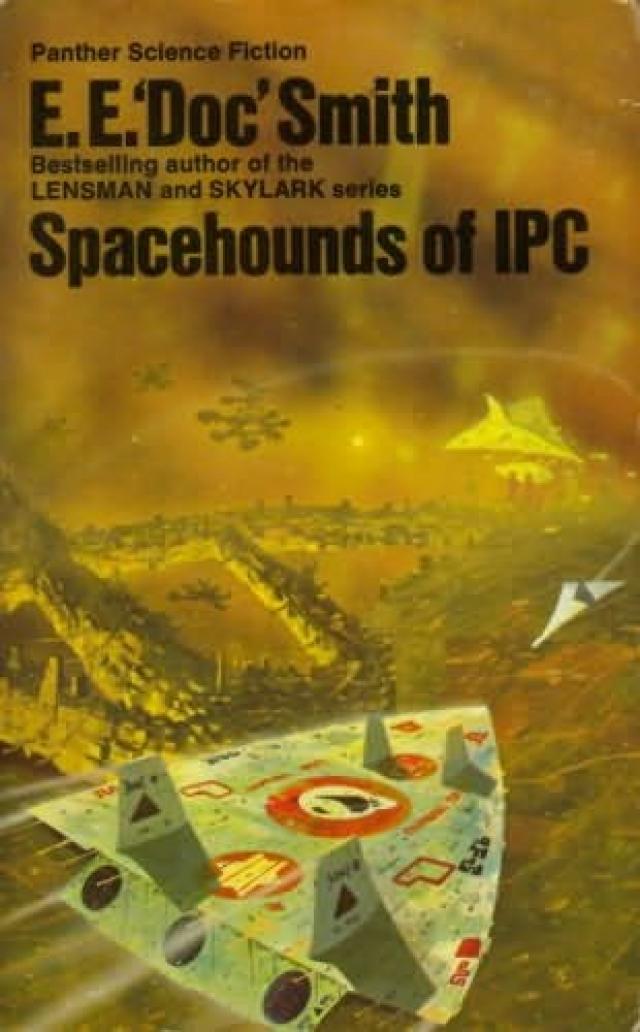


He made his way through the bitterly cold shop into the control-room of their lifeboat, and while he was divesting himself of his heavy suit, Nadia lifted the Forlorn Hope into the blue-green sky of Titan, accompanied by an escort of the mirrored globes. Well clear of the atmosphere of the satellite, the terrestrial cruiser shot forward at normal acceleration, while the Titanian vessels halted and wove a pattern of blue and golden rays in salute to the departing guests.
"Well, Nadia, we're off--on a long trek, too."
"Said Wun Long Hop, the Chinese pee-lo," Nadia agreed. "Sure everything's all x, big boy?"
"To nineteen decimals," he declared. "You couldn't squeeze another frank into our accumulators with a proof-bar, and since they're sending us all the power we want to draw, we won't need to touch our batteries or tap our own beam until we're almost to Jupiter. To cap the climax, what it takes to make big medicine on those spherical friends of ours, we've got. We're not sitting on top of the world, ace--we've perched exactly at the apex of the entire universe!"
"How long is it going to take?"
"Don't know. Haven't figured it yet, but it'll be beaucoup days," and the two wanderers from far-distant Earth settled down to the routine of a long and uneventful journey.
They gave Saturn and his spectacular rings a wide berth and sped on, with ever-increasing velocity. Past the outer satellites, on and on, the good ship Forlorn Hope flew into the black-and-brilliant depths of interplanetary space. Saturn was an ever-diminishing disk beneath them: above them was Jupiter's thin crescent, growing ever larger and more bright, and the Monarch of the Solar System, remaining almost stationary day after day, increasing steadily in apparent diameter and in brilliance.
* * * * *
Although the voyage from Titan to Ganymede was long, it was not monotonous, for there was much work to be done in the designing and fabrication of the various units which were to comprise the ultra-radio transmitting station. In the various compartments of the Forlorn Hope there were sundry small motors, blowers, coils, condensers, force-field generators, and other items which Stevens could use with little or no alteration; but for the most part he had to build everything himself. Thus it was that time passed quickly; so quickly that Jupiter loomed large and the Saturnian beam of power began to attenuate almost before the Terrestrials realized that their journey was drawing to an end.
"Our beam's falling apart fast," Stevens read his meters carefully, then swung his communicator beam toward Jupiter. "We aren't getting quite enough power to hold our acceleration at normal--think I'll cut now, while we're still drawing enough to let the Titanians know we're off their beam. We've got lots of power of our own now; and we're getting pretty close to enemy territory, so they may locate that heavy beam. Have you found Ganymede yet?"
"Yes, it will be on the other side of Jupiter by the time we get there. Shall I detour, or put on a little more negative and wait for it to come around to this side?"
"Better wait, I think. The farther away we stay from Jupiter and the major satellites, the better."
"All x--it's on. Suppose we'd better start standing watches, in case some of them show up?"
"No use," he dissented. "I've been afraid to put out our electro-magnetic detectors, as they could surely trace them in use. Without them, we couldn't spot an enemy ship even if we were looking right at it, except by accident; since they won't be lighted up and it's awfully hard to see anything out here, anyway. We probably won't know they're within a million kilometers until they put a beam on us. Barkovis says that this mirror will reflect any beam they can use, and I've already got a set of photo-cells in circuit to ring an alarm at the first flash off of our mirror plating. I'd like to get in the first licks myself, but I haven't been able to dope out any way of doing it. So you might as well sleep in your own room, as usual, and I'll camp here right under the panel until we get to Ganymede. There's a couple of little things I just thought of, though, that may help some; and I'm going to do 'em right now."
Putting on his space-suit, he picked up a power drill and went out into the bitter cold of the outer structure. There he attacked the inner wall of their vessel, and the carefully established inter-wall vacuum disappeared in a screaming hiss of air as the tempered point bit through plate after plate.
"What's the idea, Steve?" Nadia asked, when he had re-entered the control room. "Now you'll have all that pumping to do over again."
"Protection for the mirrors," he explained. "You see, they aren't perfect reflectors. There's a little absorption, so that some stuff comes through. Not much, of course; but enough to kill some of those Titanians and almost enough to ruin their ship got through in about ten minutes, and only one enemy was dealing it out. We can stand more than they could, of course, but the mirror itself won't stand much more heat than it was absorbing then. But with air in those spaces instead of vacuum, and with the whole mass of the Hope, except this one lifeboat, as cold as it is, I figure that there'll be enough conduction and convection through them to keep the outer wall and the mirror cold--cool enough, at least, to hold the mirror on for an hour. If only one ship tackles us, it won't be bad--but I figure that if there's only one, we're lucky."
* * * * *
Stevens' fears were only too well grounded, for during the "evening" of the following day, while he was carefully scanning the heavens for some sign of enemy craft, the alarm bell over his head burst into its brazen clamor. Instantly he shot out the detectors and ultra-lights and saw not one, but six of the deadly globes--almost upon them, at point-blank range! One was already playing a beam of force upon the Forlorn Hope, and the other five went into action immediately upon feeling the detector impulses and perceiving that the weapon of their sister ship had encountered an unusual resistance in the material of that peculiarly mirrored wedge. As those terrific forces struck her, the terrestrial cruiser became a vast pyrotechnic set piece, a dazzling fountain of coruscant brilliance: for the mirror held. The enemy beams shot back upon themselves and rebounded in all directions, in the same spectacular exhibition of frenzied incandescence which had marked the resistance of the Titanian sphere to a similar attack.
But Stevens was not idle. In the instant of launching his detectors, as fast as he could work the trips, four of the frightful nitrogen bombs of Titan--all that he could handle at once--shot out into space, their rocket-tubes flaring viciously. The enemy detectors of course located the flying torpedoes immediately, but, contemptuous of material projectiles, the spheres made no attempt to dodge, but merely lashed out upon them with their ravening rays. So close was the range that they had no time to avoid the radio-directed bombs after discovering that their beams were useless against the unknown protective covering of those mirrored shells. There were four practically simultaneous detonations--silent, but terrific explosions as the pent-up internal energy of solid pentavalent nitrogen was instantaneously released--and the four insensately murderous spheres disappeared into jagged fragments of wreckage, flying wildly away from the centers of explosion. One great mass of riven and twisted metal was blown directly upon the fifth globe, and Nadia stared in horrified fascination at the silent crash as the entire side of the ship crumpled inward like a shell of cardboard under the awful impact. That vessel was probably out of action, but Stevens was taking no chances. As soon as he had clamped a pale blue tractor rod upon the sixth and last of the enemy fleet, he drove a torpedo through the gaping wall and into the interior of the helpless war-vessel. There he exploded it, and the awful charge, detonated in that confined space, literally tore the globular space-ship to bits.
"We'll show these jaspers what kind of trees make shingles!" he gritted between clenched teeth; and his eyes, hard now as gray iron, fairly emitted sparks as he launched four torpedoes upon the sole remaining globe of the squadron of the void. "I've had a lot of curiosity to know just what kind of unnatural monstrosities can possibly have such fiendish dispositions as they've got--but beasts, men or devils, they'll find they've grabbed something this time they can't let go of," and fierce blasts of energy ripped from the exhausts as he drove his missiles, at their highest possible acceleration, toward the captive sphere so savagely struggling at the extremity of his tractor beam.
But that one remaining vessel was to prove no such easy victim as had its sister ships. Being six to one, and supposedly invincible, the squadron had been overconfident and had attacked carelessly, with only its crippling slicing beams instead of its more deadly weapons of total destruction; and so fierce and hard had been Stevens' counter-attack that five of its numbers had been destroyed before they realized what powerful armament was mounted by that apparently crude, helpless, and innocuous wedge. The sixth, however, was fully warned, and every resource at the command of its hellish crew was now being directed against the Forlorn Hope.
Sheets, cones, and gigantic rods of force flashed and crackled. Space was filled with silent, devastating tongues of flame. The Forlorn Hope was dragged about erratically as the sphere tried to dodge those hurtling torpedoes; tried to break away from the hawser of energy anchoring her so solidly to her opponent. But the linkage held, and closer and closer Stevens drove the fourfold menace of his frightful dirigible bombs. Pressor beams beat upon them in vain. Hard driven as those pushers were, they could find no footing, but were reflected at many angles by that untouchable mirror and their utmost force scarcely impeded the progress of the rocket-propelled missiles. Comparatively small as the projectiles were, however, they soon felt the effects of the prodigious beams of heat enveloping them, and torpedo after torpedo exploded harmlessly in space as their mirrors warmed up and volatilized. But for each bomb that was lost, Stevens launched another, and each one came closer to its objective than had its predecessor.
Made desperate by the failure of his every beam, the enemy commander thought to use material projectiles himself--weapons abandoned long since by his race as antiquated and inefficient, but a few of which were still carried by the older types of vessels. One such shell was found and launched--but in the instant of its launching Stevens' foremost bomb struck its mark and exploded. So close were the other three bombs, that they also let go at the shock; and the warlike sphere, hemmed in by four centers of explosions, flew apart--literally pulverized. Its projectile, so barely discharged, did not explode--it was loaded with material which could be detonated only by the warhead upon impact or by a radio signal. It was, however, deflected markedly from its course by the force of the blast, so that instead of striking the Forlorn Hope in direct central impact, its head merely touched the apex of the mirror-plated wedge. That touch was enough. There was another appalling concussion, another blinding glare, and the entire front quarter of the terrestrial vessel had gone to join the shattered globes.
Between the point of explosion and the lifeboats there had been many channels of insulation, many bulkheads, many air-breaks, and compartment after compartment of accumulator cells. These had borne the brunt of the explosion, so that the control room was unharmed, and Stevens swung his communicator rapidly through the damaged portions of the vessels.
"How badly are we hurt, Steve--can we make it to Ganymede?"
Nadia was quietly staring over his shoulder into the plate, studying with him the pictures of destruction there portrayed as he flashed the projector from compartment to compartment.
"We're hurt--no fooling--but it might have been a lot worse," he replied, as he completed the survey. "We've lost about all of our accumulators, but we can land on our own beam, and landing power is all we want, I think. You see, we're drifting straight for where Ganymede will be, and we'd better cut out every bit of power we're using, even the heaters, until we get there. This lifeboat will hold heat for quite a while, and I'd rather get pretty cold than meet any more of that gang. I figured eight hours just before they met us, and we were just about drifting then. I think it is safe to say seven hours blind."
"But can't they detect us anyway? They may have sent out a call, you know."
"If we aren't using any power for anything, their electr-omagnetics are the only things we'll register on, and they're mighty short-range finders. Even if they should get that close to us, they'll probably think we're meteoric, since we'll be dead to their other instruments. Luckily we've got lots of air, so the chemical purifiers can handle it without power. I'll shut off everything and we'll drift it. Couldn't do much of anything, anyway--even our shop out there won't hold air. But we can have light. We've got acetylene emergency lamps, you know, and we don't need to economize on oxygen."
"Perhaps we'd better run in the dark. Remember what you told me about their possible visirays, and that you've got only two bombs left."
"All x; that would be better. If I forget it, remind me to blow up those before we hit the atmosphere of Ganymede, will you?" He opened all the power switches, and, every source of ethereal vibrations cut off, the Forlorn Hope drifted slowly on, now appearing forlorn indeed.
* * * * *
Seven hours dragged past: seven age-long hours during which the two sat tense, expecting they knew not what, talking only at intervals and in subdued tones. Stevens then snapped on the communicator beam just long enough to take an observation upon Ganymede. Several such brief glimpses were taken; then, after a warning word to his companion, he sent out and exploded the nitrogen bombs. He then threw on the power, and the vessel leaped toward the satellite under full acceleration. Close to the atmosphere it slanted downward in a screaming, fifteen-hundred-mile drive; and soon the mangled wedge dropped down into the little canyon, which for so long had been "home."
"Well, colonel, home again!" Stevens exulted as he neutralized the controls. "There's that falls, our power plant, the catapults, 'n' everything. Now, unless something interrupts us again; we'll run up our radio tower and give Brandon the long yell."
"How much more have you got to do before you can start sending?"
"Not an awful lot. Everything built--all I've got to do is assemble it. I should be able to do it easily in a week. Hope nothing else happens--if I drag you into any more such messes as those we've just been getting out of by the skin of our teeth, I'll begin to wish that we had started out at first to drift it back to Tellus in the Hope. Let's see how much time we've got. We should start shooting one day after an eclipse, so that we'll have five days to send. You see, we don't want to point our beam too close to Jupiter or to any of the large satellites, because the enemy might live there and might intercept it. We had an eclipse yesterday--so one week from today, at sunrise, I start shooting."
"But Earth's an evening star now; you can't see it in the morning."
"I'm not going to aim at Tellus. I'm shooting at Brandon, and he's never there for more than a week or two at a stretch. They're prowling around out in space somewhere almost all the time."
"Then how can you possibly hope to hit them?"
"It may be quite a job of hunting, but not as bad as you might think. They probably aren't much, if any, outside the orbit of Mars, and they usually stay within a couple of million kilometers or so of the Ecliptic, so we'll start at the sun and shoot our beam in a spiral to cover that field. We ought to be able to hit them inside of twelve hours, but if we don't, we'll widen our spiral and keep on trying until we do hit them."
"Heavens, Steve! Are you planning on telegraphing steadily for days at a time?"
"Sure, but not by hand, of course--I'll have an automatic sender and automatic pointers."
Stevens had at his command a very complete machine-shop, he had an ample supply of power, and all that remained for him to do was to assemble the parts which he had built during the long journey from Titan to Ganymede. Therefore, at sunrise of the designated day, he was ready, and, with Nadia hanging breathless over his shoulder, he closed the switch, a toothed wheel engaged a delicate interrupter, and a light sounder began its strident chatter.
"Ganymede point oh four seven ganymede point oh four seven ganymede point oh four seven..." endlessly the message was poured out into the ether, carried by a tight beam of ultra-vibrations and driven by forces sufficient to propel it well beyond the opposite limits of the orbit of Mars.
"What does it say? I can't read code."
Stevens translated the brief message, but Nadia remained unimpressed.
"But it doesn't say anything!" she protested. "It isn't addressed to anybody, it isn't signed--it doesn't tell anybody anything about anything."
"It's all there, ace. You see, since the beam is moving sidewise very rapidly at that range and we're shooting at a small target, the message has to be very short or they won't get it all while the beam's on 'em--it isn't as though we were broadcasting. It doesn't need any address, because nobody but the Sirius can receive it--except possibly the Jovians. They'll know who's sending it without any signature. It tells them that Ganymede wants to receive a message on the ultra-band centering on forty-seven thousandths. Isn't that enough?"
"Maybe. But suppose some of them live right here on Ganymede--you'll be shooting right through the ground all night--or suppose that even if they don't live here, that they can find our beam some way? Or suppose that Brandon hasn't got his machine built yet, or suppose that it isn't turned on when our beam passes them, or suppose they're asleep then? A lot of things might happen."
"Not so many, ace--your first objection is the only one that hasn't got more holes in it than a sieve, so I'll take it first. Since our beam is only a meter in diameter here and doesn't spread much in the first few million kilometers, the chance of direct reception by the enemy, even if they do live here on Ganymede, is infinitesimally small. But I don't believe that they live here--at least, they certainly didn't land on this satellite. As you suggest, however, it is conceivable that they may have detector screens delicate enough to locate our beam at a distance; but since in all probability that means a distance of hundreds of thousands of kilometers, I think it highly improbable. We've got to take the same risk anyway, no matter what we do, whenever we start to use any kind of driving power, so there's no use worrying about it. As for your last two objections, I know Brandon and I know Westfall. Brandon will have receivers built that will take in any wave possible of propagation, and Westfall, the cautious old egg, will have them running twenty-four hours a day, with automatic recorders, finders, and everything else that Brandon can invent--and believe me, sweetheart, that's a lot of stuff!"


