

Spacehounds of ipc, p.9
Spacehounds of IPC, page 9
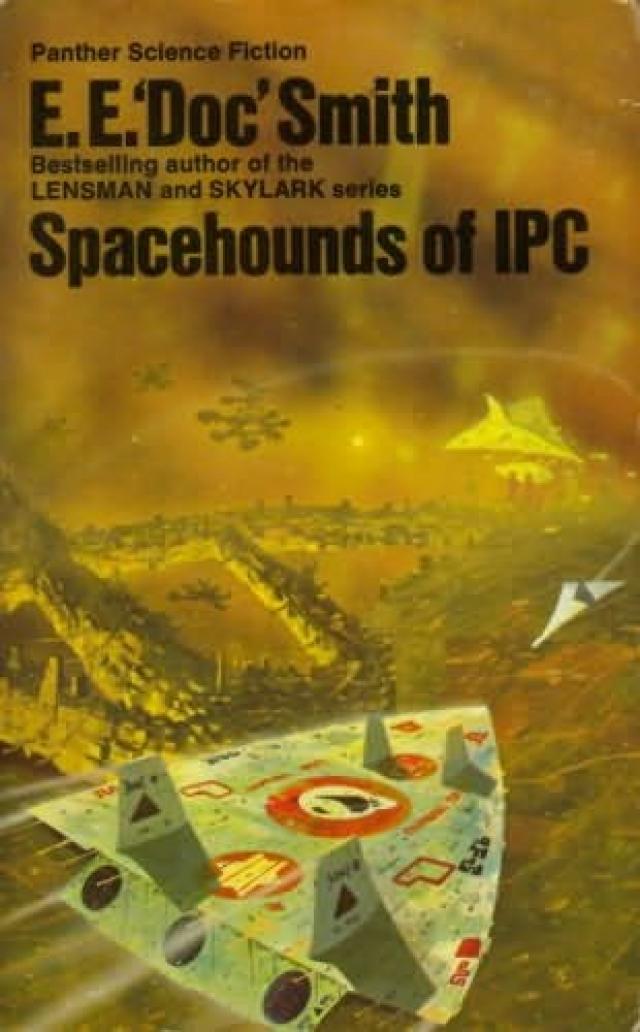


Day after day passed. Their larder was full, the receptor was finished, and the beam transmitter was almost ready to attach to the turbo-alternator before the calm was broken.
"Steve!" Nadia shrieked. Glancing idly into the communicator plate, she had been perfunctorily surveying the surrounding territory. "They're coming! Thousands of them! They're all over the bench up there, and just simply pouring down the hills and up the valley!"
"Wish they'd waited a few hours longer--we'd have been gone. However, we're just about ready for them," he commented grimly, as he stared over her shoulder into the communicator plate. "We'll make a lot of those Indians wish that they had stayed at home with their papooses."
"Have you got all those rays and things fixed up?"
"Not as many as I'd like to have. You see, I don't know the composition of the I-P ray, since it is outlawed to everybody except the police. Of course I could have found out from Brandon, but never paid any attention to it. I've got some nice ultra-violet, though, and a short-wave oscillatory that'll cook an elephant to a cinder in about eight seconds. We'll keep them amused, no fooling! Glad we had time to cover our open sides, and it looks as though that meteorite armor we put over the projectors may be mighty useful, too."
On and on the savages came, massed in formations showing some signs of rude discipline. This time there was neither shrieking nor yelling; the weird creatures advanced silently and methodically. Here and there were massed groups of hundreds, dragging behind them engines which Stevens studied with interest.
"Hm ... m ... m. Catapults," he mused. "You were right, girl of my dreams--armor and bows and arrows wouldn't help us much right now. They're going to throw rocks at us that'll have both mass and momentum. With those things they can cave in our side-armor, and might even dent our roof. When one of those projectiles hits, we want to know where it ain't, that's all."
Stevens cast off the heavily-insulated plug connecting the power plant leads to his now almost fully charged accumulators, strapped himself and Nadia into place at the controls, and waited, staring into the plate. Catapult after catapult was dragged to the lip of the little canyon, until six of them bore upon the target. The huge stranded springs of hair, fiber, and sinew were wound up to the limit, and enormous masses of rock were toilsomely rolled upon the platforms. Each "gunner" seized his trip, and as the leader shrieked his signal the six ponderous masses of metalliferous rock heaved into the air as one. But they did not strike their objective, for as the signal was given, Stevens shot power into his projectors. The "Forlorn Hope" leaped out of the canyon and high into the air over the open meadow, just as the six great projectiles crashed into the ground upon the spot which, an instant before, she had occupied.
* * * * *
Rudimentary discipline forgotten, the horde rushed down into the canyon and the valley, in full clamor of their barbaric urgings. Horns and arms tossed fiercely, savage noises rent the air, and arrows splintered harmlessly upon steel plate an the mystified and maddened warriors upon the plain below gave vent to their outraged feelings.
"Look, Nadia! A whole gang of them are smelling around that power plug. Pretty soon somebody's going to touch a hot spot, and when he does, we'll cut loose on the rest of them."
The huge insulating plug, housing the ends of the three great cables leading to the converters of the turbo-alternator, lay innocently upon the ground, its three yawning holes invitingly open to savage arms. The chief, who had been inspecting the power-plant, walked along the triplex lead and joined his followers at its terminus. Pointing with his horns, he jabbered orders and three red monsters, one at each cable, bent to lift the plug, while the leader himself thrust an arm into each of the three contact holes. There was a flash of searing flame and the reeking smoke of burning flesh--those three arms had taken the terrific no-load voltage of the three-phase converter system, and the full power of the alternator had been shorted directly to ground through the comparatively small resistance of his body.
Stevens had poised the "Forlorn Hope" edgewise in mid-air, so that the gleaming, heavily armored parabolic reflectors of his projectors, mounted upon the leading edge of the fortress, covered the scene below. As the charred corpse of the savage chieftain dropped to the ground, it seemed to the six-limbed creatures that the demons of the falls had indeed been annoyed beyond endurance by their intrusion; for, as if in response to the flash of fire from the power plug, that structure so peculiarly and so stolidly hanging in the air came plunging down toward them. From it there reached down twin fans of death and destruction: one flaming and almost invisibly incandescent violet which tore at the eyes and excruciatingly disintegrated brain and nervous tissues; the other dully glowing an equally invisible red, at the touch of which body temperature soared to lethal heights and foliage burst cracklingly into spontaneous flame.
In their massed hundreds, the savages dropped where they stood, life rived away by the torturing ultra-violet, burned away by the blast of pure heat, or consumed by the conflagrations that raged instantly wherever that wide-sweeping fan encountered combustible material. In the face of power supernatural they lost all thought of attack or of conquest, and sought only and madly to escape. Weapons were thrown away, the catapults were abandoned, and, every man for himself, the mob fled in wildest disorder, each striving to put as much distance as possible between himself and that place of dread mystery, the waterfall.
"Well, I guess that'll hold 'em for a while," Stevens dropped their craft back into its original quarters in the canyon. "Whether they ever believed before that this falls was inhabited by devils or not, they think so now. I'll bet that it will be six hundred Jovian years before any of them ever come within a hundred kilometers of it again. I'm glad of it, too, because they'll let our power plant alone now. Well, let's get going--we've got to make things hum for a while!"
"Why all the rush? You just said that we have scared them away for good."
"The savages, yes, but not those others. We've just turned loose enough radiation to affect detectors all over the system, and it's up to us to get this beam projector set up, get away from here, and get our power shut off before they can trace us. Snap it up, ace!"
The transmitter unit was installed at the converters, the cable was torn out, and, having broken the last material link between it and Ganymede, Stevens hurled the "Forlorn Hope" out into space, using the highest acceleration Nadia could endure. Hour after hour the massive wedge of steel bored outward, away from Jupiter; hour after hour Stevens' anxious eyes scanned his instruments; hour after hour hope mounted and relief took the place of anxiety as the screens remained blank throughout every inquiring thrust into the empty ether. But they knew they would have to keep sharp vigilance.
* * * * *
* * *
Continuing a Thrilling New Serial of Interplanetary Life and Travel by Edward E. Smith, Ph.D.
Author of "Skylark of Space," and "Skylark Three"
* * *
PART II
* * *
Spacehounds of IPC
One of the most fascinating mysteries of the heavens is the comet. It goes through space, gets near enough to the earth to be seen, and then goes off and disappears in celestial distance. Often it has a hyperbolic orbit, which would make it impossible to come back. Yet it may return--apparently contradicting the geometry of conic sections. This only goes to prove once more that it is risky to say anything is impossible--even that our hero of this story manages beautifully, with the aid of Cantrell's Comet, to avoid complete annihilation while stranded in interstellar space.
Read "what went before" and then continue the second instalment.
What Went Before:
The Interplanetary Vessel Arcturus sets out for Mars, with Breckenridge as chief pilot, carrying on board, besides its regular crew and some passengers, the famous Dr. Stevens, designer of space ships and computer. He checks computations made by astronomers stationed in floating observatories, and after he has located any trouble and suggests a plan for minimizing the hazards of the trip from the earth to Mars, he reports his findings and suggestions to Mr. Newton, chief of the Interplanetary Corporation.
Stevens then takes Nadia, Mr. Newton's beautiful young daughter, on a specially conducted sight-seeing tour of the Arcturus and thoroughly explains to her all of the works of the vessel. Nadia has herself had a good science education. While they are down at the bottom of the ship--nearing the end of their tour--Stevens feels a barely perceptible movement of the vessel from its course. When he turns on the visiplate, he is horrified to find that a mysterious ray of unparalleled power has neatly sliced the Arcturus in several places.
Nadia and Stevens are completely separated from the rest of the crew and passengers of the ship, so they get into a lifeboat, which is equipped for a limited amount of space travel. Despite the strict and apparently effective vigilance of the enemy destroyer, Stevens and Nadia make their getaway in the lifeboat, which they aptly call "Forlorn Hope," and finally make a safe landing on Ganymede, where Stevens plans to build a power-plant and a radio transmitter, to enable him to communicate with the earth or with the IPV Sirius, which is used by Westfall and Brandon (two of the world's best scientists) as a floating laboratory.
With the very scant apparatus and material available, Stevens sets to work on his power plant. Just as they have it completed and ready to start for Cantrell's Comet, where Stevens believes he can obtain the necessary metal for his giant transmitting tube, they experience a close call with carnivorous plants on the satellite and later with savage inhabitants, which precipitates their trip to the comet.
CHAPTER V
Cantrell's Comet
Far out in space, Jupiter, a tiny moon and its satellites mere pin-points of light, Stevens turned to his companion with a grin.
"Well, Nadia, old golf-shootist, here's where we turn spacehounds again. Hope you like it better this time, because I'm afraid that we'll have to stay weightless for quite a while." He slowly throttled down the mighty flow of power, and watched the conflicting emotions play over Nadia's face in her purely personal battle against the sickening sensations caused by the decrease in their acceleration.
"I'm sorry as the dickens, sweetheart," he went on, tenderly, and the grin disappeared. "Wish I could take it for you, but...."
"But there are times when we've got to fight our own battles and bury our own dead," she interrupted, gamely. "Cut off the rest of that power! I'm not going to be sick--I won't be a--what do you spacehounds call us poor earth-bound dubs who can't stand weightlessness--weight-fiends, isn't it?"
"Yes; but you aren't...."
"I know I'm not, and I'm not going to be one, either! I'm all x, Steve--it's not so bad now, really. I held myself together that time, anyway, and I feel lots better now. Have you found Cantrell's Comet yet? And why so sure all of a sudden that they can't find us? That power beam still connects us to Ganymede, doesn't it? Maybe they can trace it."
"At-a-girl, ace!" he cheered. "I'll tell the world you're no weight-fiend--you're a spacehound right. Most first-trippers, at this stage of the game, wouldn't be caring a whoop whether school kept or not, and here you're taking an interest in all kinds of things already. You'll do, girl of my heart--no fooling!"
"Maybe, and maybe you're trying to kid somebody," she returned, eyeing him intently. "Or maybe you just don't want to answer those questions I asked you a minute ago."
[Illustration: At the bottom of a shaft a section of the rocky wall swung aside, revealing the yawning black mouth of a horizontal tunnel. At intervals upon its roof there winked into being almost invisible points of light. Along that line of lights the life-boats felt their way, coming finally into a huge cavern....]
"No, that's straight data, right on zero across the panel," he assured her. "And as for your questions, they're easy. No, I haven't looked for the comet yet, because we'll have to drift for a couple of days before we'll be anywhere near where I think it is. No, they can't trace us, because there is now nothing to trace, unless they can detect the slight power we are using in our lights and so on--which possibility is vanishingly small. Potentially, our beam still exists, but since we are drawing no power, it has no actual present existence. See?"
"Uh-uh," she dissented. "I can't say that I can quite understand how a beam can exist potentially and yet not be there actually enough to trace. Why, a thing has to be actual or not exist at all--you can't possibly have something that is nothing. It doesn't make sense. But lay off those integrations of yours, please," as now armed with a slate-pencil, Stevens began to draw a diagram upon a four-foot sheet of smooth slate. "You know that your brand of math is over my head like a circus tent, so we'll let it lie. I'll take your word for it. Steve--if you're satisfied, it's all x with me."
"I think I can straighten you out a little, by analogy. Here's a rough sketch of a cylinder, with shade and shadow. You've had descriptive geometry, of course, and so know that a shadow, being simply a projection of a material object upon a plane, is a two-dimensional thing--or rather, a two-dimensional concept. Now take the shade, which is, of course, this entire figure here, between the cylinder casting the shadow and the plane of projection. You simply imagine that there is a point source of light at your point of projection: it isn't really there. The shade, then, of which I am drawing a picture, has only a potential existence. You know exactly where it is, you can draw it, you can define it, compute it, and work with it--but still it doesn't exist; there is absolutely nothing to differentiate it from any other volume of air, and it cannot be detected by any physical or mechanical means. If, however, you place a light at the point of projection, the shade becomes actual and can be detected optically. By a sufficient stretch of the imagination, you might compare our beam to that shade. When we turn our power on, the beam is actual; it is a stream of tangible force, and as such can be detected electrically. When our switches here are open, however, it exists only potentially. There is no motion in the ether, nothing whatever to indicate that a beam had ever actually existed there. With me?"
"Floundering pretty badly, but I see it after a fashion. You physicists are peculiar freaks--where we ordinary mortals see actual, solid, heavy objects, you see only empty space with a few electrons and things floating around in it; and yet where we see only empty space, you can see things 'potentially' that may never exist at all. You'll be the death of me yet, Steve! But I'm wasting a lot of time. What do we do now?"
"We get busy on the big tube. You might warm up the annealing oven and melt me that pot of glass, while I get busy on the filament supports, plate brackets, and so on." Both fell to work with a will, and hours passed rapidly and almost silently, so intent was each upon his own tasks.
"All x, Steve." Nadia broke the long silence. "The pyrometer's on the red, and the oven's hot," and the man left his bench. Taking up a long paddle and an even longer blowpipe, he skimmed the melt to a dazzlingly bright surface and deftly formed a bubble.
"I just love to talk at you when you've got your mouth full of a blowpipe." Nadia eyed him impishly and tucked her feet beneath her, poised weightless as she was. "I've got you foul now--I can say anything I want to, and you can't talk back, because your bubble will lose its shape if you do. Oh, isn't that a beauty! I never saw you blow anything that big before," and she fell silent, watching intently.
Slowly there was being drawn from the pot a huge, tapering bulb of hot, glistening glass, its cross-section at the molten surface varying as Stevens changed the rate of draw or the volume of air blown through the pipe. Soon that section narrowed sharply. The glass-blower waved his hand and Nadia severed the form neatly with a glowing wire, just above the fluid surface of the glass remaining in the pot. Pendant from the blowpipe, the bulb was placed over the hot-bench, where Stevens, now begoggled, begloved, and armed with a welding torch, proceeded to fuse into the still, almost plastic, glass sundry necks, side-tubes, supports and other attachments of peculiar pattern. Finally the partially assembled tube was placed in the annealing oven, where it would remain at a high and constant temperature until its filaments, grids, and plates had been installed. Eventually, in that same oven, it would be allowed to cool slowly and uniformly over a period of days.
* * * * *
Thus were performed many other tasks which are ordinarily done either by automatic machinery or by highly skilled specialists in labor--for these two, thrown upon their own resources, had long since learned how much specialization may be represented by the most commonplace article. Whenever they needed a thing they did not have--which happened every day--they had either to make it or else, failing in that, to go back and build something that would enable them to manufacture the required item. Such setbacks had become so numerous as to be expected as part of the day's work; they no longer caused exasperation or annoyance. For two days the two jacks-of-all-trades worked at many lines and with many materials before Stevens called a halt.
"All x, Nadia. It's time for us to stop tinkering and turn into astronomers. We've been out for fifty I-P hours, and we'd better begin looking around for our heap of scrap metal," and, the girl at the communicator plate and Stevens at their one small telescope, they began to search the black, star-jeweled heavens for Cantrell's Comet.
"According to my figures, it ought to be about four hours right ascension, and something like plus twenty degrees declination. My figures aren't accurate, though, since I'm working purely from memory, so we'd better cover everything from Aldebaran to the Pleiades."
"But the directions will change as we go along, won't they?"
"Not unless we pass it, because we're heading pretty nearly straight at it, I think."
"I don't see anything interesting thereabouts except stars. Will it have much tail?"
"Very little--it's close to aphelion, you know, and a comet doesn't have much of a tail so far away from the sun. Hope it's got some of its tail left, though, or we may miss it entirely."


