Master of restless shado.., p.1
Master of Restless Shadows, page 1
part #1 of Master of Restless Shadows Series


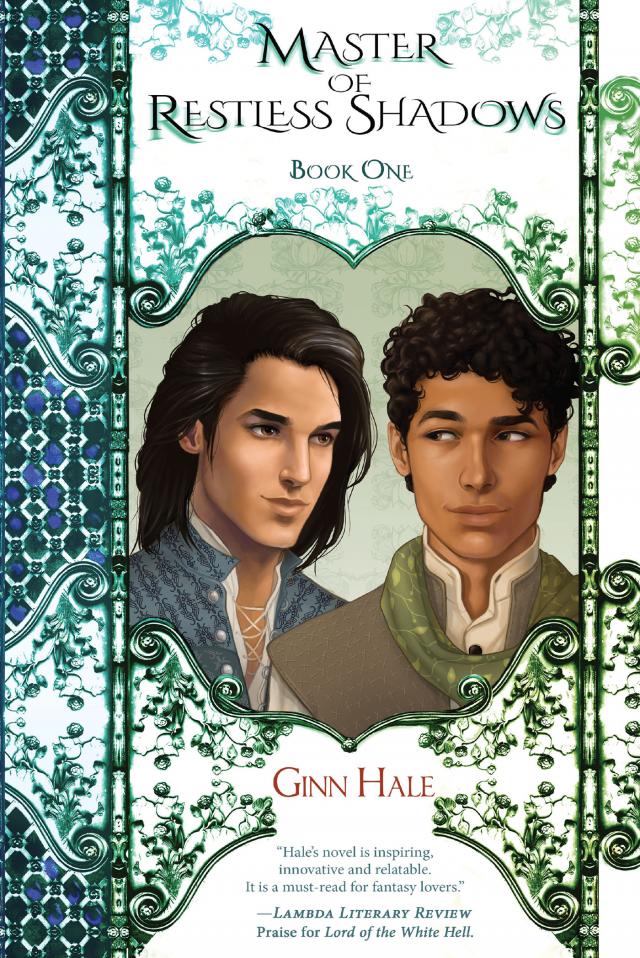
Master of Restless Shadows
by Ginn Hale
Copyright © 2019 by Ginn Hale
Published by: Blind Eye Books 1141 Grant Street Bellingham, WA. 98225
All rights reserved. No part of this book may be used or reproduced in any manner without written permission of the publisher, except for the purpose of reviews.
Edited by Nicole Kimberling
Copyedit by Megan Gendell
Proofreading by Alan Williams
Ebook design by Michael J. DeLuca
Cover Illustration by Zaya Feli
Cieloalta city map by Rhys Davies
Cover Design by Dawn Kimberling
Interior design and typesetting by Dawn Kimberling
This book is a work of fiction and as such all characters and situations are fictional. Any resemblances to actual people or events are coincidental.
First Edition October 2019
ISBN: 978-1-935560-63-0
Library of Congress Control Number: 2019944115
To Nicole who was always on Atreau’s side. To A. for loving spiders and to J. for your boundless energy and fearless leaps.
Also huge thanks to Gwen and Zaya for everything!
Chapter One
As Narsi rode through the towering city gates of Cieloalta, a sense of great accomplishment swept over him. Twenty days of road dust caked his body, hair and clothes. His dappled mare’s coat looked gray as clay. He wasn’t certain which of the two of them smelled worse or felt more relieved to see the renowned beauty of the city’s public fountains. After years of study, planning and longing, he’d at last reached the capital.
Merchants in painted carriages rolled past, while herdsmen drove swine, cattle and sheep around the statuary, likely en route to the famous market grounds. Narsi dismounted, rinsed his face and allowed his tired mare to drink. From a column at the center of the fountain rose a stone sculpture of three stallions and a single soaring eagle. The horses Narsi recognized: Faith, Honor and Strength. But he couldn’t recall from which sermon the eagle originated. “Heights of Bravery,” from the Book of Trueno? Or was it “The Rise of Courage,” from the Epistles of Bishop Seferino?
It hardly mattered, for the sheer beauty of the carvings, coupled with the relief of fresh water, awed him. His sense of wonder only grew as he turned around, taking in the towering, angular Cadeleonian architecture that lined the wide, straight thoroughfare. Even in this modest quarter, building after building boasted blue-washed walls, bright yellow roof tiles and downspouts in the shapes of horses. Far across the river, royal emblems and colors blazed still more brilliantly from the royal palace. There immense lapis-lazuli-inlayed walls supported gilded spires where dozens of indigo flags bearing the stark white form of the Sagrada stallion fluttered. Overhead, flocks of white messenger doves moved like clouds across the bright summer sky.
“It’s just as Lord Vediya describes it in his memoirs,” Narsi told his horse. “A royal city made so bright and proud that it would challenge the heavens if only they would listen.”
Narsi grinned and stroked his mare’s jaw. She ignored him and kept drinking.
He felt as if he’d stepped into one of the thrilling epics that he so loved to read. He wondered suddenly if he might be able to find the plaza where the notorious swordsman Elezar Grunito had fought duel after bloody duel before going on to battle monsters in the savage northlands. Or better still, could he hunt through the narrow lanes surrounding the opera houses to find the green door of the kaweh tavern where Lord Vediya had penned so many of his daring, brilliant memoirs?
Or should he head closer to the river where a veritable palace full of exotic and medicinal herbs were maintained by royal decree? The doors opened to anyone bearing the silver signet of a trained physician, and he wore his newly cast ring proudly on his right hand.
Cieloalta was the city where the best and brightest people flocked to find the patronage of princes, dukes, even the king, and where a young man like himself stood a chance of meeting them all.
“Make way, you brown bastard,” a sunburned pig herder shouted, and Narsi reflexively stepped aside as the red-faced man and his squealing charges shoved their way past. Narsi’s mare snorted and stamped when a sow snuffled too near her legs. The herder paused to eye Narsi with the disgusted expression of a man confronted by a two-headed lamb.
Tall even for a Cadeleonian, Narsi’s big hands and broad shoulders made the rest of his slim figure appear all the more gangly and adolescent. And he supposed the streaks of gray road dust and crusts of mud had lent a particularly ashy pallor to his dark skin. Likely, neither the dirt nor sleeping in a bedroll on the roadside for weeks had imbued his curly black hair with any semblance of civility either. All and all, he probably looked like he’d stolen his horse, bags and gray coat from a real physician whom he’d throttled in the woods. But Narsi doubted that this scruffy pig herder was taking exception to his unkempt appearance.
His recent travels had familiarized Narsi with this particular reaction. Still, it was discomforting to be gawked at as if he were freakish beyond imagining. Even rural Cadeleonians living this far north had to have encountered Haldiim—or at least bands of nomadic Irabiim—and they saw one another day in, day out. So Narsi didn’t understand why they so often appeared taken aback when laying eyes upon his mixed features. Did they really think it utterly impossible for a Cadeleonian and a Haldiim to fall in love and produce a child? Or was such a union so blasphemous that they could not help but stare at the progeny?
Narsi frowned at the dozens and dozens of Cadeleonians all around him on the street, taking in the uniformity of their stout bodies, pale faces and straight, dark hair. It had been at least a week since he’d sighted anyone as dark-complected or lanky as himself, much less as blond or light-eyed as his mother had been. He didn’t want to admit it, but that absence gnawed at his initial excitement and inspired a sudden feeling of unease.
But he couldn’t let the sheer number of Cadeleonians surrounding him intimidate him. The swineherd shot him an even more suspicious glance before hurrying his pigs up the road to the butchers’ square.
“Better to be a traveler he disdains than the piglet he smiles upon and leads to slaughter,” Narsi murmured to himself.
He wondered if the thought was worth jotting down in his shabby little diary.
Likely not.
He’d just swung back up into his saddle and started down the crowded road when he spied a mounted man clad in the black and violet robes of a Cadeleonian priest riding toward him.
“Berto?” For just a moment Narsi hadn’t recognized his childhood friend. He looked so distinctly Cadeleonian now, with his formal robes, short-cropped hair and dapper cap. He’d filled out handsomely.
“Narsi, Lord bless me! You’ve grown even taller!” Berto’s broad grin transformed his stern face back into the beaming countenance of the twelve-year-old classmate that Narsi remembered from when they’d both lived in the chapel of the Grunito household.
“You haven’t been waiting here for me, have you?” Narsi asked. He’d had no way to send ahead and inform Father Timoteo of when exactly to expect him, and yet it seemed an unlikely piece of luck that Berto should happen by just as he passed through the south gate.
“Father Timoteo asked the duke’s couriers to watch for you on the King’s Road. We’ve been kept abreast of your progress every other day or so.”
“And here I’d presumed myself traveling alone and unknown across a vast, strange land,” Narsi commented and Berto laughed. How like Father Timoteo to find a way to watch over him even across the miles of mountains and wilderness.
“Has the Holy Father kept well?” Narsi asked.
Berto’s expression sobered.
“His spirit is stronger than ever, but his body . . .” Sorrow showed so plainly upon Berto’s face that it alarmed Narsi.
“Has he kept anything down?” Narsi gripped his mare’s reins. There was no time to tarry if Father Timoteo had succumbed to grippe again. “I’ve brought powdered cloudroot but we may need to brew bluedust—”
“No, no. He’s not collapsed again. He’s only been restless lately. Not eating or sleeping as he ought to. Nothing new.” Berto’s long-suffering expression eased a little. “But he’ll be better once you’re with him. You always know how to convince him to show himself a little kindness.”
“That’s less my doing than my mother’s recipe for velvet soup. I can always tempt him to eat a little more than he thinks he needs.” Narsi tried not to let his pleasure in being capable of moving Father Timoteo show. All too often people jumped to the wrong conclusion when they noticed Narsi’s resemblance to the priest. The last thing Narsi wanted was to burden Father Timoteo with another bout of cruel rumors of some illicit affair with Narsi’s mother.
“So how have you been?” Narsi asked Berto. He noted that his friend’s robe still bore the silver insignia of a scholar rather than the violet of a priest. He’d not yet taken the final holy vows of obedience and celibacy. “Is life as a scripture scholar in Cieloalta all you hoped?”
Berto laughed but his expression struck Narsi as bitter.
“I’ll tell you all while we ride.” Berto cast a wary glance back at one of the uniformed city guards, who slowly strolled from the shadow of the city gates toward them. The guard wore a captain’s epaulettes. His hand rested o n his sword hilt.
“Of late, the city guards have not been overly fond of men in priestly colors,” Berto murmured. “If relations between Prince Sevanyo and the royal bishop worsen we may well witness open brawling in the streets. The bodies of two decapitated priests were found here at the south gate only a week past and a novice nun went missing only two days ago.”
Narsi glanced again to the city guard and realized that the man’s glower was aimed at Berto. Narsi and Berto quickly reined their horses forward.
Berto led the way down a narrow lane that was refreshingly free of livestock. As they wove between carriages and oxcarts, Narsi inquired about the deteriorating relations between Prince Sevanyo and his brother, the royal bishop, but Berto refused to be drawn out on the subject. Instead, he entertained Narsi with descriptions of the odd and amusing occurrences in his life since he’d followed Father Timoteo to the Duke of Rauma’s palatial residence.
“I’ve actually met the duke several times now, though the first encounter embarrassed me to the core. I somehow mistook him for one of those good-looking grooms that are so fashionable just now,” Berto said, grimacing. “I handed him my horse’s reins. And then he humored me by actually accepting them! It wasn’t until I decided to tip him for seeming so attentive to my mare that he explained that he didn’t need my pennies, as he owned all of Rauma.”
“I have heard that Lord Quemanor is quite strange in his own way,” Narsi commented.
“In many ways,” Berto responded. “But he and his wife have been very welcoming to Father Timoteo and myself.” Berto told him how he’d ingratiated himself with the duke’s elegant wife after driving off a mangy black cat that had been stalking Lady Quemanor’s parrot. Then he went on to describe his single sighting of Count Radulf’s towering, flame-haired sister, who had sailed from the wilds of northern Labara apparently just to horrify the Cadeleonian court with her casual references to her brother’s taste in men and her own prowess as a witch.
Even in the Haldiim District of the city of Anacleto, people rarely spoke so blatantly of attractions or practices that transgressed Cadeleonian holy law—certainly never to Cadeleonians.
“Did the royal bishop have her arrested?” Having just read Lord Vediya’s scandalous memoir recounting his time in Count Radulf’s court, Narsi felt an attachment to the count’s young sister. Lord Vediya had brought her to life as proud, vulnerable and so relentlessly loyal to her brother that Narsi couldn’t help but think protectively of her.
“He’s decried her as a heretic and has dispatched the infamous Captain Yago to throttle her,” Berto replied casually, and Narsi supposed it showed how common noble machinations were here in the royal city that the plotted murder of a nineteen-year-old girl didn’t alarm his friend. “But Prince Sevanyo’s fourth son, Jacinto, is rumored to have been enchanted—perhaps literally—by the girl and is suspected of sheltering her from his uncle’s thugs.”
“Even a person so lofty as the royal bishop can’t really be so rash as to order the murder of a foreign dignitary, can he?”
“Who truly knows?” Berto shrugged. “Courtiers’ gossip is half exaggeration and half lies. Most of mine is secondhand on top of that.”
As they rode down the narrow street a woman with her hair tucked into a matronly snood dumped a pitcher of murky water from a second-story window, while across the way a little girl gleefully tossed down marigold flowers. Narsi caught one and felt several others fall into the dark curls of his hair. The girl gave a startled squeal and then disappeared back into her house.
“Already charming the ladies,” Berto commented dryly.
“It’s a wonder I’m still single,” Narsi replied. “You know, I had expected that you and Father Timoteo would have been received into the royal bishop’s retinue by now.”
“Oh, we were invited last fall. Bishop’s robes had already been cut, fitted and embroidered for Father Timoteo.” Berto scowled out to the shining gold of a distant towering steeple. “But then at supper the royal bishop brought up his plans to suppress the revival of Haldiim religious practices in Anacleto.” Berto sighed. “I think he truly expected Father Timoteo to simply agree with his condemnations.”
“The royal bishop hadn’t encountered Father Timoteo before then, had he?” Narsi met Berto’s gaze and they exchanged a smile of sad understanding.
Father Timoteo practiced brutal self-denial and was truly devout, but he also recognized miracles even when they occurred outside the consecrated halls of Cadeleonian chapels. He readily accepted Haldiim and Mirogoths into his household and collected and studied holy texts regardless of their origins. In his own way Father Timoteo could be as much of a radical as his infamous younger brother, Elezar.
Perhaps more so, since Father Timoteo supported his assertions with scripture that not even the royal bishop could condemn.
“They argued and then the royal bishop basically turned us out into the street with nothing,” Berto replied. “Thankfully, the Duke of Rauma took us in the very next morning.”
“And you immediately mistook him for a groom?” Narsi commented.
“Yes. You have no idea how mortified I still feel about it.” Berto drew his mount to a halt at the top of a hill. He pointed beyond the surrounding squares of neat homes and boisterous businesses, past the two huge stone bridges, to vast tracks of ornately planted grounds and what looked to Narsi like dozens of gilded palaces. “There to the west is the Sagrada Palace, and just east of it is the duke’s household, where we’re bound. And if you look down there you’ll see the Peraloro River and the Shard of Heaven.”
Narsi followed Berto’s direction and was amazed anew. From the middle of the river rose the Shard of Heaven. Four furlongs wide and nearly as long, the bright blue stone rose high above the turbulent waters. Huge seams of shining gold flashed as the afternoon sun caught the angular facets of the massive crystal. Truly it did look as though a piece of blue sky filled with rays of golden sun had fallen from the heavens and turned to stone.
A bridge arched out from each riverbank as if to lash the Shard of Heaven down. The huge chapel squatting atop it would likely have looked resplendent anywhere else, but compared to the effortless grandeur of the stone, all the temple’s gilded buttresses, statues and spires struck Narsi as garish.
“How rare and wise is that man who recognizes the divine without crushing it beneath pulpits and palisades.” Narsi quoted Lord Vediya, feeling he now understood the author’s words.
“Tell me that you aren’t still quoting that poxy whoremonger Atreau Vediya day and night.” Berto cast him a disappointed glance.
“He’s Lord Vediya to you,” Narsi corrected, though he felt absurdly pompous the moment the words were out of his mouth.
“Fourth son of a destitute baron and some Labaran trollop.” Berto rolled his eyes. “His nobility runs as deep as my foreskin. Even he doesn’t call himself anything but Atreau.”
Narsi resisted the urge to point out that the man’s books were all proudly attributed to Lord Atreau Inerio Vediya.
He and Berto agreed on most subjects, but Lord Vediya remained a glaring exception and had been since eleven years prior when they had both met the man. Berto blamed Lord Vediya for the pregnancy and departure of a maid who’d always secreted him sweets. Narsi wished that he could have assured Berto that Lord Vediya had not been with the maid that night, but to do so Narsi would have had to reveal how he knew.
That would be dangerous for both himself and Lord Vediya. So, Narsi kept the knowledge to himself along with his vivid memory of Lord Vediya’s warm lips brushing his own—the scent and taste of the other man melding into the swell of distant music and the deep shadows of the dark garden of the Grunito townhouse in Anacleto.
“You know that he was nearly executed for publishing his latest obscene epic?” Berto asked, but then he went on. “The bishop’s men-at-arms and the royal city guards joined forces for the first time in probably a generation just to scour the city for every copy of that filthy book and burn them all.”