

Operation exodus, p.15
Operation Exodus, page 15
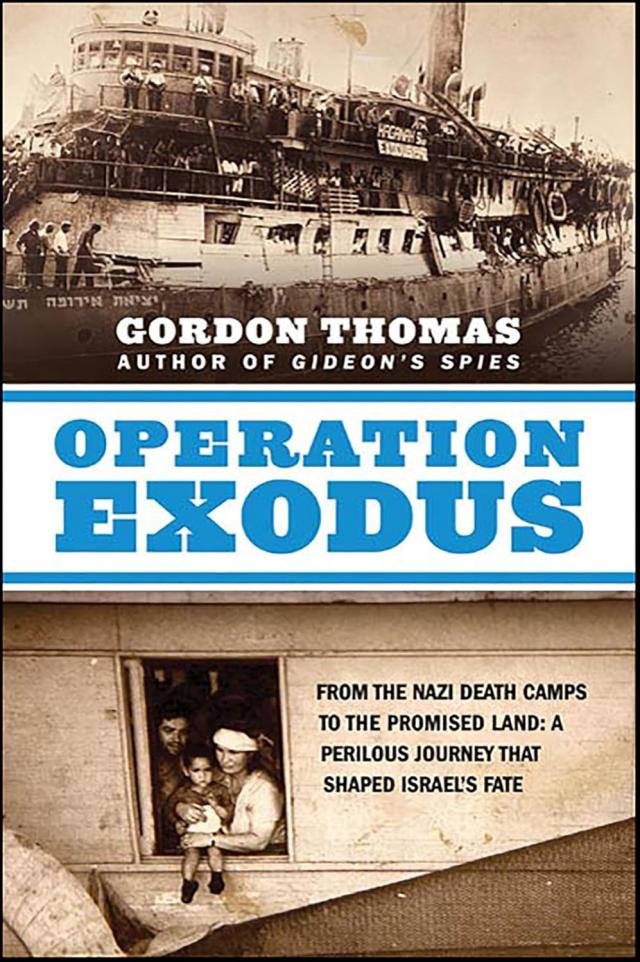


Over a thousand refugees, mostly women and children and old men, were brought into Haifa port and sent to detention camps.
In 1947, Lieutenant Roger Pearce was a deck officer on HMS Charity, a destroyer in the Palestine Patrol, based in Haifa. The port had a history going back to the days of King Herod and the town itself rested below Mount Carmel. Twice already the well-liked Pearce had led boarding parties on blockade-runners. On the first occasion HMS Charity took off 586 immigrants, including 49 pregnant women, 18 children, a doctor and two nurses. In the second boarding, off a beach at Tel Aviv, 265 immigrants, including 65 pregnant passengers and four children, were taken on board HMS Charity and brought into Haifa. The illegal immigrants received medical attention and were fed. Both interceptions were carried out with almost no violence between immigrants and the ship’s crew, but that would change. As Pearce recalled: ‘Soon our job was to try to carry out the Foreign Office policy of not having any illegal immigrants arriving in Palestine. We would come alongside one of the illegal ships and try and spot who was the ringleader and we would go aboard and collar him. After that it was reasonably easy. To do it effectively we had special training with the Royal Marines. Sailors are not very good at doing that sort of thing so it was quite interesting.’
Meanwhile, Moshe Bar-Gilad, a fluent Farsi speaker, had extended his search into Persia (now Iran), basing himself in the holy city of Mashad, hoping to bring overland some of the Polish Jews who had fled their homeland as the Germans advanced. Many had been conscripted by the Russians into the Red Army or put to work in factories and collective farms in the Soviet Republics of Turkistan and Uzbekistan. Bar-Gilad had heard that as many as 40,000 Poles were now trying to get home. He created an escape route for them and guided the first group of Jews to the border city of Merv in Turkmenistan. But when he had to travel ahead to check the next stage of the route, the refugees were caught and thrown into prison. Not wishing to see the others suffer a similar fate, he had abandoned attempts to rescue them.
Eliyahu Golomb and David Shaltiel had gone to Cairo to seek help from the long-established Jewish community along the Nile. But the Egyptian Jews looked upon the Zionist aspirations in Palestine, so close to their borders, with mounting apprehension. For them, loyalty to the throne of King Farouk was paramount. It was only when Ruth Klieger, a multilingual German Jewess, arrived in Cairo to help that the community’s attitude changed. Within weeks a cheque for £80,000 to buy boats was handed over.
While the money was gratefully accepted, there were still insufficient boats to replace those that the Palestine Patrol was systematically catching.
On a Friday evening in January 1947, Stewart Menzies cancelled his plans to attend a hunt ball and instead entertained a guest at the Travellers Club in Pall Mall, long the haunt of senior politicians and the elite of the intelligence services. The head of MI6 had chosen his favourite table at the rear of the club. From there he could observe everyone arriving, but ensure no one would overhear the booming voice of Reginald Manningham-Buller. He was an outstanding King’s Counsel at the Inner Temple and his voice had brought many an admission from a witness. He had been Lord Chancellor and Attorney-General in Churchill’s wartime Cabinet. As a Member of Parliament, he had served on a number of government inquiries. The latest had been as legal adviser to the Committee of Inquiry on Palestine.
The committee had been established after President Truman had proposed to Prime Minister Attlee that 100,000 Holocaust survivors should be admitted as soon as possible to Palestine. Bevin had rejected the proposal, making it clear to Menzies: ‘Legal or historical arguments must not be allowed to sway Britain’s opposition. To do so would have the most serious consequences.’
It was the first time Menzies had heard the Foreign Secretary mention the legal issue and he had invited Manningham-Buller, an expert on the International Law of the Sea, to brief him on how far the Royal Navy could legally intercept and arrest blockade-runners.
Manningham-Buller had reduced the question to three elements: ‘To intercept a ship on the high seas which flew no recognised flag, a ship which carried a crew that was not registered, a ship which flew the flag of a former enemy, such as Italy, Romania or Bulgaria. Any of those violations of the law made it permissible for the vessel to be seized with all reasonable force and taken under arrest to the nearest British port.’
Menzies had shown Manningham-Buller a letter written to him on Admiralty notepaper by Admiral Sir Algernon Usborne Willis, commander-in-chief of the Mediterranean Fleet: ‘Commanding officers experienced in boarding operations must consider a mile per knot is necessary to give boarding parties a reasonable chance of gaining control. That will include the distance covered by “quarry” during the operation of forming up, ranging alongside, a zigzagging ship, to put on boarders, including a feint or two, to draw the empty bottles and other missiles.’
Manningham-Buller had handed back the document: ‘In plain English, our ships can attack an illegal before it gets into the three-mile territorial limit of Palestine waters.’
That night Menzies went back to his office and wrote, in the green ink he used for all important letters, to Admiral Willis: ‘The precise legal definition I have been given by Mr Manningham-Buller of the three-mile limit for the purpose of dealing with a ship carrying illegal immigrants can be extended to cover the distance well beyond the Palestine coast so that pursuit of an illegal vessel can be concluded in a seamanlike operation. If a boarding takes place beyond the three-mile limit, the exact position should not be mentioned in signals or in the reports of proceedings by ships taking part in interceptions.’
Menzies had given the fully armed warships of the Palestine Patrol a clearance to act as it wished against ships which Admiral Willis had said possessed ‘empty bottles and other missiles’ to resist an attack.
Firmly believing that boats would eventually be found, Arazi and Ada had travelled to Milan to see Eliyahu Cohen. He said that not only would he still be able to provide trucks, but he would also help plan the best route to the Mediterranean: for the refugees it would be a long and often uncomfortable trip through Austria, across the northern mountains of Italy and down through France to Sète. Cohen used military maps, ringing points along the route with the letter ‘R’, explaining they were mansions and farms which had been requisitioned by the advancing Allies but were now deserted.
A delighted Arazi said they would make perfect staging stops on the way south. It was Ada who reminded them the travellers from the DP camps would include a number of elderly men, women and children. Cohen explained that the trucks would have blankets on board and each rest stop would have mattresses as well as food and hot drinks.
As the questions arose, Cohen had ready answers. What if thieves tried to rob the refugees? There would be an armed soldier on every truck, with orders of shoot to kill. Supposing a truck broke down? Or ran out of fuel? Refuelling dumps would be set up along the route. Each truck would carry a radio transmitter to call for help and Jeeps with mechanics would be stationed at regular points. Ada said that she would have a number of nurses she had used in her own network before it was suspended at every staging post. Cohen concluded by explaining that the truck drivers would be carrying military documents that they were taking the DP refugees to another repatriation centre.
Yehuda Arazi, whose own skills in the art of deception were renowned, marvelled at Cohen’s detailed planning. That night he and Ada sat in the company mess and toasted him well into the night.
It had been another long day for Leo Bernstein in his Washington, DC office. With the war over, the property market had picked up and the phone had been busy. He was about to close up when it rang again. This time it wasn’t an enquiry about a house. It was Abe Kay, the city’s biggest builder.
Kay was a leading figure of the United Jewish Appeal. He told Leo that Aliyah Bet was preparing another ship to bring Jews from Europe to Palestine. He was to phone all the United Jewish Appeal donors on his list and ask them to come to his office the following evening. He concluded, ‘If you have it, bring gold. But also as many dollars as you can lay your hands on. You’ll find out why when you come, but you have to be there.’
By early evening the next day over 300 men had crammed into Leo’s office. Shortly afterwards a car arrived filled with young bearded men who were escorted to a corner of the room. One of them carried a large leather suitcase. Leo placed it on one of the desks, behind which his salesmen worked, opened it and explained its purpose. He told them that by the end of the evening he hoped there would be $500,000 in cash deposited. ‘More would be good. Gold is fine. But no cheques. They can be traced back to you and you could be arrested.’
Leo looked into the faces around him. When he spoke his voice was harder: ‘I have heard the British are trying to get our Treasury to stop any funds going to support what the British call “illegal immigrants”. What’s illegal about wanting to live in the homeland God gave us? We all know that’s why Jews in Europe want to go there. To live like we are allowed to live here in the freedoms all Americans have. That’s why we have “Bricha”, the freedom to go to Palestine by sea. So far the ships have been small, only able to carry a few hundred. But now we need bigger ships to bring them home. That is why the British want to stop those refugees. Britain wants to keep Palestine as it wants it. That is why you are here tonight. To show the British we will not be beaten.’
Once more Leo paused and pointed to the group of young men. ‘None of these you know. None will give you their names. But they are sailors. Members of Aliyah Bet. When they leave here tonight your money will ensure that another ship will be bought to sail to Europe to collect maybe 800 Jews, maybe more, and bring them to Eretz Yisrael. Isn’t that the best possible use you can make of your money?’
The sailors moved to stand beside the suitcase. Each donor dropped his donation into the suitcase. There were hundred-dollar bills and bundles of notes along with bars of gold, gold rings and lockets. Finally the last donation was placed in the suitcase and the lid was closed and strapped. The sailors carried the suitcase to the car and drove off.
Leo never knew how much had been raised but he later learned that the money was used to help the outfitting of President Warfield.
In 2009, at the age of 93, Leo Bernstein made an intriguing claim about the drama of that fund-raising gathering. He said that among the sailors who had taken away the suitcase was a mysterious figure: ‘He was the captain of the boat that the money was needed for. I don’t know his name and I don’t think we were introduced. We didn’t get names and nobody was telling names. They didn’t count the money and tell us what they raised.’
Leo was satisfied that the money was needed to outfit President Warfield. So who was the mysterious figure? Was it Ike Ahronowitz, the slim, temperamental Pole and the designated captain of the ship? Or was it Yossi Harel? There is no record of either having being in Washington, DC, at that time. Could it possibly have been a mistake in Bernstein’s recollection?
Yet his description of his own role has a ring of clarity that matches reports of other fund-raising gatherings. Could Ike and Yossi have been smuggled into the United States to avoid being questioned by the FBI over their work for the Haganah? Had Teddy Kollek, an energetic Palestinian Jew, deeply engaged by 1947 in breaking the British blockade, made the arrangements for them? Kollek was Ben-Gurion’s executive secretary and eventually mayor of Jerusalem in the new State of Israel – a creation that Leo Bernstein had contributed to.
In 1947, MI6 persuaded the FBI to track Kollek’s activities, especially in smuggling into the US key personnel of the Haganah, who often came into the country on either Canadian or British passports down through Montreal.
In February 1947, Sir William Stephenson, the head of MI6 in the United States, had written a memo to Stewart Menzies:
Since the end of WW2 there continues to be a significant increase of Haganah activity out of Canada into New York and Washington. A number of senior operatives of the Jewish Agency are known to be active in both cities whose intention is to attack our government policy to oppose illegal immigration. There is no doubt that U.S. support for Aliyah Bet in Congress is reflected in political attitudes but also in supporting fund raising to buy ships of an increased tonnage and to warn that organisation of impending danger.
Just who those senior operatives were remains a mystery – which is hardly surprising, given the clandestine nature of the operation and the secret nature of Leo Bernstein’s vital fund-raising activities.
Chapter 10
Plans and Proposals
In the spacious office assigned to him on HMS Moreta, the Royal Navy shore base at Haifa, the newly appointed First Sea Lord, Admiral Sir John Henry Dacres Cunningham, considered the message he had received on that February morning in 1947 from his namesake, Sir Alan Cunningham, Britain’s High Commissioner in Palestine. It read: ‘MOST IMMEDIATE. TOP SECRET. We are unable at this moment to guard any more illegal immigrants in this country. I would urge that every other ship on the sea is diverted otherwise the situation may become impossible.’
With his tanned face and pale blue eyes, 61-year-old Sir John had always kept himself wonderfully fit. He still played competition-level tennis and swam for an hour every day. As the highest-ranking sailor in the Mediterranean Fleet, his authority ran from the Rock of Gibraltar to the Suez Canal and Haifa, where he based himself.
On his orders, the Haifa port area was constantly patrolled by two motor launches carrying Mandate policemen armed with sub-machine guns. At night, every warship was lit with arc lamps suspended over the side and its propellers turned every two minutes to drive away swimmers who could be planning to plant limpet mines on ships’ hulls. In addition, one-kilo explosive charges were dropped in the water to further deter swimmers. At first light a navy swimmer dived under each warship to search for explosives.
From his office window on that February morning Sir John could see four blockade-runners riding at anchor in the bay after being successfully intercepted by the Palestine Patrol. Even from that distance they looked grubby in the morning sun; their names hurriedly painted on their prows in Hebrew that was already starting to fade. It gave Sir John satisfaction to know it would have needed more than a name change to outwit his captains. There was the Chaim, an old Coast Guard cutter registered in Havana, Cuba. A short distance away was Ben Hecht, a steamer that had once sailed between Morocco and Málaga in Spain carrying coal and had been renamed by the Haganah after the waspish novelist and playwright. Shabtai and Ha’almoni were both auxiliary schooners and Sir John guessed they had been renamed after either Old Testament prophets or biblical warriors. A devout Christian, he reminded himself he must find out what the names meant.
On that sunny morning all Sir John knew was that between them the old boats had tried to smuggle ashore another 3,000 illegals who, upon arrest, had defiantly refused to say where they had sailed from in Europe. Their crews had been equally unresponsive, giving only their surnames and refusing to admit they were members of the Palyam. Sir John had come to know the name for the Jewish secret navy; it gained headlines in the Jerusalem Post each time a blockade-runner avoided interception. Further out in the bay beyond the breakwater were three other boats holding several hundred more would-be immigrants waiting to be brought ashore, questioned and sent to Mandate detention camps.
Despite their refusal to answer questions, during their search of the boats intelligence officers found a list of bank transfers from the Bank of America for $245,000 to an account run by Dr Joseph Schwartz, the director of the American Jewish Joint Distribution Committee, the Jewish relief organisation known as the ‘Joint’. Ralph Goldman later became its executive director. The claim about the transfers is in an MI6 file in the archives, one of several files that deal with the activities of the Secret Intelligence Service between 1944 and 1948.
Gordon Lett, a senior MI6 officer, had set up what he called ‘anti-immigration units’ staffed by former SOE operatives in Genoa to track the Joint’s activities in Europe. Lett’s orders were set out in a memo to Menzies he wrote in 1946: ‘To penetrate the Haganah and capture the leaders in Europe of its far-flung underground organisation; to intercept clothing and medical aid for the use of refugees; to obtain the names of Haganah diplomatic contacts, especially American; to disrupt those contacts; to deal with border guards the Zionists have bribed; to confiscate all forged travel documents and have the forgers arrested.’
Several of Lett’s agents had worked with Yehuda Arazi during the war and sympathised with the immigrants. One was Cathal O’Connor, who felt it was ‘very harrowing to be asked to deal with Jews from the Holocaust’.
Others showed less sympathy. Harold Perkins, the MI6 station commander in Rome, proposed to Menzies, ‘The way to disrupt the flow of immigrants is to attach limpet mines to refugee ships.’
To carry out such an operation required Menzies to seek the approval of Prime Minister Attlee. If he received any response, it has remained to this day in the ‘Y File’ category, the most restricted of all in the Secret Intelligence Service’s files.
Lett had requisitioned a villa in Portovenere, at the tip of the bay of La Spezia, and from its compound he supervised two interrogation centres for Jews who ‘appear more interesting’. One was the Combined Services Detailed Interrogation Centre (CSDIC) in Haifa, which was responsible for questioning captured members of the terrorist Stern and Irgun gangs. The other was a high-security complex at Fayid on the Suez Canal to interrogate the planners of Jewish immigration.
One of its feared interrogators was Maurice Oldfield, a portly homosexual with a taste for Arab youths, who would be a future head of MI6. He described his tactics at Fayid as ‘beating and pushing people’s heads into buckets of water’.


