

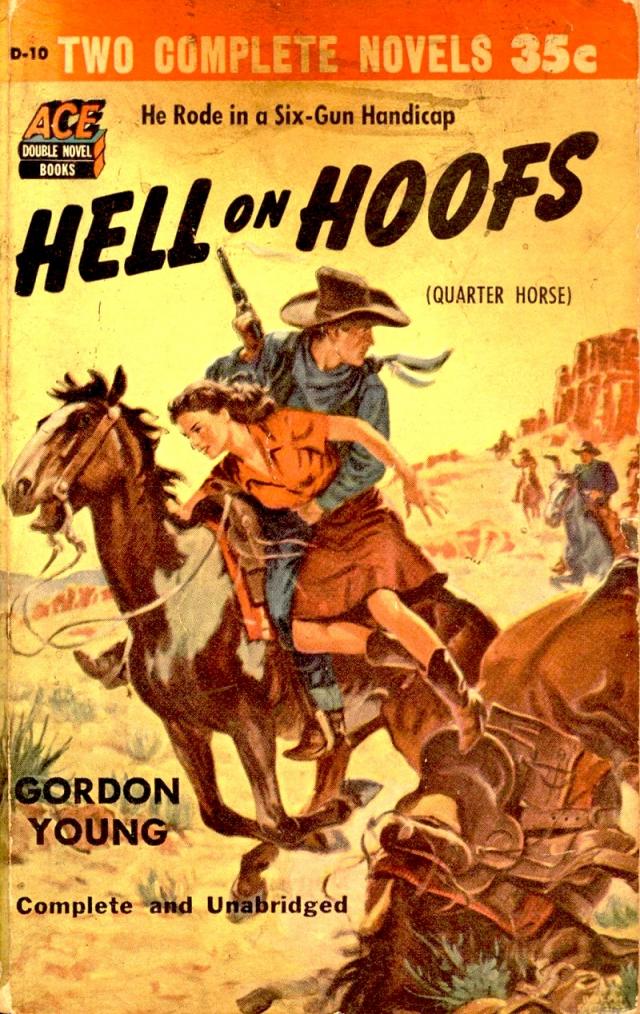
Hell on hoofs, p.14
Hell on Hoofs, page 14


Judge Trumbull, the squat Sam Malloy, and three other townsmen came with slow clump and shuffle of feet, overcrowding the small room. Mrs. Summers was flustered though she called them all by their first names.
They didn’t know what to decide on; the marshal was drunk, the sheriff out of town, and Belle Hart had to be held. The judge rumbled haltingly that no woman had ever been put in jail. He felt that none ought to be. Sam Malloy shook his head at talk of having her removed to the Alpine.
Mrs. Summers wiped her face with the bottom of her apron. “She can stay right here the rest of the night and some of you can stay and watch her if you want.” Then she told the men, “I don’t believe folks are bad because they want to be. It’s ’cause somehow they can’t help themselves!“ Allentyre studied her tired face and thought she must have worked that out as a kind of pardon for Whitey’s being such a disappointment.
The judge shook his head at Allentyre, spoke solemnly. “Joel, just what kind of deal has the sheriff made with John Grant?”
“Deal?”
“A man who took part in old Mundy’s murder can’t go scot-free!”
“What makes you think the sheriff will let him, Judge?”
“Eh? He’s promised, hasn’t he?” And when Allentyre shook his head the judge turned and bent severely. “Boy, you said the sheriff promised to—”
“I said what Cutts said!”
“What did Cutts say to you, Bill?” Allentyre asked.
“He said it to Roper. Said John Grant would go scot-free because he’d helped the sheriff catch ’em. I stood right there an’ heard, an’—”
Allentyre’s hand moved silencingly. “It was like Cutts! Judge, he made it up out of whole cloth to worry Roper. Bill here didn’t know. Where’s Grant now?”
“Nobody knows,” said Sam Malloy. “And the town quieted down in a hurry. People pulling out like they wanted to get away quick!”
2
When the kid tagged along into the Palace he wasn’t like a two-headed calf any more; he was scarcely noticed. Men spoke with gloomy praise of Red Sanger who died like a man ought, but curses were dribbled over John Grants’ name. Even the kid couldn’t clear his feeling that Grant had been treacherous. Sanger, about to die, had said so with tremendous force.
The kid lurched into a chair; he was tired and hurt through and through. No games were going and the music box was still. Blacky, now alone behind the bar, meticulously made change. The more likkered had wandered away or sat soggily in chairs, sleeping it off. Soberer men had a dejected weariness as they sagged about the bar and in brooding monotone said the same things over and over.
Judge Trumbull asked, “Where’s Mr. Trusand?” “Mister” now, respectfully.
“Upstairs for a minute, Judge.”
Jeff wasn’t sober but he was somber. He mumbled in Sam Malloy’s ear and Malloy shook his head; then he tugged Allentyre aside, wanting to borrow. He got some money and weaved back to the bar, offering to buy a round of drinks.
Trusand came out of the shadows at the rear, again as if from a bandbox. The rumpled look was gone, his boots were wiped clean of dust, his hair smoothed. His paleness was like a mask when Judge Trumbull strode up heavily and stopped, then said with earnestness: “Sir, I never saw a finer thing! You are a brave man, Mr. Trusand!”
“I tried for what I thought was right,” Trusand replied, and felt that he’d been lucky. His cold face had a prideful lift until his glance collided with Allentyre’s studied watchfulness, and it wasn’t Allentyre’s eyes that moved first.
Trusand tapped the bar for a round of drinks. Classes came up and the bottle; while it was going from hand to hand he stepped across to where the kid had slumped in a chair. “Look, Bill,” the gambler said, “you’re all tired out. Go upstairs and pile in. I’m alone.”
The kid dragged himself off, and Trusand’s gaze followed. He wanted the kid well away from there. The gambler knew that men were for him tonight, and this seemed a suitable time and place to force a showdown and make Allentyre draw in his horns.
Drinks were lifted; some said, “Luck, Dan!” and some, “Your health!” with deference in their manner. The judge put down his glass, bunched the handkerchief back into his pocket, said, “Good night, gentlemen,” and turned toward the door, Allentyre with him.
Trusand called, “Joel?” And when Allentyre paused, Trusand said, “There’s something I’d like to ask you about, Joel?”
Allentyre stepped nearer, sensing the challenge. “Go ahead.”
“Among other things, Joel, I believe John Grant is a damn’ liar!”
“Possibly.”
Now a hard seriousness showed in the gambler’s eyes. “This race that’s coming up. Grant says you told him it would be crooked!” He stopped as if he had said all he was going to, and men’s jaded nerves tightened. But Trusand coolly offered a way out, his voice friendly with, “I don’t believe you ever said anything of the kind. Did you?”
It was a strong play, edged with danger. Grant hadn’t said it like that at all, but the gambler purposely gave Grant’s words a distorted twist so that Allentyre might the more easily make his denial. And daring to bring talk of a fixed race out in the open would do much to make men sure that it wasn’t to be fixed.
Allentyre eyed the gambler, studied a bit, and his nod seemed unconcerned, his tone too. “Well, yes, that’s about the size of it, Trusand!”
That was like blowing on the glow in a powder keg. Men’s feet moved with nervous scuffle, giving room; and Judge Trumbull protested, “For Cod’s sake, gentlemen!” Blacky stopped wiping glasses to stare across the bar like a dark owl.
Whatever counterplay Trusand may have expected, he hadn’t foreseen that one, nor rightly judged the tough hardness under Allentyre’s quiet way. Their eyes met and struggled, neither wavering; and it was Trusand now who had only one way out, and he summoned an astonished wrath to demand, “Why damn your soul, sir! You call me cheat!”
Allentyre eyed him with a smile that was as cold as a crack in ice. “I don’t—now! I don’t think you’ll dare let her loose—now! I know that if Blue Chip’s in shape, Rain Drop can’t beat her except in a fixed race! And she’ll be in shape when she comes to the starting point, or I’ll see to it that the race is scratched! Do you understand, Trusand? Anything else?”
Blacky now looked like an owl dazed by sunrise; as he saw it, Trusand had come to grips and lost, ruining the sure-thing setup. Men’s eyes flickered uncertainly between the gambler’s cold, staring face and Allentyre’s unyielding indifference to the menace with which Trusand silently threatened him. Sam Malloy’s pudgy face dripped cold sweat.
Something had to come. Trusand could think fast and coolly even when angered; he had no scruples, and now he said: “You’re pretty damn’ smart, Allentyre! You don’t know and couldn’t know if anything crooked was planned in that race! It isn’t! But you’ve said so! Said it here before my friends! You want to ruin my good name, Allentyre! Now when Blue Chip wins, you’ll tell people you made an honest race out of it! And leave my name blackened! Do you think I don’t know why you want to ruin my name?” Trusand paused, then, furiously, “Say something!”
“You’re doing the talking!”
“I’m no fool!” Trusand spoke with wicked coolness. “You’ve said more than once that I must be an honest man— or my wife would leave me! She’s such a fine woman! You’d like to have her leave me, wouldn’t you, Allentyre?”
Allentyre’s half-smoked cigarette fell from his fingers and hadn’t torched the floor when his fist rocked into the gambler’s face, knocking him back, and Allentyre came on to hit again but Sam Malloy got between them. Trusand staggered off balance, his hand going up inside his coat, and when the hand came out the knife was lifted.
Men yapped their fright. Judge Trumbull snatched in ponderous haste for Trusand’s arm. Blacky yelled, “Dan, no!” Men overbore Trusand, and the drunken Jeff’s words were the most sobering: “Knife him unarmed—there’ll be another lynchin’.”
Allentyre stepped in close, leaned forward. “Trusand, if ever you mention my name with your wife’s again I’ll kill you!” Then he turned on a heel and went out.
3
The kid slipped from bed in the dark of the morning and pulled the curtain aside; a faint dawn haze’ was coming, and he stared down the street toward the unfinished Hartmann building, though he knew that Red Sanger’s body wasn’t there, knew that Red Sanger wasn’t dead.
The night before, when the kid left the saloon, he hadn’t come straight upstairs to bed, but went from the side door, being morbidly drawn back to the Hartmann building; there he ventured closer and closer in fascinated dread as he saw that one of the long, lump-shapes hung perfectly still but the other moved.
The thin moon laid blobs of candle-dim light among the crisscrossed shadows, and the kid’s voice choked up in the hushed call of “Red?” No answer; but the big dangling shape seemed to sway as if being called into life. The kid-scarcely knew what he was doing as he crept with frightened slowness onto the planking that had been thrown down for the sawhorses to rest on. His heart beat so hard he could hear it.
A slant of light now fell on Sanger’s feet. His toes rested on the four-inch back of the sawhorse. When the two-by-six had been jerked from under the doomed men there had been no more than the two-inch fall, and they had been left to strangle. But Sanger’s was a powerful, bull-shaped neck, his weight stretched the rope a little, and by luck he had been placed directly over a sawhorse and his toe tips could reach it and ease the choke of the noose. Nobody had noticed, and the crowd withdrew and Sanger helplessly held on to life.. The moon had moved and now its slant through joists and rafters showed why he lived.
The kid felt his way to X-brace. Two or three turns had been taken around it before the end was slip-knotted; when he loosened the knot and let the rope slip, Red’s feet thrashed out feebly, groping to keep their painful balance. The kid let him down until his feet were on the planking under the sawhorses, but Red couldn’t stand, and as the rope was eased he sank down and lay still. The kid tore the noose from about Red’s thick, swollen neck and untied the lashings about his wrists and legs. Then he shook Red and spoke his name.
Dead now for sure, it seemed. Hie kid didn’t think of running to call anybody; he didn’t even think of Red being an outlaw who maybe deserved hanging. He didn’t think at all; he had liked Red, and Red had been hurt and now needed help, so the kid raced across the street to the water trough before the saddler’s shop. He jerked the cup from its chain, dipped up water, and carried it back on the run.
Red had raised himself to an elbow and held a hand to this throat, breathing hoarsely. At first he took no notice of the kid who tried to force the water on him. Then he made an attempt to swallow some of the water and couldn’t, and he couldn’t speak, but he splashed the water against his face, and held out the cup, seeming to ask for more. The kid went for it, and when he returned Red had gone.
And that was the nightmarish remembrance that the kid had this morning. The secret weighed on him, and with it the feeling that maybe he had done wrong. He wasn’t regretful, though, and he was stubbornly resolved to tell no one. He wanted to get out of town before talk about it began. Anyhow, he had promised to return the Knolds’s pony the first thing this morning.
He fumbled into his clothes quietly, so as not to awaken Trusand, who liked to sleep late. Miss Kate’s scented powder and perfume still pervaded the room, setting astir the homesick wish to be with her. He wondered where Rock Creek was and the Willets place.
There wasn’t a soul in sight on the street as he ran up to Harlow’s,’-but Bobs was standing in the livery-stable runway while the lumbering Malk saddled her golden horse. Under the lantern glow she glumly studied her fingernails, and her face was sleep-swollen and rebellious, too, because she was mad at being sent home. Sam Malloy had awakened her long before sunup and told her that she had to light out for the ranch. “Joel’s orders, honey.”
Sam had babied her from the time she could walk. He had proudly told her what Joel had done to the gambler; it was over Blue Chip, he said, not mentioning Kate. Joel had picked up a man to go with him and had ridden out to try to catch Mike Eads before he got wind of how things were and dodged away. Joel expected that just as soon as he returned to town he would have more trouble with Trusand, and didn’t want Bobs around.
The kid felt that he and Bobs had buried the hatchet last night, so now he marched up to her and said, “Hello,” but Bobs frowned staringly. She knew, because Sam Malloy had told her, where the kid had spent the night; then, right off, she blazed out: “Are you going to throw in with that gambler or stand by Joel?”
He hadn’t an idea of what she was talking about, but anger was all over her and boiled in her voice. Why she should be like this after last night he couldn’t imagine, and suddenly didn’t care, and scowled to say: “I’ll do whatever I damn please!”
“To please that gambler!”
“Anybody I want—’cept you!” He went on past her and felt his way into Blue Chip’s dark stall.
Malk parted the reins over the horse’s head. “All ready, Miss Bobs,” he said, and offered his hand to her foot as a help in mounting.
Bobs went from the stable into the cool dawn with a flush on her face that looked like sunburn. She rode slowly, too, obstinately not wanting to go home and wishing for some excuse to disobey. Joel might whip her; he never had, but he might. Somehow she felt she didn’t care. She wasn’t going straight home.
The kid pulled out shortly afterward on a livery horse and saddle, leading the Knolds’s pony; and he took the direct road, not the cut from the Humps which Allentyre had used.
As early as it was when he reached the Knolds place, he found that some neighbors had already come to look around and talk about the way Cutts had died. And cowhands who had stopped here and there through the night had told of the lynchings in town.
The flat-faced George looked his pony over and grumble-muttered about other fellows riding him; but his mother reckoned that no great harm had been done, and she brought the kid into the kitchen to give him breakfast. The kid now knew that the Willets place wasn’t far from the Knolds’s because Malk, there at the stable, had said so; but when he asked, Mrs. Knolds glanced around sharply. “What you want to know for?”
“I’ve heard it talked about some.”
“I bet! There used to be a lot of talk. But I reckon that Sathe is makin’ Ned a wife that suits him—though nobody has neighbored with her yet! He married her out of a saloon! Ned Willets is purt’ near simple-minded but a steady, hard worker.”
CHAPTER FIFTEEN
THE MID-MORNING sun was warm on his back and he kicked the sluggish livery-stable horse at a trot along the level winding trail where shadows were pocketed back in the red rocks.
He couldn’t get Bobs out of his mind, and remembered his dad’s “Women do a man no good,” and so it seemed. Now again he wished that she were a boy instead of merely looking like one sometimes. He’d bang her on the nose and hate her about as much as he hated Whitey. Ugly thing! he thought, but knew that he was trying to lie to himself. Her features were as even and sensitive as a high-bred filly’s, and she had a wild cat’s tawny eyes and directness. Temper too! And she didn’t play fair in being nice sometimes for no reason at all, then turning mean with the same lack of reason.
He saw the sloping field of ripened hay, and the wind lay over it and got up and moved on and the grass flowed back, upright, not even tousled. The Willets fence showed what a power of back-heaving and patience it had taken to raise that rock-and-split-log barrier against the drift of range cows that would come toward the Sink’s rim for water. Dead stumps stood along bottomland where Ned Willets had felled his timber; they were undercut as slick as a knife through cheese, with no roughness but the splintered ridge of the break when the tree had toppled, the kid had seen men haggle trees and brush for his dad’s corrals and knew that this was smooth ax work.
Below the hayfield the creek flowed with shallow murmur among the boulders. The horse drank and turned back to the shaded path, dribbling water on the rust-dark sand, his slow feet nearly noiseless. The Willets house wasn’t far now. A small pasture came down and crossed the creek and a colt stretched at the fence and tipped its ears.
The kid followed the fence across the creek and was leaning to peer under branches up toward the house when right close by he heard, ‘Why—why, Billy!”
He would have gone by without noticing that Kate sat there in a dark dress, on a sloping rock that water purred against. Branches dropped low from above her. A handkerchief that she dipped into the stream to bathe her eyes had left the look of tears. Sathe Willet’s witch-hazel packs and Ned’s beefsteak had lessened the swelling and she could see better, but blotches of purple-black overlay her puffed face.
The kid’s eyes stretched wide, frozen in disbelief that this bruised wet face peering up out of the shade was Miss Kate’s. He wouldn’t have known her, not at once, except for her voice; even her hair was knotted tight on her head as if in an effort to be wholly ugly. He spoke with stunned slowness. “You—hurt like that!” Then he hit the ground as if thrown from the saddle and leaned toward her. ‘Who hurt you?”
A flame seemed to, bum in his eyes, and she knew what it meant, for that was how she had seen him look over the revolver that he held on Roper in the cabin. Kate covered her face with her hands and put her head down and tried to think, but was only frightened.
“Who hurt you?”
It was all he said, but enough, and she mustn’t tell him; whatever else, not that. Trusand was cold and quick and without pity.
‘Who hurt you?” he asked again—just the singleness of one question, a spaced hammer-blow of a question, direct and numbing.


