

Hell on hoofs, p.6
Hell on Hoofs, page 6
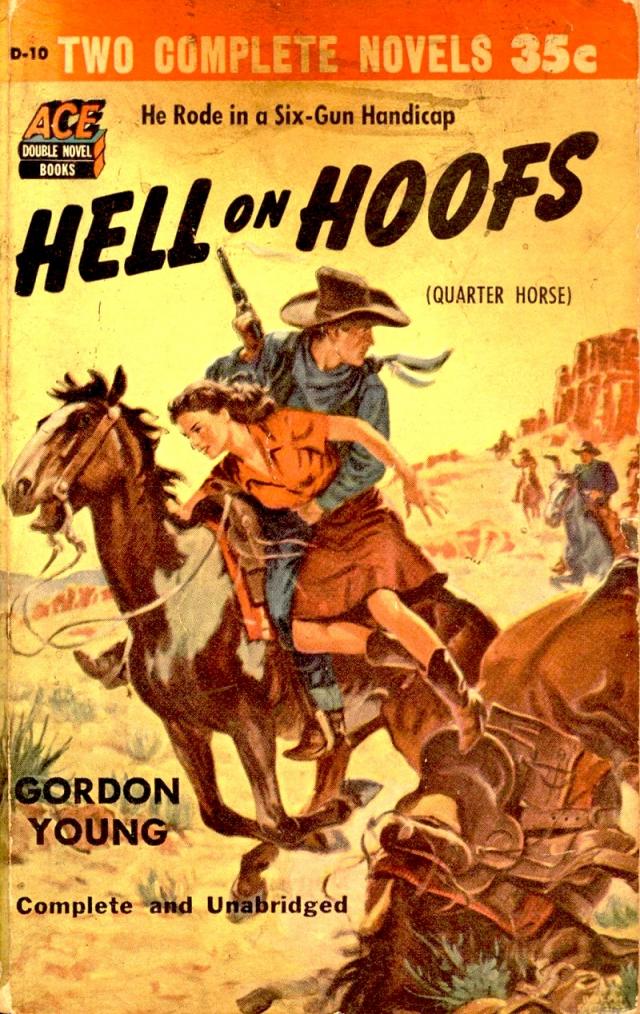


Two men were with the sheriff; one wore the deputy’s badge and the other was a lanky fellow with the scar-deep wrinkles running to the comers of his loose mouth, and the malicious cross-eyed squint. The lad remembered that this was the man who had sent him across the street to Dan Trusand as a kind of joke. His name was Cutts, he was a cattle buyer, and rode often with the sheriff; now he called familiarly, “Hello there, Bub!” The kid stared sullenly and made no other reply.
Sheriff Fields came out of the saddle. Sheriffs were pretty big people to the kid’s way of thinking; this one was chunky, gray, brown-faced, looked tired inside and out and, though straight in the saddle, when on foot his shoulders were a little stooped. A thick mustache bracketed his mouth, and there was something dogged in the way his big nose jutted out. His clothes had a worn bagginess, as if he had lost weight since they were fitted, and he seemed to look at things and people with careful distrust. As his big hand closed firmly on the kid’s small fingers he said, “I’m glad to meet you, Bill.”
The deliberation in the sheriff’s voice and eyes made the kid tighten up inside; it wasn’t fear but had much the same smothery pressure because something was wrong and these men were tense. Even the loose-mouthed Cutts, still in the saddle, had a heedful quietness. The deputy was now down on his haunches and thoughtfully broke up twigs.
The kid glanced questioningly at Allentyre. A swarm of gnats spun out of the shade, encircling his hat, and he moved aside with leisurely slap of hand at them and said, “It’s bad, Bill. But we feared worse!”
Cutts nodded. The deputy flung down his twigs and stood up, rubbing his palms on his hips. Grant couldn’t stand it any longer and asked, “What in hell?”
That brought everybody’s eyes from the kid to him, and the sheriff asked, “John, are you sick?”
Grant looked it and pressed his hands to his belly. “Been having spells with my stomach.”
The sheriff’s deliberation may have been weariness, but Grant felt that it was suspicion; then the sheriff droned in a somber, dead-beat voice: “Tom Roper’s turned mad-dog bad! Last night he killed Harmon Jones and Cy’s not likely to live. Was stealin a horse out of their stable!”
Grant, dying himself, couldn’t have looked more drawn and pallor-stained.
The sheriff droned on: “By happen so, Bobs rode over early this morning and found Cy on the ground where I guess Roper’d left him for dead. She drug him into the house and lit for home. We’d spent the night at Joel’s to have a look on the Swayback at something he’d sent word about. Joel here has some boys go over with the buckboard to fetch Cy, and Hannon too. But he was anxious about you fellows, now that Roper’s out to kill; and we come fast until we seen the smoke out of your chimney.”
Then the sheriff talked to the kid: “Roper’s crazy mean. What you done will make him lay for you sure! He was born in this country and’ll be hard to catch. Folks that aren’t his friends’ll help hide him out of fear.”
And after that the sheriff pondered, eying Grant: “John, just what about you and Roper the other night when you two showed up here? Him, I hear, on Sanger’s Sorrel Top. Where’d you been? What was wrong?”
The gnats were now about Grant’s bare head; he slapped at them and that gave him a little time to brace up. His story was pat, or so he thought; he and Sanger had talked it over to make their tales jibe and put Roper in a bad light.
“Why, some days back,” Grant began, and stopped to wet his lips and swallow a time or two. “Y’see, Red hired me to go along with him and Eads and Roper north to the Niadora” —Risto, near where the stage had been attacked, lay to the southwest—“to see about dickerin’ for some steers to feed on his range down there. I was to help with the drive if he made a deal.
“It turned out a land of wild-goose chase, and I wanted to come back on account of the boy being here alone. So Red told me to light out. Before night Roper he overtook me, said Red had give him his horse to hurry back word to a fellow here. I ought’ve known he was lyin’, but never thought; not right then. He’d rowed with Red and stole the Sorrel Top and turned his own horse loose so Red couldn’t chase him.
“We showed up here dead tired and found Miss Kate and her friend had come out to see the boy. Roper got mean and the kid grabbed my gun and made him go. That’s how it was, Sheriff.”
“Empty, I hear.” The sheriff’s frown was incredulous. “How’d it come you wore an empty gun?”
Grant cleared his throat and swallowed some more, then went on: “That day Roper got to braggin’ about how he could shoot from horseback. So we’d ride toward something and bang away, and the last time I just plain forgot to reload.”
The men eyed Grant, not quite believing, and he felt his hands tremble and rammed them into his pockets. The sheriff said “Uh?” and took a cigar and bit off a piece to chew on. The kid sensed that their suspicious silence questioned Grant, but he believed all that Grant had said, and whatever Grant’s slackness, they were a kind of partners. The kid got tense about speaking up before a sheriff and these other strange men, yet he meant to be heard clearly, so his voice went higher than he wanted as he spoke directly to Allentyre. “Stands to reason, mister, he’d done nothin’ wrong or he wouldn’t have forgot to reload! You don’t forget when you’re scared!”
Allentyre gazed at the kid and considered, then murmured, “Sheriff, that seems to be about the size of it!” The sheriff grunted unwilling assent, and even Cutts grinned in agreement; but the deputy, again down on his haunches, kept snapping twigs and dropping them as if he didn’t care one way or the other.
The old sheriff’s tight stare stayed on Grant’s face; even when he spit his eyes didn’t move, and he wadded the chew in his jaw, gave one side of his mustache a slow pull. “Wild-goose chase, hm?” His tired voice had a straight-from-the-shoulder firmness but no temper. “John, I can’t guess why they took you or went themselves. Not for the reasons you give, anyhow. So far as I know, you haven’t, done anything wrong—yet. Except not be very smart! Bringing in cattle to feed, hm? Red Sanger don’t bold enough private range to swing a wide loop on!’’
Grant mumbled, “I just never thought,”
The sheriff went on in the straight-from-the-shoulder way: “I’ve known you near all your fife, John. And liked you. I can’t believe you’d want to tie up with the wrong kind, but you’re liable to let them tie to you, which adds up to tbe same bad thing. Roper’s no man to he friends with, ever! Mike Eads, for all his quiet ways, is a killer. Red Sanger’s even worse for you because he’s got brains and nerve and so far”—the pause was meaningful—“so far he’s been smart enough to explain his way out of shady deals. And now,” said the sheriff, disgusted, “you are goin’ in for horse racing! Why don’t you hire out and work for a living?”
The sheriff abruptly took his reins and walked off toward the water. The deputy and Cutts skimmed Grant’s face with brief stares and followed, but Allentyre fingered for the chance to say something more, and said it quietly: “John, you’d best walk wide of Sanger from now on. Keep clear away from him!”
From a tight throat Grant jerked out, “Why, Joel, what’s known now?”
Allentyre coolly didn’t say, but with quiet severity continued: “And I don’t know, and won’t ask, what kind of deal is on between you and Trusand. So far as I know, Trusand is a square gambler. And a smart man. But he doesn’t know anything about horse racing. Neither do you. Nor the boy here. Yet all that you and Trusand are after is the money. That gambler doesn’t want a horse to run for fun. And that is all the Election Day race against Doc’s Rain Drop will be if —if Blue Chip wins!”
Grant had to say something and he tried hard against the steadiness of Allentyre’s eyes. “Why, honest, Joel, I don’t know what you mean!” He sounded as if lying. He was.
Allentyre gathered the reins of his Roman-nose and walked over to the water.
Grant went to the doorway and in loneliness sat there, and fears of different shapes surged at him; and he wished these men, who tiredly stood together without much talk would ride off, yet dreaded to have them go. Roper even now might be lurking behind yucca on the slope.
And when they rode off, would it be toward the Sway-back? Too late for today, but tomorrow? Wind would have scuffled the dust there and nothing definite could be learned —maybe.
It was sickening to think of the Jones boys. Had Roper killed them because he knew what they had reported? Or was he out to show the countryside that it was wrong to laugh at him for having been lifted into the saddle by an empty gun in the hands of a kid? Red Sanger had foretold that Roper would turn mean and kill, “mad-dog bad” was the way the sheriff put it.
The kid was scrouged up close to the wall, an arm’s reach away from Grant, with a hard-faced look at nothing; but to Grant this seemed a kind of loyalty after the way the sheriff and Allentyre had talked. Grant wasn’t resentful toward them; he was plain hurt and scared, and lamented, I’ll never do anything like it again! Maybe Sanger was actually suspicioned. The old sheriff himself wasn’t very smart, or so people —that is, some people—thought; but he was dogged, and Mundy, having been his wife’s brother, made it worse.
Another shadowy fear now tormenting Grant was the ominousness of Allentyre s “if the mare wins!” Grant and Sanger knew what was going to happen in that race, or knew at least what the gambler planned. Grant, thinking of the kid’s feelings, didn’t like it, but easy money was hard to come by. Just this once, he told himself, and he’d never do anything like it again. Anyhow, the kid would never know the truth about why Blue Chip lost, and Grant meant to make it up to him by buying a rifle or something. Yet it gave Grant a shaky feeling to see that even before the betting started, Joel Allentyre seemed aware of what was intended.
Grant saw the men coming toward him again, leading their horses. The sheriff spoke first. “Joel here has something to say.”
Allentyre talked to Grant but looked at the kid. “Like we were saying a while ago, John, Roper will lay for the boy. A safe place as any will be for Bill to go home with me. And you oughtn’t to stay here, either. The Sheriff’s riding back to town and you can go along with him, or come with me. You’re always welcome at my house, John.”
Grant wanted to say sure, he’d go, but had to consider how it would look. Sanger didn’t like Allentyre and would think things. Grant meant to walk wide of Red Sanger, but it wouldn’t look right to walk that wide all at once. Red was a suspicious man, and Grant knew that Eads didn’t like him anyhow.
“You’ll take Blue Chip too?” Grant asked. And when Allentyre said, “Of course,” Grant decided, “Then, Joel, maybe I’d better go in and explain to Trusand about her being over to your place. Bill, you go along with Joel.”
The kid got up, looked hard at Allentyre, then blurted: “That girl hates me!” He was trying not to reveal that he also hated her.
Allentyre thought it over, carefully not smiling as he explained, “Bill, she’s too good a horseman to really hate anybody that can ride her down!”
CHAPTER SEVEN
IT WAS AFTER nightfall as they approached the ranch house and two big dogs came bounding a half mile down the road to meet Allentyre; and he said, “I don’t know how they know, but they always do and meet mel” He had ridden slowly to protect Blue Chip’s knees and there hadn’t been much conversation; the kid wouldn’t talk to him.
When they dismounted before the house a small man with a curiously springy step clumped toward them through the lighted doorway, a thin shadow-shape with spidery legs and a hurried jangle of small spurs, and he spoke somberly: “Aye, it’s bad, sir! Cy died on the way in, and the boy’s been sent to head off the doctor.” The voice was quick and jerky, with a tone strange to the kid’s ears, and the smell of the stable and liniment was strong about this man.
One of the big dogs forcefully poked his head against the kid’s hand, wanting to be petted. Allentyre stood for a long moment, deep in thought, then he said, “Boran, this is Bill Helgar, and you know Blue Chip. They are staying with us for a while.”
“Eh? And glad to meet you, lad, that I ami” Boran leaned close through the darkness, shaking hands.
“The sheriff won’t go to the Swayback,” Allentyre explained. “We talked it over. The trail’s cold. Besides, Roper’s on the loose. And Boran, keep Blue Chip up but turn Roan out. And come back after we’ve had supper and take Bill with you for the night.”
Allentyre led the way indoors, and the dogs came, too, walking through a wide hall lighted by a lamp on chains and into a big room; and the kid remembered Miss Kate’s instructions about pulling his hat when indoors where there were women. No women were in sight, but the tidiness and nice things meant they were near; however, Allentyre kept his hat on.
“Set down, Bill. I’ll be back in a little while, then we’ll wash up and eat. Ranger can keep you company.”
Ranger was a young dog, brindled, short-haired, full-grown, but not filled out; he acted hopeful that tbe kid would play. Ranger’s mother had tagged Allentyre’s long stride from the room.
The kid sat on the edge of a big chair and felt lost. The room seemed bigger than most houses. Overhead were black rough-hewn beams; Indian blankets were on the floor, framed colored pictures on the walls, and the windows had heavy drapes that were so darkly red they looked almost black. The fireplace was high enough for the kid to stand in, and the table was wider than he could reach across. One place was laid at the head of the table, and a tall cruet stand shimmered with glass bottles that made him think of Miss Kate’s perfumery.
Ranger got up with tail awag to meet the girl as she came from the hall; but she wouldn’t notice him or the kid, that being her way of acknowledging the kid’s unwelcome presence. And in spite of himself surprise fluttered in the lad’s eyes; now in a flowing dress, the bottom heavy with ruffles, she looked like a girl, and she moved quickly with sharp tap, tap, tap of heels, her straight back stiffening against the stare she knew must follow her. The copper-colored hair was bunched like a grown lady’s, and it wasn’t often worn that way because a splotch of untanned whiteness showed on the nape.
She disappeared through a dark doorway and jarred the door with angered closing behind her. The dog had gone with her.
The kid sat rigidly and peered toward the elk antlers above the fireplace, not seeing them. He had no words for his feeling, but it was much as if she had played an unfair trick; except for the hair, he had remembered her as nothing but a skinny boylike girl. “Ugly!” he had insisted within his own thoughts. He forgot that word now, but didn’t like her any better; she didn’t want him here and he didn’t want to be Here, and meant not to stay.
2
Boran’s quarters were near the stable and colored prints were tacked on the walls, all of lean, sleek horses, some at the extended gallop with red-coated peak-capped riders on saddles like the one that hung by a stirrup above Boran’s bed. The kid had never seen such a flat saddle before and wondered but wouldn’t ask. Boran spread blankets, lots of them, for a pallet on the floor, then lit a storm lantern and took the kid into the stable, showing the huge medicine cupboard, the tin-lined granary bins, and the big draft-proof rooms that he called ’loose boxes.” Again the kid wondered, but wouldn’t ask questions.
A horse clattered up and stopped outside.
“Wait a bit,” Boran said; “Helen’s back.” He went outside.
The kid couldn’t understand what was being said at the stable entrance except from a raspingly petulant voice: “Nobody but Uncle Joel can tell me what to dol A furriner can’t!”
“Helen,” Boran had said, and the kid thought some woman had returned; but that wasn’t a woman’s voice. Boran identified horses rather than their riders.
He came back now, leading the saddled, sweat-covered golden horse that Bobs had been on when the kid gave chase; and Boran was in a fuming splutter as he walked Helen about until she cooled. The word “furriner” had also made him mad. He began to rub her down and the kid helped; Boran could see that there was love of horses in the kid’s hands, and tirelessness too. When they were through, Boran fetched a blanket and buckled it over Helen. The kid had never seen a horse blanketed before.
The next morning he was roused from his pallet in the dark with, “Fold your blankets, lad. Stir quickly!” After that Boran led the way, lantern in hand, with springy steps that seemed about to stumble but never did. The kid drowsily sniffed the warm ammoniac smell, the horsy odors, the scent of leather, and felt happy. Boran hurried from horse to horse, having a look, and he talked to each as to a pretty child. Three had been kept in stalls and were turned out to water, and he gave the kid a bucket of oats to distribute in feedboxes, and the kid began to think that he would like to stay on here.
A Mexican came in and languidly forked manure into a wheelbarrow.
The horses trailed back to eat, and the kid took a brush, softer than any he had ever seen before, and a leather pad, to rub down Blue Chip. “Dressing,” Boran called it when he brought a moist sponge to wipe the mare’s eyes and nostrils. He told the kid that Mr. Allentyre raised fine horses because he wanted them rather than because he wanted to make money out of them.
Boran went jogging off about something and the kid rubbed, proudly adding luster to the mare’s black coat; then he heard the girl’s voice call in lilting eagerness, “Oh, Boran, where’s my Blue Chip?”
Boran was somewhere out of hearing, and she ran along the dim stalls and came to Blue Chip, but stopped short, seeing the lad. It was now daylight, but the lanterns hadn’t been put out and one hung there, throwing down its glow on her; and again she wore bibless overalls with the silver-studded belt as wide on her waist as the kind some busters used to keep their insides from being churned. Her stiff-brimmed hat hung by thongs at the back of her head, and the hair was loose on her shoulders, and wrath came into her face.


