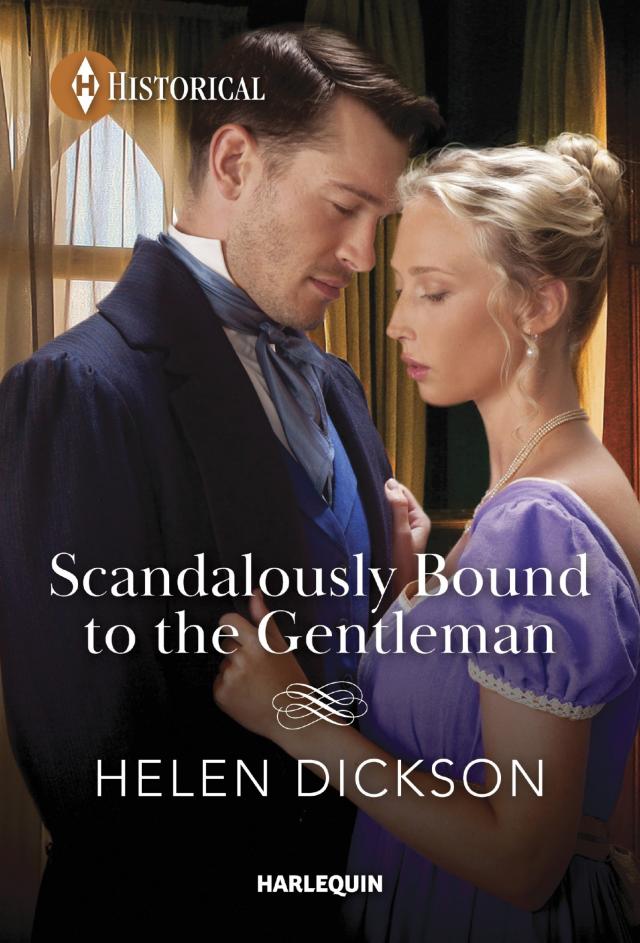
Scandalously bound to th.., p.1
Scandalously Bound to the Gentleman, page 1


Cranford Estate Siblings
Wherever the siblings of Cranford Estate go, scandal is sure to follow!
As the future marquess, William must marry appropriately, yet he’s tempted by his close friend’s sister, Anna... A most inconvenient attraction indeed!
Tilly flees London with her reputation in tatters! And promptly meets Lucas, the Earl of Clifton, and his adorable baby nephew. But with scandal hot on her heels, will she make a suitable wife?
Eligible bachelor Charles is stunned when strikingly unconventional Lucy goes out of her way to avoid him. They have a connection, but Lucy is hiding a heartbreaking secret...
Read William’s story in
Lord Lancaster Courts a Scandal
Tilly’s story in
Too Scandalous for the Earl
And Charles’s story in
Scandalously Bound to the Gentleman
All available now!
Author Note
Scandalously Bound to the Gentleman is the third book in the Cranford Estate Siblings trilogy.
I have thoroughly enjoyed writing this story, which is about Charles, a diplomatic envoy working for the British government, and Lucy Quinn, an independent woman with a troubled past. The beginning of the story is set against the colorful backdrop of India, where Charles’s and Lucy’s attraction to each other brings them together. It is in the palace of the Rajah of Guntal where they share a magical night of love. Having experienced an unhappy affair in the past, Charles is in no rush to step up to the altar. Lucy has also suffered a trauma in her life and is as reluctant as Charles to wed. It is agreed there will be no commitment and afterward they part, Charles for England, Lucy to remain in India.
Unfortunate circumstances and a child born as a result of their night together force Lucy to leave India for London. Here she meets Charles once more, and after much soul-searching, they eventually resolve their conflicts.
Scandalously Bound to the Gentleman is a story of hope and a passionate search for love and happiness with many pitfalls along the way.
Scandalously Bound to the Gentleman
HELEN DICKSON
Helen Dickson was born and still lives in South Yorkshire, UK, with her retired farm-manager husband. Having moved out of the busy farmhouse where she raised their two sons, she now has more time to indulge in her favorite pastimes. She enjoys being outdoors, traveling, reading and music. An incurable romantic, she writes for pleasure. It was a love of history that drove her to writing historical fiction.
Books by Helen Dickson
Harlequin Historical
Caught in Scandal’s Storm
Lucy Lane and the Lieutenant
Lord Lansbury’s Christmas Wedding
Royalist on the Run
The Foundling Bride
Carrying the Gentleman’s Secret
A Vow for an Heiress
The Governess’s Scandalous Marriage
Reunited at the King’s Court
Wedded for His Secret Child
Resisting Her Enemy Lord
A Viscount to Save Her Reputation
Enthralled by Her Enemy’s Kiss
To Catch a Runaway Bride
Conveniently Wed to a Spy
The Earl’s Wager for a Lady
Cranford Estate Siblings
Lord Lancaster Courts a Scandal
Too Scandalous for the Earl
Visit the Author Profile page
at Harlequin.com for more titles.
Contents
Chapter One
Chapter Two
Chapter Three
Chapter Four
Chapter Five
Chapter Six
Chapter Seven
Chapter Eight
Chapter Nine
Chapter Ten
Chapter Eleven
Epilogue
Excerpt from The Lady’s Proposal for the Laird by Jeanine Englert
Chapter One
1817—India
Enclosed by hills carrying the bounteous colour of an Indian summer through the glare of the sun, Charles didn’t see the danger coming. He rode over rocky ground, his animal guided by his sure hand, its hooves negotiating the loose scree. Suddenly his groom shouted something that sounded like danger, but even though Charles’s mind leapt to alertness, it was too late. His horse, spooked by a large snake that slithered from the rocks and across its path, reared, its front legs frantically pawing the air and throwing Charles from the saddle. The next thing he knew he was hitting the ground and rolling down the hillside into a gully below. Pain shot through his thigh, followed by a blow to his head as it made contact with a large boulder, halting his fall. Darkness engulfed him.
* * *
How long he had lain there he had no idea as he slipped in and out of consciousness. With a grinding pain inside his head, half opening his eyes, through a haze he saw a bullock cart drawn by two skinny-looking oxen making its way towards him. A woman sat inside the cart, guiding it between boulders strewn on the ground. A plague of flies had descended on him, but there was nothing he could do about it. The cart stopped beside him. The woman spoke to his groom in what he recognised as Urdu. She remained in the cart while someone lifted him inside. The bullock cart began to move off.
It rumbled over the uneven ground in sweltering heat. Each jolt was agony to him. The journey seemed endless. He opened his eyes, his faltering gaze settling on the woman. She was wearing traditional garments—the long skirt with a blouse and a billowing scarf that covered her head and floated in the breeze, the delicate fabric the colour of scarlet threaded with gold.
His gaze became fixed on a long strand of hair that had escaped its confines. There was something not quite right about it, he thought. It was light blonde in colouring, most strange, he thought, for an Indian lady. As he continued to slip in and out of consciousness, in his lucid moments the long strand of light blonde hair—lifting defiantly in the breeze like a ship’s sprightly pennant—continued to hold his attention.
* * *
He couldn’t remember being lifted out of the cart. Some hours later he was aware of a wet cloth being applied to his brow, cooling, welcome. Soft words were murmured, the sound comforting along with the tinkling of bangles.
‘Mr Anderson?’
A woman’s voice.
‘Tilly?’ his voice rasped.
Disconnected memories flooded his mind. He was delirious, dreaming of his sister again surrounded by pastures green in the country of his birth. A searing heat tore through his right thigh, combining with the pain inside his head. Where in God’s name was he? What had happened to him? He remembered being thrown from his horse and nothing else.
Voices drifted towards him in the darkness. He attempted to move, to raise his head, but his eyelids were weighted and the pain inside his head and leg was unbearable. His bloodshot eyes blinked in puzzlement. He couldn’t understand why the face bending over his was shrouded in a swirling haze.
‘He has a concussion,’ the voice said, a soft voice, a caring voice.
‘Perhaps it’s as well he’s out of it until his wound has been treated. Have him brought to the treatment room. I’ll give him something to dull the pain and see what can be done to save his leg.’
‘He’s in a bad way. Will he make it?’ the female voice asked with concern.
‘He’s strong and healthy. It always helps.’
The agony of being lifted on to a stretcher was too much. A merciful darkness descended once more.
* * *
The fever gradually left Charles. There was a babble of voices all around him. His eyes flickered open. As the haze lessened, he brought his gaze into focus. He didn’t recognise where he was. Noting the other beds where injured British and Indian men lay, he realised he was in an infirmary, a small, whitewashed affair. Two women and a man bustled about, tending to the other patients. He tried to raise his head, but the room began to spin. He squeezed his eyes tight. The sudden movement made his head feel as though it would explode.
He tried to remember what had happened. When he had set out from Madras, the landscape had stretched out before him, clouds of dust stirred up by his horse’s hooves settling on his coat and that of his groom. Mile after mile, hour after hour, they had climbed hills and forded rushing streams. He loved riding over the Indian plains, mysterious, still unknown to him after four years in India, despite his curiosity and desire to know more. They had been riding for four days when his horse threw him.
After a while he carefully blinked his eyes open, relieved to find his sight no longer quite so blurred. A woman approached his bed with a bowl in her hands. She murmured a few words of conventional greeting, placing the bowl on a low table, but when she looked at him a sudden feeling of unease caused him to start, his scalp prickling. It was the woman who had brought him here in the bullock cart, he was sure of it, but she was no longer dressed in Indian clothes. She was studying him with a cool interest, her expression immobile and guarded. His eyes met the steady gaze and for one discomforting moment it seemed that she was staring into the very heart of him, getting the measure of him, of his faults and failings. He had never seen eyes that contained more energy and depth.
‘You’re awake at last,’ she said.
‘We brought you in two days ago. You are in a small hospital in Nandra in the state of Puna, close to the border with Guntal. Do you remember what happened?’
‘My horse threw me. How bad is it?’
‘Not good.’ She stood aside as a man came to the bed and began removing the dressing from his leg.
‘I’m Dr Patrick Jessop—at your service,’ he said without raising his head as his piercing eyes scrutinised the wound. ‘The muscles in your thigh were badly injured when you fell—thankfully no broken bones, which would have complicated matters. I’ve managed to suture the wound back together, but it will be a while before you can bear your weight on it. It’s a nasty wound and it’s possible it will leave you with a limp, but we’ll have to see.’
‘At least my leg is still attached to the rest of me—thank the Lord—not forgetting yourself, Dr Jessop,’ Charles uttered, staring at the middle-aged doctor, for the lilt of the voice was unmistakably Irish. He met twinkling grey eyes in a face tanned dark. He looked at the woman.
She didn’t crack a smile or even blink. When she looked at him her stare was forthright. ‘You should. You also suffered a head wound and developed a fever.’
‘Which I am relieved to see has left you,’ Dr Jessop said, prodding the flesh around the wound, causing Charles to grimace with the pain this caused.
Slowly the pain subsided a little and Dr Jessop stood back and looked down at him. ‘You’re Irish,’ Charles remarked, wondering why he should state the obvious.
‘Sure I am—from County Wicklow, but it’s a long time since I saw the Old Country. I’m a surgeon by profession. I’ve worked for the East India Company for more years than I care to count, but my work extends beyond the Company. Many residents of Nandra and the villages beyond seek my services when they are in need.’
‘I imagine a trained surgeon is a treasure in such a remote place as this.’
‘I go where I’m needed. There’s no lack of work to be done—soldiers to patch up after some skirmish or other.’
‘We’re glad to have you at the hospital for a while, Dr Jessop—to make use of your skills,’ the young woman said, gathering up the soiled dressings.
‘I sure have my work cut out. We can mend broken bones and wounds incurred in fighting, but nothing can keep out the disease, the fevers and the gangrene that creep silently and infect people without notice until it’s too late and kills so silently.
‘I’m due to leave any time soon—to get back to the regiment in Madras. I can’t say I won’t be glad to leave the state of Puna. The territory is too unsettled to be easy. I will leave you now. It’s been a long day and I’m ready for my supper. I will leave you in Miss Quinn’s capable hands. She has been taught how to treat fevers and common ailments and how to clean and dress many types of wounds. You should rest more easily now the fever’s left you.’ Without more ado he left them.
‘Now you’re awake I’ll fetch you something to eat when I’ve dressed your leg,’ the young woman said. ‘You must be hungry.’
When she talked Charles realised the depth of her charm. Her voice was low and beautifully modulated. ‘My horse? Do you know what happened to my horse?’
‘You will have to ask the man who was with you to tell you that. I believe he is being accommodated in the military encampment on the edge of town. I came upon you by chance and was concerned with getting you to the hospital at the time. Now please be quiet while I dress your wound. It will cause you some discomfort which, I am afraid, is unavoidable. Please remain still.’
Charles watched her as she worked, clenching his teeth when the pain almost overwhelmed him. In an attempt to overcome the agony, he concentrated on the young woman. Her body was lean and sleek as a greyhound’s. There was a natural grace about her, almost stately, and a quiet dignity. He’d noted as she walked towards his bed that she moved like a dancer.
An abundance of silky pale blonde hair drawn back from her face was plaited and wrapped in a coil at the nape of her neck. Her cheekbones were high, her features perfect, her eyes huge and the colour being a dark green flecked with gold lights that hinted at hidden depths, reminding him of a tiger he had seen on a hunt when he had first come to India.
The sun had tanned her skin to a golden colour and her mouth was rosy and full. Despite his pain he took pleasure in looking at her. Her face was alluring yet imperious, that told the world that she wasn’t to be trifled with. Everything about her fascinated him, drew him to her, and he felt a stirring of interest as he looked into the glowing dark eyes. A large soiled apron covered her grey dress.
Her allure was tangible and he saw the danger of getting to know her too well. She was as exquisite and dangerous as the cobra he had seen emerge from the basket of a man in the bazaar in Madras.
Sitting on the floor cross-legged, the man had removed the lid of his basket and started to play his pipe. Soon the head of a cobra with its spreading hood had appeared, drawn by the mystical sound of the pipe. Its eyes were cold, mesmerising and deadly. Charles had stood and watched, transfixed. His companion had laughed at him when he had stepped back.
‘Impressive, is it not, Charles? But be assured that its venom could fell an elephant should its fangs pierce its skin.’
Why Charles should think of that when he looked at Miss Quinn, a woman he suspected was in possession of an intelligent mind as well as beauty, he had no idea. On her part her attention was born of an inclination to minister to his wounds, but in a strange way her attention excited him.
‘The doctor referred to you as Miss Quinn. Are you Jeremiah Quinn’s daughter by any chance?’
‘He is my father. You know him?’
‘We have never met but his name is familiar to me. He was a Company factor I believe.’
‘He was a Company Resident in Puna and a collector of land revenues. Ill health forced him to retire three years ago.’
‘Yet he remains here—in Nandra.’
‘He says he is too old to move on. He loves India and Nandra has become his home. It is where his friends are. I am Lucy Quinn. I brought you to this small infirmary. It was fortunate Dr Jessop was here to attend your injury.’
‘For which I shall be eternally grateful. Hopefully my recovery will be swift and I will be on my way.’
‘You used to work for the Company, did you not, Mr Anderson?’
He nodded. ‘Once.’
‘But you no longer do so.’
‘You—have heard of me?’
‘Oh, yes. You are well known. Your reputation has preceded you. Are you as wicked and dangerous as your reputation would lead one to believe?’
He laughed. ‘Miss Quinn, I beg you not to destroy my reputation. I have worked very hard at it.’ Was that a smile he saw twitching her lips?
‘I imagine it wasn’t too difficult. However,’ she said, on a more serious note, ‘I have heard you are a man of attainment, of exceptional courage and resourcefulness, that when you worked for the Company you took your duties beyond what was expected of you. Indeed, such is your prowess with lance and musket that I am surprised you did not make soldiering your career.’
Her remark was a statement of fact, without any form of sarcasm from which he would have taken offence. ‘I happen to like what I do now and leave soldiering to the professionals. As for the Honourable Company, it did not take me long to realise the corporate greed of the Company’s reign of supremacy, with the most dire consequences for the Indians.’
‘Is that why you left?’ she asked, curious.
His stare did not waver from her face and he did not immediately answer. All the years of his adult life, working at East India House in London, the only thing he had invested with real importance had been the Company. It had always given a meaning to his life, to everything he did. But all that had changed when he had arrived in India. With no sense of achievement he had left the Company with only the leaden sickness of disillusionment.