

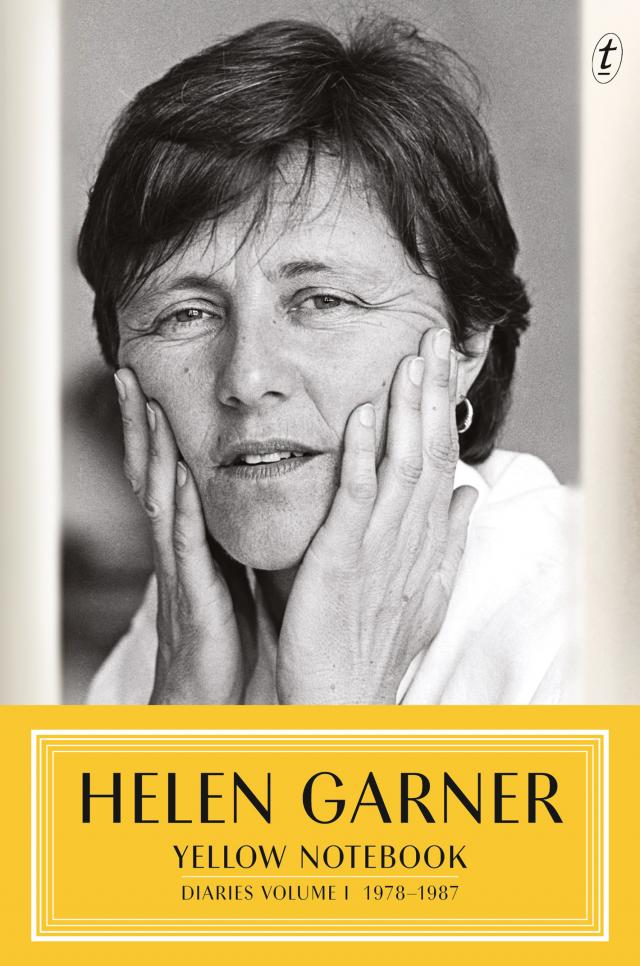
Yellow notebook, p.2
Yellow Notebook, page 2


HG: ‘I can’t stand it when blokes talk like those two. I just wish they’d shut up.’
FM: (mildly) ‘They were high on caffeine, weren’t they. It was a coffee thing.’
——
I passed through the kitchen and saw N at the table with my huge galleys on her knee. She looked up with a laugh and said, ‘You’re going to be hung, drawn and quartered.’ I went away in a panic. This morning she said, ‘It’s delightful to read. I kept laughing. But you’re very hard on the character who’s partly you.’
——
M’s entrance exam at University High: a hundred and fifty frightened kids being harangued by an old fart in an academic gown. I saw that her face was white. I was ready to kill. I cried all the way home on the bus and walking down our street. She did not look well as she came out of the exam: strained, pale and slightly vague. She told me all about it, with seriousness. I looked at her skinny little leg muscles in fawn tights and wanted to do terrible violence to someone. She said, ‘The maths was really hard—you know—“If n equals m times 2”, that kind of thing. I nearly cried when I saw some of the questions.’ She made a trembling gesture with out-stretched arms. ‘I just thought, Oh, no!’
——
A perfect spring morning: colourless clear sky, luminous at the horizon, faint roar of distant traffic, car window pearled with condensation, power lines and antennae sharply defined in pure air. A tall tree behind the house opposite is thick with creamy blossom. A rooster crows far away towards Westgarth Street. Nothing moves except the odd passing bird.
——
I was cooking dinner tonight while a couple of hard-line leftie visitors raved on at the kitchen table about an academic they knew who was writing a book on Indo-China.
‘In Bangkok,’ said the woman, ‘he got up to all sorts of stuff he could never do in Australia.’
‘What, like fucking prostitutes?’ I asked.
‘Oh, worse. You know—twelve-year-old virgins.’ She laughed. ‘The kinds of things he shouldn’t really be into, considering where he’s at.’
I turned back to the stove.
‘Actually,’ she went on, in a voice softened by affection, ‘he fell in love with the first prostitute he got involved with. He wanted to bring her back to Australia. It was a tragic story, really. He spent a fortune getting her papers and everything, and then she didn’t want to go.’
Smart girl.
——
‘Once you’ve used your experience to make something,’ said T, ‘it takes on a life of its own. It’s a bit silly to keep dragging it back to its source.’
——
When I read the writers, particularly the Jews, in Best American Short Stories I feel lazy, weak and lacking in skill. They will drive and drive, these blokes. What does this mean, for me? It means I must push myself outside what I’m sure of. Take risks.
——
Spring night: black sky speckled with stars, air cool and thickly scented with grass, and the odours of things growing.
——
She says she’s writing an essay on the nature of art as myth, myth as the expression of male dominance, myth as useless to women.
——
Honour will be out in two weeks. It has several fairly serious typos. I resolve not to look at it any more.
——
Yesterday I felt like burning all my old diaries. I spoke about it to two people, a writer and a photographer. Each replied to this effect: ‘You’ll be the same person, with the same past, whether you burn them or not.’ I decided not to burn anything, but to pack them up and store them somewhere where I can’t get at them.
——
My eyes are sore, and yesterday my front tooth got chipped while I was eating a Butter Menthol, but is now fixed.
1981
Finished rereading E. M. Forster’s Where Angels Fear to Tread. I’m sure he had never seen a real baby when he wrote it, but this doesn’t matter, it’s still marvellous. He is one of the writers I long to meet or write to, and this is one way in which I grasp the fact of death: because I can’t. Virginia Woolf is another, despite Pamela Brown’s insistence to me that Gertrude Stein was greater.
——
Went to the State Library looking for Mourning Becomes Electra. It wasn’t where it should have been so I flipped through V. S. Pritchett’s The Working Novelist. Fabulous, intelligent, witty without even a tinge of the smartypants. ‘The cork-pop of the easy epigram.’
——
To Dallas Brooks Hall to hear Roger Woodward play Chopin. A stiffly dramatic performance: some very controlled throwing up of the hands. I liked the music but his presence was so intellectual and contained that one might as well have been watching a movie. Little warmth; but in certain pieces his control seemed less rigid, and the left hand rolled almost sexually. In a cafe afterwards a man greeted two guys sitting at the other end of my table. He leaned over them with both hands on the table edge, stiff-armed as a detective, and said that he hadn’t liked the concert.
HG: (butting in) ‘Why?’
Him: ‘Because it was bad.’
HG: ‘Yes, but in what precise ways?’
Him: ‘Too many wrong notes. Memory lapses, which offended me. And too cold. Very Polish interpretation: holding the beat over into the next bar. When he does that it’s no good because—Rubenstein, for example, when he does it he’s still in contact with the basic human thing—Claudio Arrau, too, he messes with things, but you always know he’s still really feeling.’
Finally he left.
‘What a bloody bore,’ said one of the men. ‘Some people have no antennae.’ He wriggled his hand in the air above his left ear.
The other said, very politely, ‘I was quite interested in what he was saying.’
——
Rumour reaches me that H in Prahran has ‘joined the born-again Christians’. This does not surprise me. I rang him tonight. After a relaxed twenty-minute conversation he said, ‘Can you keep a secret?’
‘Yes.’
‘Can you really?’
‘Of course.’
‘I’ve gone back to Jesus.
He said it completely without irony or defence. With gladness, really. ‘I used to act proud,’ he said, ‘as if the things I’d hung on to from the New Testament were really things I’d made up myself. I was taking the credit for them.’
——
The Age asks me to review Beatrice Faust’s book Women, Sex and Pornography. I file a piece in dialogue form that I really enjoyed writing. They reject it. Would I please rewrite it as a straight review. Rage and contempt. Cutting potatoes and onions, I reflect on the pain of rejection, and on how little of it I’ve had to endure. I think of my CAE students and the way I cheerfully rip into their precious work. I could try to learn a lesson from their humility. I agree to rewrite.
——
Reagan gets shot, but not killed. On TV, the high, thin voice of the gunman crying, ‘President Reagan! President Reagan!’ The shots. In seconds the gunman is buried in men’s bodies against a brick wall.
Next morning I said to the librarian, ‘Did you hear about Ronald Reagan?’
‘Yes, I did,’ she said. ‘I’ve been thinking about how clearly I remember exactly what I was doing when I heard that Kennedy had been shot. And this time I just thought, Ho hum.’
——
Dreamt I travelled a long way on a rickety train with slatted sides. I got off at a country station and saw a wonderful house that backed on to the platform: faded green corrugated iron walls, dirt floors inside, no doors; on the lower part of the roof a thick strewing of peppercorns and gum twigs; the area surrounding the house clear, uncluttered; gum trees, three or four, standing on a slight angle as in a Hans Heysen painting.
——
Australian journalist: ‘Why do Americans want to carry guns in such large numbers?’
American politician: ‘They want to carry guns because…to them…it’s the symbol of life itself.’
——
Having had a child when I did has been one of the major strokes of good fortune in my life.
——
The woman calls me. Why? I hardly know her. ‘I read Honour and I just burst into tears. It was such a relief.’ She talks, through bursts of bitter laughter and occasional weeping, of her impossible marriage. I suggest timidly that she might consider leaving the whole box and dice. ‘I’ll never leave my children, never—do you understand?’ she shouts. She invites me to her house for lunch. I accept out of curiosity. She is out. A maid lets me in: she has a maid. Soon she returns with food in white plastic bags. In her elegant clothes and high-heeled black sandals she takes awkward strides, throwing her arms around pointlessly. Chin always lifted and thrust forward in defensive posture. Her hair cut to shoulder-length, swept away to the left in a movie-star style. She’s always fiddling with it but not tentatively—rather she will seize the comb that’s holding it off her face, bunch the hair up at the back of her head and thrust the comb into it again, thus creating an entirely new hairdo. She did this at least ten times while I was there. Something shocking about her relationship with inanimate objects. She moved around the kitchen with violence: open a cupboard door, look inside, slam it again with a loud report. She did not seem to know where anything was. I cut up some vegetables: first I wasn’t cutting fine enough, then I cut too fine, but it didn’t matter, she didn’t ‘give a damn’ how I cut them, it wasn’t important to her at all. She sliced up fish and flung the whole collection of cut matter into an extremely hot wok. Trying to make conversation I mentioned a woman I did not know she hated. This drove her into a frenzy. Even trying to write this down is making me sick. We sat at the bench with our plates of food. It was delicious but I couldn’t get past the brutality of its preparation. She kept jumping up to feed the cat, to push its three bowls about on a sheet of newspaper. Once she went to the back door and opened it. The autumn wind blew in and she banged it shut with a muttered word.
——
I call him. From the first moment I hear his voice I know that all is lost. I am once again the terrified, plain eighteen-year-old on the green telephone chair in the hall, having done the unforgivably forward thing and rung up a boy. The sensation is exactly the same. He is surprised. He draws back infinitesimally, there is a yawning gulf. Perhaps he is not even alone. I am humiliated. I hear the drawl in his voice. I am shaking with fear.
——
If it does nothing else, this whole business will turn me into a feminist again. I was about to write, ‘I am terribly unhappy.’ And then I thought, That is not even true.
——
After the phone call I worked on bitterly, trying to finish my review of the University of Queensland Press short story collection: the only woman in it is the naked one on the cover. I had to work very hard indeed to hold the bitterness out of my writing, while at the same time keeping criticism sharp. I think I succeeded. It’s quite funny, and not particularly punishing.
——
The letter comes at long last. He plays certain notes, knows what their effect will be. I know, myself, that when I am able to write a charming letter, neither too short nor too long, striking just the right balance between literary stylishness and spontaneity, I am writing falsely, and perhaps even lying.
——
I am about to make a colossal fool of myself. I am breaking a decent man’s heart. ‘What can I do for you?’ says F. ‘Trust me,’ I say, ‘and leave me alone.’ In case anyone should want to know, I’m crying because I was born in Australia and not in Europe, and because I’m tired and sick, and because in the taxi I read Kafka, At Night: ‘Why are you watching? Someone must watch, it is said. Someone must be there.’
——
My intellectual equipment has gone rusty. And has never developed to its full strength in the first place. I get frightened when I think it might be too late.
——
Yesterday M sat happily at the piano in the kitchen, playing the simplified ‘Moonlight Sonata’. She had been working away at it for half an hour or so, completely absorbed, when a woman from the circus wandered in. She listened for a moment in her stoned, distracted way, then said very loudly, in a harsh voice, ‘Can she play rock-and-roll as well?’ ‘Oh yes,’ said someone hastily, ‘she plays a mean boogie.’ The child, oblivious, laboured on.
——
Got up at 6.30 to work. A fat, bone-coloured moon was sinking into a sky streaked pink and lavender, between the rabbit hutch and the fig tree.
——
Letters are too slow; the telephone is too fast.
——
Romantics are dangerous. They will not give up the privileges of childhood. They save up little secrets for themselves, which can become lies. Sometimes, if surprised, they turn a cold face.
——
‘…Thus it is that egoists always have the last word; having laid down at the start that their determination is unshakeable, the more the sentiment in them to which one appeals to make them abandon it is touched, the more fault they find, not with themselves who resist the appeal but with those persons who put them under the necessity of resisting it, with the result that their own firmness may be carried to the utmost degree of cruelty, which only aggravates all the more in their eyes the culpability of the person who is so indelicate as to be hurt, to be in the right, and to cause them thus treacherously the pain of acting against their natural instinct of pity.’ —Marcel Proust,
The Guermantes Way
——
I feel like a bombed city. All the remaining life is underground.
——
I have to go right to the end of the story.
——
‘What’s attractive about you is a very charming…nastiness,’ said the journalist. ‘It makes you able to squeeze through cracks. Suddenly a brick is thrown, and you’re gone.’
——
About writing: meaning is in the smallest event. It doesn’t have to be put there: only revealed.
——
Bobby Sands died today in the Maze. There is fighting in the streets of Belfast. These things I heard on the car radio as I mastered the lane system of Sydney’s streets. Will he go to hell? Is starving yourself to death counted as suicide? —
At their table sat a wild child. A boy, androgynous (M swore he was a girl but something in his cheek-line was masculine to me) with an expressionless face, eyes slitted over high Russian cheekbones, blond hair chopped short and dyed in a skunk-like streak from brow to nape. He did not speak at all, but shovelled down a plate of soup, listening warily to the grunts and cries of what passed for conversation among the young men at his table. By the time we got to the register he was at the counter ordering a coffee. He carried it carefully to a table and drank it by lowering his face to the cup, in which still stood a spoon.
——
Suddenly the editor turns to me where I’m sitting behind him on a couch. ‘You know what I liked, in an interview with you that I read? The way you said you write by hand. I reckon handwriting’s bloody dying out.’
——
‘Good, sensible people often withdraw from one another because of secret differences, each becoming absorbed by what he feels is right and by the error of the other. Conditions then grow more and more complicated and exasperating, until it becomes impossible to undo the knot at the crucial moment on which everything depends.’
—Goethe, The Sorrows of Young Werther
——
Small boy: ‘We’ve got—well, him and my mum aren’t married yet. A boarder. He hit her one night when he was drunk!’
HG: ‘I hope she gave him a couple of good ones back.’
Boy: ‘She was unconscious! She sat up and said, “What was that about?”’
——
The people next door were celebrating something with fireworks. Each of them was waving a sparkler. Their faces were soft with excitement and pleasure. M and I got hold of a cracker (‘Trilogy Ground Type’) and took it out to the car park to let it off. We were so busy running away, glancing back over our shoulders, that we saw only the very beginning of the explosion, and the cloud of smoke left hanging over the bare concrete. As we came back to the house, hand in hand up the lane, an answering rocket shot into the balmy air a hundred yards ahead of us, above some houses. We screeched in fright and both instinctively stepped sideways as if to press ourselves against the smooth white side wall of the house next door.
——
‘When you’re young,’ said C’s wife, ‘you really believe that two people can make some kind of dream together; but you try it, and you get older, and you come to realise that all there is is you, finally.’
——
What is the point of this diary? There is always something deeper, that I don’t write, even when I think I’m saying everything.
——
At 6 pm S came to pick me up and we ran through the park, across Heidelberg Road and the freeway, and all the way to the river, in tides of warm air and under an apricot sky. We squatted at the water’s edge and watched the daylight fade and the wind stream through the gum-tree tops. A half-moon was out, high up. We walked back along the fence of the football ground. A soccer team was doing sit-ups in the dark. A parked car flicked its lights at us: a grinning, stupid face behind the windscreen.
——
B comes home from Italy. Her boyfriend in Bologna calls her. I hear her laughing and chatting with him: ‘Il cielo è molto diverso. E bellissimo.’
——
‘It was only a joke.’
‘Jokes don’t come from nowhere!’


