

Yellow notebook, p.23
Yellow Notebook, page 23


——
Leaves working hard in a coolish wind. Nobody in Sydney knows I’m here. There is no food in this borrowed house and I’m not hungry. How lucky I am to be a grown-up (or trying to stay one) in an empty house in another town. I could go somewhere, or visit someone, or call one or both of the men, but I don’t want to lose this period of non-existence. Incognito, incommunicado. I feel powerful. As soon as I announce myself my freedom will be over.
——
I’m thinner. Dressing, I see muscles move in my shoulders and upper arms. Swimmer’s muscles.
——
In Bernard Crick’s life of George Orwell (about Cyril Connolly? Or did Connolly say it about Orwell?): ‘And he was emotionally independent with the egoism of all natural writers…’
——
Dreamt of a battered house, a central bedroom with doors opening off it in all directions. The room was dirty, dusty, papers strewn about. Other people and I were busily cleaning it and putting it in order. Someone had tucked a clean white sheet very tightly over a pile of different-sized mattresses, so that what looked orderly was in fact chaotic. I had to take it apart and start again. No resentment—rather an excited happiness at the enterprise of it all.
——
In L’s backyard. His tanned face, his habit of smiling and laughing. He talked at length, vehemently, about his annoyance with friends, especially couples with children, who took the liberty of asking him close personal questions of a patronising kind. I wasn’t sure what he was getting at. I sat there squinting with my hands around my face against the sun and listened. I pieced together a subtext: that he is still deep in at least one unresolved relationship with a woman. His friends are urging him to choose.
I put my arm round his shoulders (two holes in the top seam of his white T-shirt). ‘Do you want children? Are you going to have children?’
He looks down, shifts in his seat. And it hits me that I’m a protection for him, against a full-on relationship that might lead to his getting married. He tells me his father saw his fear of it and said, ‘Sooner or later you have to touch that hot thing, and see what happens.’
I felt like saying, Marry someone. Have some kids. I should have said, In my life you are a happy sub-plot. But I only said, ‘Don’t choose me!’
We laughed.
‘You’re calm, aren’t you,’ he said. ‘How did you get like that?’
‘I’m older.’
‘Not that much.’
‘Enough. I got sick of being ratty.’
‘It’d be ridiculous, at fifty.’
(Thinks) ‘It’ll be ridiculous at forty, baby. You’ve got two years.’ (says) ‘Also, I’ve spent a year on my own.’
But I don’t think he heard this, the most important bit.
——
The other one calls. His terrifying dry voice. Almost a drawl. I feel shy, almost rebuffed, awkward. I don’t know if I can handle this.
We sit under the trees in the garden of the borrowed house. He puts his sunglasses on the table and the wind is so strong that they move across its surface. He says the proofs of his novel have come, and they make him feel sick. We make the kind of conversation about nothing that clever people make when they are too shy to be silent. In the living room I point out some large patches of mould: ‘If you had a wall like this in your house, you’d do something about it, wouldn’t you.’ ‘Yes. But I can’t help admiring the fact that they don’t. Pretty soon that surface is gonna look like expensive French wallpaper. Brocade.’
——
In the gallery he shows me ‘the best picture here, maybe the best picture ever painted in Australia’. ‘The Sisters’, by Hugh Ramsay. ‘Why is it the best?’ ‘Oh, because it’s so funny. Because…’ He trails off. He shows me a Picasso. It means nothing. I fall behind. Then I pull myself together, detach myself from him, begin to look for myself. ‘See this guy?’ he says. ‘He made his own teeth. Out of wood. His wife used to wear long white gloves. Even in summer. Did you know Lloyd Rees’ mother was a leper?’
——
We notice a woman gardener, young and slim with brown legs, shorts, a thick bob, a regulation-issue broad-brimmed hat. An old Chinese woman in a pink, soft, pleated dress, slip-on wedgies and little white socks passes, and we admire her as well.
——
‘Can you cook?’
He is astonished: ‘Course not.’
——
On New Year’s Eve I call home. ‘You should see the dining-room table!’ says M, her voice bright with excitement and happiness. ‘There’s at least twenty-five beer cans on it!’
——
Coming away, with my friends, from the terrible play at the Opera House. The air by the water was creamy. This wonderful city. Every night here, when I turn out the light in my borrowed house, I put on Glenn Gould playing the French Suites and fall happily to sleep, hearing their beauty, intricacy and order.
——
The monolith of his marriage, and my own solitariness and flimsiness by comparison. I feel very small, slight, impermanent. It is not too late for me to save myself.
ALSO BY HELEN GARNER
FICTION
Monkey Grip
Honour & Other People’s Children
The Children’s Bach
Postcards from Surfers
Cosmo Cosmolino
The Spare Room
Stories
NON-FICTION
The First Stone
The Feel of Steel
Joe Cinque’s Consolation
This House of Grief
Everywhere I Look
True Stories
FILM SCRIPTS
The Last Days of Chez Nous
Two Friends
About Helen Garner
Helen Garner writes novels, stories, screenplays and works of non-fiction. In 2006 she received the inaugural Melbourne Prize for Literature, and in 2016 she won the prestigious Windham-Campbell Prize for non-fiction and the Western Australian Premier’s Book Award. In 2019 she was honoured with the Australia Council Award for Lifetime Achievement in Literature. Her books include Monkey Grip, The Spare Room, This House of Grief and Everywhere I Look.
PRAISE FOR HELEN GARNER
‘This is the power of Garner’s writing. She drills into experience and comes up with such clean, precise distillations of life, once you read them they enter into you. Successive generations of writers have felt the keen influence of her work and for this reason Garner has become part of us all.’ Australian
‘Garner is a natural storyteller.’ James Wood, New Yorker
‘Her prose is wiry, stark, precise, but to find her equal for the tone of generous humanity one has to call up writers like Isaac Babel and Anton Chekhov.’ Wall Street Journal
‘Helen Garner [is] our greatest contemporary practitioner of observation, self-interrogation and compassion. Everything she writes, in her candid, graceful prose, rings true, enlightens, stays.’ Joan London
‘Her use of language is sublime.’ Scotsman
‘Garner’s stories share characteristics of the postcard: they flash before us carefully recorded images that remind us of harsher realities not pictured. And like postcards they are economically written, a bit of conversation is transcribed, a memory recalled, an event noted, scenes pass as if viewed from a train—momentarily, distinct and tantalising in their beauty.’ New York Times
‘There’s no denying the force of her storytelling.’ Telegraph
‘Garner is one of those wonderful writers whose voice one hears and whose eyes one sees through. Her style, conversational but never slack, is natural, supple and exact, her way of seeing is acute and sympathetic, you receive an instant impression of being in the company of a congenial friend and it is impossible not to follow her as she brings to life the events and feelings she is exploring.’ Diana Athill ‘A voice of great honesty and energy.’ Anne Enright
‘Scrupulously objective and profoundly personal.’ Kate Atkinson
‘Garner’s spare, clean style flowers into magnificent poetry.’ Australian Book Review
‘She has a Jane Austen–like ability to whizz an arrow straight into the truest depths of human nature, including her own.’ Life Sentence
‘Compassionate and dispassionate in equal measure…She writes with a profound understanding of human vulnerability, and of the subtle workings of love, memory and remorse.’ Economist
‘Garner’s precise descriptions, her interest in minute shifts of emotion, and the ways in which we reveal ourselves to others are always at work in these books, and make them a real joy to read.’ Age
‘She watches, imagines, second-guesses, empathises, agonises. Her voice—intimate yet sharp, wry yet urgent—inspires trust.’ Atlantic
‘Garner’s writing [is] so assured and compassionate that any reader will be enthralled and swept along.’ Books+Publishing
‘The words almost dance off the page.’ Launceston Examiner
‘Garner is a beautiful writer who winkles out difficult emotions from difficult hiding places.’ Sunday Telegraph
‘Garner writes with a fearsome, uplifting grace.’ Metro UK
‘A combination of wit and lyricism that is immensely alluring.’ Observer
‘Honest, unsparing and brave.’ New York Times
textpublishing.com.au
The Text Publishing Company
Swann House, 22 William Street, Melbourne Victoria 3000, Australia
The Text Publishing Company (UK) Ltd
130 Wood Street, London EC2V 6DL, United Kingdom
Copyright © Helen Garner 2019
The moral right of Helen Garner to be identified as the author of this work has been asserted.
All rights reserved. Without limiting the rights under copyright above, no part of this publication shall be reproduced, stored in or introduced into a retrieval system, or transmitted in any form or by any means (electronic, mechanical, photocopying, recording or otherwise), without the prior permission of both the copyright owner and the publisher of this book.
Published by The Text Publishing Company, 2019.
Book design by W. H. Chong.
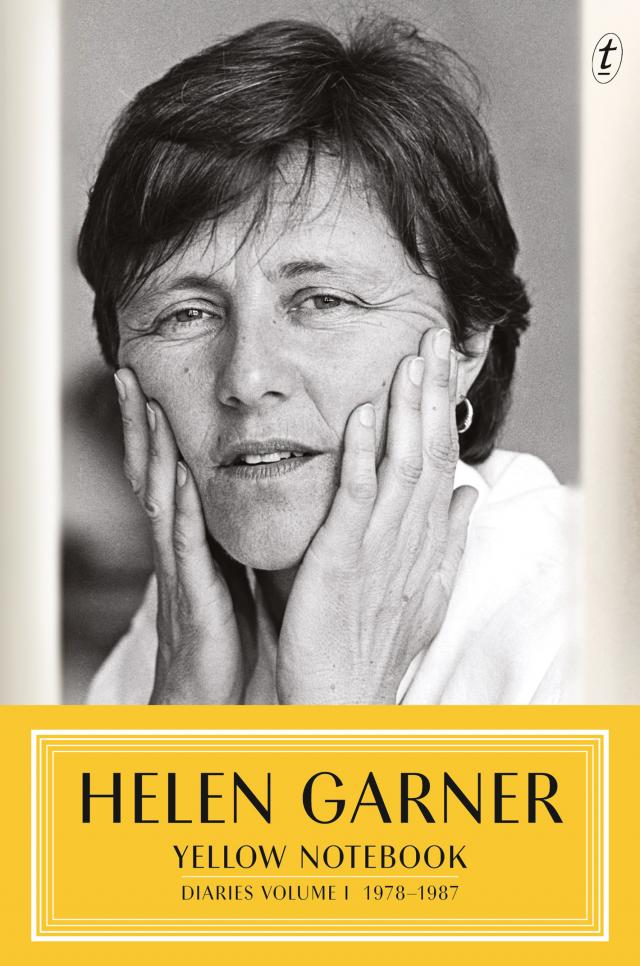
Jacket photograph by William Yang.
Typeset by J&M Typesetting.
ISBN: 9781922268143 (hardback)
ISBN: 9781925774917 (ebook)
A catalogue record for this book is available from the National Library of Australia.
Helen Garner, Yellow Notebook


