

A method of reaching ext.., p.1
A Method of Reaching Extreme Altitudes, page 1


Lynn and Lynda Miller Southwest Fiction Series
LYNN C. MILLER and LYNDA MILLER, Series Editors
This series showcases novels, novellas, and story collections that focus on the Southwestern experience. Often underrepresented in American literature, Southwestern voices provide unique and diverse perspectives to readers exploring the region’s varied landscapes and communities. Works in the series range from traditional to experimental, with an emphasis on how the landscapes and cultures of this distinct region shape stories and situations and influence the ways in which they are told.
Also available in the Lynn and Lynda Miller Southwest Fiction Series:
The Llano County Mermaid Club: A Novel by Kathleen M. Rodgers
The Problem You Have: Stories by Robert Garner McBrearty
The Last Hanging of Ángel Martinez by Kate Niles
Nopalito, Texas: Stories by David Meischen
Hungry Shoes: A Novel by Sue Boggio and Mare Pearl
The Half-White Album by Cynthia J. Sylvester
Girl Flees Circus: A Novel by C. W. Smith
A Method
of Reaching
Extreme
Altitudes
and Other Stories
Nancy J. Allen
University of New Mexico Press
Albuquerque
© 2026 by Nancy J. Allen
All rights reserved. Published 2026
Printed in the United States of America
ISBN 978-0-8263-6927-7 (paper)
ISBN 978-0-8263-6928-4 (ePub)
Library of Congress Control Number: 2025944343
Founded in 1889, the University of New Mexico sits on the traditional homelands of the Pueblo of Sandia. The original peoples of New Mexico—Pueblo, Navajo, and Apache—since time immemorial have deep connections to the land and have made significant contributions to the broader community statewide. We honor the land itself and those who remain stewards of this land throughout the generations and also acknowledge our committed relationship to Indigenous peoples. We gratefully recognize our history.
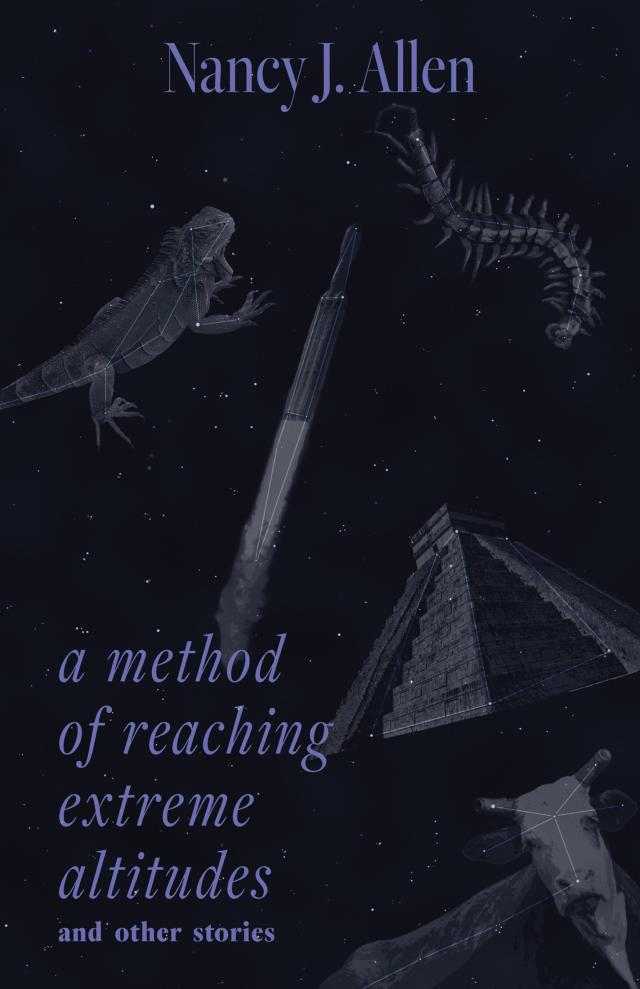
Cover illustration by Isaac Morris, adapted from photographs by Rusty Clark and Adrian Scottow via Flickr and Raquel Moss, SpaceX, and Cindy Williams Moore via Unsplash.
Designed by Isaac Morris
Composed in Athelas, and Freight
This book is for my girls, Lacy and Jamie
—and, as always, for Roger
Contents
Stolen Boy
Gospel of New Eyes
A Method of Reaching Extreme Altitudes
Impulse
Mehrangarh
Running
Camouflage
Eat You Up
Real Life
ADVENTURES OF CORN MAIDEN: A TRIPTYCH
Alvarado
Mezzanine
Galisteo
Acknowledgments
Stolen Boy
FRAN AND ROLLO LEFT BEHIND THE SUN-GLINT SEA AND THE SAILBOAT WITH its languorous days of lazy swells and sunsets mixed with cocktails and crawled into the dim interior of a tiny car. A stone-faced driver carried them high into the dry, cracked mountains of the island. Rollo punched at numbers on his cell phone, but curves of treacherous switchbacks slung Fran time and again against him, ruining his sequences. Fran’s attempts at conversation, disrupted by Rollo’s defensive elbow jabs, failed to breach the fortress of the driver’s silence. Their destination was only forty miles from a sea that had been tamed by the Minoans three thousand years before, but it took the car a very long time to get there.
The excursion to the village had been arranged the previous night to satisfy Fran’s desire to see its fourteenth-century fresco. The guide was a surprise. “My name’s Lucky!” he shouted as he opened the door so Fran could crawl out of the car. Small exploding stars of pain traveled the length of her curved spine, blurring her eyesight.
Her pain, the switchbacks, the guide’s fantastical appearance—all combined to make her unsteady. She stood, trying to find her balance, in the middle of a highway that was also the village’s main street. Fran’s clothes had been chosen for their purposeful blocks of solid color, then altered to hide her scoliosis. Her bluegreen silk blouse hung loose and long to cover her hiked-up hip; the left leg of her aqua pants was triple-hemmed to create the illusion that her legs were the same length. When her unsteadiness subsided and her eyes cleared, Fran saw that, indeed, she’d not been mistaken: their guide was wearing a hairnet, black nylon like the one her grandmother had worn to sleep in. He held a biblical-looking staff with a shepherd’s crook rising high above his head. She stood, mesmerized, then movement behind him caught her attention. Stepping daintily out the front door of the single, deserted café: a white goat with a piebald eye, its dinking bell the only sound in the place.
Rollo advanced on the guide, jabbing a finger at his wristwatch, “No mucho time-o. Famous fresco pronto. Esta noché—”
“He’s Greek,” Fran said. “Not Spanish.”
“Not Greek,” Lucky said in perfect English. “Cretan. There is big differences.”
By the time Lucky had finished explaining about the Greeks and their untrustworthiness, he had led the Henleys away from the café’s narrow strip of macadam and onto a wide dirt track. When he politely suggested that cell phone service was spotty, Rollo shoved his phone into the pocket of his khakis. He shot Fran a look, then retreated into a stony silence that matched the landscape. She refused to let Rollo’s mood penetrate her: he could sulk if he wanted. Fran concentrated on the feel of the sun on the back of her neck, smelled the clean dirt, and felt something within her release. Because it was their thirty-fifth wedding anniversary, Rollo had acquiesced to her desire to see ancient ruins. He liked Vegas jaunts that involved drinking, gambling, and golf. “I like ruins and bars,” Fran had said reasonably, and when Rollo continued to balk, she invented a reasonable statistic. She told Rollo that 65.8 percent of couples who get married in college—it didn’t matter why; it didn’t have to be a pregnancy—divorce when older. She told him she could imagine it. She didn’t tell him how very often she did imagine it: Rollo would never be able to push a wheelchair with grace.
There’d been few bars on their holiday to the Aegean, and no gambling or golf. For ten days, while she’d limped with her guidebooks through places she’d dreamed of—Lindos, Knossos, Akrotiri—Rollo had talked on his cell phone. To his lawyer, his sisters—the three siblings supported by the same third-generation hardware store, their community standing dependent on it. Rollo had no interest in ancient excavations. It was the new foundation dug and poured by Walmart within the Roswell City Limits that occupied his mind—imperiling, as it did, HENLEY’S, estab. 1921.
It was mid-afternoon, hot even in October, rich in silence and ruin: abandoned buildings covered with trumpet vines and apricot-colored bougainvillea; fragments of walls. These soon yielded to hills covered with olive trees. New Mexico had no olive trees, was not surrounded by water, but its adobe dwellings resembled these, and the colors of the Cretan landscape, sagey greens and soft shades of ocher, not to mention the third-world quality of it, mirrored home. Not Roswell, but the landscapes Fran drove through when recruiting art students.
“At least a thousand years old, this tree!” Lucky said, tapping a massive gray trunk with his shepherd’s staff. The ground around the tree lay covered with black nets that resembled his hairnet, but it was Lucky’s staff that caught Fran’s attention: its foot had been sharp-planed into a miniature goat’s hoof.
“This tree,” Lucky said, reaching out to tap another stumpy trunk. “Nine hundred years!”
Fran laughed. She didn’t believe him, but his enthusiasm fizzed in her body. Rollo used to make her feel this way—lighter, physically buoyant. But, then, Rollo’s self-delight had always been infectious, his hazel eyes cutting sideways, full of teasing laughter. Did this boy have that same quality? Was it the wildness of Lucky’s exaggerations or the pain pill that was making her feel floaty?
She examined the guide. He looked as though he might be in his mid-thirties, but it was hard to tell because his thick mustache with its curlicued tips made him look both old and young. Also, the hairnet distracted her. He’d tied it so that a single long fringe hung down against his right cheekbone. Fran fought a motherly urge to push the fringe behind his ear.
“Eight hundred years, that one!”
Even Rollo barked at this outrageousness.
“Why do you laugh?” Lucky demanded, his brown eyes merry. “Do you think I lie?”
“Absolutely,” Fran said. “I love it!”
Lucky walked on and Fran followed. His staff left cloven oval imprints in the dirt that pleased her. Studying the impressions, she thought they could pass for symbols in some ancient script: Egyptian hieroglyphics, Hittite pictographs, Assyrian cuneiform. So many places and civilizations she longed to see! Her back spasmed. She lowered her head and devoted herself to putting one foot in front of the other. Ten days on a boat, no matter how luxurious, was too long for a body that required physical therapy and chiropractic adjustments—not to mention massages—to keep the pain manageable. She smiled to herself at the irony: she was the one who’d planned the trip, picked the luxurious sailboat, but she’d never once thought about the cost to her body.
They climbed steadily. Roosters crowed now and then; goat bells rang amid the sere grasses. They passed a tumbled grist mill, a defunct olive press, sites that Lucky pointed to with his s
taff, announcing, “Grist mill!” “Olive press!”—as though these slumped ruins in the middle of nowhere equaled the glory of Athens or Ephesus. Soon the silence of the afternoon had swallowed all the small sounds, and it seemed to Fran that the three of them were alone, the only people alive. Next to her, Rollo trudged, head down, brown hiking boots deliberately scuffing up dust. Fran felt his frustration as a slight but insistent pressure on her body. She called out for Lucky. Hastening toward him, she peppered him with words. Why did he live in this village rather than Heraklion or Chania? Did he go down to the beaches at Paleochora?
Lucky shook his shiny brown curls and expressed surprise at her knowledge of Cretan place names. Fran pulled a guidebook from her flatwoven Greek purse and rifled its pages to show him her underlinings and margin notes.
“Always the good student, our Franny,” Rollo said, catching up, breathing heavily.
The muscles in Fran’s back constricted, warping her hip. Inwardly she hardened, but she kept her smile in place. She’d had to study, hadn’t she? Rollo wouldn’t have known what he was looking at if she weren’t there to tell him.
“Lucky me,” Rollo said.
“No, I’m Lucky,” Lucky said.
The spark of life in Rollo’s face was answered by Lucky’s laugh, and then the two men were laughing and slapping each other on the back. They laughed at their cleverness for a long time. Fran watched them as if from a far distance, but the hitch in her hip relaxed.
When they resumed walking, Lucky talked about himself as a “restorer of the old ways.” This was a good reason, no?, to live in his ancestral village? But he’d lived in America until he was six. In Chicago. They were climbing as he talked. Bees sounded in the honeysuckle; sheep bleated, hurrying out of their way. At each turn in the path, there was a new vista to the distant sea. Fran heard herself babbling about the views, how artistic they were. So many angles created by the up-thrust land. Extraordinary, really, the beauty of rock and—
“Frances.”
She stopped walking and jerked silent. She was talking too much—again. Was there some over-talking virus? Had she been infected due to years of exposure to Rollo’s never-silent mother and sisters? She had always been reserved, had never talked to fill empty space like she did now. But, then, there’d never been so much emptiness to fill. “You got to give yourself a jolt. Thirty-five years is too long to be married to the same person!” This was what she’d said to explain their Aegean excursion and every time she’d said it, she got the laughs she looked for. That Fran Henley. Isn’t she a card? Shame she’s crippled—and it’s getting worse. You can tell.
“I’m sorry,” Fran said. “I was running on. Rollo, it’s a lovely afternoon, we just need—”
“Don’t tell me what I need. I need a little shade and a big Scotch.”
She turned to Lucky with a smile and a shrug that said, You see how this doesn’t bother me. How many times had she done this? Acted like Rollo’s rudeness was nothing? And his drinking? Why should he quit, just because his father had had a problem?
Eight years ago, with the girls married and moved away, Martha to Albuquerque, Lucille to Santa Fe, the silences in their house had grown, squeezing Fran until she’d felt words—prattling, haphazard words—physically forced out of her. She would’ve done anything, with or without pay, to escape, but she’d found a paying job where her chattiness became capacity. When you conversed with shy high school students and their parents, dead space often dominated, and the new Fran Henley could fill every silence. As a recruiter for the Albuquerque School of Art and Design, she was her own boss. She could drive the state’s back roads as much as she wished. Five days out of seven? Ten straight? It didn’t matter to ASAD: student art portfolios were manifold, endless. Her new ability also saved her from being labeled peculiar. That Fran! Such a talker! Meaningless social conversation was a known quantity. Mrs. Rollo Arthur Henley III, prominent Roswell socialite, tooling down dirt roads into God knows what pueblo or reservation, was not.
“Let’s get on with it,” Rollo said. “Where’s this fresco?”
Lucky had led them to a whitewashed building that stood alone against massed vines. “The fresco is very famous,” Lucky said. “People travel to it from all over the world. But I want you to see this first.” He took Fran’s elbow. “The step is high. I will help you.”
She jerked away. “I do not need help.”
Lucky pulled back. Fran cursed herself; she should take another pain pill.
“You’ll forgive her, I know,” Rollo said smoothly. “She has scoli—she’s had a condition since childhood. She can’t run, but otherwise she’s perfectly capable.”
How dare Rollo talk about her as if she weren’t present! As if she couldn’t hear him! She hid her fury and managed to modulate her tone. “Thank you, Lucky. I’m fine. Really.”
Lucky climbed the stone steps, followed by Rollo. Fran limped in last, face flaming, eyes stung with tears. Now Rollo had ruined Lucky for her. Now he would treat her with the special care everyone in Roswell showed. With her odd body, she’d only wanted to be normal, to fit in. Her specialness suffocated her. Was she her body? She didn’t think so. She was somewhere in it, but she herself wasn’t odd or misshapen. She pulled down hard on the hem of her shirt, stretching the silk over her hip. How had not fitting in come to feel like home?
The building was one long dusty room, stuffy with disuse.
“This is our museum,” Lucky said. “One of our main tourist attractions.”
Fran slipped a pain pill with a swallow from her water bottle. Lucky leaned his staff by the front door and furtively centered his hairnet with a palm—a boyish gesture that belied his actual age. She smiled to herself and felt her furious pulse slow.
“One of your main tourist attractions,” Rollo repeated in a flat tone. He cut a little smile at Fran that said, How charmingly naive this boy is. She understood this as an attempt to soothe her and was able to return the smile. It always amazed her how easily their mutual annoyance could mutate into camaraderie.
She studied her husband as he stood at the front door, seeing him as he’d once been—like Lucky, slim, with a full head of chestnut brown hair. But Rollo had never been naive. Early on, he’d acquired the nickname “Ropes.” Ropes Henley gets anything he wants. She was in the ninth grade when she’d overheard a boy say this, her arms full of books, making her way through a hall packed with students. She’d had no idea what the comment meant.
When Lucky started in about village history, Fran wandered away. The “museum” was uncomfortably hot. She ambled down its length in search of a pocket of coolness, waiting for the pill to kick in, gazing distractedly at the crumbling documents, the antique weapons in the exhibit cases. Behind her, she heard Lucky say something about village vendettas. He began recounting hundreds of years of murderous activity, his voice drifting in fragments through dusty streams of sunlight as she walked. Ambushed, like outlaws. Black-and-white oversized portraits of mustachioed men stared down at her from the walls. Photo after photo, the same frozen face. Pistols, like cowboys. These old Cretans could have come from any Hispanic community in Northern New Mexico. Suspicious of outsiders, of any place other than home. Behind her, the men laughed. An outlaw named Billy the Kid.
She turned to look down the long room to where Rollo stood in sunlight. Wasn’t it just like him to act like Billy the Kid was a personal acquaintance? As if he’d ever visited the town where the Kid was gunned down. Fort Sumner, like this village, was a dying place, trying to scrabble itself together with a scrap of fame. One of her scholarship students lived there. Eduardo Gonzalez. She’d sat in the hostility of his home, trying to damp down her Anglo forthrightness, her tinted hair, her stockings and pumps. You would’ve thought she was trying to kidnap their son—when all she’d wanted was to save him! Where had his big, angry talent come from? Skinny and sweet-faced, expected to join the family’s Sheetrock business, Eduardo had sat, head bowed, between his parents. Let me give him a scholarship, she’d begged.
Fran thinks she’s saving the world. This was what Rollo said in public, at parties, making a joke of her commitment. In private, he accused her of traveling more than she had to, of exaggerating the importance of her insignificant job. Her retort? “You might be in the color business, Rollo, but yours is Sherwin-Williams, mine is art.”


