

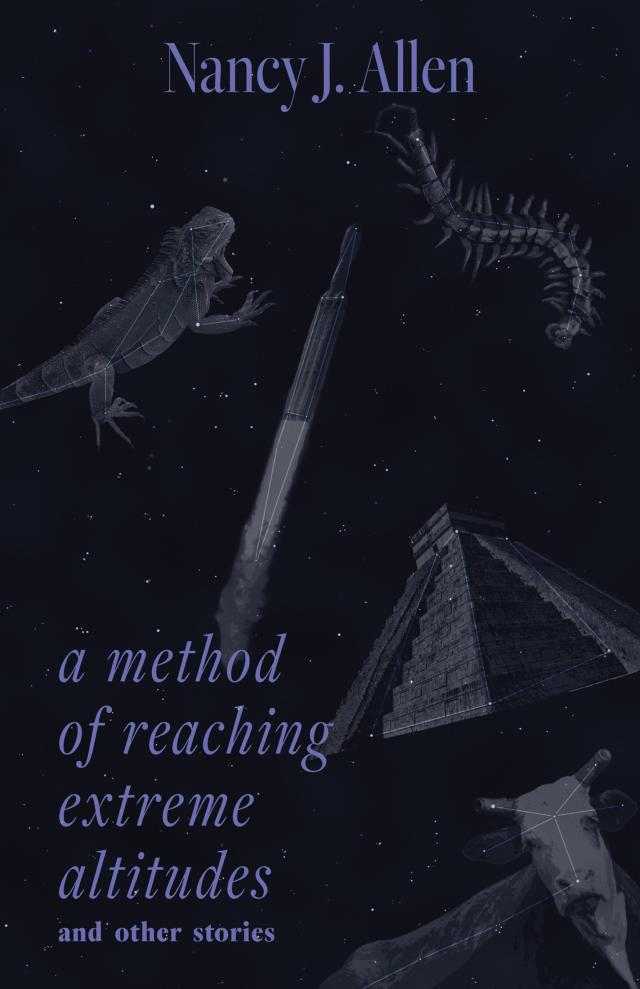
A method of reaching ext.., p.21
A Method of Reaching Extreme Altitudes, page 21


“How’d you get here?” Rhymes says. “Aren’t you from Philadelphia—the Main Line, or something?”
“Asthma,” Lenore says. “Doctors recommended this climate.”
“Never told me that,” Russell says.
Lenore looks at him, touches her pearls. “That’s what I tell everyone. The truth is my second husband strangled me—I have trouble breathing. I can’t wear anything around my neck. Not scarves or turtlenecks. I could never wear your necklace, Rhymes. I thought my third husband would—well, it’s not worth talking about. Function in disaster, finish in style. Miss Madeira’s motto.”
A circle of waiters, some walking backward, all taking small steps.
“And asthma’s not exactly a lie. I did move here for the air.”
Ta-daa! Sparklers on a bombe, champagne popping.
In the commotion—sparkles, refractions, multiples of tiny lights, everything fizzy—Rhymes gauges Lenore, she of the ping-pong-ball pearls, the relentless enthusiasm and good cheer. Her sequins faceted. Not invincible, perhaps courageous.
The waiters begin to sing, and Rhymes thinks Russell will be embarrassed, but the candlelight shines off his happy high forehead. It’s a ceremony of chocolate, meringue, and Dom Perignon. With a sweeping gesture, Lenore orders champagne for the whole room. Granted, there aren’t many people left in the room and she’s ordered a local label, but Rhymes wonders if perhaps Rusty had made more money than she realized. Then she remembers: the Market’s headed for the stratosphere.
Around the room, people lift their champagne flutes toward Russell. Rhymes looks at him and raises her glass. He’s smiling and nodding to everyone, his beautiful face, its fine structure, shining. He turns to say something to her, but he stops. With an infinitesimal jerk, he sits upright, moves his head a fraction, and a startled look comes into his eyes.
Rhymes is suddenly and completely sober.
Lenore continues toasting the room, too busy to understand something has happened, but for Rhymes the room and everything in it have fallen away. There is only Russell’s face that has softened to become a child’s face. There’s an odd look in his eyes, a little-boy look of such surprise and wonder, and a slight smile as though what he sees is round and full. Sufficient. His face softens again, and she sees how he must have looked as a small child, the purity, and her heart reconfigures itself and grows large and moves out to enfold him, all the years of contention and strife wiped away.
This vision lasts only a minute, probably not a full minute. A blank space cut out of time, a hitch in the ongoing pattern. The silence of deep outer space surrounds them, and then sound, like an old record beginning again, trailing an echo, begins to roll, and the busyness and commotion start back up.
Rhymes reaches out for his hand. “Are you all right?”
Lenore says, “All right, what?”
Russell sits back and shakes his head, as though to clear it. “Don’t know what happened,” he says. He shakes his head again. His hand lies boney and limp in hers. He sits still, his face chalk, beads of moisture on his forehead. “Don’t know,” he says.
No one speaks.
After a moment, he takes his hand away from Rhymes, picks up a spoon, and leans forward to scoop a bite of chocolate bombe. Another moment, and Lenore picks up a spoon and leans to scoop a bite too.
They are making small ecstatic sounds when Rhymes picks up her spoon. In the tranquil tail end of the evening, the three of them eat and drink and talk of inconsequential matters, as though the blank space hadn’t opened, as though Rhymes hadn’t seen within it her husband’s death.
Acknowledgments
* * *
It is commonly assumed that stories spring fully formed from the mind of their creator, like Athena from the head of Zeus. But if you are eighty years old and lucky enough to be publishing your first book, you know what a myth this is. It took a lifetime of friends.
Thanks to Lynn C. Miller for soliciting this manuscript for the great University of New Mexico Press.
Toni Nelson, thank you for that long-ago afternoon in Taos at the bar of the Sagebrush when you suggested graduate school and said you would write me a recommendation. I had never heard of Warren Wilson, had no idea I could go to graduate school for writing. I was sixty-five years old. I went.
I won the jackpot there and was privileged to study with Jane Hamilton, David Haynes, Dominic Smith, and Kevin McIlvoy, stardust now. Could I have made it through that rigorous program without my Wild Bloomers? I doubt it. We were older women—well, I was older—among young hotshots. We loved each other in Swannanoa and have loved each other ever since.
Thanks to Kalita’s mom for hosting the Five & Dime until we all finally ran out of change.
To the Fabulous Fountaineers, thank you. Who knew the magic of Aspen Summer Words could continue?
Special thanks to the greatest book club ever—still meeting monthly after fifty-three years! You are my foundation. What we have been through together no one will ever know.
And, finally, those whose names must be spoken individually here: my beloved baby sister, Jamie Jennings, Lynette D’Amico, Jane Saginaw, Lee Prusik, William Hawkins, Diane DeSanders, Barbara Corn Patterson, Jaina Sanga, Mary Jane Kinnebrew, and Peg Cronin. This book would not exist without you.
* * *
Thanks also to the following publications in which the following stories first appeared:
“Stolen Boy”: winner of 2017 Short Story America Fiction Prize, published in Short Story America Anthology, Sixth Edition, September 2018; nominated for Pushcart Prize.
“The Gospel of New Eyes”: Finalist, 2017 New Millennium Fiction Award.
“A Method of Reaching Extreme Altitudes”: winner of 2013 bosque Fiction Award; published in bosque (the magazine); November 2013; nominated for Pushcart Prize.
“Camouflage”: shortlisted for 2009 David Nathan Meyerson Fiction Prize; published in Shadowgraph Magazine, Winter 2015; nominated for Pushcart Prize.
“Eat You Up”: published in 2016 Best Short Stories from the Saturday Evening Post’s Great American Fiction Contest.
“Mezzanine”: a version published as “Calculation” in Southwest Review, Volume, 93, Number 2, 2008.
“Galisteo”: Finalist, StoryQuarterly’s Fiction Contest, a version published as “Heishe” in StoryQuarterly 49, February 2016.
Nancy J. Allen, A Method of Reaching Extreme Altitudes


