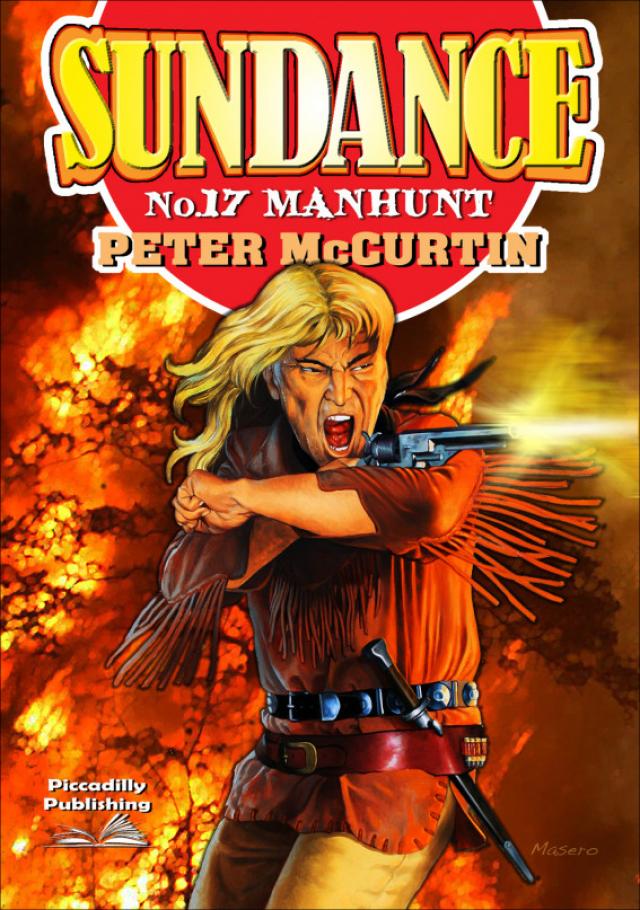
Sundance 17, p.10
Sundance 17, page 10


Well, there was no help for that. He left the woods, snowshoed out onto an unbroken expanse of white. He knew that, a dark blot against the snow, he was a superb target. He ran as best he could, weaving and dodging, on the awkward webs.
Suddenly, from across the lake, guns thundered. Bullets slapped past Sundance’s head, others, falling short, sprayed snow. A band of gunmen had emerged from the timber over there, and now the men behind him saw him, too, and lead came from that direction, also. Caught in a crossfire, Sundance did not try to shoot back. The willows were only thirty yards away, now, twenty. Hunched over, he strained every muscle making for their shelter.
He was almost there when the impact of a bullet knocked him sprawling. He plowed deep into the snow. Yet he felt no pain and instantly, as he rolled, he realized what had happened. A round had slammed into the receiver of his rifle, held in front of him. He worked the lever, but it jammed. The gun was ruined, useless. Sundance cursed, rolled again as bullets plowed around him, scrabbled through the snow for the willows, abandoning the gun.
He made the cover of the thicket just ahead of a rain of lead from both directions that chopped twigs and brush around his head. His snowshoes caught; he kicked them off, crawled on his belly through the willows like a snake, pistol drawn, now. The rim of brush was perhaps sixty yards wide, and it ran halfway around the lake, all the small growth that springs up on a pond’s edge, tightly interwoven, with here and there trails made by beavers as they came out through their trenches from under the ice to feed on willow bark. But with all this uproar, the beavers would be hiding snugly in the sleeping chambers of their houses in the lake.
He envied them, as he crawled through the snow. Then he stopped dead, pressing down low into the cover. Men were running across the beaver pond, on the ice, and others coming down from the jack pines on the hill, converging on him from both directions. Someone yelled, “He’s in there, in the willows! You can see where he went in! Rake the goddam place!”
Then it was as if an army had opened fire on him. Half a dozen guns, more, all pumping lead into the brush as fast as the men who held them could load and pull the trigger. A deadly sleet laced through the willows. Sundance, pinned, dared not move, lest the shaking of the brush betray his hiding place. And yet lead was whining all around him, and his luck could only hold for so long. He had made his gamble and it looked as if he’d lost.
There had been, he thought bitterly, one major flaw in all his calculations. He had planned to wage a war of attrition against the Carcajou, expecting two, three, maybe five men at a time to deal with him, one lone fighting man—and a woman. He had not expected the Carcajou so quickly to raise a massive fighting force and put it into action so decisively, and that miscalculation looked now as if it would cost him his life. But he was not ready to give up yet. As long as he breathed, he had a chance. And—his hand tightened on the gun—if he went, he’d damned well take some of them with him.
But now he had to figure some way out of this hail of lead before a slug chopped in to him, put paid to everything, as his English father had used to say. Again he thought enviously of the beavers. Damn it, too bad he wasn’t—
Then he stiffened. He sucked in breath. The idea was scary, scary as hell. But so was staying here, to be slaughtered in the brush. And it was a chance, a bare chance. Better than none at all.
It seemed to take an eternity to pull off the heavy parka, shrug out of the thick mukluks. Cold bit into him, and it would be worse before it was better, and if he didn’t freeze, he’d probably die by drowning. His mind made up, he took the risk of squirming another five yards through the brush. It shook with his progress and he drew a renewed and lethal hail of fire.
But he made the destination that he had sought: the deep-worn trench made by beavers, leading under the ice, into the water of the pond. Just about as wide as his shoulders, it was a bit over two feet deep. Sundance slid into it.
They were in the brush, now, eight, ten of them, slamming through the willows like so many bull moose, sweeping every foot of ground ahead of them with gunfire. There was no more time for doubt or hesitation. Sundance, on his belly, squirmed down the trench, filling his lungs with air.
Suddenly it dipped sharply, dropping almost straight down. He gave a final shove, fell, and then he was in ice cold water that nearly took his breath away. He kicked off, hard, swimming out into the lake, sealed off from the surface by an eight inch rind of ice above him. He had a minute, perhaps a minute and a half, to reach his objective or die. If he did not suffocate, the cold would paralyze him, stop his heart.
But he knew it was there, only thirty yards from shore, that enormous beaver house. It was almost pitch dark here beneath the surface. The ice diffused, shut off, the daylight. Sundance’s lungs ached, he forced himself not to panic, to keep his movement slow, methodical and powerful.
But he had missed it, surely. He had swum far enough, by now he should have reached it. Then he saw it, to his right, a greater darkness in the water’s murk. His ears roared, his chest seemed about to explode as he stroked toward it, and then his hand touched the rough wall of sticks and mud of which the dome-shaped thing was built.
Five seconds, ten, maybe he could last that long. He dived deeply, groping along the house’s wall. But he could find no opening, only the unyielding solidity of the construction, built by ingenious, patient, animals that were natural engineers.
He was going, and going fast. If he didn’t find that underwater entrance …
Then his hand shoved into it, the hole, the portal, low down on the house, far below the water. And now, either his guess was right or he would die. But, damn it, the passage upwards had to be big enough to admit his body!
It barely was. Somehow, desperately, he squeezed in, breath completely exhausted now. Frantically he scrabbled upward. The passage was water-filled. His movements grew weaker. From somewhere he found a last faint measure of strength, clawed with a socked foot, found purchase against the house’s wall, and then his head broke from water into air.
Foul, rank, stinking air—but the sweetest he had ever breathed. He sucked it deep into his lungs, shook his head, opened his eyes. Then, instinctively, his hand went to the knife on his hip, jerked it free, held it out in front of him in total darkness.
Something chittering loudly ran against it, and he heard the clang of flinty teeth on metal. He slashed with the knife and the beaver drew back. Sundance felt a chill additional to the coldness of the water in which he still floated. His head, above the surface, was in the living chamber of beavers, in the top of the house’s dome, and a big male beaver with three inch teeth that could chisel down a two-foot diameter tree could chop a man’s face or hand off with those enormous front teeth. Beavers were shy animals, vegetarians, but they were rodents, and when cornered they were fierce as wharf rats and thirty, forty times as big.
The chittering was loud, it filled his ears, as he slashed about him with the knife. There was scuttling, a strange slapping sound, made by the flat tails of the animals. They had retreated now, he hoped, against one wall of the chamber, but he kept on slashing with the knife anyhow as he hoisted himself out on a substantial floor of sticks and mud, into a space not quite a yard high and maybe two yards across. “Out!” Sundance snapped, gasping. “Out, damn you, all of you!”
The sound of the human voice was what did it. Furry bodies brushed against him, water splashed. The beavers fled, hurtling down into the passage, five of them, one after the other. And now Sundance had the beaver house to himself. He huddled there against the wall, shivering uncontrollably, almost sick with strain and reaction, and the rank, animal stench of the place, the smell of dung, urine, and the strong musk of the scent glands of the animals. But he was safe, and he would not freeze. It was strangely warm in here. The walls were thick and strong, better insulated than those of any man made cabin, and the beavers had generated enormous body heat which was trapped in here. It was chill, but it was above freezing. He hoped his own body would give off heat enough to keep it that way.
As best he could, he wrung all the moisture from his clothes while they were still on his body, then shifted position to a dryer spot. A substantial half-gnawed aspen branch moved under him; he picked it up for use as a club in case the beavers tried to come back. He would have to listen for any sound of scrabbling feet, strike out blindly, hope a random blow would send them away. He had once known a trapper who had bled to death when a beaver he was taking from a trap had sunk those long fangs into his wrist, severing an artery there, nearly cutting off the hand.
It was black as the inside of a filled grave in here. Presently the chattering of his teeth stopped. Moving around, he found where the beavers had made a bed of dry grass and leaves. That helped a little. He had thrust his Colt in the waistband of his pants when he had gone into the water. Now he busied himself cleaning and drying it as best he could by feel. For the time being, there was nothing he could do but wait. Only when darkness came would he have a chance.
Chapter Eight
Like most outdoorsmen, Jim Sundance had a clock in his head that was. nearly as automatic and accurate as any manmade timepiece. But, subconsciously, it was tuned to the slant of sunlight, the wheel of stars. In here it was disoriented. In this stuffy blackness, not cold enough to freeze, not warm enough to be comfortable, knowing that out there in the valley there were dozens of men who would kill him on sight, he could only guess at time’s passage. Under these circumstances, a minute was like an hour and an hour was eternity.
He did not sleep, either, because he dared not drift off arid find that the beavers had returned. Once they tried to come back, an old boar sniffing and scrabbling suspiciously as it came up the passage. He slammed out with the aspen stick, felt it bounce off the creature’s nose, and it fled, with a clashing of its chisel teeth.
He thought about Laughing Woman and made a sound in his throat. He’d hated to abandon her, could only trust that they’d meant what they’d said about not harming her. Still, perhaps they wouldn’t—for a while. By now they knew that there were set-guns and man traps around the valley. They would have to keep her alive to show them to them, lest they blunder into them.
Hunger gnawed his belly, but he ignored it. He could go without food for a long time if need be. Water he got from the beaver passage, leaning down, after probing first cautiously with the stick, to scoop it up in his hand. His own body heat had dried his clothes. And now, he thought at last, it was time to go to work.
He could not reach land the way he’d come. The moment he emerged from the trench, if he could find one, he’d freeze in wet clothes. So, with his sheath knife, he began to hack away at the roof of the beaver house.
It was slow going, the mud frozen, but he chopped and pulled when he could get a hand hole on a stick, and after a while he’d made a hole. He guessed right. It was dark, outside, and clear. He scanned the stars, saw that it was probably a couple of hours until midnight. Icy wind poured in on him, and he shivered.
Presently the hole was large enough. Sundance climbed out through the roof of the beaver house, socked feet sinking into snow. Everything was still, save for the howling of wolves in the distance. He slid down the house’s side to the snow-covered ice of the lake. Bent low, ignoring the cold, he quickly made the thirty yards to land. There, he edged into the brush, groping, seeking the trench by which he’d entered the lake.
Body racked by shivers, he groped in the willows. Then his hand touched something soft, and he let out a whisper of relief. Quickly he pulled on the mukluks and the parka that he’d discarded before entering the lake, As the thick fur trapped warmth, the shivering ceased. He slipped the loaded Colt back into its holster. The parka, now would keep it warm, its action from freezing. He groped back through the brush, guiding on a taller, warped willow that he remembered from this morning. Near its base, he fumbled in the darkness, and presently his hand touched a snowshoe’s web.
All right, he thought, finding the other one. Now I’m back in business. But, he told himself, in a damned small way. One man, one sixgun, against … how many? Armed with rifles. Damn it, he needed a long gun, too. But, of course, they would have found his set guns at the valley entrances.
He considered for a moment. It was a chance, a long one, but maybe, just maybe, in the excitement of the chase this morning … Anyhow he had to look and see.
He mushed across the open, deserted now, back into the jack pine timber. Even in here, starlight glinting on the snow was enough to reveal the backtrail he had made this morning. He climbed the slope, and presently he found it—the place where the sled had overturned. It was still there, along with the dead dogs in its harness.
Sundance groped in the overturned sled, but it was not there. On hands and knees, he searched the snow. Then he made a sound of satisfaction. The long buffalo hide parfleche had rolled off the sled when it went over. Laughing Woman’s weight had forced it down into the snow and it had been overlooked. Sundance’s grin was like the snarl of a hungry wolf as he opened the pannier, took out the short, recurved bow and strung it. The arrows in the panther skin quiver, two dozen of them, were intact, and they rattled faintly as he slung the quiver on his shoulder.
He needed food; what lay ahead would require all his strength. That was a problem quickly solved. With his sheath knife, he butchered a dead dog, and, moving deeper into the timber, built a fire in the shelter of a snowdrift, where it was practically invisible, using the waterproof matches in the case from his parka. He roasted a haunch of dog well done, ate it all, wiped grease from his mouth on his sleeve. It was, after all, a common food in Indian camps, one he’d been raised on.
Putting out the fire, he moved on, snow-shoes making a faint hissing in the crusting white. Otherwise, he might have been a ghost, a spirit back from the dead, moving through the timber in the darkness. He carried the bloody dog skin rolled up inside the parka. The time might come when he had a use for it. Meanwhile, there was plenty of other work to do.
~*~
The body still lay where it had fallen, up in the Slot, its leg still clamped in the enormous bear trap. Without jackscrews, they had not been able to open it, and had not bothered to drag the heavy log to which it was chained; it had been simply easier to leave him for the wolves. Two of them growled sullenly and scurried away from their ghastly feast at the half-breed’s approach.
The heavy jackscrews were still in his parka. It took ten minutes to get the trap jaws open, pull out the swollen leg. Then Sundance sprang the trap from beneath the jaws. Throwing its massive weight over his shoulder, he moved on.
The next one, miles away, was trickier. It was still set, and he approached with caution, not daring to make the mistake of stepping into it himself. Carefully, with a long pole, he probed in the snow. Then there was a loud clash of metal and the trap jumped up and seized the stick. Sundance opened the jaws only a trifle, removed the stick, slung that trap, too.
For the moment, these two would have to do. They were all he could carry. It was past midnight now, and he had a long way to go. Fortunately daybreak came late.
Four hours later, he was lying on the snow, both resting and looking down at the cabin from a hill several hundred yards away from it. No lights shone in the windows; the place was dark. Sundance made a sound of satisfaction in his throat. The fools had staked their dogs a long way from the cabin. That was so their yapping and fighting in the night would not wake up those inside. That, Sundance thought, would make it easier.
There would be too many of them for the cabin to hold. Some would be sleeping in the stable. They had no guards out; no one wanted to patrol in this chill, and whether he was alive or dead, they would not fear him—one lone man, and, as far as they knew, unarmed.
He waited until the wind changed, blew against his face, as he approached the stable from the rear. The dogs, a couple of hundred yards away, cowered in burrows in the snow, tails wrapped around their muzzles, slept on, soundly.
Sundance stopped to rest a moment, sweating inside his parka. It was hard, dangerous work, lugging two set bear traps, their jaws gaping, pans exposed, which, if they banged against him, would chop his own flesh. Then he moved on.
He set one of the traps in front of the stable door.
The other, with the wind still blowing to him, the dogs still silent, he concealed beneath the snow just outside the cabin door. Carefully, with a pine bough, he brushed away all sign of disturbance in the snow in front of the doors of both buildings. Then he faded back up into the hills, for it would not be long now until morning. Behind a snow hummock, he lay down and waited.
The sun rose, ice crystals glinting in the air. A thread of smoke twirled up from the cabin roof. The door of the stable opened and a parkaed man carrying a rifle stepped out.
He screamed when the great trap leaped halfway up his leg and clamped his calf.
He fell, dropping his rifle, pounding the snow in agony. Others poured out of the stable behind him, saw what happened, stopped dead. “Christ,” Sundance heard someone say, the voice drifting clearly to him in the cold, crisp air. “How many more of those damned things you reckon there are here?” He and the others backed into the stable cautiously.
The screaming went on. “Goddammit, somebody help me! Jake! Jake!”
The cabin door opened. “What the hell?” somebody yelled and jumped out, hurtling over Sundance’s trap. The second man came more slowly. He stepped into it as squarely as the man from the stable, and his scream was just as agonizing.
Sundance did not wait to see more. He faded back into the woods. But the screaming went on for a long, long time. It would take the heaviest men in the group, maybe holding big rocks in their hands for extra weight, standing on both trap springs simultaneously to force them open without the special jack-screws. And those two trapped men wouldn’t be snowshoeing around this valley for a long, long time—if ever.