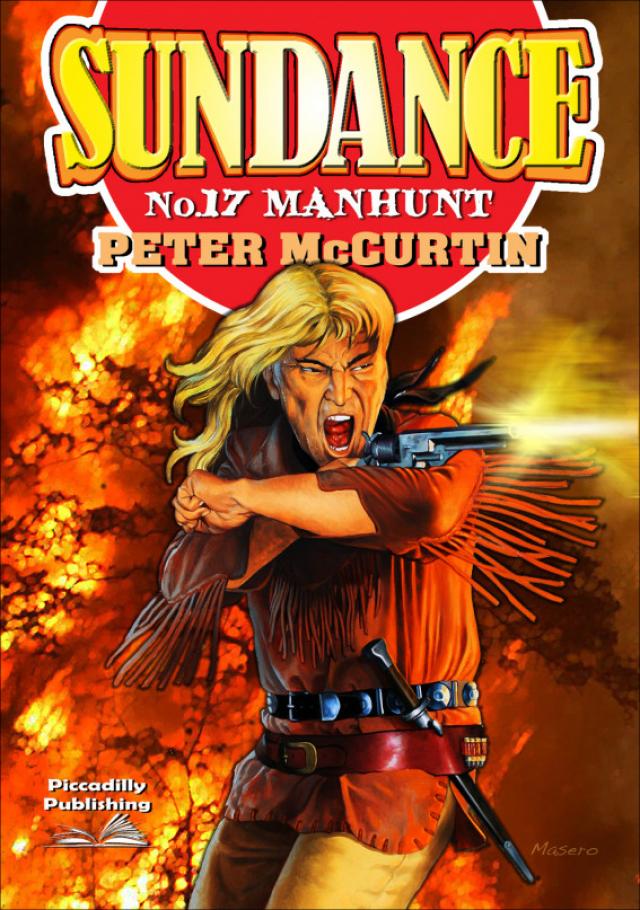
Sundance 17, p.5
Sundance 17, page 5


He saw nothing to alarm him: here a moose had crossed; there two wolves had loped down the trail for a short distance before turning into the timber. Yonder a snowy owl had caught a hare, leaving wing marks and blood drops in the snow. But there was no sign of any human passage.
Then he stiffened in the saddle. Suddenly he dismounted, went to his horse’s head, clamped his gloved hand across its muzzle, stifling a whicker just in time. Instantly, MacDougal did the same with his own mount, seeing, as Sundance did, the twitch of its ears forward, its sudden alertness. “Jim?”
“How far’s the cabin?”
“Less than a quarter of a mile.”
“There’s somebody there. Another horse, at least.”
MacDougal bit his lip. “Who the hell?”
“We’ll find out,” Sundance said. “Let’s tie the horses.” When this was done, he gestured. “You go out to the left, I’ll go to the right. Keep your eyes open.”
“Sure.” Expert woodsman, MacDougal faded into the timber on the left, Sundance vanished into the cover on the right. He moved forward slowly, wholly silent, pausing every few steps to look around. Once something rustled overhead, and he halted, eyes probing the darkness of the spruce. Then the sound came again and Sundance saw it—a pine marten, a small, squirrel-sized animal with auburn fur, high on a limb, staring at him with beady, glittering eyes. Sundance grinned tightly, moved on.
Ahead the woods thinned; there was a clearing. He worked to its edge, peeped through a screen of brush. His eyes narrowed. The cabin was solidly built, fairly large for a structure of its kind. From its chimney came a curl of smoke.
Across the trail, a squirrel chittered. Sundance turned, caught sight of MacDougal in the brush. Sundance nodded, gestured, and the trader understood. He swung farther to the left, Sundance to the right, working around the clearing’s edge. Sundance waited until MacDougal was in position at the clearing’s edge, gave another hand signal, then covered the cabin with his rifle while MacDougal dashed across the open, crouched low, came up to the window on the cabin’s flank.
Then the half breed broke from the brush, dashing through snow ankle deep for the front door of the cabin.
Reaching it, without pause he threw his weight against it. The door, unlatched, swung in. Sundance leaped through, rifle leveled. “Freeze!” he yelled at the figure feeding wood into the cast iron stove.
The figure jerked around, straightened, and Sundance stared. The woman’s eyes were wide and black, her hair, hanging in braids the color of a raven’s wing, thick and rich; her face was delicate with high cheekbones and a full, red mouth. She was in her middle twenties, and she was Indian, with all the unique beauty that Indian women have if they are not worked into premature old age or do not drink or eat too much. “Hell,” Sundance said, lowering the gun. Then he called: “Sam, come in here!”
The girl, hands uplifted, raked her gaze over him. “Who are you?” she asked in English. She was tall, and while the beautifully made parka and pants masked the outlines of her figure, he could see the swell of bosom beneath the garments. The only trace of fear she showed was a slight quaver in her voice.
Before he could answer, MacDougal’s voice said from behind him, both relieved and embarrassed, “Laughing Woman! I might have known! What are you doing here?” He came on in and shut the door.
“Sam.” The girl relaxed. “Why. shouldn’t I be here? It was my husband’s trapline. Now it’s mine.”
“I told you,” MacDougal said, “that you weren’t to come out here by yourself. Let that ride for now. Jim, this is Mrs. Murchison, Hank’s wife. Like I told you, her husband was one of those the Carcajou got. And—” he looked at her sternly “—you want the same thing to happen to you?”
“I am not afraid.” Her eyes went questioningly to Sundance, and MacDougal introduced him. “He’s coming to work for the Company at Storm River.”
Laughing Woman smiled wryly. “He’s very efficient. Good at taking women by surprise and frightening them.” She put out her hand.
“Mr. Sundance.” Noting something in his eyes, she went on with faint mockery. “Yes, I’m all Indian. But I was educated on the outside by mission fathers. And my husband was Canadian. And what are you? Half-Sioux?”
“Cheyenne,” Sundance said.
The mockery went away and there was respect in her eyes. “No wonder you surprised me. Now, the fire’s going. There’ll be tea in a minute. You gentlemen will join me?”
“Right. We’ll stay the night,” MacDougal said, “and then all go back to Storm River tomorrow together.”
“I am not going back to Storm River.”
“The hell you aren’t!” MacDougal snapped. “My husband is dead. But I know how to run a trapline, too.
“If you try to stay here, the Carcajou will do to you what he did to Hank—or worse.”
“Let him try,” she said harshly. She gestured toward a gun leaning against the wall. “I can shoot. And I’d welcome a chance to get him in my sights.”
“Sundance walked in on you and took you cold.”
“And I learned a lesson. It won’t happen again.”
MacDougal made a gesture of disgust. “We’ll talk about it later. Jim, I’ll go get the horses.”
“Watch your step,” Sundance said.
“Don’t worry about me.” The trader went out. The girl, Laughing Woman, put more wood on the fire, dumped tea in the kettle. Sundance rolled a cigarette, watching the easy grace with which she moved. Now the cabin was warming up. Laughing Woman turned from the stove, pulled the parka off, untied the heavy pants and worked out of them. Beneath, she wore a plaid woolen shirt and Levis, and these did not conceal the lines of a body at the peak of female ripeness, with large, high breasts, a narrow waist, full hips and long legs.
Laughing Woman poured tea, shoved the cup to Sundance, “So you’re working for the Company? Here to catch the Carcajou?”
“Here to do whatever Sam tells me,” he hedged.
She laughed, a deep throated sound, “Don’t try to fool me. I’ve been around. I know a gunman when I see one.” Then she was serious, her eyes glittering. “I hope you catch him! And when you do, by damn, I hope I get a chance at him before he dies! With this!” She touched a long knife at her hip.
“He killed your husband?”
Her eyes shadowed. “Yes. Hank came out to prospect his line, locate the best places for traps, while I visited my folks. I’m from a band over by the Chilcotin. Then they sent me word. Hank was dead.” Her voice broke. “The Carcajou had cut him up with an axe.”
After a moment, she regained self-control, poured tea for herself. “So now I am a widow. And perhaps one woman alone can’t fight the Carcajou. But in a way, running Hank’s trapline this winter will be a way of fighting him, defying him. Besides, what else am I to do?”
Sundance said, “Find another man.”
Her mouth thinned. “Just like that? I’m afraid it’s not that easy for me, Mr. Sundance. To begin with, what man? Some Indian trapper?”
“You’re Indian,” he answered simply.
“Yes. This black hair. This red skin. But ...” She shook her head. “Maybe it was a mistake. A mistake when they sent me outside to be educated by the white men. That didn’t turn me white. But now I can no longer be all Indian, either. I found that out this summer, visiting with my people. I am a woman, but I am not a squaw. My education has ruined me for that. I don’t intend to be old and withered by the time I’m thirty from chopping firewood and chaw-tanning caribou hide with my teeth and having a baby every ten months. I had begun to learn to be a nursing sister down in Vancouver when I met Hank and we were married. Now, I think I will trap one season here and take the money and go back and finish learning that. Then I can work in a hospital, or among my people, and perhaps fill the emptiness in my life now that Hank’s gone. But I’m talking too much and …”
She broke off and Sundance whirled as the flat double slap of a pair of rifle shots came from outside. “MacDougal!” Sundance rasped, snatched up the Winchester, and was out the door.
The light was growing dim, snow swirling harder. Another shot from somewhere to the right and two or three hundred yards away in the direction of the horses, and a cry of pain. Sundance cursed, running crouched. He made the woods, and, as the cry sounded once again, bent his course toward it. It was almost dark here in the spruce. A horse whinnied, frightened. Then, suddenly, from the darkness, a hundred yards off, gun-thunder sounded, and Sundance saw the bright wink of muzzle-flame. He threw himself aside, fetching up hard behind the bole of a big spruce, as lead made its ugly buzz inches from his body. Then he was working the lever and the trigger of the Winchester, hosing rounds into the darkness, firing in a spread, at that muzzle flame and on either side of it.
A hoarse voice yelled something formless. The firing stopped. Sundance waited. Then there was a crashing in the woods, the. noise made by a running man. Sundance laced the last rounds from the rifle in that direction. In the snow and darkness, it was impossible to see whether he’d sent a slug home or not, but the chances were against it. The crashing went on, fading away, the sound of a man in panic—or in pain—getting out of there, and fast. Sundance waited, fumbling rounds into the rifle from a supply of cartridges in the pocket of the parka.
And now the woods were hushed and silent. Sundance eased out from behind the tree. Noiselessly, like a big gray wolf in the twilight, he loped through the spruce, and just before he reached the horses, he halted, listening, straining his eyes to penetrate the gloom. Taking cover behind a spruce, he called, softly, “Sam?”
His answer was a groan. Sundance’s mouth twisted, and he moved on, bent low. He reached the frightened horses, pulling at their tie ropes—and then he saw the sprawled figure lying in the snow, and the red stain spreading in the whiteness around it. With one last cautionary look, Sundance ran forward. “Sam!”
“Jim.” There was sickness in MacDougal’s voice. “Bushwhacked. Sonofabitch got me through both legs. Bleedin’. Can’t get up.”
“Lie easy,” Sundance said. “I’ll—”
“Sundance!”
The voice came from behind him, and he whirled, bringing up the rifle. A shape emerged from the gloom, and Sundance eased off, cursing softly, as he recognized it. “Damn it,” he rasped, “don’t come up behind a man that way! I almost plugged you! What are you doin’ out here?”
Laughing Woman ignored that, shoving past him. “Mac—is he hurt?”
“Took a slug through his legs. He can’t wal—” Sundance broke off as he saw a knife in the girl’s hand.
“Easy, Sam,” she said. “Let me see.” Deftly she slit his pants legs. It was so dark now she was working by touch. In a minute she said, “No bones broken. Lot of muscles torn up, a lot of bleeding. But he’ll be all right. I’ve got to have some cloth.”
“Hang on.” Sundance pulled his knife, slashed the ties of the bedroll behind his horse, pulled out a clean flannel shirt. The keen blade of the Bowie sliced it into bandages in seconds. “Use that. I’ll make a litter.”
“Right.” Her voice was steady as she went to work.
Sundance found a big four-point blanket, spread it out. With the knife he hacked two long, straight saplings heavy enough to bear MacDougal’s weight. They would make the handles, and deftly he folded the blanket around them in such a way that MacDougal’s heft would hold it in place, without the necessity for any ties. They rolled MacDougal on it, and after Sundance had tied the horses together with the lead rope of the one in front looped around his arm, he took one end and Laughing Woman the other. She had strength to spare, and they lifted him easily. Then they carried him down the path to the cabin. Sundance’s spine prickled along the way; there might still be a gunman out there in the spruce, and even in the darkness, with both his hands encumbered, they were sitting ducks.
But there was no more shooting. When they reached the clearing, he set down the stretcher, checked the cabin before they brought MacDougal in. “The bastard could have doubled around, been waiting for us here,” he told Laughing Woman.
“You don’t take any chances, do you?”
“No,” Sundance said. “That’s why I’m still alive.”
Shutters closed, he lit candles, and in their light the girl worked on MacDougal, who was unconscious now, while Sundance put up the horses in a stable out in back and fed them. Returning to the cabin, he said, “This looks as much like a homestead as a trapping layout.”
“We intended to make it one,” Laughing Woman said, and there was a catch in her voice. “But the Carcajou fixed that, all right. At least he didn’t get Mac, though. It’ll be a while before he walks or rides again, but you can get him to Storm River on a travois in a few days.”
“We can,” Sundance said.
“No. I’m not going with you. I’m staying here.”
“Nope,” Sundance said. “Not if I have to knock you out and drag you back. You wouldn’t last a day here alone.” His voice roughened. “It wasn’t Sam and me that gunman out yonder was after. Far as the Carcajou knew, we’d already been taken care of. That was somebody lookin’ for you, to give you the same treatment he gave your husband. Besides, you know the way to Storm River and I don’t. You can save me some time and Sam a lot of pain by goin’ along.”
Laughing Woman hesitated, then nodded. “All right,” she said. Then defiantly added, “But as soon as we get him to Storm River, I’m coming back here and string my trapline.”
Sundance did not answer. The cabin was warm and cozy now, and he brought in a bucket of snow, set it on the stove, let it melt. “Mind if I wash up?”
“Go ahead. All the way if you want to.” She grinned. “I was raised in an Indian camp and I worked in a hospital, and I’ve been married. I know what men look like.”
Sundance grinned back, raking his eyes over her ripe body. “I’ll bet you do,” he said. He liked this woman, liked the grace and strength and courage of her; and her beauty and her richly curved figure stirred him. He stripped his torso bare, washed himself to the waist, and he was aware of her eyes on his own coppery, muscular body.
“You have,” she said in awe, “got a lot of scars.”
“Sometimes I don’t duck quite fast enough.”
“You’ve done an awful lot of fighting in your time.” She came to him, boldly touched a long pucker on his flank. Her fingertips were light and warm. “What made that?”
“Crow lance. I was stealing a buffalo horse he had tied outside his teepee when I was seventeen years old. Trouble was, he woke up and caught me and nearly sliced my liver out.”
“And what about him?”
“He didn’t duck fast enough, either.”
She turned away. “Go ahead, don’t mind me. I know how you Cheyennes are. You like being clean. Not like the white men up here who won’t bathe from one spring to the other. Finish your bath. I’ll cook supper.”
Sundance nodded. Without self-consciousness, he finished stripping, washing, and then when he was dressed, went over and looked at MacDougal. The man was breathing regularly, but he was unconscious: shock, Sundance guessed. By then, Laughing Woman had some soup ready, and she ladled it into MacDougal, knowing he would need both the liquid and the nourishment to replace lost blood, but he barely wakened, and was soon out cold again. Sundance and the girl ate heartily of deer liver and potatoes—the girl had killed a deer on the way from Storm River. Meanwhile, he pumped her for all the information possible on the territory and its inhabitants. Her feminine eye would have spotted things MacDougal would have overlooked, and as an Indian she would have heard things that would never have reached any white man’s ears.
“What do the Indians think about the Carcajou?” he asked.
“They’re of two minds. The foolish ones think it’s an evil spirit; the smarter ones know it’s a killer, or a gang of killers. Either way, they’re scared. A lot of ’em won’t trap this season. I don’t know how they’ll stay alive or pay their debts to Hudson’s Bay, but you can hardly blame them.”
“And why aren’t you scared?”
“Maybe I’m too dumb. Or too mad. Besides, out here at least I’d be away from Owen Cameron.”
Sundance sat up straight. “Who’s Owen Cameron? Mac told me there was a Mountie named Cameron.”
“That’s right. Constable Owen Cameron, Northwest Mounted Police.” Her mouth twisted. “Oh, he’s a good policeman, I guess. Damned good. In the three, four months he’s been stationed at Storm River, he’s cleaned up a lot of trouble, straightened out a lot of tough people. But they ought to let those men marry and bring their wives out here with them. It would take the pressure off us Indian squaws.” Her voice was rueful, sarcastic.
“Cameron’s been after you?”
“After anything that’s female, but, yes, mostly after me. Ever since Hank got killed. Well, all right, he’s big, big as you, good looking, not thirty years old yet and randy as a bull moose in rut. All that’s fine. Only—”
“Only—” Sundance said.
“Only Owen’s full of sweet-talk. But none of that sweet-talk includes marriage.”
“Why should it? Way I understand it, they’re not allowed to marry until they reach a certain grade.”
“That wouldn’t make any difference to Owen Cameron. Not where an Indian woman is concerned, even one with a white man’s education. We squaws are just supposed to flop over on our backs every time a white man comes around, especially if he’s wearing that pretty red coat. But marriage to an Indian!” She laughed bitterly. Sundance nodded. It was an old, a universal problem wherever whites and Indians intermingled. His father had been one of the few whites who had stayed faithful to an Indian wife for years. He had known many white men who took Indian women casually and then abandoned them as if they were no more than dogs.
“So the hell with Owen Cameron,” she said. “And the hell with talking about him, too.” She shoved away her plate, went over and looked at MacDougal. “Out for the night. Sundance. What about another bucket of snow?”