

Dragged up proppa, p.6
Dragged Up Proppa, page 6
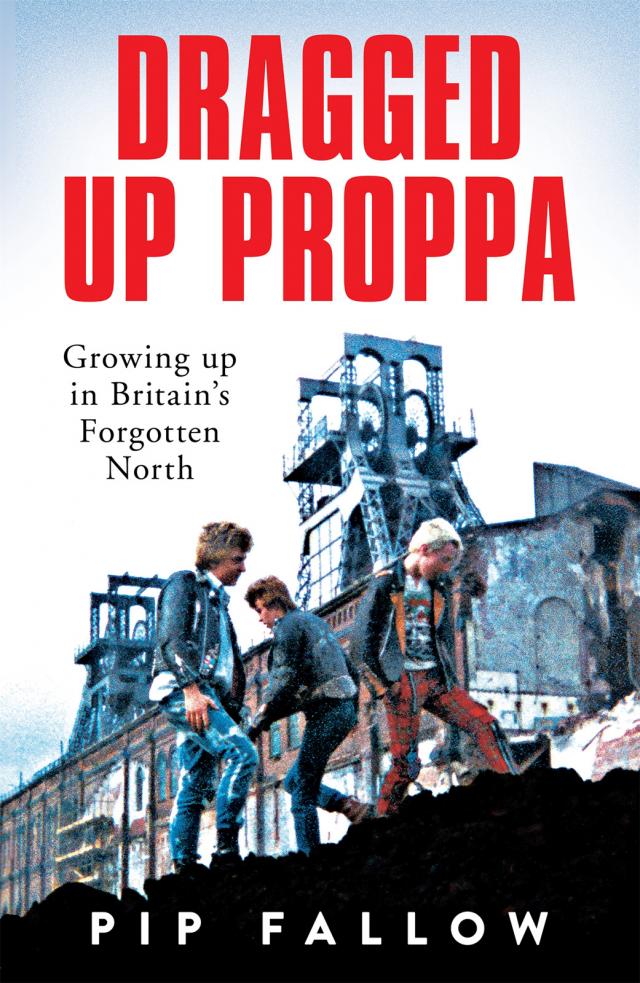


My first three years at infant school were easy. Looking back on those days now, all I can feel is an overall sense of mothering. Lots of what seemed like very old women fussing and being kind. I felt popular and liked, the food was hot and good and I remember being let outside a lot to play. Being let outside was very important to me then. It still is today.
The infant and junior schools were joined together. The building itself was a red-brick affair with separate yards for boys and girls surrounded by black spiked wrought iron and right in the centre of the village, under the massive daunting shadow of the iron pithead. It was under its shadow in every sense. It seemed the pithead, like the school building itself, was part of life’s big plan. You started at the south end aged four and every year you were moved up a class and a step closer to the north end of the building. Eventually at the age of eleven you fell out of the north end of the building onto the cobbled streets, picked yourself up and started at the comprehensive school which was just that bit further north and just that bit closer to the dark hole that was to be your place of work for the next fifty-something years.
From my classroom window, I would look up at the massive cast-iron pit wheels spinning and listen to their hum, their whizz and then their clang. My father was the on-setter, which meant he sat at the bottom of the shaft, and was partly responsible for the sound. His job was making sure the men were safely in the cage before sending them, or coal, up when all was well. I would know when he was down there and felt connected somehow to that sound. It seemed its dominance and sheer might, together with its constant chiming, were the drive for a very slow-moving conveyor belt sucking me and all I knew towards that shaft. I felt glued to that belt and powerless to get off.
Following my five brothers through school carried expectations and I don’t think, for me, this was a good thing. I couldn’t help thinking the teachers were disappointed and expected a little more. Number one son had been a high achiever and had passed his eleven plus, gone on to grammar school (too good for the pit!) and had later become a fire chief. Number two had been a very high achiever and had gone off to be a fighter pilot in the RAF (definitely too good for the pit!). He didn’t make the grade actually and after two years of flying they had made him an aircraft engineer. Number three son was the welder at Easington pit but had been a very strong character and had definitely left his mark. Number four, Calum, had been excluded from the mainstream education system for violent behaviour. He had been getting bullied, had waited outside the school for the bully and had taken things a little too far. He was not allowed to mix with other pupils and had been removed from the comprehensive school and put back into the junior school where I was and spent his last year in the education system having one-to-one tuition because he was deemed a threat to others. I would often see Calum sitting face-to-face with his teacher in his own classroom, but I was not allowed to speak to him inside the school building. We would cross one another in the corridors and have to ignore each other, but then he would wait outside the gates for me and we would chat and walk home together.
It didn’t do him any harm. Today he is the chief executive of some local government department somewhere or other, getting very well paid for doing a job I don’t really understand. Number five son, Nigel, hadn’t helped my cause at all. Perhaps I should have pushed him harder down those wooden stairs. I think he was a mathematical genius because he had been taken out of the system and sent to a college where they possessed the right resources for concentrating on his talents. He studied pure maths for a while before doing a masters in Civil Engineering. Then there was me and for some reason I was having difficulty reading and writing and I think this was the time of my life that this started to become a problem. Today they would have a label for it. Dyslexia or dyspraxia or something or other. What the teachers called it then was ‘backward’. I could recognise letters and know their sounds. I could build up the letters, put the sounds in order and read a word. I could slowly but surely build up the sounds in a series of words and read a sentence, but the effort involved would leave me with no recollection of what the sentence had said. This made most subjects difficult and all written exams impossible.
As I was moved a few classrooms further north, I started my four years in junior school and this was when things started to get sticky. I think I must have been a Marmite child. Some teachers liked me and would go out of their way to help me and others would only shout at me, wouldn’t have me in their classrooms and would call me a dunce and a retard.
Things haven’t changed so much. I have three sons and my youngest had exactly the same problems as me. I found myself at his school on three different occasions telling three different teachers, ‘It doesn’t matter if you don’t like my child, your job is to pretend you do and to teach him.’ They all took it on the chin actually and one young lady teacher actually broke down and cried and apologised for failing in her duties. I don’t blame the teachers. I don’t think I would have ever recognised these failures in the system if I had not once been that boy. It was the same with his reading and I was quick to pick up on that too before it became an issue. I think it is easy to solve a problem if that problem was once yours and you know it inside out. He is a very funny boy who puts humour above all else. He is good at sports, has never looked at a television in his life and hates walls around him. It was easy for me to teach him to read; all I did was make sure it was fun, and on a subject he would be interested in and then familiarise him with what he was about to read so he didn’t have to concentrate so hard on the plot as he was concentrating on the words. I don’t think he will ever read for pleasure but he is getting on very well in life. Back to the plot.
Apart from the dinners, things got quite unpleasant for me at school. I have very sad memories of being stuck inside the school building whilst everybody else was running about outside in the sun and air. One teacher, Mr Sanderton, would shout out ten words like completion, commotion, companion, and so on, and we would have to write them down on a piece of paper. We would then have to line up, present him with our papers and if they were spelled correctly, you would be allowed outside to breathe. This would result in me rarely getting out and the few times I did were because I had cheated. He was on my case and if all ten were correct, he would shake his head and say, ‘I don’t think so, boy!’ The bastard would know and would make me write them out again in front of him.
Some kids could not spell at all and would be let out without question. I think they were seen as lost causes. The write-offs. Completely backward. They had it good, they didn’t have to do anything to be allowed outside. I think the teacher wanted them out of his way so he could teach the worthy. I remember wishing I was fully backward like them and not only half backward like I was. I even had a few teachers hoodwinked. I would slow my words, slow my speech and limit my sentences so they would think I was a lost cause. A write-off. It worked and often I would be ignored and left alone. Anything for an easy life. It seemed it was survival of the thickest.
There were a few lessons that if you pretended you were interested in, you could get out of the classroom. Gardening was one. Being in the hottest, most boring greenhouse in the world was a thousand times better than being in any class, but it was seasonal and didn’t save me for long. I joined the choir but that came to an end when they realised where the noise was coming from.
I hated Mr Sanderton and once stole his chalk and wrote SANDBAG IS A BASTERD in huge letters on the brickwork outside his classroom. I got caught for the crime and found guilty straight away because I was the only one in his class arrogant, yet backward enough to have a go at spelling bastard and fail. He beat me badly, which was frightening, but the bit I remember most about that beating was the reaction from the rest of the class. As he struck me repeatedly, all the boys stared down at the floor, whilst all the girls pulled their school jumpers over their faces and sobbed uncontrollably. He blamed me for making the girls cry and I clearly remember him shouting, ‘Now, look what you have done!’ as he beat me more. His weapon of abuse was called the slipper but was, in fact, a shoe. He kept it hung high on a nail to the right-hand side of his blackboard. It was blood red, ridiculously long and pointed and must have surely one day belonged to a giant clown. That day he grabbed the shoe, by the toe, with his right hand and my hair with his left. He swung at me repeatedly, hitting me with the heel until my hair came out in his hand. He threw my hair on the floor, grabbed my collar and continued.
Next time you are fortunate enough to be in the company of a ten-year-old child, look how cute they are, take the time to look at the size of their bodies. Their height, their small legs, look how thin their arms are, imagine how much they weigh. FFS.
A few days later, whilst in the bath, my mother realised clumps of my hair were missing and then spotted my arms were covered in bruises. I had sacrificed my arms to protect my backward brain from his blows. Sensing her high level of concern, I told her the truth about what had happened. The next day, she told me I had to help her with her cleaning job at the pub and she would drive me to school. I thought I was in trouble. Those days if you got in bother at school and your parents found out, it usually meant you got a second round of bother at home. We arrived at the school and she told me to wait in the van while she had a meeting with Mr Sanderton. I could see her but not hear her through the window as she leaned across with knuckles pressed into his desk and shouted at the teacher with all her fight! She returned to the van composed and very calmly explained that if I kept my nose clean, Mr Sanderton would not be hurting me again, before explaining to me how very important it was that I didn’t tell my father about ‘any of this’. She then smiled and told me to get into school and do exactly as told. Not sure to this day why father was to be kept in the dark. Perhaps she knew he had at some point in his life become tired of murdering people and was scared he might relapse.
Mr Sanderton never hurt me again. Better than that, he seldom spoke to me thereafter. The only time he would speak to me was when he told me to get outside with the rest of the halfwits and write-offs so he could get on and teach the worthy. It felt like a huge weight had been lifted from my shoulders and I enjoyed the sun, the space and freshness of the air. I hated being in that room. I would stare out at the pit pulleys as they hummed loudly and spun so fast that their spokes would blur and vanish, before magically appearing again as they slowed and then stopped with their whizz and that clang. I would then look across the corridor at Calum, head to head with his one-to-one teacher before staring back at the slipper and realising there was no escape. It continued like that right up to the day I fell out of the north end onto the cobbles, picked myself up and started my five-year stint at comprehensive school. It seemed I was caught in a trap. It didn’t matter what I did, I was being slowly drawn closer and closer to that ‘provider of all’ black hole at the bottom of the village and every time I tried to grab on to something solid, it would simply snap off and turn to dust in my fist.
5
My mother
Where do I start? At the beginning, I suppose. There was a twelve-year age gap between my mother and father which meant she had a much better deal in her childhood and lost only one sibling. Billy died before his second birthday. Poor Billy. Didn’t even live to see the bottom of a pit shaft. Eight survived. My mother has very early memories of creeping down the stairs with two of her sisters in the dead of night and seeing Billy’s tiny white coffin with its shiny brass furniture laid out in the middle of the front room. They were very young and had no concept or understanding of the finality of death. She remembers being excited and thinking the coffin containing her brother was a cake.
If my father looked like Tarzan, my mother looked like Jane. She was a beauty queen and beat thousands to win the Miss County Durham beauty competition three years running. She won it on the fourth year too but some bastard grassed her up for being a Mrs and not a Miss. And because she was married with two kids she was duly disqualified and asked not to enter again. She was, and still is, highly intelligent, but intelligence then was not something a woman should display or be recognised for. She was sent to grammar school at the age of eleven and excelled, but after a few years her father judged she was getting a little above her station and at the age of fourteen she was instructed to stop attending school, forget her studies, help her mother with the upbringing of her seven siblings and assist with domestic chores. Her wings clipped.
She was brought up with nine other members of her family in a two-bedroomed colliery house. The house, 67 Tenth Street, was straight opposite my father’s house, at the top of the village, and as you can imagine was tightly wedged between Ninth Street and Eleventh Street. I remember the house well and would visit my grandparents at the weekends. To see a house like that today you would have to visit a museum. There was a coal fire burning in every room. All cooking was done on the fire and there was no bathroom. There was an outside toilet at the bottom of the backyard next to the coal house, a single external cold tap, a tin bath hung on the wall just outside the back door and a huge photo of Queen Elizabeth II on her coronation day hung above the fire on the chimney breast in the living room. I’m only fifty-five now and can hardly believe this is how people lived in my lifetime. When I tell my kids about how my grandparents lived, they look at me like I must be a phantom who has just celebrated his four hundredth year alive. Perhaps I’ve turned into one of those dads.
The house was always full of wonderful smells and if you weren’t hungry before you went through the back door, you were starved by the time you got sat on the wooden framed two-seater sofa with its hard, brown nylon cushions. I don’t think I was ever as hungry as Brocken, the skinny black ’n’ tan Jack Russell who lived in the backyard but was secretly allowed on the hearth rug when my grandfather was not in the house. Brocken survived on humans being clumsy and was only ever fed if food was accidentally dropped or slipped to him by us sly kids.
I don’t think I ever saw my grandmother sat down and I can’t remember ever seeing my grandfather stood upright. She was a large woman who didn’t ever stop, was constantly on the go, tending to the two fires upstairs and the two fires downstairs or my grandfather’s needs. My grandmother loved the Lord. My grandmother loved her Guinness, and my grandmother loved Brocken. I think she loved them in that order. Her twelve half bottles of Guinness would be delivered in a wooden crate by a wooden-backed brewery wagon every Friday. It must have been before off-licences or before women were allowed in pubs and every week the wagon would drive around the colliery streets dropping off beer in backyards for cash. Two bottles per night but nothing on a Sunday, Sundays being the day of the Lord!
I remember Stan the postman delivering a letter one Tuesday morning while I was there. It was from the brewery. It read that Brocken the dog had bit the brewery man on the back of his calf on his way out of the gate and if nothing was done, there would be no delivery the following Friday. I called around the following week and asked where the dog was.
‘We had it destroyed on Wednesday, son. He was nee good!’ she explained.
My grandfather was everything you would expect from a Durham miner. He looked like Clark Gable and shared the same perfectly trimmed moustache. He worked down the pit from the age of thirteen until the day he was sixty-five, always wore a three-piece suit with a trilby hat, had racing pigeons and was chairman of the committee at the working men’s club for over thirty years. If I ever needed to prove my working-class roots, I would fall on this man. If I am a quarter of him, that should be enough to give me a bloody good pedigree. However, he was a man I never liked. Despite not ever doing anything for anybody he would constantly be ranting about somebody he had once asked to do something for him and because they hadn’t, how useless they were and how they had done him wrong. He had no humour and thought the world revolved around him. It did.
They had two bedrooms upstairs, a cupboard-sized kitchen off the back of the house and two living rooms downstairs but only one would be used. The front room was ‘kept for best’. It was full of all the best furniture that was not allowed to be sat on and had a china cabinet in the corner which contained the best plates that were far too good to eat from, teacups that were too good to drink from and in the middle of the floor, a mat too good to walk on. Not sure what ‘kept for best’ actually meant. Not sure if everything was kept for better people or for better days. My grandmother didn’t get any better days. She dropped dead on the living room floor, looked down on by the cheap glossy print of the Queen in her gold, diamond-encrusted crown. She died between stoking the coal fire and making her man a mug of tea. A hard life lived. I remember one of my aunties commenting that at least she hadn’t suffered, and my mother correcting her and saying she had done nothing but. My mother has always felt cheated in this respect. If her mother had only lived a little longer, they could have showered her with the niceties that today we refer to as the basics. Perhaps we can all learn from this.
After her death my grandfather fully expected his daughters (not his sons) to step up and tend to his every need; and they did. Much of his time spent down the mine had been on his knees shovelling coal and within a few years of retiring both legs had been amputated above the knee. He would shout out his one-word orders from his armchair.
‘Sandwich! Tea! Biscuit!’ And they would be placed on his knee. Or rather his lap.
I got the job of keeping his fire alight. I did this for about four years. I would call around early on a morning before doing my paper rounds and liberating my chickens. My job was to put the kettle on the gas hob on entry, empty the teapot, put two pushes of loose tea into it, which came from a white bottle-shaped plastic PG Tips dispenser that was fixed to the wall with a big black button on it, pour the boiled kettle onto the loose tea, rake the fire, take out the ashes and put them in the metal bin outside, put coal on the fire, fill his two metal buckets from the coal house, pour his tea through a strainer into an enamel mug, which looked to me about the same size as the metal coal buckets I had just filled, and leave it next to his armchair for when he got up – a job he never once thanked me for. If I learned nothing else from this man, it was how not to be.


