

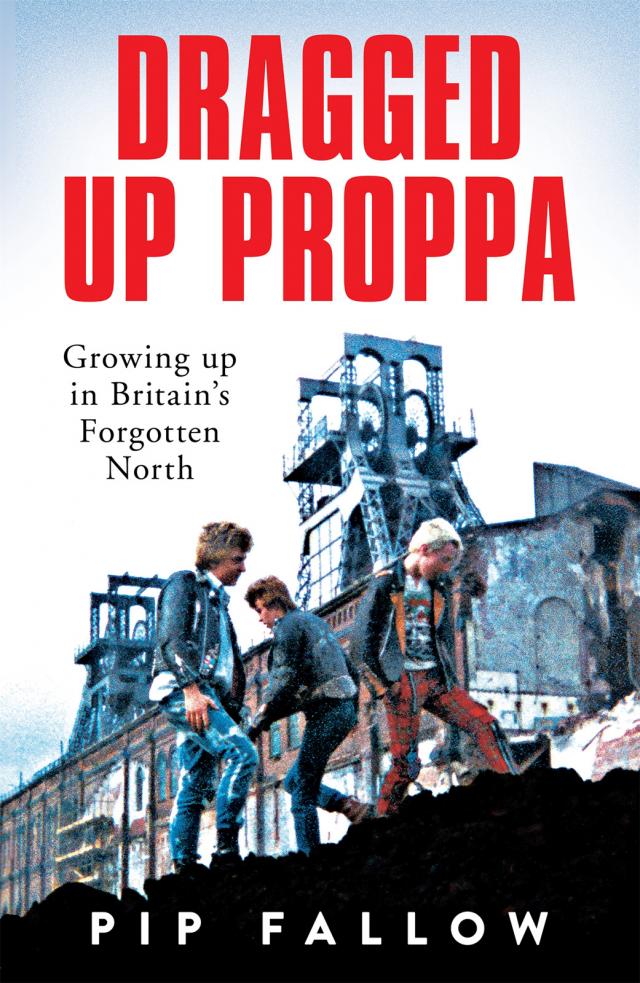
Dragged up proppa, p.7
Dragged Up Proppa, page 7


Every morning, as I went to leave, he would shout from his bedroom, ‘Have you filled the second bucket?’
To which I would answer, ‘Aye!’
To which he would say, ‘. . .’ Nothing. One morning I filled the second bucket but he didn’t ask if I had done so. My Auntie Rachel found him dead one hour later when she called to check on him. To this day, I still regret not going back and checking on my grandfather that morning. After all, I’d wasted two pushes of loose tea.
My mother was six when war broke out and almost twelve when it ended. She remembers those days very well. The village only suffered one air raid. The German bomber dropped three bombs before being shot down. One of the bombs hit a house only one hundred yards from where my mother lived and killed a family of four. She was in a concrete shelter with her brothers and sisters when the bomb thumped outside. The blast moved the shelter they were in a couple of feet across the street. There had not been enough room in the shelter for her mother and father and the children had sat in silence, wearing their gas masks and staring at one another thinking their parents had been blown to pieces outside. No wonder they remember those days so well.
When my father left for war, my mother was a kid in the street. Thirteen years later, he walked her home from a village dance and the rest, as they say, is history. My grandfather didn’t quite like the idea of his daughter being involved with a man who had been away for so long and done and seen so much. Someone who had what we might call today ‘baggage’. However, love is love and after a two-year courtship my twenty-year-old mother was married to my thirty-two-year-old father at the village chapel. I think they were very well matched in the sense that they both seemed to put humour above all else. If there is an ethos running thick through the veins of small colliery villages, it’s ‘if you don’t laugh, you’ll cry’, and I think them as a couple personified this ethos. Another thing they seemed to have in common was they seemed to look down at the world from up above. They had a global view on almost everything. Whereas most people I knew would put their heads down, get on with life and question little, my mother and father would question everything. I think in my father’s case it was because he was so well travelled and had seen so much. I think in my mother’s case this was merely an indication and proof, if needed, of her intellect.
For six years I watched my mother study. I would get up to use the toilet in the early hours of the morning and she would be there in her chair, halfway through some assignment or other. A few hours later she would be getting us up for school, seeing us off and shooting off to school herself to teach. I really don’t know to this day where she found the energy to achieve what she did. There were a few periods when she had to go away to university for a week. I think this only happened twice and I don’t remember this for any other reason than my father was left in charge and we lived like savages. As soon as she walked out of the door it was like we were in an SAS training camp. There would be a huge pan of beef stew that he called ‘scouse’ and nothing else. Everything in that pan, apart from the meat, came from the garden and if you didn’t eat it, you starved. Funny how things stay with you. I made a pan of that same scouse only two days ago. My kids took one look at it and went out for food. Don’t know what’s good for them!
After four years my mother had her degree and was employed full-time as a school teacher. After another few years my father had been made redundant, my mother was headmistress and my father would make tea for her coming in on an evening. She must have looked down at her plate each night and thought she had joined the Foreign Legion. My mother worked until she was sixty-three. They travelled and enjoyed a happy retirement together.
She is eighty-seven now and had a stroke shortly after the passing of my father. She fights her disability with such ferocity that sometimes I forget just how hard she has to fight.
It’s quite common and a bit of a cliché to compliment someone by saying they taught you everything you know. But in the case of my mother and me, it really is true. In fact, she is still teaching me more and more each day and probably will do for the rest of my life. If I ever have to judge a person or a situation, my brain subconsciously checks it out with ‘what Mother might think’ before my decision is made. If I was to borrow my father’s thoughts, I fear the very same method would land me in jail. So, I don’t! However, the system of my mother guiding me through life without me hardly being aware seems to be reasonably successfully and the only time I appear to get it wrong is when I have misjudged what my mother might have thought. Perhaps I should listen to her more.
I suppose you are wondering, If she is such a wonderful mother, then why didn’t she teach you to read? Well, I think the answer is this. At a young age, I would have to sit on my mother’s knee and read a book. I hated this and knew the books were for someone half my age. I would slowly work through the book and then the next time we sat down it would be like I had never seen the book before. I would fill up and cry uncontrollably and my tears would splash onto the pages. My brothers would sense my discomfort and plead for her to leave me alone. I don’t think I cried because I couldn’t read, though I suppose if I could have read there would have been no crying. But it was more complicated than that. I think I cried because I disappointed. Have you ever tried to teach your own child how to drive? I have, three times and it doesn’t seem to work. Each time I have tried, I have given up and handed the job over to a professional instructor. It works. Not only does it work but they think the instructor is cool and you’re not. I have thought long and hard about my failures in this field and spent time wondering what they have got that I haven’t. But that’s a simple one: it is, I think, much easier to teach without the powerful and confusing presence of love.
Those days are over now and I’ll let you be the judge but I think I might be getting the hang of this reading and writing thing. However, I do get everything I write proofread. By my mother, of course. Hope when you proofread this, Mother, your tears don’t splash on these pages. That was not my intention. Love, Pip x.
6
Comprehensive school
There was a huge drop in the birth rate, here up North. I’m not sure why, probably because of the pill. But it had been too late for me – I’d missed that one and had already been born. Instead of everybody having families of sixes and sevens like mine, the rate had dropped to two point two. Some schools had closed due to the lack of numbers and some had fought to stay open. The comprehensive school in my village had been one of the survivors. How this affected me was that when I started the comp, I hardly recognised a soul. Double-decker buses packed with kids were being drafted in from the next pit village which had lost its school and I didn’t know any of them. The new kids were a strange bunch and it didn’t take long to realise their junior school had not been of a good standard. In fact, there was nothing they did or said that gave any indication they had actually attended a school.
This was perfect for me. My backwardness became so well diluted, I almost looked clever. Or at least average. There were seven classes of thirty-eight and within the first month we had been streamed according to our ability. There were no kids from the next village in the top two classes and I was placed in the fourth. It read like I was mid-table, which kept my mother happy, but what she didn’t know was my class was like a box of monkeys.
It wasn’t that the communication line between my school and my parents had been severed, it was more a case that it had never been put there in the first place. I can’t remember a parents’ evening and if there was one, I think the majority of parents would have probably felt too intimidated to return to the school. My parents weren’t in that category but most were and a culture of ‘parents should not interfere in their kids’ education’ had become a village norm. There had been several generations of poorly educated children churned out by the brutal system before us. Yesterday’s under-achievers were now the mothers and fathers of today’s under-achievers. Thinking about the state of that system now, I believe this was probably part of the problem. The chasm in the disparity of intellect between school staff and the people who had not long left, and were now parents, was so wide, a two-way understanding between both parties could never have been established.
The teachers drove in daily from afar and the headmaster’s attitude was one of ‘all the teachers are better human beings than you lot!’ He would remind us of this at the beginning of every day. We would gather in the school hall and he would tell us how disappointed he was in us and how we should show more gratitude to his staff as they could be doing something better in life but had instead decided to give up their valuable time to help us. He would tell us how they were trying their best to make something out of us, but it seemed we were not interested and how it appeared to him we were happy to remain the ‘nothings’ that we would always be.
I can’t remember anybody having a good relationship with a teacher. Apart from a girl in the fifth year that fell pregnant to a geography teacher. I think the headmaster was probably half right about the teachers being better humans than us because the geography teacher made an honest woman out of the girl and married her as soon as she was sixteen. I say only half right because by the time I was in my fifth year he had divorced her and had another pupil pregnant. The arts teacher was probably a better man. He had a sexual relationship with a boy but had the decency to hang himself before it became public and his wife found out. What inspiring mentors they were.
As I went from the first year to the second year, I was actually moved up a class. Don’t ask why, but I was. I was average at maths and a few other lessons that didn’t involve reading and I can only think this tipped the balance. My mother was pleased. On paper it looked like an improvement and a step up. But what she was oblivious to was that the teachers had given up on half the school and I was still surrounded by monkeys. Don’t get me wrong, these were good monkeys, funny monkeys and definitely cheeky monkeys, some of who are still good friends of mine today. Who knows, perhaps I was the biggest monkey in that room? Whenever I meet someone from that time of my life, I am always reminded that I most certainly was. To put things into perspective, class six did nothing but the gardening around the school grounds and class seven picked up the litter, emptied the bins, kept the school’s boiler stoked with coal and kept the teachers’ cars clean. Inside and out.
It stayed like this for a while. It was fun. Half the school was learning very little and the other half was learning nothing. Half the school was treading water because as a man you weren’t allowed down the pit until you were sixteen and the other half were treading water because as a female you couldn’t be a housewife until you were eighteen. In our third year we got to choose what lessons we would like to take. The school must have been following some national curriculum that might have been understandable or relevant in Surrey or Kent but to us pit fodder it seemed like mush. The girls seemed to go one way (domestic sciences) and the boys another (technical skills).
Maths and English were compulsory and apart from them, I chose subjects that didn’t involve reading. Before I knew it, I was in my last year.
The best way to catch a mouse alive is in a milk bottle. They had to be trapped; if left alone they would eat tomatoes, and tomatoes were money. What those hungry little bastards didn’t understand was that when you are fifteen years old, money rules. A battle of wits, man against mouse and there could only be one winner. Me! After attending to my grandfather and finishing my two early morning paper rounds, I would release the padlock and heavy chain from the rusted old tin-sheet gate of my allotment, get myself, my panting dog and bike inside, before clanking it shut. Bliss. This was my world. The first job would be to lift the hatch on the end of the chicken shed. Now morning had broken and Mr Fox was safely back in his den, the hens could be liberated. They would squawk and flap as each and every one would compete to get their share from the enamel mug of corn scattered on the soil whilst I would enter the shed and steal their eggs, placing them carefully in the bottom of my straw-lined tin bucket. Just like tomatoes, these were also money.
With about four dozen hens and a long wooden greenhouse my father had built but then lost interest in, it was really quite an industry. It was all a daily routine to me: two paper rounds, collect the eggs, pick and bag up all ripe tomatoes, lock up, deliver three dozen eggs and four one-pound bags of toms to my customers before dropping off my dog, throwing on my uniform and pedalling off to school. However, casting my mind back now, there is one particular day in my last year at that school which seems to jump out and poke me in the eye.
How can I get out of today’s English lesson? I wondered as I folded up and pushed the Sun newspaper through a letter box whilst lifting a pint of milk from the step and skilfully slipping it into my bag. Thatcher had stopped school milk so I pinched one every day. I always took them from Sun readers. The Sun had not been kind to us during the last strike so I’d decided if anyone was to be robbed, it should be the Sun reader. Probably Tories anyway. I never lifted milk from the same step twice, obviously; that would be suicide and a sure way to get caught. If a family lost one pint every day, my thinking was they would be out to get me, but if they only lost one every six/seven weeks, they were hardly about to build a hideout in some corner of the garden and camp out in an effort to bust me. Anyway, back to my thoughts that day. How can I escape that one hour in a hot classroom doing English with Mrs Black? I asked myself as I cycled, no-handed, whilst slurping at the warm stolen milk. God, I hated her, with her pink, thick-framed, pointed glasses and her wicked lust for embarrassing people. Especially me. Actually, thinking back to those times, I didn’t hate all of school. It was only the dreaded English lessons I despised. Twice a week they came, Wednesday mornings and Thursday afternoons. English Language one day and then English Literature the next. Who knew the difference, I’m not sure, only the teacher I reckoned! I’ve got an idea, I thought as I slipped the empty milk bottle into my paper bag and grabbed the Curly Wurly I had nicked from the newsagent’s counter whilst picking up my paper bag earlier.
I reached the garden, sorted out the chickens and entered the greenhouse. If you haven’t caught a mouse in a milk bottle and you want to know how it is done, it is now time to pay attention. What you do first, and this is essential before setting the trap, is snap a truss from a tomato plant and rub its thick, pungent, green leaves into the skin of your fingers to rid yourself of all human odour. When your fingers are green and stinking then you can get started. The secret is to bury the empty milk bottle halfway in the soft soil at the foot of a plant you know has been recently ransacked by the thieving little bastards. The bottle has to be at an angle of about 45 degrees, then under the open neck of the bottle put a small block of wood, as a step, no bigger than a matchbox. Rub the bait (in this case the last inch of my melted Curly Wurly) all over the wooden block and then around the inside rim of the bottle neck before popping what is left of the chocolate down into the very bottom of the bottle. Time to retreat.
It doesn’t take long before the mice appear. On this particular day it didn’t take long at all. I remember it like yesterday. I collected the eggs and sat a safe distance away, hidden amongst the cabbages and brussels. I focused hard on the block of wood through the clear glass of the greenhouse. Inside a minute, a mouse appeared. He sniffed around the wooden block and another came from nowhere and jumped straight up onto the block. The first joined him as they sniffed around the open neck. I worried for a moment that they might feel the intensity of my stare but quickly dismissed the concept and, not daring to move my eyes, I focused harder still.
‘Go, get in that bottle you little bastards!’ I whispered under my breath. After what seemed like a minute but might have only been a half, one of them put his front legs and head into the open neck.
‘Go, go, you little bastard,’ and he did. His whole body disappearing out of sight as he slid down the glassy slide, not yet realising he’d been outwitted and when it came to getting out, his feet would slip on the smooth glass, sealing his fate. ‘Wait!’ The other little critter was looking into the bottle, watching his mate feasting on chocolate and toffee.
‘Go on, go on, two for the price of one!’ I whispered to myself, as the second slid in. ‘Yes!’ Two in one bottle, double trouble, I told myself as I jumped out triumphant from the brassicas.
After tipping the two new inmates into an empty biscuit tin on the workbench of the tool shed and watching them run about protesting at their incarceration for a while, I came up with a plan. My father had stacks of old green tobacco tins, each one containing a different category of rusty nail, screw, drill bit or whatever on a shelf above the bench. I cracked the lid from one and emptied what looked like some oily Stanley knife blades wrapped in brown wax paper onto the bench. That will fit into my blazer pocket, I thought. I stabbed a few air holes in the lid with my pen knife – they would be no good to anybody dead – and picking up the prisoners by their tails, I dropped them into the tin before firmly clicking down the lid.
‘Git down, Sherry!’ I shouted at my Jack Russell as I got on my bike. She was up at my pocket. She could smell the mice and wanted one for her breakfast.
It was Wednesday and that meant one dozen eggs and a pound of toms for Mrs Gorton in East Street, a quid! One dozen eggs and a pound of yellow toms for the Peacocks in Sixth Street, another quid! Two dozen eggs and two pounds of mixed toms for the Crossmans in the old police house outside the park gates. Only a quid! My father had told me Mrs Crossman’s goods must be half the price. Her husband had been killed down the pit under a fall of stone and Mrs Crossman had been left on her own with four children and was struggling to make ends meet. My last delivery was to Old Mrs Bateman. Now excuse me for going back in time at this stage of the tale, but I think it’s important I explain how I came to know Mrs Bateman.


