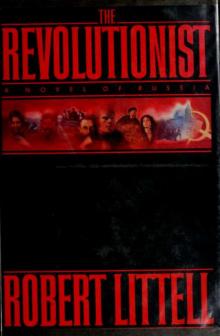
The revolutionist, p.25
The Revolutionist, page 25


Dzerzhinsky needed only to be pointed in a certain direction and he marched. "We do not need justice," he lectured the first handful of Chekists, Tuohy among them, mustered in the organization's new headquarters, the Rossiya Insurance Building on Moscow's Lubyanka Square. "What we need is a battle to the death."
Tuohy paced back and forth beside the lead truck. "Can't you get them to load any faster.'"' he asked one of the men in the prodotryad, the food-requisitioning team.
The Chekist, a new recruit with a blond stubble on his chin and a needlelike Italian machine gun cradled delicately in his arms, called
THE REVOLUTIONIST
over to the factor workers who had come out with them from the capital. "How much longer, comrades?"
"Ten sacks, fifteen at most," one of the workers yelled back. "What do we do with the animals.''"
"We take them," Tuohy told the recruit.
"We take them," the Chekist recruit called to the factory workers.
Tuohy studied the seven kulaks—the relatively well-off peasants who owned a cow or two and occasionally hired others to help them in the fields—leaning against the side of a barn. They were seemingly indifferent to what was going on around them, rolling thick cigarettes with their callused fingers, scraping wooden matches against the soles of their boots to light them. They had defied a Soviet edict requiring them to turn over most of their harvest to the state. Dzerzhinsky had dispatched Cheka teams into the country-side to enforce the edict. Tuohy now headed such a team—himself, three other young Chekists, a dozen factory workers mobilized for the occasion, two automobiles, two trucks. Their job was fairly routine. They pulled into a village, assembled all the males over the age of twelve, and convinced the poor peasants to denounce the "rich" ones. After that it was child's play to get the kulaks to reveal where they had hidden the harvest. A cocked pistol pressed against a son's temple usually loosened a father's tongue.
"We've got the grain," one of the factory workers said, hefting a burlap sack into the back of the truck. Several others dragged five lambs and two young pigs out of the barn on tethers and wrestled them into the truck. The last factory workers emerged from a house with a barrel of pickles, a crate of sausages, and a tub of butter.
From across the stream, not far from a shriveled oak, forrv^ or fifty poor peasants silently watched the proceedings. At the barn the kulaks talked among themselves. They pushed one tall fellow toward Tuohy, but he lost his nerve and turned back to the group. They urged him forward again. He screwed up his face until his eyes practically disappeared in the folds of his skin. "Comrade Chekist," he called.
Tuohy's mustache twitched with pleasure. "You want to tell me where more grain is hidden.^"
"Your honors have taken all the grain."
"Go ahead and ask him," grunted another kulak behind him.
The tall kulak gathered his courage and took another step in Tuohy's direction. "Your honors have also taken all the seed."
"We will feed the seed to Socialist birds in Moscow," Tuohy said. The three young Chekists guarding the kulaks snickered.
"Your honors, if there is no seed, there will be no crop next season. If there is no crop, there will be nothing for you to confiscate."
Behind Tuohy, the factory^ workers piled into the cabs of the
ROBERT LITTELL
trucks and into an automobile, started up the motors and edged out along the dirt track that ran parallel to the stream.
One of the young Chekists indicated the kulaks with a toss of his head. "What are we going to do with them.''"
Tuohy glanced at the poor peasants watching from across the stream. "We are going to put them to work for our revolution."
An older kulak, hearing this, elevated his chin a notch. "We will not work for those who confiscate our grain. If you want our grain, you must buy it—and not with worthless paper money you print up like postage stamps."
The two trucks and the automobile disappeared around a curve. "You will serve our revolution," Tuohy said matter-of-factly, "as an example to others." He nodded to the three young Chekists. The one cradling the machine gun brought the muzzle around until it bore on the kulaks.
The tall kulak held up his hands the way a priest did when he blessed a crowd. "Your honors do not understand about seeds—" he started to say.
The young Chekist squeezed the trigger.
At the Church of All Mourners, across the Moscow River from the Kremlin, worshippers holding thin, flickering tapers swayed to the rhythm of the choral music. Icons shimmered on the marble pillars. Incense drifted up from silver censers wielded by shadowy priests in black robes. At midnight the long-bearded metropolitan in brocaded vestments shouldered his way past the leather-jacketed Cheka agents assembled to intimidate the worshippers and, mounting the altar, proclaimed in a high-pitched voice, "Christ is antibolshevik!" His words echoed through the vaulted domes of the cold church. Several Chekists near the door burst out laughing. Overhead, bells began to peal.
In the back of the church, behind a marble pillar, Appolinaria turned to Ronzha. Her cheeks were aflame, her eyes sparkling in the light of the candle she held. "My heart," she whispered, "my life, my love," and she reached up and bestowed on him the triple kiss of the Trinity, what Pushkin had called the "Resurrection kiss."
Later, walking back to the damp basement room they occupied in exchange for Ronzha working as the janitor of the building, Appolinaria asked, "Do vou think we shall live to share another Resurrection kiss.?"
"God knows," muttered Ronzha, who hadn't eaten anything in days.
THE REVOLUTIONIST
"The Communists say there is no God," AppoHnaria observed bitterly."Maybe they are right after all." "There has to be a God." A note of hysteria crept into Appolinaria's voice. "How can you be
sure
"If God does not exist," Ronzha shot back, quoting Dostoevsky's Ivan Karamazov, "all things are permitted."
During the Great War he had blown up bridges, pill boxes, barges, barracks—anything that the retreating Russians didn't want to fall into German hands. He had blown in doors, most recently during the storming of the Winter Palace. Once he had destroyed a dam, once he had diverted a river. But Alyosha Zhitkin, the demolition expert, had never done anything quite like this before. He rolled some cigar leaf into a twist of newspaper, lit it, and studied the church through a haze of smoke. The walls must be at least a meter thick. No architectural plans were available. He would have to go on instinct when he placed the sticks of dynamite. The workers who had been assigned to him were chipping holes in the bases of the pillars. The problem wasn't simply to destroy the church; that would have been just another day's work. No. The Minsk Bolsheviks had set up shop in the rectory building next door. They wanted the church to come down without damaging the rectory. Pity about the stained glass windows, Alyosha thought. He personally didn't harbor the slightest religious sentiment, but he respected art in all its forms. He glanced up and studied the cupola. From its center, an undernourished Christ presided over a pantheon of admiring disciples. When the pillars were felled, Alyosha calculated, the judgmental smile would be wiped from Christ's face and he and the disciples would come crashing down. The problem was the walls. Small charges buried in them every meter ought to knock out the underpinnings and bring them down too, he thought.
Alyosha worked through the night calculating the sequence of the explosions and translating it into fuse lengths. In the morning the Red Guards cleared the area. Alyosha, a cigar dangling from his lips, personally cut the fuses to length and placed the charges in the prepared holes.
Word had spread through Minsk, and hundreds of old people had gathered at the barriers to see if the Bolsheviks could destroy a seven-hundred-year-old church in the time it took to pronounce the word "amen." Several black-robed priests standing in a group off to one side fingered jeweled crosses. Their lips moved in silent prayer.
When Alyosha judged everything was in place, he blew four blasts on his whistle. The three dozen workers crouching inside the church
ROBERT LITTELL
lit matches and cupped their hands around the flames. Alyosha blew again on his whistle. The workers touched the matches to the fuses and sprinted clear of the building.
The first of the charges, the ones planted in the pillars, went off two minutes later. They sounded muted, pulpy, almost like a beetle being squashed under a shoe. In slow motion the ceiling buckled inward. The cupola appeared to hang in the air for an instant, then dropped from sight. The charges planted in the walls began exploding. An enormous cloud of dust and debris mushroomed up, obscuring the church. For an anguishing moment Alyosha thought he could still make out the building through the haze. The old people would take it as a sign, would drop to their knees and fervently cross themselves. The priests would smirk triumphantly. The Bolsheviks would hold Alyosha accountable; the Cheka representative might even get it into his head that sabotage was involved.
As these thoughts flashed through Alyosha's head, the cloud thinned. The small church had been reduced to a mound of rubble.
The chairman of the local Soviet bounded over to congratulate Alyosha. "Ha! We shall now proceed," he cried, flailing his arms like a windmill as he consciously imitated Lenin, "to construct the Socialist order!"
A sprawling peasant market was in full swing in a dirt clearing next to the railroad station when the train, eighteen and a half days out of Moscow, pulled in to Ekaterinburg, a provincial mining capital of some seventy thousand souls on the Asian slope of the Ural Mountains. The sight of the relatively well-dressed townfolk milling around the carts, of the sturdy peasant women in outsized men's boots meticulously weighing on ancient balances carrots and onions and cabbages and calculating the prices on abacuses—all this transported Zander to the clutter of the "pig market" on Hester Street. He could see himself pushing through the crowd to the pushcart full of used spectacles, and rummaging through them until he found a pair that brought Engels's footnotes in his copy of The Communist Manifesto into focus. He realized he missed America, missed its easygoing disorder; missed its rough informality; missed most of all its potential for change. And he thought, almost against his will: If only the revolution had happened there.
Lili noticed the expression of his eyes. "Where are you.'"' she asked quietly.
Zander shrugged, as if he were shaking off the memory, or the question, or both, but Lili persisted. "Where are you.^"
"I am in America," he told her with a touch of belligerence. He assumed she wouldn't understand. "I was daydreaming. I was wishing the Americans had revolted instead of the Russians."
Lili took it as a personal rejection. "I thought it was Russia you were nostalgic for. Make up your mind."
Vasia, who had overheard the exchange, muttered something about
205
ROBERT LITTELL
how this was the only revolution Zander had, so he might as well make the best of it.
"Vasia is right," Lili remarked. "Revolutions do not grow on trees. If we can make this one work, maybe it ae'///happen there."
"Maybe," Zander said in a tone that indicated he was far from convinced.
Moving with his peculiar stiff gait, Vasia wandered over to the Bolshevik agitation-propaganda wagon at the edge of the marketplace and asked a young girl with a dirty red bandanna around her throat how to get to Voznesensky Avenue. The girl nodded in the general direction of the center of town as she tried to hand a copy of Lenin's latest tract to a peasant. He buried his hands stubbornly in his trouser pockets and allowed as how he could not read, and Lenin would be his last choice if he could.
Ekaterinburg had once boasted a public transportation system, but in the months after the revolution the horses had been eaten or requisitioned for the Red Cavalry, and the trolleys had been parked side by side in a public park and transformed into barracks for new Bolshevik recruits. So with Zander and Lili in the lead, and Vasia trailing after them snapping occasional photographs, the three made their way into town down the wide unpaved avenue along which the trolley had once run. They passed dozens of large mansions with elegant fagades and glass visible in the windows that hadn't been boarded up. Twenty minutes later they turned right onto Voznesensky Avenue, and soon after spotted the Ipatiev house up ahead. Set back from the street, the two-story building with a white stucco front had belonged to Professor Nikolai Ipatiev until the local Bolsheviks turned it into "The House of Special Purpose," as they euphemistically termed it in their official reports. The "special purpose" they were referring to was the incarceration of Citizen Nikolai Romanov, his wife, their four teenage daughters, and their hemophiliac son, along with the family doctor and the last of their servants.
With the once-royal family installed, the Bolsheviks had built a wooden stockade near the facade, and a second beyond the courtyard so that from the street only the roof and several of the white-washed-over upstairs windows were visible.
Vasia set up his tripod in the middle of the street and began adjusting his camera to take a photograph of the house. At the entrance of the outermost stockade, a guard lazily trailing a rifle behind him stepped into the street to see what was going on. A dozen children marching in rough formation came around the corner. They were carrying wooden sticks on their shoulders as if they were rifles, and leading another child whose hands were behind his back. The children pushed their "prisoner" against the stockade, and then formed
THE REVOLUTIONIST
a line facing him. "Take aim," one of the children cried, and they leveled their sticks at the condemned boy. "Fire!" the child in charge cried. The others mimicked the sound of rifle shots. The prisoner at the stockade crumpled in the dirt. The soldier watching from the gate laughed. Vasia redirected his camera and squeezed the plunger.
The child who had been "executed" jumped up and started brushing the dirt off his clothes. "Next time," he whined, "someone else has got to be the tsar."
Standing in the bright sun, Lili linked her arm through Zander's. "It is not hard to guess what the local people think is going to happen," she said.
"Let's hope we have not gotten here too late to influence the decision," Zander said.
Zander sensed the hostility as soon as he stepped across the threshold into Room Three of the Hotel America, diagonally across the street from the Ipatiev house. Producing the instructions he brought from Moscow only made matters worse.
"As a matter of fact, we have already made up our minds," said Alexander Beloborodov, a dour revolutionist who seemed obsessed by the dark side of any situation that offered alternatives. In his early forties, Beloborodov was the chairman of the Ural Soviet, and as such the top Communist—as the Bolsheviks had taken to calling themselves—on the scene.
Commissar Yakov Yurovsky, the Cheka agent in charge of the Ipatiev house and the royal family, tilted his chair back against a wall and fixed Zander with a suspicious stare. His mustache sagged limply in the damp air. "Nothing you can tell us will change the fact that the Czechs are tightening their hold on Ekaterinburg. When the wind is right, you can hear their cannon. They sound like distant farts." He smacked his lips at his own pleasantry. "Our boys are falling back. It is a matter of time before the Whites take the city."
There was a single knock on the door. Beloborodov called huskily, "Come." A Red Guard officer, unshaven, his uniform filthy, tramped into the room and handed him a note. Beloborodov frowned as he read it. "Permission granted," he told the officer, "on condition they blow the bridge before they pull back."
When the door closed behind the Red Guard officer, Beloborodov shook his head morosely. "I don't see that we have a choice," he told Zander. "The Hughes line is down, cut by Whites raiding our rear. Your lady code clerk can encipher messages from now to doomsday— there is no way any of us can communicate with Moscow. The instructions you brought are clear. Trotsky is saying what he would
ROBERT LITTELL
prefer, but he leaves it to us to make the final decision based on the local situation as we see it."
Yurovsky picked absently at an ear with a fingernail and examined it to see what he had come up with. He looked vaguely disappointed. "The tsar must die," he said flatly.
"You could try to evacuate him," Zander argued. "Trotsky considers a public trial desirable. The world must be allowed to see his crimes. Only then can the sentence of death be carried out without the foreign press portraying us as murderers."
Beloborodov shook his head again. "Whether the trial is held in Ekaterinburg, or in Moscow with Trotsky playing prosecutor, the world will call it murder. Better to put an end to the matter here than risk Nicky falling into the hands of the Whites and providing them with something to rally around. With Nicky dead, there can be no restoration."
"Nicky and the boy," Yurovsky corrected him.
"Nicky and the boy," Beloborodov agreed.
"You are going to execute the boy too.''" Zander asked. "Even if the W^hites recapture him, he is too sick to reign,"
"He is not too sick to sign papers put in front of his nose," Beloborodov snapped in irritation. "It is pointless to argue with us. We have made up our minds."
Out in the street a horse whinnied tiredly. Beyond the door a waiter could be heard wheeling a cart full of dishes down the corridor. Zander nodded grimly. "What about the women.''"
Yurovsky pulled out a silver pocket watch and glanced at it. "What about the women.'* This is not the moment for bourgeois sentimentality."