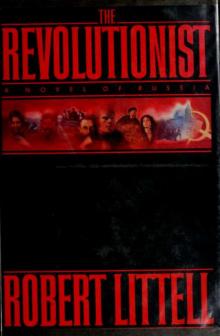
The revolutionist, p.48
The Revolutionist, page 48


Zander sipped his own glass of slivowitz. "A hundred rubles for a few hours work is hard to resist."
"The films are shown in private apartments," Andrei said. "The projectionist is usually fed in the kitchen afterward. You probably will be too. And the food tends to be first rate."
"When would you want me to start.'*"
"Tonight if you like. We're sending over a film called King Kong to show to one of the members of the Politburo. Fay Wray is fantastic in it. What I mean is, fantastically decadent." With a wink Andrei lifted his glass again. "So: Let's drink. To decadence, in all its forms."
"To decadence," Zander agreed. And he, too, scalded his throat with slivowitz.
"This your first time out, is it.-"' the projectionist, who had introduced himself as Grinka, whispered. He was a young man with unruly hair and a multi-colored hand-knit tie, the knot of which bobbed comically against his Adam's apple as he spoke. He deftly threaded the tip of the film through the projector up into the empty reel and snapped the lid shut. The equipment had been set up at one end of a long, rectangular dining room. The thick oak table had been pushed against a wall and folding chairs had been lined up in two rows. A portable screen had been suspended from a hook on the far wall. "The important thing," Grinka continued, "is not to be nervous. Take a tip from me—^you treat a member of the Politburo as if he were an ordinary factory comrade, and he'll love you for life. They appreciate a good show of equality."
ROBERT LITTELL
At nine-fifteen Nikita Khrushchev, laughing boisterously, led his wife, Nina, and several couples into the room. Some of the men held cognac glasses. Khrushchev carried the bottle by the throat. "Are you ready for us, Grinka.^" he demanded. He shook hands with the projectionist, asked him how his family was, chatted for a moment about the weather. Spotting Zander, he said, "So it's you who's translating for us tonight,"
"Yes, comrade."
Khrushchev's bald, fat head bobbed up and down in an emphatic nod as he offered a fat hand for Zander to shake. "Khrushchev," he said, introducing himself.
"Til."
"You speak American.^"
"Fluently."
"Well, I've managed to muddle through on nothing but Russian," Khrushchev said with a satisfied chuckle. "I won't know if you are translating what the actors say or making it up as you go along. As long as it sounds good." Laughing good-naturedly, Khrushchev shooed his guests to their places. "Ladies up front," he called. "Men behind. Smoke if it gives you pleasure. Don't if it doesn't. Somebody get those lights."
In the darkness Grinka started the projector. The titles appeared. Cigar smoke filtered up through the waving beams of light. Watching from the back of the room. Zander remembered how he and Abner once released a jar full of moths in a motion picture theater on the Lower East Side; the moths, attracted by the beams of light from the projector, had cast enormous shadows on the screen that scared the female pianist supplying background music. He wondered what had become of his other brother. What he wouldn't give to see him once more—to see if Palestine had become Leon's promised land.
The opening scene flashed on the screen. Fay Wray uttered her first lines. Zander translated.
"Don't be afraid to speak up, comrade translator," Khrushchev ordered.
When Grinka changed reels. Zander observed Khrushchev and his guests. The men had the easy, sure style of people accustomed to privilege; they sucked noisily on fat cigars and gulped cognac. Khrushchev splashed more cognac into any glass that looked half empty, and held court with a series of vaguely scatological one-liners that kept the men laughing loudly. The women, in a group off to one side, were more restrained. None of them smoked or drank. They spoke, when they spoke at all, in undertones, and nodded in emphatic agreement whenever Nina Khrushchev made a remark. When one of the women laughed out loud, she instantly brought a hand to her lips to stifle the sound.
THE REVOLUTIONIST
"It happens to be true that our trees are smaller than American trees," Khrushchev was saying. "Our long winters stunt them. Go push out roots when the ground is frozen! But try to cut down a Russian tree that has grown slowly. The wood is dense. It'll break the teeth on your saw. As to American trees, you can cut them down with a dull kitchen knife. As I see it," he plunged on, everyone hanging on his words, "this sums up the basic difference between your average Russian and your average American."
Grinka snapped the cover of the projector shut. Khrushchev motioned for the man nearest the lights to switch them off. The film came on again. The African tribesmen had tied Fay Wray on a platform and were watching from the top of their stockade as Kong, roaring, emerged from the dense rain forest to claim the sacrifice. "It's always the same," Khrushchev wisecracked from his seat. "Nowadays the chemozhopy' —the Russian word had the same sense as "niggers" —wear fine clothes, but underneath they're all cannibals."
This drew appreciative snickers from several of the guests.
When the film was over, Grinka and Zander were invited by a maid into the kitchen, where they found two plates heaped with chicken livers and potatoes, along with half a bottle of Georgian red wine. Khrushchev ambled in to fetch another bottle of cognac, and Zander noticed the shelf brimming with liquor bottles when he opened the closet door. "I liked the way you translated," Khrushchev remarked to Zander. "What did you say your name was again.^"'
"Til. Alexander Til."
Khrushchev registered this with a curt nod of his bald head.
Zsuzsa was waiting up for Zander when he got back to the apartment. "How did it go.''" she asked anxiously.
"Khrushchev himself complimented me on my translation."
"He didn't ask you how you came to speak American.^"
"He only said he had muddled through with his Russian."
"Muddled through is one way of putting it," Zsuzsa sneered. "He sent a lot of people to their graves with his Russian." She rose on her toes and buried her face in Zander's neck and said, "You are too dear to me, that is the heart of the problem. Those people live in a viper's nest. If you look at one of them cross-eyed, they will come for you in the night."
"You're blowing it up out of proportion," Zander reassured her. "It is only a job."
"I worry about you," Zsuzsa whispered into his neck. She pulled back and smiled up at him, and Zander was struck again by the peculiarity of her smile—it always made her look uncomfortably close to tears. He took the expression as further evidence of the human condition in Soviet Russia: how close laughter and tears really were;
ROBERT LITTELL
how at times the emotion balanced on a razor's edge and could go either way.
Zsuzsa seemed to Zander to have been worrying about him from the moment he set eyes on her. He had drifted out of the cloud of a coma to see the pained expression draped across her face like a flag. It was a vision he would never forget. "Can you hear my voice.^" she had asked, pronouncing each word distinctly, smiling down at him as if she might burst into sobs if he failed to answer.
He had nodded feebly and uttered the word "yes" only, so he thought at the time, to prevent her from crying. At the sound of his voice the smile had installed itself more firmly, the edges of her mouth fanning out, her eyes relaxing. She had taken his hand in both of hers—the backs of her hands, like her face, were swarming with freckles—and leaning forward until she hovered directly over him, she had spoken soothingly. "You will have a thousand questions. When you are stronger, I will answer them all. For the moment you must take my word for it that you are not seriously wounded. You had a concussion, caused by the explosion of a bomb or an artillery shell. Aside from that there wasn't a mark on you. With rest, with time, you will be as good as new."
She tried to pull her hands free, but Zander kept a grip on her wrist. "Did the Germans take Moscow.-^" he wanted to know.
Zsuzsa produced the pained smile of hers again. "They came close enough to see the spires. But the tank traps people like you dug stopped them."
Zander had been mustered, along with thousands of others involved in what the Party considered "nonessential" war work, on Gorky Street. They had been issued pickaxes and shovels from the backs of army trucks and marched through the deserted streets of the city to the outskirts to begin constructing a last line of defense against the Panzer divisions closing in on the capital. During the day they could hear the hollow thud of artillery shells bursting in the west; at night they could see flashes lighting up the horizon. On the third day the overcast skies cleared and the German Stukas, diving out of a ceramic sun, came at them in waves. Burrowing into the corner of the deepest tank trap, pressing his nostrils into the fragrant earth until it was difficult to breathe. Zander could hear the explosions of the Stuka's bombs along the trench line. He thought he heard what could only have been a bomb plowing into the spongy ground—it had been raining for days—and remembered listening to the absolute stillness as he waited for it to explode.
The silence was the last thing he had heard. "According to the
THE REVOLUTIONIST
dossier that came with you," Zsuzsa told him several days later, "you were as close to an exploding bomb as anyone has gotten and still lived. The shock waves traveling through the ground are what caused your concussion. You were covered with dirt and they had to dig you out. At first they thought you were dead, but some bright comrade had the sense to check for pulses in the bodies waiting to be buried. He found one in you. And here you are today."
Zander had been evacuated from Moscow to a peasant village called Yundola on the Asian slope of the Urals, not far, curiously, from Ekaterinberg, which was now called Sverdlovsk. There was no electricity in the village, but the streets were wired with loudspeakers from which martial music or war news blared constantly. The closed hangar that served as a village center for Party meetings and propaganda lectures and weddings and funerals had been fitted out with cots and converted into a sanitarium for convalescent soldiers. There were twenty-seven of them, some with missing limbs, some blind, two with total amnesia, all under the care of Zsuzsa and an old man who claimed to have been a male nurse in the First World War. In the beginning Zander had taken Zsuzsa for a doctor. He was surprised to discover, the first time they went for a stroll together, that she was only difeldsher, a semi-qualified medical attendant. She had completed a year of medical school when the war broke out. When the first wave of casualties swamped the Soviet Union's hospitals, anyone with the slightest medical background was pressed into service. Zsuzsa was given a military medical manual that described which wounds were treatable and which were so grave that the wounded had no hope of surviving. Through trial and error she became, in the space of six short months at a field hospital, a qualified surgeon. She knew nothing about rheumatism and asthma and precious little about hernias and hemorrhoids or the common cold, but she was pretty much of an expert at removing limbs or digging shrapnel out of any part of the anatomy. A great many of her operations had been performed, because of a lack of anesthesia, with orderlies pinning the wounded man to the operating table. "I can still hear their screams," she confided to Zander one day. "That was the most difficult part for me—inflicting unbearable pain in order to save their lives. But I gritted my teeth and forced myself to do it. God, it was a nightmare. Was I relieved when they assigned me to Yundola."
During what had become their regular afternoon walk, they had climbed the slope that began beyond the last woodshed and ended in a high meadow a few hundred meters above the village. From there it was possible to see the valley that split the hills on the other side and the snow-capped Ural Mountains that were higher than the lowest clouds. That particular afternoon they had been talking about war
ROBERT LITTELL
again. Zsuzsa watched the currents of air undulating through the high grass of the meadow. Her eyes bHniced rapidly. A pained smile spread across her face—and then the smile ceded to the pain and she burst into tears. Zander put an arm awkwardly over her shoulder and pulled her against his chest and felt her body trembling against his. After a while she became calmer. "I am truly sorry about that," she told him, panting slightly, wiping tears away with the back of her hands. "I don't usually lose control of myself."
"There was no harm done," Zander said. "People need to cry occasionally."
"All this space, all this quiet, makes it hard to believe there is a war raging beyond those mountains," she said. "It's hard to believe feldshers are cutting bullets out of young boys being held down by orderlies." She flung herself onto the ground and opened another button of her shirt and spread wide her collar to get some sun on her chest and neck. "When the war is over I am going to go back to medical school and learn about all the things I missed—runny noses and warts and measles and chicken pox. I plan to specialize in ingrown toenails."
Settling down next to her on the ground. Zander suddenly found himself staring at the rise and fall of her breasts under her khaki shirt and the triangle of skin she had bared to the sun. It struck him that she was sensual without being aware of it—as sensual as snow is, or the rippling flow of a shallow brook. He was overpowered by the urge to feel her coolness, to taste her wetness. Without premeditation he reached out and undid the next button of her shirt. Her eyes flicked open. Her tongue moistened her upper lip. Her fingertips came to rest so lightly on his knuckles he wasn't sure if she were restraining him or encouraging him.
"Why do you hesitate.'*" she asked huskily.
"I didn't know if you would appreciate my . . . gesture."
She smiled her smile that could go either way and gently guided his fingers down to the next button. Her shirt parted like a curtain opening on the first act of a new play. Zander undid the other buttons. Leaning over Zsuzsa, he gratefully buried his face in the swell of a freckled breast.
Tuohy strolled over to the sideboard for a bottle of mineral water. "Keep talking," he instructed the department head who was reporting on the transportation situation. He filled his glass and carried it back to his place at the head of the conference table.
"We calculate we will require," said the aide, a stoop-shouldered bureaucrat with the pasty complexion of someone who had worked indoors for thirty years, "a minimum of three hundred railway wagons a day for a period of ten days to deal with the situation in Moscow. Mustering this kind of rolling stock will pose no insurmountable problems—we will simply cancel all civilian traffic during that period. With three hundred wagons, we're talking forty-five thousand people a day, or four hundred fifty thousand in the ten days that the operation lasts."
"Would you use several railway stations or a single station.?" Tuohy asked.
"From the point of view of efficiency, of localizing the potential disturbances, we think it would be advisable to use a single station. We would propose a fifteen-wagon train every hour for twenty hours a day, with a four-hour interval to clean the station and the toilets."
Tuohy sipped his mineral water thoughtfully, then picked up a pencil and resumed his doodling. "How would we get them to come to the railway station.?" he asked the man sitting directly across from him. He was the MGB (as the NKVD was now called) expert on the "Jewish problem."
"There can be no question of rounding them up," the expert replied. "What with two and a half million Jews nationwide, and four
389
ROBERT LITTELL
to five hundred thousand of them in Moscow alone, we don't have that kind of manpower available. What we do have is lists. We would do a mailing. Summon them to appear at such and such a station at such and such an hour. Specify how much baggage they were permitted to bring with them. Most important, specify the eventual sanction for those who fail to comply. My guess is we would get ninety-eight percent of them to walk in under their own steam. Then it would be a problem of logistics—there could be no question of the trains running late, for instance, and the deportees piling up."
"If I commit my department to three hundred wagons a day, that is precisely what we will deliver," the pasty-faced bureaucrat said stiffly.
"Correct me if I'm wrong," an intense young MGB aide who worked for Tuohy interjected, "but I'm under the impression that the actual trip to Birobidzhan near the Chinese frontier will take five days."
The railroad man nodded. "Five full days," he agreed.
"Which means we would have to position stocks of food along the route to feed the Jews," the young MGB aide noted.
"Not necessarily," Tuohy said. "We could require them to show up with a five-day supply of food in their baggage. That way we would be responsible only for drinking water. That's what we did when we deported the Crimea Tartars to Siberia."
"What about foreign journalists.^" an MGB department head asked. "They are bound to find out about the deportation before it is a fait accompli. The publicity could be embarrassing for us. The capitalist press, which always paints our actions in the worst possible light, is likely to say we are picking up where Hitler left off."
"We could cordon off the entire area around the station," the young MGB aide suggested. "No foreigner would be permitted past our barriers."
An older man who had been silently following the conversation lifted a forefinger. Tuohy nodded respectfully at him. "The foreign press will pose no problem," the older man, who directed the department that dealt with nondiplomatic foreigners in Moscow, said flatly. "We will divert their attention—organize something for them outside of the capital they won't want to miss. A birthday party for Comrade Stalin in Georgia, for example. Or a tour of the Leningrad naval facility."
"The American press will be the most dangerous to us," the railroad man said. "Everyone knows it is owned and staffed by Jews or their hangers-on."
"It is for this reason," the older department head said tiredly, "that their stories will be discredited."
THE REVOLUTIONIST
"The Jewish press," Tuohy added, "didn't kick and scream at the German final solution—stories about the extermination of eight hundred thousand Polish Jews were printed on the back pages. And in any case, we are not exterminating the Jews—we are simply creating a Jewish autonomous republic and inviting them to move to it. There is a difference."
"The films are shown in private apartments," Andrei said. "The projectionist is usually fed in the kitchen afterward. You probably will be too. And the food tends to be first rate."
"When would you want me to start.'*"
"Tonight if you like. We're sending over a film called King Kong to show to one of the members of the Politburo. Fay Wray is fantastic in it. What I mean is, fantastically decadent." With a wink Andrei lifted his glass again. "So: Let's drink. To decadence, in all its forms."
"To decadence," Zander agreed. And he, too, scalded his throat with slivowitz.
"This your first time out, is it.-"' the projectionist, who had introduced himself as Grinka, whispered. He was a young man with unruly hair and a multi-colored hand-knit tie, the knot of which bobbed comically against his Adam's apple as he spoke. He deftly threaded the tip of the film through the projector up into the empty reel and snapped the lid shut. The equipment had been set up at one end of a long, rectangular dining room. The thick oak table had been pushed against a wall and folding chairs had been lined up in two rows. A portable screen had been suspended from a hook on the far wall. "The important thing," Grinka continued, "is not to be nervous. Take a tip from me—^you treat a member of the Politburo as if he were an ordinary factory comrade, and he'll love you for life. They appreciate a good show of equality."
ROBERT LITTELL
At nine-fifteen Nikita Khrushchev, laughing boisterously, led his wife, Nina, and several couples into the room. Some of the men held cognac glasses. Khrushchev carried the bottle by the throat. "Are you ready for us, Grinka.^" he demanded. He shook hands with the projectionist, asked him how his family was, chatted for a moment about the weather. Spotting Zander, he said, "So it's you who's translating for us tonight,"
"Yes, comrade."
Khrushchev's bald, fat head bobbed up and down in an emphatic nod as he offered a fat hand for Zander to shake. "Khrushchev," he said, introducing himself.
"Til."
"You speak American.^"
"Fluently."
"Well, I've managed to muddle through on nothing but Russian," Khrushchev said with a satisfied chuckle. "I won't know if you are translating what the actors say or making it up as you go along. As long as it sounds good." Laughing good-naturedly, Khrushchev shooed his guests to their places. "Ladies up front," he called. "Men behind. Smoke if it gives you pleasure. Don't if it doesn't. Somebody get those lights."
In the darkness Grinka started the projector. The titles appeared. Cigar smoke filtered up through the waving beams of light. Watching from the back of the room. Zander remembered how he and Abner once released a jar full of moths in a motion picture theater on the Lower East Side; the moths, attracted by the beams of light from the projector, had cast enormous shadows on the screen that scared the female pianist supplying background music. He wondered what had become of his other brother. What he wouldn't give to see him once more—to see if Palestine had become Leon's promised land.
The opening scene flashed on the screen. Fay Wray uttered her first lines. Zander translated.
"Don't be afraid to speak up, comrade translator," Khrushchev ordered.
When Grinka changed reels. Zander observed Khrushchev and his guests. The men had the easy, sure style of people accustomed to privilege; they sucked noisily on fat cigars and gulped cognac. Khrushchev splashed more cognac into any glass that looked half empty, and held court with a series of vaguely scatological one-liners that kept the men laughing loudly. The women, in a group off to one side, were more restrained. None of them smoked or drank. They spoke, when they spoke at all, in undertones, and nodded in emphatic agreement whenever Nina Khrushchev made a remark. When one of the women laughed out loud, she instantly brought a hand to her lips to stifle the sound.
THE REVOLUTIONIST
"It happens to be true that our trees are smaller than American trees," Khrushchev was saying. "Our long winters stunt them. Go push out roots when the ground is frozen! But try to cut down a Russian tree that has grown slowly. The wood is dense. It'll break the teeth on your saw. As to American trees, you can cut them down with a dull kitchen knife. As I see it," he plunged on, everyone hanging on his words, "this sums up the basic difference between your average Russian and your average American."
Grinka snapped the cover of the projector shut. Khrushchev motioned for the man nearest the lights to switch them off. The film came on again. The African tribesmen had tied Fay Wray on a platform and were watching from the top of their stockade as Kong, roaring, emerged from the dense rain forest to claim the sacrifice. "It's always the same," Khrushchev wisecracked from his seat. "Nowadays the chemozhopy' —the Russian word had the same sense as "niggers" —wear fine clothes, but underneath they're all cannibals."
This drew appreciative snickers from several of the guests.
When the film was over, Grinka and Zander were invited by a maid into the kitchen, where they found two plates heaped with chicken livers and potatoes, along with half a bottle of Georgian red wine. Khrushchev ambled in to fetch another bottle of cognac, and Zander noticed the shelf brimming with liquor bottles when he opened the closet door. "I liked the way you translated," Khrushchev remarked to Zander. "What did you say your name was again.^"'
"Til. Alexander Til."
Khrushchev registered this with a curt nod of his bald head.
Zsuzsa was waiting up for Zander when he got back to the apartment. "How did it go.''" she asked anxiously.
"Khrushchev himself complimented me on my translation."
"He didn't ask you how you came to speak American.^"
"He only said he had muddled through with his Russian."
"Muddled through is one way of putting it," Zsuzsa sneered. "He sent a lot of people to their graves with his Russian." She rose on her toes and buried her face in Zander's neck and said, "You are too dear to me, that is the heart of the problem. Those people live in a viper's nest. If you look at one of them cross-eyed, they will come for you in the night."
"You're blowing it up out of proportion," Zander reassured her. "It is only a job."
"I worry about you," Zsuzsa whispered into his neck. She pulled back and smiled up at him, and Zander was struck again by the peculiarity of her smile—it always made her look uncomfortably close to tears. He took the expression as further evidence of the human condition in Soviet Russia: how close laughter and tears really were;
ROBERT LITTELL
how at times the emotion balanced on a razor's edge and could go either way.
Zsuzsa seemed to Zander to have been worrying about him from the moment he set eyes on her. He had drifted out of the cloud of a coma to see the pained expression draped across her face like a flag. It was a vision he would never forget. "Can you hear my voice.^" she had asked, pronouncing each word distinctly, smiling down at him as if she might burst into sobs if he failed to answer.
He had nodded feebly and uttered the word "yes" only, so he thought at the time, to prevent her from crying. At the sound of his voice the smile had installed itself more firmly, the edges of her mouth fanning out, her eyes relaxing. She had taken his hand in both of hers—the backs of her hands, like her face, were swarming with freckles—and leaning forward until she hovered directly over him, she had spoken soothingly. "You will have a thousand questions. When you are stronger, I will answer them all. For the moment you must take my word for it that you are not seriously wounded. You had a concussion, caused by the explosion of a bomb or an artillery shell. Aside from that there wasn't a mark on you. With rest, with time, you will be as good as new."
She tried to pull her hands free, but Zander kept a grip on her wrist. "Did the Germans take Moscow.-^" he wanted to know.
Zsuzsa produced the pained smile of hers again. "They came close enough to see the spires. But the tank traps people like you dug stopped them."
Zander had been mustered, along with thousands of others involved in what the Party considered "nonessential" war work, on Gorky Street. They had been issued pickaxes and shovels from the backs of army trucks and marched through the deserted streets of the city to the outskirts to begin constructing a last line of defense against the Panzer divisions closing in on the capital. During the day they could hear the hollow thud of artillery shells bursting in the west; at night they could see flashes lighting up the horizon. On the third day the overcast skies cleared and the German Stukas, diving out of a ceramic sun, came at them in waves. Burrowing into the corner of the deepest tank trap, pressing his nostrils into the fragrant earth until it was difficult to breathe. Zander could hear the explosions of the Stuka's bombs along the trench line. He thought he heard what could only have been a bomb plowing into the spongy ground—it had been raining for days—and remembered listening to the absolute stillness as he waited for it to explode.
The silence was the last thing he had heard. "According to the
THE REVOLUTIONIST
dossier that came with you," Zsuzsa told him several days later, "you were as close to an exploding bomb as anyone has gotten and still lived. The shock waves traveling through the ground are what caused your concussion. You were covered with dirt and they had to dig you out. At first they thought you were dead, but some bright comrade had the sense to check for pulses in the bodies waiting to be buried. He found one in you. And here you are today."
Zander had been evacuated from Moscow to a peasant village called Yundola on the Asian slope of the Urals, not far, curiously, from Ekaterinberg, which was now called Sverdlovsk. There was no electricity in the village, but the streets were wired with loudspeakers from which martial music or war news blared constantly. The closed hangar that served as a village center for Party meetings and propaganda lectures and weddings and funerals had been fitted out with cots and converted into a sanitarium for convalescent soldiers. There were twenty-seven of them, some with missing limbs, some blind, two with total amnesia, all under the care of Zsuzsa and an old man who claimed to have been a male nurse in the First World War. In the beginning Zander had taken Zsuzsa for a doctor. He was surprised to discover, the first time they went for a stroll together, that she was only difeldsher, a semi-qualified medical attendant. She had completed a year of medical school when the war broke out. When the first wave of casualties swamped the Soviet Union's hospitals, anyone with the slightest medical background was pressed into service. Zsuzsa was given a military medical manual that described which wounds were treatable and which were so grave that the wounded had no hope of surviving. Through trial and error she became, in the space of six short months at a field hospital, a qualified surgeon. She knew nothing about rheumatism and asthma and precious little about hernias and hemorrhoids or the common cold, but she was pretty much of an expert at removing limbs or digging shrapnel out of any part of the anatomy. A great many of her operations had been performed, because of a lack of anesthesia, with orderlies pinning the wounded man to the operating table. "I can still hear their screams," she confided to Zander one day. "That was the most difficult part for me—inflicting unbearable pain in order to save their lives. But I gritted my teeth and forced myself to do it. God, it was a nightmare. Was I relieved when they assigned me to Yundola."
During what had become their regular afternoon walk, they had climbed the slope that began beyond the last woodshed and ended in a high meadow a few hundred meters above the village. From there it was possible to see the valley that split the hills on the other side and the snow-capped Ural Mountains that were higher than the lowest clouds. That particular afternoon they had been talking about war
ROBERT LITTELL
again. Zsuzsa watched the currents of air undulating through the high grass of the meadow. Her eyes bHniced rapidly. A pained smile spread across her face—and then the smile ceded to the pain and she burst into tears. Zander put an arm awkwardly over her shoulder and pulled her against his chest and felt her body trembling against his. After a while she became calmer. "I am truly sorry about that," she told him, panting slightly, wiping tears away with the back of her hands. "I don't usually lose control of myself."
"There was no harm done," Zander said. "People need to cry occasionally."
"All this space, all this quiet, makes it hard to believe there is a war raging beyond those mountains," she said. "It's hard to believe feldshers are cutting bullets out of young boys being held down by orderlies." She flung herself onto the ground and opened another button of her shirt and spread wide her collar to get some sun on her chest and neck. "When the war is over I am going to go back to medical school and learn about all the things I missed—runny noses and warts and measles and chicken pox. I plan to specialize in ingrown toenails."
Settling down next to her on the ground. Zander suddenly found himself staring at the rise and fall of her breasts under her khaki shirt and the triangle of skin she had bared to the sun. It struck him that she was sensual without being aware of it—as sensual as snow is, or the rippling flow of a shallow brook. He was overpowered by the urge to feel her coolness, to taste her wetness. Without premeditation he reached out and undid the next button of her shirt. Her eyes flicked open. Her tongue moistened her upper lip. Her fingertips came to rest so lightly on his knuckles he wasn't sure if she were restraining him or encouraging him.
"Why do you hesitate.'*" she asked huskily.
"I didn't know if you would appreciate my . . . gesture."
She smiled her smile that could go either way and gently guided his fingers down to the next button. Her shirt parted like a curtain opening on the first act of a new play. Zander undid the other buttons. Leaning over Zsuzsa, he gratefully buried his face in the swell of a freckled breast.
Tuohy strolled over to the sideboard for a bottle of mineral water. "Keep talking," he instructed the department head who was reporting on the transportation situation. He filled his glass and carried it back to his place at the head of the conference table.
"We calculate we will require," said the aide, a stoop-shouldered bureaucrat with the pasty complexion of someone who had worked indoors for thirty years, "a minimum of three hundred railway wagons a day for a period of ten days to deal with the situation in Moscow. Mustering this kind of rolling stock will pose no insurmountable problems—we will simply cancel all civilian traffic during that period. With three hundred wagons, we're talking forty-five thousand people a day, or four hundred fifty thousand in the ten days that the operation lasts."
"Would you use several railway stations or a single station.?" Tuohy asked.
"From the point of view of efficiency, of localizing the potential disturbances, we think it would be advisable to use a single station. We would propose a fifteen-wagon train every hour for twenty hours a day, with a four-hour interval to clean the station and the toilets."
Tuohy sipped his mineral water thoughtfully, then picked up a pencil and resumed his doodling. "How would we get them to come to the railway station.?" he asked the man sitting directly across from him. He was the MGB (as the NKVD was now called) expert on the "Jewish problem."
"There can be no question of rounding them up," the expert replied. "What with two and a half million Jews nationwide, and four
389
ROBERT LITTELL
to five hundred thousand of them in Moscow alone, we don't have that kind of manpower available. What we do have is lists. We would do a mailing. Summon them to appear at such and such a station at such and such an hour. Specify how much baggage they were permitted to bring with them. Most important, specify the eventual sanction for those who fail to comply. My guess is we would get ninety-eight percent of them to walk in under their own steam. Then it would be a problem of logistics—there could be no question of the trains running late, for instance, and the deportees piling up."
"If I commit my department to three hundred wagons a day, that is precisely what we will deliver," the pasty-faced bureaucrat said stiffly.
"Correct me if I'm wrong," an intense young MGB aide who worked for Tuohy interjected, "but I'm under the impression that the actual trip to Birobidzhan near the Chinese frontier will take five days."
The railroad man nodded. "Five full days," he agreed.
"Which means we would have to position stocks of food along the route to feed the Jews," the young MGB aide noted.
"Not necessarily," Tuohy said. "We could require them to show up with a five-day supply of food in their baggage. That way we would be responsible only for drinking water. That's what we did when we deported the Crimea Tartars to Siberia."
"What about foreign journalists.^" an MGB department head asked. "They are bound to find out about the deportation before it is a fait accompli. The publicity could be embarrassing for us. The capitalist press, which always paints our actions in the worst possible light, is likely to say we are picking up where Hitler left off."
"We could cordon off the entire area around the station," the young MGB aide suggested. "No foreigner would be permitted past our barriers."
An older man who had been silently following the conversation lifted a forefinger. Tuohy nodded respectfully at him. "The foreign press will pose no problem," the older man, who directed the department that dealt with nondiplomatic foreigners in Moscow, said flatly. "We will divert their attention—organize something for them outside of the capital they won't want to miss. A birthday party for Comrade Stalin in Georgia, for example. Or a tour of the Leningrad naval facility."
"The American press will be the most dangerous to us," the railroad man said. "Everyone knows it is owned and staffed by Jews or their hangers-on."
"It is for this reason," the older department head said tiredly, "that their stories will be discredited."
THE REVOLUTIONIST
"The Jewish press," Tuohy added, "didn't kick and scream at the German final solution—stories about the extermination of eight hundred thousand Polish Jews were printed on the back pages. And in any case, we are not exterminating the Jews—we are simply creating a Jewish autonomous republic and inviting them to move to it. There is a difference."