

Bisexual men exist, p.1
Bisexual Men Exist, page 1


of related interest
Bi the Way
The Bisexual Guide to Life
Lois Shearing
ISBN 978 1 78775 290 0
eISBN 978 1 78775 291 7
Coming Out Stories
Personal Experiences of Coming Out from Across the LGBTQ+ Spectrum
Edited by Emma Goswell and Sam Walker
Foreword by Tim Sigsworth MBE
ISBN 978 1 78775 495 9
eISBN 978 1 78775 496 6
Queer Body Power
Finding Your Body Positivity
Essie Dennis
ISBN 978 1 78775 904 6
eISBN 978 1 78775 905 3
LGBTQIA+ Pride Sticker Book
Jessica Kingsley Publishers
ISBN 978 1 83997 246 1
Illustrated by Ollie Mann
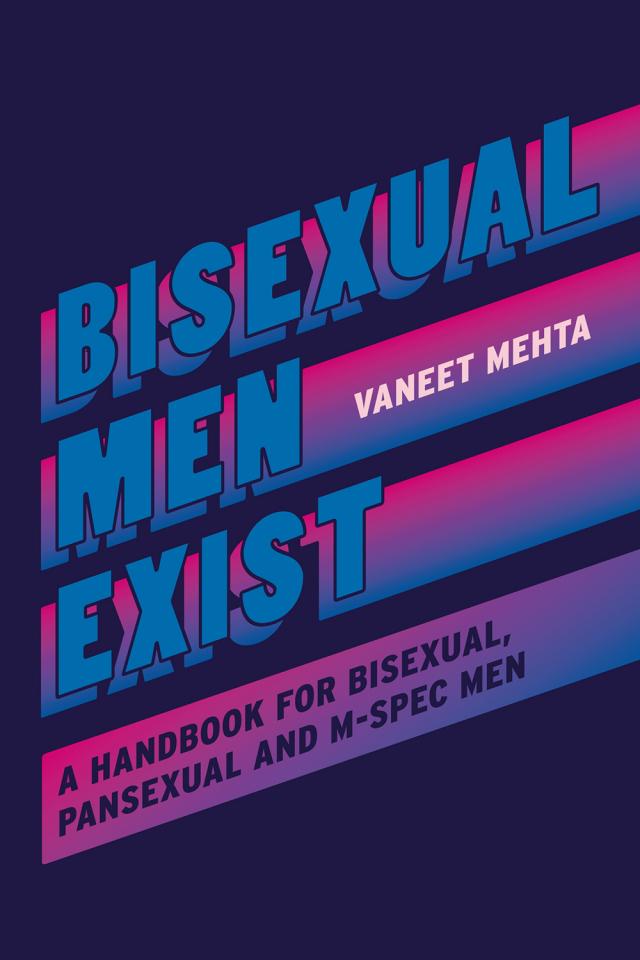
Bisexual
Men Exist
A Handbook for Bisexual, Pansexual and
M-Spec Men
Vaneet Mehta
First published in Great Britain in 2023 by Jessica Kingsley Publishers
An imprint of Hodder & Stoughton Ltd
An Hachette Company
1
Copyright © Vaneet Mehta 2023
All rights reserved. No part of this publication may be reproduced, stored in a retrieval system, or transmitted, in any form or by any means without the prior written permission of the publisher, nor be otherwise circulated in any form of binding or cover other than that in which it is published and without a similar condition being imposed on the subsequent purchaser.
The information contained in this book is not intended to replace the services of trained medical professionals or to be a substitute for medical advice. You are advised to consult a doctor on any matters relating to your health, and in particular on any matters that may require diagnosis or medical attention.
A CIP catalogue record for this title is available from the British Library and the Library of Congress
ISBN 978 1 78775 719 6
eISBN 978 1 78775 720 2
Jessica Kingsley Publishers’ policy is to use papers that are natural, renewable and recyclable products and made from wood grown in sustainable forests. The logging and manufacturing processes are expected to conform to the environmental regulations of the country of origin.
Jessica Kingsley Publishers
Carmelite House
50 Victoria Embankment
London EC4Y 0DZ
www.jkp.com
To Mrs Stevens for believing in me when I did not.
To Joseph for inspiring me.
To Chay for uplifting me.
To Lauren and Ellen for giving me a voice.
Without you, I would not be where I am today.
Contents
Introduction
Ch 1: Representation and Education
Ch 2: Coming Out
Ch 3: Dating and Relationships
Ch 4: Health
Mental Health
Sexual Health
The Health of M-spec Men
Ch 5: Intersectionality
M-spec and Trans
M-spec and People of Colour (POC)
M-spec and A-spec
The Importance of Intersectionality
Ch 6: Pride
Epilogue
Acknowledgements
References
Index
Introduction
Being an m-spec man is no easy task. I should know. I spent over a decade grappling with my sexuality, finding ways to deny it or push it aside, before I eventually came out. Then I was met with a minefield of being questioned, erased, ridiculed and rejected from numerous different angles, which didn’t go away when I entered LGBTQIA + (lesbian, gay, bisexual, transgender, queer or questioning, intersex, asexual, aromantic or agender and others) spaces. I have struggled, and at times still struggle, with recognizing and embracing my identity, every part of it.
I felt I went years being uninformed and ignorant about m-spec identities, which only became deeper and deeper ingrained and internalized. I had to spend so much time and energy to unwork this in my head in order to accept myself. This struggle was made so much harder due to the invisibility of m-spec men.
This was part of the reason why I created my hashtag, #BisexualMenExist. Partly it was to help combat the hate and erasure that m-spec men receive, to drown it out with a positive message. Partly it was to help educate people, to make the masses realize that we are here and there are a significant number of us. Partly it was to help me connect with more people like myself, to find my people, my queer m-spec brothers and siblings.
But the main reason was to help those who were like me, who felt so alone and trapped and who struggled to accept their identity. I wanted to help those who were questioning, those who were in denial and closeted, all those m-spec men hiding away, to embrace themselves and be who they truly are by realizing that they aren’t alone in their fight.
This book is truly an extension of that. In this book, I navigate through a number of key areas of m-spec men’s lives, from coming out to dating, relationships and health. I discuss the importance of representation and education and how that underpins the issues we experience, look through the lens of various intersectional identities and explore the treatment of m-spec men in LGBTQIA + spaces. I unpack the issues that m-spec men experience and bring in people’s personal experiences to highlight the impact these issues have on real people, including myself. I mainly focus on the UK and US through the statistics I use, and while the contributors come from all over, the vast majority are from the UK and US.
What is m-spec?
Before I get into these various topics, I should first cover the basics. First, what is m-spec? M-spec stands for multi-gender attracted spectrum, so it covers all of the various identities where their attraction is not limited to a single gender. Some labels that come under this umbrella are bisexual, pansexual, polysexual, omnisexual and many more. These labels all have their own definition, their own flag and their own community. Here are some definitions of the four I have mentioned above:
•bisexual – attraction to more than one gender
•pansexual – attraction regardless of gender
•polysexual – attraction to multiple genders
•omnisexual – attraction to all genders.
However, these labels also have a broad overlap, as you may see from the definitions. The way people identify may place them in one, two, or even all of these labels. But identity is a very personal thing, and the labels that people choose to use are up to them and what they personally feel comfortable with.
People may choose to only use one label exclusively, or use numerous labels interchangeably. Someone may align closely with one definition but personally choose to use another. And the reasons for doing so can range wildly, from the label being more well known to liking the colour of the flag better.
This is important to remember. At the end of the day, it is us who make the label have meaning, not the other way around. And all the labels are valid. They don’t take away from each other and no one should be forced to use one over the other, for any reason.
As mentioned, all of these labels have a lot in common. They all identify people as multi-gender attracted, m-spec. Some people use bisexual+, bisexual or bi as an umbrella term instead; however, not all m-spec people like this. This is because it can erase the individuality of these labels, painting them all as ‘basically bi’ and ignoring the key differences between the terms.
While my hashtag focused on bisexual men, I did invite other m-spec people to join in. Some did, but not everyone was comfortable with that. Some changed it up, switching bisexual to pansexual for example, which I completely welcomed.
I am not immune to treating bi as an umbrella term; in fact the title of this book does the same. The issues I discuss in this book aren’t exclusive to bisexual men, but affect all m-spec men. While the majority of people involved in this book may be bisexual, not everyone uses this term or uses it exclusively.
So throughout this book, I have opted to use the term m-spec. This is to acknowledge that these issues aren’t exclusive to bisexual men and bisexual is not a suitable umbrella for all m-spec men. I use this wherever possible, but when referencing texts I revert to the terminology they use within their text.
Who are the contributors?
While this book may have ‘men’ in the title, not everyone included in the book necessarily identifies as a man. Some may use man in conjunction with other labels, while others may not use man at all. Non-binary, genderqueer and genderfluid are just some of the labels some of the contributors use. I do not wish to erase these people’s identities through the process of this book, so I thought it important to bring attention to this fact here.
These people, with the title of this book in mind, have been willing to share their story with me as they believe it has relevance to the topic at hand. This may be due to how they previously identified themselves as a man or how society perceives them, potentially due to the way in which they present.
What this highlights is the binary view in which society perceives people’s gender, labelling people as either a man or a woman and erasing their actual gender identity. Some may experience misogyny based on their gender presentation, while others may e xperience misandry. What this means is that some of the experiences that these people have may be similar to those of m-spec men. Throughout this book, I will be referring to m-spec men and the way in which the structures in society create certain barriers and bigotry that impact them specifically. But it is important to note that this particular breed of m-spec phobia and erasure is not faced by m-spec men alone.
CHAPTER 1
Representation and Education
Representation and education play a big role in our society. Education allows people to understand the complexities of the world around them and grasp the differences we see in society. It can help people gain acceptance of those who are different from them and understand their struggles.
Education is often understood as attending school; however, traditional schooling has not always provided the right information or support for those within the LGBTQIA + community. This may be due to laws, an outdated curriculum, unequipped staff or even personal bigotry among faculty.
But there are other sources of education besides traditional schooling, such as various forms of media. Representation, whether that be on TV, in films or written in books, can help educate people about the variety in society. This can be fictional stories with characters from different walks of life, or non-fictional representation from pop idols to Hollywood celebrities.
Not only that, but representation can help people see themselves reflected in society. It can help people see their own story as valid and make them feel less alone in the world. It can help them own themselves and put into words their experiences and hardship. This is incredibly important for LGBTQIA + people, to know that there are other people who identify as they do and that there is a community out there.
According to GLAAD’s Where We Are On TV report for 2019–2020, 26 per cent of LGBTQ characters are bisexual+ despite some studies showing that bisexual people make up the majority (52%) of LGB people (Movement Advancement Project 2016). The majority of bisexual+ characters shown on screen are women, at 70 per cent, while only 28 per cent are men and 2 per cent are non-binary.
In real terms, this gives us 36 bisexual+ men on screen during 2019–2020, which is a pretty decent number. However, this is the representation we see on screen in the present day. If we go back just a few years and look at GLAAD’s Where We Are On TV report from 2014–2015, there were only two bisexual+ men. This clearly shows that there was a lack of historic m-spec representation on TV, which would likely have had an impact on m-spec men on their journey of self-discovery.
Having education and representation is just one side of the coin. Simply having it is not enough. How are m-spec identities portrayed in media? What are people taught about m-spec people? Is the representation or education actually helping the community, or causing more harm?
In this chapter, I will be going through some examples showing the m-spec erasure and phobia that is within the representation we see. I will be discussing how this poor representation, as well as education, only causes further harm to m-spec men.
Lack of representation
I personally had an idea that I was ‘not straight’ when I was around ten. I say ‘not straight’ as I had no idea what my sexuality was. I found myself having crushes on the girls in my class, but also being weirdly intrigued by the boys as well. The only labels I was aware of were straight and gay, and I couldn’t explain my feelings into either one of these categories. Bisexual and m-spec identities were something I was completely unaware of – the label had simply not entered my vocabulary.
The lack of representation played a big part here. The GLAAD Where We Are On TV reports give us a great insight into the LGBTQ representation we see on screen. From 2010 to today, it can be seen that the representation of bisexual+ men has been increasing over the years, but the historic lack of representation will naturally have had an impact on m-spec men.
I was ten in 2002 and unfortunately I cannot find a report from that far back. But when looking at the 2009–2010 report – the earliest one I can find – it shows that out of the 16 LGB characters on screen there were only four bisexual women and no bisexual men as regular characters on broadcast networks. I don’t think it’s a stretch to assume that the representation on screen from 2002 would not have been better.
At the age of ten and throughout my teens, I can recall several gay and lesbian characters, but no m-spec characters whatsoever. Shows which included representation of gay or lesbian characters often portrayed sexuality as a binary concept, straight or gay. Any characters who showed indications of being attracted to more than one gender were either left ambiguous or forced into either straight or gay.
‘No bisexuals’ trope
There are several TV tropes of note here. One trope is ‘no bisexuals’ (TV Tropes, No Bisexuals), which is when the fictional world for the piece of media simply does not include bisexual or m-spec people whatsoever. This often leads to storylines where a character will change from straight to gay, and in some cases even the reverse will happen.
A notable example of this for me is Buffy the Vampire Slayer. In seasons 1 to 3, Willow is shown to be straight. She shows attraction to multiple men and has a long-standing relationship with the character Oz, as well as a fling with Xander. However, this changes in season 4.
In season 4, we are introduced to a new character, Tara. Willow starts having feelings for Tara and this causes her to question her sexuality. It is presented somewhat ambiguously at first, not clearly defining the relationship they have nor the fact that Willow is a lesbian. Willow still shows lingering feelings for Oz when he returns to visit her. But after this, these feelings seem to disappear entirely and the show starts doubling down on her new-found sexuality. There are several storylines where the show makes it abundantly clear that she is into women, and only women. In the season 7 episode ‘Him’, a spell causes Willow (along with other women) to fall for a man. The other characters try to snap her out of it, reminding her that she’s gay.
Now this may be an entirely valid experience for some lesbian and gay people. Not everyone knows their sexuality from a young age and may find themselves in different sex relationships, only to explore their sexuality as they get older and realize that they’re actually gay/lesbian. New experiences can bring about new understanding of your identity. I don’t wish to discredit that. However, this also felt like a missed opportunity.
With Willow’s history with men whom she was clearly deeply in love with, and no indication of any doubt during these relationships, her new-found attraction to Tara could have been a breakthrough for her realizing she was m-spec. But unfortunately,this isn’t what occurred. It felt like m-spec erasure was being played out on screen, which was incredibly invalidating.
This issue was addressed by Joss Whedon himself, the creator and executive producer of Buffy. He stated in an interview with Metro that he was pressured into making Willow not bisexual (Griffiths 2020). There were fears that it would make same-sex attraction appear as a phase and cause harm to lesbian people, which misses the fact that this binary approach to sexuality caused harm to bisexual and m-spec people.
A similar storyline occurred in 2008’s 90210, this time with a man. The character of Teddy first enters the show in season 2 and, as with all men on these teen dramas, is portrayed as a ladies’ man, a player. He briefly dates Adrianna before getting into a long-term relationship with Silver, two women who made the main cast of the show. However, this changed in season 3.
After getting drunk at a party, Teddy ends up sleeping with another man called Ian. Teddy starts going through the motions of coming out. He starts with denying it and trying to reaffirm his straight identity, which doesn’t work out. He slowly starts exploring his sexuality by visiting gay bars and starts a secret relationship with Ian. Eventually, he comes out to his friends as gay.
Yet again, this feels like a missed opportunity. His history with women was always shown authentically, that he was truly in love with them. In order to explain this the show had Teddy and Silver talk about their history and confirmed that, while he did indeed love her, he was lying to himself throughout their relationship.


