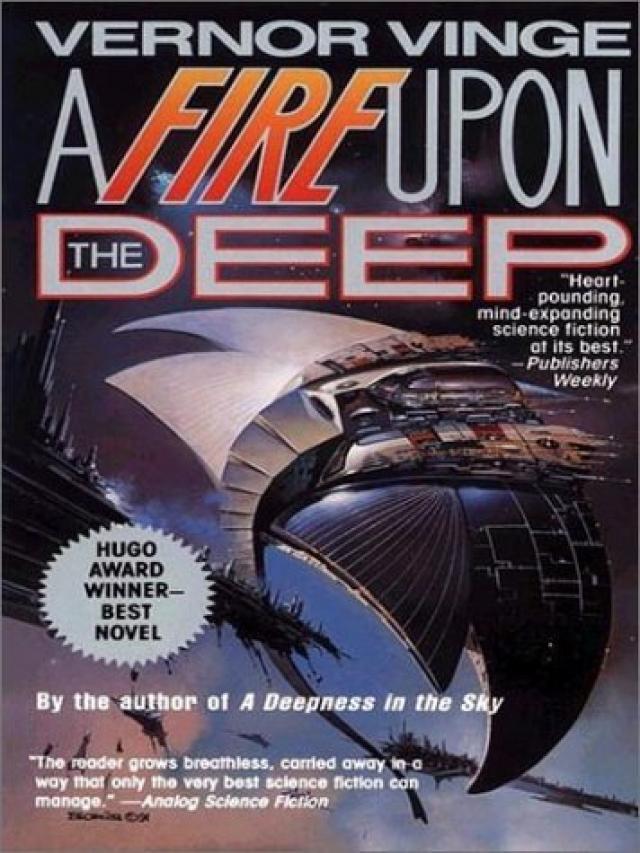
A fire upon the deep zon.., p.1
A Fire Upon The Deep (Zones of Thought), page 1


Contents
Behind the Scenes of A Fire Upon the Deep
A Primitive Form of Story Documentation
A Zoology of Annotations
A Little History
The Future of Annotations
PROLOG
PART I
Chapter 1
Chapter 2
Chapter 3
Chapter 4
Chapter 5
Chapter 6
Chapter 7
Chapter 8
Chapter 9
Chapter 10
Chapter 11
Chapter 12
Chapter 13
Chapter 14
Chapter 15
Chapter 16
PART II
Chapter 17
Chapter 18
Chapter 19
Chapter 20
Chapter 21
Chapter 22
Chapter 23
Chapter 24
Chapter 25
Chapter 26
Chapter 27
Chapter 28
Chapter 29
Chapter 30
Chapter 31
Chapter 32
Chapter 33
Chapter 34
Chapter 35
Chapter 36
PART III
Chapter 37
Chapter 38
Chapter 39
Chapter 40
Chapter 41
EPILOG
A Fire Upon the Deep
Special Edition
Vernor Vinge
A Tom Doherty Associates Book
New York
www.ebookyes.com
This is a work of fiction. All the characters and events portrayed in this novel are either fictitious or are used fictitiously.
A FIRE UPON THE DEEP
Copyright © 2002 by Vernor Vinge
All rights reserved, including the right to reproduce this book, or portions thereof, in any form.
Edited by James Frenkel
A Tor Book
Published by Tom Doherty Associates, Inc.
175 Fifth Avenue
New York, NY 10010
Tor Books on the World Wide Web:
http://www.tor.com
Tor © is a registered trademark of Tom Doherty Associates, Inc.
eISBN 0-312-70369-4
ALSO BY VERNOR VINGE
Tatja Grimm's World
The Witling
True Names and Other Dangers (collection)
Threats... and Other Promises (collection)
Across Realtime
comprising:
The Peace War
The Ungoverned
Marooned in Realtime
*A Fire Upon the Deep
*A Deepness in the Sky
*Collected Stories of Vernor Vinge
*True Names and the Opening of the Cyberspace Frontier
*denotes a Tor book
Acknowledgments
I am grateful for the advice and help of: Jeff Allen, Robert Cademy, John Carroll, Howard L. Davidson, Michael Gannis, Gordon Garb, Corky Hansen, Dianne L. Hansen, Sharon Jarvis, Judy Lazar, and Joan D. Vinge.
I am very grateful to James R. Frenkel for the wonderful job of editing he has done with this book.
Thanks to Poul Anderson for the quote that I use as the motto of the Qeng Ho.
During the summer of 1988, I visited Norway. Many things I saw there influenced the writing of this story. I am very grateful to: Johannes Berg and Heidi Lyshol and the Aniara Society for showing me Oslo and for wonderful hospitality; the organizers of the Arctic '88 distributed systems course at the University of Tromsø, in particular Dag Johansen. As for Tromsøy and the surrounding lands: I had not dreamed that so pleasant and beautiful a place could exist in the arctic.
Science Fiction has imagined many alien creatures; this is one of the genre's great charms. I don't know what in particular inspired me to make the Riders in this novel, but I do know that Robert Abernathy wrote about a similar race in his short story, "Junior" (Galaxy, January 1956). "Junior" is a beautiful commentary on the spirit of life.
[Added in 2002: I'm grateful to Brad Templeton for suggesting, way back in 1993, that the annotated version of the manuscript should be published. Thanks also to various members of the USENET science-fiction community for encouraging republication of the annotated version in 2002.
Thanks to Jeff Gomez of St. Martin's Press for shepherding this republication, and to Ken Brooks of Publishing Dimensions for transforming my flat ascii into the forms used here.]
Dedication
To my father, Clarence L. Vinge, with love.
— V. V.
Behind the Scenes of A Fire Upon the Deep
[This introduction was originally written in 1993, before the rise of the Web. I have edited the intro somewhat, but I don't think I have changed any technological prognostications.]
A Primitive Form of Story Documentation
Since 1979 I've used the manuscript convention that lines beginning with "^" should not normally be printed. This makes it easy for me to "comment my text". Over the years, as storage capacities increased, I found that even this extremely crude tactic could be very helpful in story development. About one fourth of my Fire Upon the Deep manuscript is such hidden commentary. These comments served a variety of purposes, and I used various tag words to discriminate between these purposes (see the table below). Besides formal tags, I had a large number of key words to identify different aspects of the story. I used several tools — mainly grep — to follow the key words around the manuscript. Note that this technique is not hypertext (... well, maybe it could be called a "manual form" of hypertext, with grep being used to dynamically compute links :-).
In 1993, Brad Templeton of Clarinet published a CDROM, Hugo and Nebula Anthology 1993, that included a version of this annotated manuscript. (And this introduction is only slightly modified from the one in that CDROM.) I think the annotated manuscript was fun for people who wanted to look behind the scenes at a story as it is being constructed. I'm happy that it will see the light of day again!
In preparing the manuscript notes for publication, I tried to extend and clean up the notes. However, I want to warn you that since these are mainly internal development notes, they are often cryptic, repetitive, and inconsistent. (The notes are also tentative in the sense that they may be contradicted by later-written sequels and prequels.) There are interesting things in these notes, but you can get lost in the tedium of minor issues or be led astray by discussion of problems that were later solved (leaving the discussion without referent!). Hopefully, this introduction will make it more convenient for people who do want to look at the notes.
A Zoology of Annotations
In the formatting of this 2002 edition, comments are easily identified by their graphical layout. In my own "plain ascii" files, I used very much cruder conventions. Those are mostly invisible in this edition, but I list them here for people who are curious to know what the raw (text editor friendly) version would look like:
I delimit italicized text with underscores. (I don't have any page-long italicized passages, so any such are probably due to loss of "underscore-parity".)
Embedded comments have "^ " as the first non-whitespace on the line. Commands to my formatter (inherited from Kernighan and Plauger's Software Tools, Addison-Wesley, 1976!) use a similar convention: ^bp page break
^ls n linespacing
^he s define page header
^fo s define page footer
My formatter prints the pair ampersand numbersign ( "&#" ) as a single numbersign ( "#" ). Thus, I use "&#&#&#" as a section break. When a numbersign ( "#" ) is not preceded by an ampersand, it is supposed to be a single space. (I use this character to force vertical whitespace and as part of the indent for paragraphs.)
Where the first alpha characters on a line are "NOTE", you are normally seeing a note to the copyeditor. (I use this mostly to flag the beginning of monospace font (eg, Courier) for the Net messages.)
I use tags a lot. In a sense almost anything could become a tag (and a target for grep), but the most formalized tags and their meanings are as follows.
AWK The referenced prose seems awkward. (Hopefully most of these are fixed.)
BKG The comment is background.
CHAR The comment is related to some character issue.
CHKd Issue from CHK comment has been verified.
CHK The comment involves something that I should verify.
CHRON The comment requires a check of the consistency of the timing or sequence of the story
DEL Delete
DONE The action suggested in the comment has been done.
FIXED I fixed the problem raised by the question.
FIX Same as FIXED.
FRAG The commented text is a fragment either something that is looking for a home in the manuscript, or perhaps the reverse, namely text that has been removed/replaced. In the latter case, the fragment may contradict the published story line.
iD An idea that has either been incorporated or eleminated from consideration.
ID Comment represents an idea for consideration
IDEA The comment is an idea unrelated to this story.
ID The comment is an idea related to this story.
IMPER The comment was thought to be imperative.
iMP The comment was thought to be important, but has been resolved
IMP The comment was thought to be important.
incon An inconsistency since resolved.
iNCON Inconsistency, since resolved
INCON The comment identifies an inconsistency in the story or facts.
INSERT Very late changes that were made in the manuscript (probably as updates from hardcopy).
mARK A bookmark in the text use for traversals, but no longer needed
MARK The comment was a book mark used during traversals.
MiRT Refers to my novel Marooned in Realtime.
MODE The notion that almost every human attribute (name, size, gender, ...) would come in two "modes" for the Tines -- one mode as the attribute applies to a pack member, and the other mode as the attribute applies to a whole pack.
NÆH I decided there was no need to follow through on the suggestion.
NO I didn't follow through on the suggestion in the comment.
NOTE TO COPY-EDITOR This comment is a note to the copy editor
NOTE Usually same as NOTE TO COPY-EDITOR.
NO TIME I didn't follow through on the comment or suggestion because I ran out of time.
pRB Problem, since resolved.
PRB The comment relates to a problem about the story.
pRO The comment describes changes that should be made later in the story, and have since been resolved.
PRO The comment describes changes that should be made later in the story ("prowritten").
qU Question, since resolved.
QU The comment is a question that I have.
rEN Renaming, since done.
REN The comment relates to the names in the story (or naming issues).
rETRO Changes that should be made earlier in the story that have been resolved.
RETRO The comment describes changes that should be made earlier in the story ("retrowritten").
SEQ The comment is about a sequel (or prequel) possibility.
SIDE Originally, I had thought it might be nice to have sidebars about background issues in the novel. I never followed up on this except with the interstellar email and newsgroups.
SOLN The comment discusses a solution to some difficulty I have.
SORRY I couldn't follow through on the suggestion in the comment.
TITLE The comment is a title suggestion.
TUF I didn't follow through on the suggestion in the comment.
TYRA Related to the character Tyrathect.
YES Indicates agreement with the comment or suggestion.
If the first letter of a tag is lower case, this means the issue in question has been taken care of. (However, this convention is not consistently followed.) CHKd means I did verify the information in question.
Most unattributed comments are by me. Comments from consultants are normally prefixed by the consultant's initials. (The initials "vsv" and the pronouns "I" and "you" often refer to me; I talk to myself a lot, with and without special notations!)
As my work progressed, there came to be layers of comments. In most cases these can be distinguished by the added tags (DONE, SOL, ...). In other cases, you can see a dialog between myself and my consultants. At least once, I rearranged the chapters. (So the chapter references -- for example, "c08" -- are not reliable. I believe this is especially the case for the references to later chapters.)
At one point (Christmas Break 1990?), I had numerous pending issues in my "^ " comments. I swept through them, inserting "!!" as I revised. Thus the stuff after "!!" was normally the old comment together with whatever action I took. Most comments are of the "!!" type, and have no special mark associated with them in this 2002 edition. (Most of the other comments represent issues that were not resolved by the "!!" sweep of the text. In this edition they are marked, for example with the code [ur].)
Some of the notes have dates attached to them. These dates are accurate for some part of the note they appear in. Unfortunately, they don't reflect everything about the note — and many comments have no date attached to them. (There is another style of date you will notice in some places, dates like 5 June 15989! This was my crude way of keeping track of the story chronology. Since Tines' World days are about the same length as Earth's, it was possible for me to use the calendar tools in Lotus Agenda(tm) to manage the chronology of the story. I more or less arbitrarily set the beginning of the story (the birth of the Straumli Blight) at 00:00:00 23 June 15988. Note that this assumption never leaks out of the annotations; it was just an artifice to make it easier for me to track the relative position of events occurring within the story. (In fact, it's not certain just how far in the future this story happens; fourteen thousand years after 1988 seems to be about the minimum.)
I used a few unusual characters in the manuscript (mainly restricted to the annotations — I took pity on myself and the copyeditors). These characters are listed in the following table. Hopefully, this table will be helpful if your display device is not mapping these 8-bit patterns to the characters I intended!
("ISO" is short for ISOLatin1Encoding as it appears on p596-599 of Postscript® Language Reference Manual, Second Edition, Adobe Systems Incorporated, Addison-Wesley Publishing Co., 1990 [the Adobe "Red Book"].)
ISO octal ISO name bit pattern actually displayed
306 AE Æ
330 Oslash Ø
340 agrave à
345 aring å
346 ae æ
347 ccedilla ç
351 eacute é
352 ecircumflex ê
357 idieresis ï
366 odieresis ö
370 oslash ø
A Little History
Some of the comments may be more intelligible if I say a little about the history of the writing of A Fire Upon the Deep.
During Christmas Break 1987/88, I wrote a novella, "The Blabber" (first published by Baen Books, 1988; now available in The Collected Stories of Vernor Vinge, from Tor Books). In fact, this story was a sequel to A Fire Upon the Deep. The novella was written after most of the background universe of the Zones and the Tines had been worked out, but before I knew the details of the novel. It might seem that the existence of such a story would make the planning of the novel more difficult. To some extent this was true, but more often "The Blabber" provided boundary conditions and inspiration for the novel. And the apparently unresolved inconsistencies between the novella and the novel may provide fuel for later revelations. Some of the notes in the novel reference "The Blabber" and these consistency issues.
I was on leave from SDSU during the 1988-1989 academic year. During the summer of 1988 I attended the distributed systems course at the University of Tromsø, and I visited Oslo. I saw much that affected the story (and I met many wonderful people — see the book's acknowledgments). During the following twelve months I completed an initial draft of most of the story. In programming there is a saying that "First you write the program; then you do it again, and this time you do it right." My experience was not quite this discouraging. The Tines' World plot line went smoothly right from the start, but the Ravna plot line was enormously difficult. In the earliest draft, Ravna was a secret agent opposed to the Straumli Realm, an empire that had unleashed the Blight in a desperate effort to avoid losing a war. In the wake of this catastrophe, she escapes to Relay where she engages a Vrinimi humanoid, Yrdnalf Scrubscooey, to help her find the refugees from the High Lab. I pursued this version through the Fall of Relay before I realized that it was unacceptably weak. It was time for me to retreat, salvage what I could, and plan a different approach: Having Ravna be an employee of Vrinimi made the background much easier to present. Having Pham be ... what he is ... gave me a direct witness on the Slow Zone and the Depths and the nature of the Powers. (And of course, it provided a romance that was within my ability to describe.) Of course it also meant that I had to completely rewrite the Relay scenes. In the comments, you will find only fleeting references to poor Yrdnalf Scrubscooey and Straum the warlike realm; now they are less than fiction.