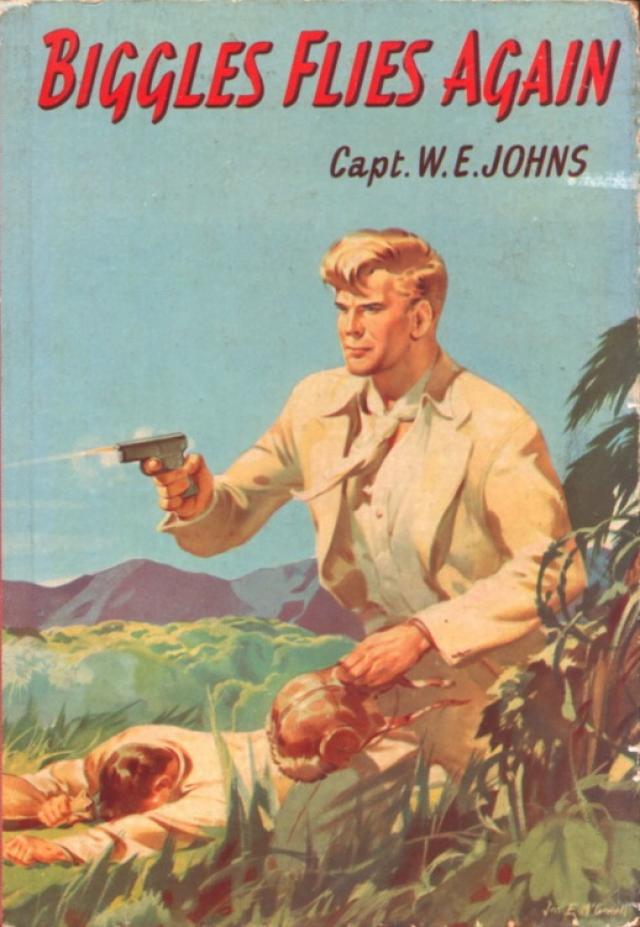
Biggles flies again, p.13
Biggles Flies Again, page 13
part #13 of Biggles Series


The Sheikh, after one fleeting glance at the contents of the case, leapt at Biggles like a tiger, a knife in his hand, but a bluejacket tripped him up and he crashed headlong. Half a dozen sailors poured out of the office and threw themselves on him.
Stampoulos could only stand and stare at the contents of the second suitcase, which had revealed another load of the narcotic. He seemed to be dazed, and followed the sailors unresistingly.
“Got your pearls, Bigglesworth?” asked Watkins, smiling.
“Yes, and you’ve got the body,” grinned Biggles. “Empty that dope of yours out of our suitcases; we want to be getting along. See you later.”
CHAPTER 12
YELLOW FREIGHT
WITH his goggles swinging lightly from the finger of his left hand, Biggles, with Algy at his side, walked slowly along the tarmac of the sun-scorched aerodrome at Heliopolis to where the “Vandal,” with Smyth standing by the propeller, rested in the shade of a hangar, in readiness for the trip to Benghazi, the next port of call on their homeward journey.
Before they reached the machine, however, their attention was attracted to a mechanic hurrying towards them.
“Looking for us, or I’m a Dutchman,” observed Biggles curiously. “I wonder what he wants?”
“Beg pardon, sir, but will you please have a word with Colonel Grivin; he’s waiting in the office.”
“What office?”
“The Nile and North African Aviation Company, sir.”
Biggles raised his eyebrows. “ Lead on; we’ll follow,” he said.
A tall, spare, grey-haired man with a troubled face rose to meet them as they entered the offices of the well-known Egyptian operating company.
“Come in, Bigglesworth, come in,” he said tersely, leading the way to an inner office. “ Pleased to meet you,” he went on quickly when they were seated. “I heard a lot about you during the war; I was at Wing H.Q. when you were in 266 Squadron.”
Biggles nodded. “Yes, I remember your name now, sir. Can I do something for you?”
Colonel Grivin drummed nervously on his desk for a moment before replying. “I don’t know,” he muttered anxiously. “It’s difficult—very difficult. The fact is, I’m in a jam, and I’m just about at my wits’ end.” He leaned forward suddenly. “You had a pretty good record in the war, Bigglesworth; you seemed to have a knack of—er sorting things out. I want you to think this over. When I’ve finished you can either stand by me or you can walk out of that door, and I shan’t say a word. Did you know Trevor Dawlish?”
“I’ve heard of him, but I don’t remember ever meeting him. He used to be in 56, didn’t he?”
“He was. Until a short time ago he was my best pilot. He left here a month ago for Benghazi, on a trip to Paris, with a special freight. He never got there. Service machines found his crash a fortnight ago in the mountains, near El Farosha, about four miles the other side of Karouma, which is the first emergency landing-ground on the run. He was—well, it was a heck of a crash—burnt out.”
The Colonel paused for a moment before continuing.
“Three days ago Bert Makins, another of my pilots, headed east on the same trip, also with freight. It seems as if he tried to get in at Karouma but made a mess of it. He finished up by crashing into the rocks on the north side of the landing-ground, and was burnt up before he could get out.”
“Bad show.”
The Colonel’s jaw set grimly. “It’s worse than that, Bigglesworth,” he said in a strained voice. “Poor Trevor and Bert were murdered.”
The two pilots stared at the speaker aghast. “Murdered? What are you talking about?” stammered Biggles.
Colonel Grivin crossed the room in swift silent strides and flung the door open. A red-fezzed native whom Biggles recognized as the petrol effendi who had just helped him fill the “Vandal’s “ tanks was leaning against a wall in the passage.
“What do you want?” barked the Colonel. “What are you hanging about here for?”
“Baksheesh,” muttered the man sheepishly.
“Well, get out of it,” snarled the Colonel. He watched the man out of sight and then returned to his visitors, mopping his face with a large handkerchief. “What was I saying?” he muttered absently.
“You said something about Dawlish and Makins being murdered,” Biggles reminded him.
“They were. They were murdered for the freight they had on board.” Biggles raised his eyebrows.
“Gold,” said the Colonel, in a curiously quiet voice. “We are shipping gold from here to Paris. I’ve got a contract that will make the firm—or I had. The quickly changing price of bullion makes every moment it spends en route important. These consignments are British, but we are only taking them as far as Paris. We fly them through this sector. The first one or two lots went through without trouble. Then Dawlish cracked up. I had to call in Service machines to find him, but what they didn’t know, what nobody knew except me, was the nature of the cargo. When we got to the wreck it had gone. I suspected foul play at once and I told Bert so—he was due to take the next lot through. He only laughed, but he knew well enough that it was true, that someone had got on the trail of the metal. Well, they got him too, and the gold he was carrying. But how? Why did he try to land at Karouma; that’s what I want to know. How did the crooks force him down?”
“Someone tinkering with the machines at this end,” suggested Algy.
“That’s what I thought at first, naturally, but in that case how could they know that the machine wouldn’t crack up taking off here? How could they time the crash at the only emergency landing-ground between here and Matruh, which is the last English-speaking petrol-station between here and Tripoli? Well, I’m going to get the, swine who killed those two boys, if I spend the rest of my life doing it. I only wish I could fly myself, but I can’t. And I’ve got another consignment to go through today.”
“But you’ve more pilots and machines?”
“Yes, but who on earth is going to fly to certain death? I’ve two pilots left. Thomson is one, but he’s down with fever, or, maybe, he’d go. Lorne is the other, and he’s dug his toes in. He says he’s a married man and is willing to fly anything anywhere—except gold. He has refused to fly any machine if an ounce of metal is put on board. That’s what he says, and he means it, and I can’t blame him.”
“What do you expect me to do?” asked Biggles quietly.
“I’m asking you to take this consignment through,” said Colonel Grivin simply. “If it doesn’t go, the Company’s broke, busted wide open, and that’s that. Apart from that, if there is any man I know who might get to the bottom of what’s going on, it’s you.”
“You mean you want us to take it in our machine?”
“In yours, or one of mine; I don’t care which. There are three machines for you to choose from in the sheds. They’re all enclosed-cabin types. I can’t offer you anything big to make on the job, because I haven’t got it, but I’ll make it worth your while. I am willing to give all I’ve got to keep up the reputation of the firm, which is an all-British show, and in trying to find out who killed those two lads.”
“I understand,” said Biggles. “Do you mind if I talk this over for a few minutes with the others? Give me, say, half an hour, then I’ll let you have a decision. By the way, has any particular machine been booked for this particular trip?”
“Yes, there she is; they are just bringing her out of the sheds,” replied the Colonel, pointing to a single-engined cabin-monoplane, which was being slowly drawn out of the firm’s hangar.
“Thanks,” returned Biggles. Outside he settled himself down in the shade of the office and cupped his chin in his hands.
“Well, what do you make— ?” began Algy.
“Don’t talk for a minute; let me think,” Biggles told him. A quarter of an hour passed in silence; then he rose to his feet and walked slowly across to the aircraft that now stood on the tarmac in readiness for the flight. He stared at it for a long time, studying it closely from several angles He climbed into the cockpit, examined the control-column, instruments, and short-wave wireless equipment. Then he closed the door, took up the small piece of matting and studied the floor of the cockpit intently. He climbed down from the machine still deep in thought and a trifle pale.
“I’m going to fly this machine,” he announced harshly.
“You mean ‘we’,” corrected Algy.
“I said I,” replied Biggles firmly. “You’re going to stand by here with the ‘Vandal’, with Smyth and the Colonel. Don’t argue,” he concluded shortly, turning towards the Company’s offices.
“I’m going to fly your machine,” he told the Colonel. “Where’s the gold?”
“In my safe.”
“Good. Keep it there. Make up some more packets to look like it and have it put aboard when I’m ready. The best thing would be to knock up some scrap lead to give it weight. Stand by with the real stuff, ready to slip it into the ‘Vandal’ when I give the word. How far away is this place, Karouma?”
“About an hour’s run.”
“Who’s in command of the R.A.F. units here?”
“Bruton—Group-Captain.”
“Do you know him?”
“Quite well.”
“Good; let’s go across. I want you to introduce me to him. I may want some assistance if what I have in mind comes off. And, Algy, I want you to slip into Cairo as quickly as you can in the Colonel’s car and do a bit of shopping for me.”
“What do you want?”
“A pair of white mice in a small cage.”
Algy stared at him incredulously, and then a look of understanding slowly dawned in his eyes. “Great Scott!” he breathed. “So that’s it.”
“That’s how I figure it,” replied Biggles shortly. “There are still some things I don’t quite understand—but I soon shall,” he added grimly. “Come on, Colonel; let’s go down to the Station Headquarters.”
II
The blueness of the Mediterranean is proverbial, but seen from five thousand feet, with depths varying from the shallows near the beach to the deeper water farther from the land, the riot of colour is indescribable. Every shade of green, blue, and purple is represented, according to the depth and the nature of the sea-bed.
But Biggles was too engrossed in other matters to enjoy the beauties of nature; his eyes only left the small cage suspended from his instrument-board to probe the surrounding sky. Every nerve was tense, for he was waiting—waiting for something to happen. Just what that would be he was not sure, but he thought he knew. If his deductions were correct, the cabin in which he sat was slowly being filled with one of the most deadly gases in the world, monoxide—an insidious poison, invisible, odourless, but deadly; presently it would induce unconquerable sleepiness that would quickly become a coma that could only end in death.
He glanced at the watch on his instrument-board and saw that he had been in the air nearly forty minutes; if his suspicions were correct, then it was time the gas was making its presence felt. He had not long to wait. Five minutes later, one of the two mice slid slowly from its perch to the floor of the cage and lay still. The other clung desperately to the frail stick for another minute and then collapsed beside its fellow.
Not until he groped into the canvas pocket beside him did Biggles realise how far the poison had worked on him; his movements were sluggish and his power of concentration already weakened. Desperately he held his breath until he had dragged out a bulky object from the pocket and slipped it quickly over his face. It was an ordinary Service gas-mask. He needed both hands to adjust it, and the machine rocked slightly as he released the control column. So much the better, he reasoned; the unusual behaviour of the aircraft would lend colour to the part he was about to play. A wave of rage swept over him, for he knew now for certain how the two air-line pilots had met their death. Too late poor Makins must have felt the presence of the unseen death, and tried to land. Indeed he had got the machine to the ground, only to collide with the rocks and perish, unable to find strength to climb out of the blazing machine. And yet—Biggles started as a new thought flashed through his mind. Perhaps he had landed safely. Men who were ruthless enough to poison a pilot in the air would not shrink from destroying all possible evidence on the ground. Yes, that was it. It was they who had run the machine into the rocks, and then set fire to it, leaving the helpless pilot in his seat. Biggles trembled for a moment under the cold fury that gripped him, but with an effort he controlled himself and looked downwards and ahead. Karouma lay below and a little to his left; eagerly his eyes swept over the surrounding country and came to rest on two horsemen with two spare horses standing in a shallow depression near the landing-ground. They were the only human beings in sight, and a puzzled expression crept over his face as he realized they were Arabs or natives of some sort. He began to move the column slowly from side to side so that the machine swayed slightly as it flew; his feet moved alternately on the rudder-bar so that his steering became more erratic and a spectator might well have thought that the pilot was allowing the machine to fly itself. He passed on over the aerodrome and then started to return in a wide circle, just as he imagined the two dead air-line pilots might have done.
Then he cut off his engine and started to glide in. His nostrils quivered once as he saw the horsemen begin to move slowly towards the desolate landing-ground.
Steeper and steeper became his dive, with an occasional sideslip as he neared the ground. He pulled out and landed as badly as he dared without deliberately crashing the machine. Bump-bump-bump, it bounced, and then ran to a standstill in a wild, swerving semi-circle. Swiftly he whipped off his gas-mask and thrust it out of sight, and then sprawled across the floor of the cockpit in an attitude of unconsciousness. Almost at once he heard the thud of horses galloping over the sandy earth towards him, and a low laugh of exultation. Through the lashes of his half-closed eyes he saw the cabin-door flung open and a bearded face, surmounted by a turban, appear. “Arabs, eh,” he thought, but the next instant he knew he was mistaken.
“O.K.,” said a voice. “He’s on the floor.”
“Never mind about him; get the stuff out,” replied his companion. “There’s no sense in hanging around. They may have smelt a rat and have another machine following.”
Quickly the supposed precious cargo was removed, and with frequent curses loaded up on the restive horses, which, apparently, did not like the proximity of the still-revolving propeller.
“That’s the lot,” said the first speaker, from the door of the cabin. “What next?”
“Same as the last,” was the reply; “it makes a clean finish. If it doesn’t catch fire we’ll light it; no one’ll ever prove anything from what’s left.”
“Good enough.”
Biggles held his breath as the speaker made his way into the cabin and reached over him for the throttle, which he jerked open, and then, before the machine had time to gather speed, sped back and leapt through the open door.
Biggles was up and in his seat in an instant, grabbing for the control-column, feet feeling for the rudder-bar. He was just in time. With stick and rudder flung right over, the machine swung round, the wing-tip missing the rocks by inches. He throttled back a little while he straightened the machine in the opposite direction, and then took off over the heads of the now plunging horses. He caught a fleeting glimpse of the expressions of utter amazement on the faces of the two riders as he passed over them. Glancing back he saw the spurt of flame from a revolver, but he paid little heed to it. Climbing swiftly, he thrust his gloved fist through a side-window of the cabin in order to admit as much fresh air as possible, redonned his gas-mask, and then felt for the key of the wireless equipment. Swiftly he morsed out his message.
It was nearly two hours later, and he was still following the horsemen, whose weary mounts had dropped back from a full gallop to a tired canter, when he saw a curious formation heading towards him. It consisted of the “Vandal,” two Service craft, and a troop-carrier. The men on the ground saw them too and pulled up, for there was little hope of escape in the open country. He saw their hands go up as a Service plane swept down, its guns chattering a warning that was not to be ignored. The troop-carrier landed, and a dozen airmen, with rifles at the trail, jumped out. He watched them string out into line and surround the fugitives, and then, beckoning the “Vandal” to follow, turned back towards the landing-ground.
“It wasn’t very difficult,” he told the Colonel, who had rushed across to him as soon as their wheels touched the ground. “As soon as I spotted that faulty manifold-connection I guessed why poor Dawlish and Makins had tried to land. Just take a look at that.” He pointed towards a short piece of tubing behind the manifold. “That leads back into the cabin. Slow, but deadly. It was devilish clever, because the pilot would be almost certain to make for the nearest landing-ground, where, of course, they were waiting. The crash was bound to look like an accident. It was a thousand to one against anybody noticing that little piece of tubing in the tangle of the wreck. We had better take it off now and the machine can be flown back to Cairo. Has Algy got the gold on the ‘Vandal’?”
“Yes.”
“Good! Then we’ll be moving on. If there is any doubt about those two crooks hanging let us know and we’ll slip back and give evidence.”
CHAPTER 13
THE LAST SHOW
UNDER a leaden-coloured sky the travel-stained amphibian fought its way through a thirty-mile-an-hour headwind across the Channel towards the English coast. From time to time, low, driving clouds blotted out the horizon and embraced the aeroplane in a clammy mist that formed in little globules on the wings, only to be swept away instantly by the swirling slipstream of the propeller.
Biggles, at the control-column, snatched a fleeting glance at Algy, who sat beside him, and forced a grin. “Welcome home!” he yelled above the roar of the engines, and then turned his attention again to the task of keeping the “Vandal” on its course. A grey moving speck in the mist a short distance ahead caught his eye and held it; he recognised it at once as one of the London-to-Paris machines, obviously bound for London from Paris. He knew also that the pilot of the airliner would be in direct wireless communication with Northolt, so he altered his course slightly to follow it. Directional control would take the big machine round or above any really bad weather that lay ahead; it would also steer clear of any traffic outward-bound from Northolt, so he was not displeased at the circumstance.