Biggles flies again, p.14
Biggles Flies Again, page 14
part #13 of Biggles Series
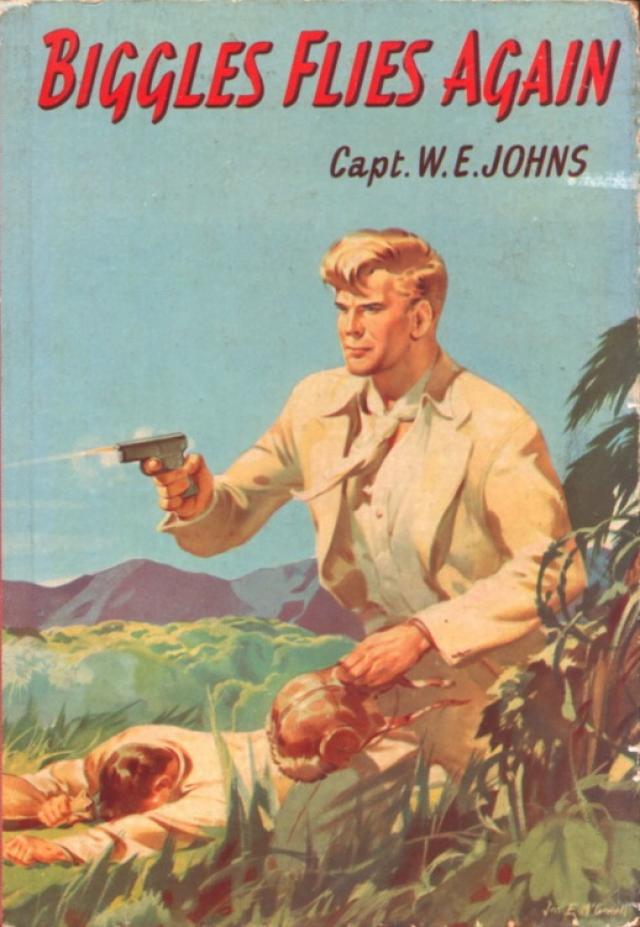


Both machines were flying low, at about one thousand feet, just under the indigo ceiling, and as the “Vandal” was slightly faster than the other it was not more than a hundred yards behind when the coastline loomed up dimly through the gloom. Biggles recognised the long, deserted arm of Dungeness immediately ahead and took some comfort from the knowledge that they were right on their course.
Then a curious thing happened, a thing he had never seen in all his flying experience. Something, a small flat object, detached itself from the airliner and dropped like a stone through space. He caught his breath sharply as he followed its fall with his eyes, and then stared back at the big machine, half expecting it to crumple up in mid-air. But a second glance revealed the machine still on even keel, apparently unaffected by the loss of a piece of its structure. He looked down again just in time to see the falling object strike the spit of sand a few yards from the water’s edge.
For a moment he hesitated, uncertain how to act. If it was a part of the machine that had come adrift, it was obviously his duty to retrieve it, so that whether or not the machine reached the airport safely the technical officers there would at least be aware of exactly what had occurred. Nevertheless he was by no means pleased at having to break his journey and abandon his guide. In the end, duty conquered; he throttled back and glided down towards the bleak stretch of foreshore, lowering his wheels as he did so. The “ Vandal” bumped once or twice, grated harshly over some loose pebbles, and then ran to a standstill a hundred yards or so from the spot where the object had struck.
“What’s wrong?” inquired Algy anxiously.
“Nothing,” replied Biggles tersely. “Hold her; I shan’t be a second.” So saying, he jumped down from the cockpit, ran across the sand, found the object without difficulty, and picking it up turned it over and over curiously. It was a flat package about ten inches by six, an inch or so in thickness, wrapped in black paper, with a broad white band pasted round the middle. He realised at once that it was this striking magpie effect that had made it so conspicuous as it lay on the dull yellow sand. There was no address on it, although it was securely tied with a piece of cord as if ready for posting.
The sound of an aero-engine overhead made him look, up quickly; it was a single-engine plane, circling as if to land. He waved his hands above his head, assuming that the pilot had seen the “Vandal” on the ground and not unnaturally thought it was in difficulties. Either the pilot did not see, or did not understand his signal, for he cut his engine and began gliding down. Biggles, unwilling to put him to the trouble of an unnecessary landing, darted back to the “Vandal,” climbed into his seat, and, swinging round into the wind, took off.
In the air, he jerked his thumb in the direction of the plane, which had taken up a position very close to them.
“He thought we’d force-landed!” he yelled in Algy’s ear. Algy nodded, understanding, and waved a cheery signal of thanks to the pilot of the other machine. Nevertheless, it stayed behind them for some minutes after they had resumed their course for London, and then it suddenly put its nose down and soon left them far behind.
“I’ll put this inside!” yelled Biggles, indicating the package, which was lying on his knees. “Take over for a minute.” He disappeared into the cabin and returned a few minutes later just as Northolt Airport came into view. The watcher on the control-tower flashed his signal giving them permission to land, and they touched their wheels on an English aerodrome for the first time for many months.
“Well, here we are,” observed Biggles. “It seems a long time since we left South America, and we’ve been a long way round. It’s time the old ‘Vandal’ had a rest; she has certainly done some work. Well, let’s get our suitcases; we shall have to clear customs here, I suppose. Smyth, stand by the machine till we come back; we’ll fix up accommodation for the machine as soon as we’ve reported in.”
“By the way, what on earth did you pick up when we landed?” asked Algy, suddenly remembering the incident.
“This,” replied Biggles, holding up the package. “It either fell overboard or else it was thrown overboard by some silly fool. I’ll give it to the Traffic Manager; he ought to know about it. Come on.”
With his suitcase in one hand and the package in the other he led the way to the customs barrier.
“Where have you come from?” asked the official. “Paris.”
“Anything to declare?”
“Nothing.”
In obedience to the official’s request he had just opened his suitcase when he became aware that two men had approached him from behind and were standing at his elbows. He turned sharply and found himself staring into the face of a thick-set man of about fifty years of age.
“Well,” asked Biggles, “what is it?”
For a moment the man made no reply. With a swift movement he whipped the package from under Biggles’s arm and held it up. “What’s this?” he asked shortly.
Now, there are moments when every Englishman, no matter what his rank may be, knows instinctively when he is in the presence of authority, and for Biggles this was one of them. Nevertheless, he bridled under the abrupt question. “What the dickens has that got to do with you?” he snapped.
“I am Detective-Inspector Myhew of Scotland Yard,” was the curt reply, and with a quick movement the officer tore a strip from the covering of the package. The tear disclosed a red morocco case and part of a heavily embossed coat-of-arms. “And I arrest you for being concerned with the theft of Lady Nunheaton’s pearls,” concluded the officer.
“I—”
“And it is my duty to warn you,” interrupted the detective imperturbably, “that anything you say may be used as evidence. Better come quietly.”
A vice-like grip closed on Biggles’s left arm.
Algy stared at the proceedings helplessly.
“But I picked this up on the beach—”
“Yes, quite so,” agreed the detective. “Are you coming quietly or—?” He tapped his pocket significantly.
“But this is a scandal,” protested Biggles indignantly. “I was just going to hand that package to the Traffic Manager.”
“Of course you were,” smiled the officer. “Come on, now; get going.”
In a daze the two airmen were quietly led through a few idle sightseers in the main hall to a big saloon-car that stood at the entrance.
“I—” stammered Algy.
“I shouldn’t talk. Wait till you get to the Yard; you can do all the talking you like then,” suggested the officer tersely.
It was nearly dark as the car threaded its way through London’s traffic. Rain had started falling in earnest and it seemed to Algy that he had never seen a more depressing spectacle. Soon, for the first time in their lives, the two airmen looked at the gloomy portal of New Scotland Yard, London’s famous police-headquarters. A policeman was on duty at the door.
“In you go,” said the detective shortly, and still in a daze the two pilots filed past the doorkeeper into a hall. It took them a couple of minutes to realise they were alone.
“Where’s that detective chap?” Biggles asked the doorkeeper irritably a few moments later.
“They said they were going to put the car away,” was the reply.
It may seem strange, but it took Biggles several seconds to realise that this procedure was not in accordance with what he understood to be the normal method of dealing with suspected persons at police-stations. He returned to the constable on duty.
“What did you say Inspector Myhew said?” he asked.
“Inspector who?”
“Myhew.”
The constable looked puzzled. “Never heard of him,” he said, shaking his head. “Are you waiting here to see someone?”
Biggles nearly choked. “Good heavens, man, we’ve just been arrested for stealing Lady Nunheaton’s pearls,” he snarled, suddenly realising that something was wrong. “You’d better take us to the inspector in charge, and lose no time about it.”
Within two minutes Biggles was telling his story to a uniformed inspector in a stiffly furnished office. When he had finished, the inspector pressed a bell, gave some orders in a rapid undertone to the men who answered it, and then returned to the two airmen.
“Well,” he said, “it looks to me as if you’ve been done, and very cleverly. They were smart lads that brought you here. The French police have had a net round Paris for the last week, ever since the pearls were stolen, a net that an ant couldn’t get through—so they said. And we’ve been watching this end. Yet, in spite of that, the thieves managed to get the goods on that aeroplane. Rather than risk having them turned up at Northolt, they dropped them at a pre-arranged spot and had another machine standing by to pick them up. By a million-to-one chance you butted in and lifted the pot, which was a thing they couldn’t foresee. The fellows in the other plane took the only course open to them, and it came off. They had to gamble you were going to land at Northolt; in fact, they were pretty sure of it after they had watched you flying towards London. Then they went on, got in ahead of you, put their story over the customs-officer—who can’t be blamed, because he knows we’ve been on the lookout—and then waited for you. It was a cool piece of work to arrest you, though; yet they had to do something. Having got the goods back they had to get rid of you, and that wasn’t so easy. If they had made one slip you might have spotted something was wrong and started asking awkward questions. They had to come to London, anyway, so they had the nerve to drop you here, the easiest place to get rid of you. Well, it’s tough luck for you two. I suppose you know the insurance people have offered two thousand pounds reward for the return of the necklace?” concluded the officer.
Biggles started. “How much?” he ejaculated. “Say that again.”
“Two thousand pounds.”
“Does that still hold good?”
“Of course.”
Biggles put his hand into his trousers-pocket and drew out a long double string of pearls that gleamed whitely in the artificial light. “That’s fine,” he said. “Where do we collect the cash?”
For a moment the inspector stared unbelievingly at the jewels; then he turned a suspicious eye on the pilot. “What’s the idea?” he said coldly. “What are you trying to put across me?”
“I’ve told you the plain, sober truth, and presently I’ll prove it, if you like,” answered Biggles simply. “When those jewels were stolen I was in Cairo, and by my logbook and carnets I can account for every minute of my time till I booked out from Le Bourget, Paris. You’ll find my wheel-tracks on the sand at Dungeness. The only thing I omitted from my story was that when we were in the air I stepped back into the cabin to look at what I had picked up. My mechanic will confirm that; he was there. I guessed that something was wrong, particularly as that single-engine plane followed us, so I did up the parcel again, but I kept the pearls in my pocket. The crooks took me in completely, I admit, but they made a bigger mistake. When they saw the red-leather case it did not occur to them for one moment that it might have been opened in the air. They knew I hadn’t opened it on the ground, either at Dungeness or at Northolt, because they were watching me all the time. So they took it for granted that the beads were still inside. They weren’t, and they’ve either kicked themselves to death by now or else they are hanging about outside waiting for us to come out.”
The inspector started. “Gosh! You may be right,” he said, making for the door.
“And we’d better see about putting our machine to bed,” observed Biggles to Algy. “ Smyth will be getting anxious. And then we’ll have a rest ourselves; we’ve earned one, I think.”
W E Johns, Biggles Flies Again