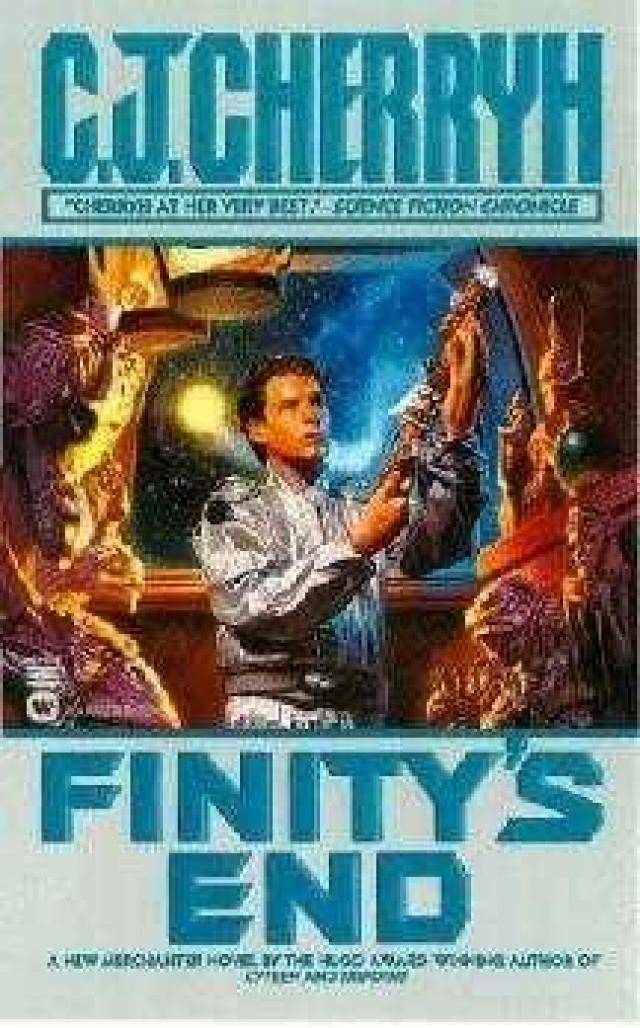
Finitys end, p.17
Finity's End, page 17
part #7 of Company Wars Series


The intercom came on. What sounded like a mechanical voice called their names, and Vince’s and Linda’s, and said, “Galley duty.”
“Shower’s yours,” Jeremy said. “We’ve got galley this round. All those pots and pans. Lucky us. But it’s not bad. Rise and shine.”
He felt like hell. And they were going to be working. The rebel part of him said ignore it, lie here, make them come get him. But it was better than lying in a bunk thinking. He stripped off and went to the shower, and was in the middle of a steamy, lung-hydrating deluge when the siren sounded.
“Takehold!” Jeremy screamed from outside. “Stay put! Damn, what’s he doing up there?”
He didn’t know what to do or which wall to brace himself against. The world dissolved and reformed. The water hit him, boiling hot. Or the world had come back. He leaned against the shower wall hoping to drown and not to be blown to atoms. Shaking head to foot.
“You all right?” Jeremy yelled.
“The emergency has ended.” a calm voice said on the intercom. “The ship is stable. That was a reposition on receipt of an unidentified, now ID’ed as Union military Amity. All clear. Request roll call and safety check.”
“Well, damn all, what are they doing here?” Jeremy said from outside the door. “Bridge wants us to call in. You all right, Fletcher?”
“Fine,” he said He stood there while the fans dried him off and he shook and shivered in the warm air. He managed to ask, meekly, “Is something wrong?”
“Must be all right,” Jeremy said through the door, “Helm must’ve not liked the look of things. But we got our all clear. We can move about”
Move about? He was in the God-help-him shower. “Do we do that a lot?”
“Pretty rare we see anybody,” Jeremy said “It’s empty out here. We didn’t nearly hit her, understand. We just, if we see anybody, we change V. In case they, you know, aren’t up to any good. In case they fired. That is a Union carrier out there.”
“So?”
“So this is sort of Alliance territory. They can come here, just kind of nosing around, but that’s one big ship out there. Usually they’d send just a cruiser to look around. That’s a whole damn command center.”
“Friendly?”
“Yeah. Sort of. It’s pretty wild. Helm must’ve forgot we were hauling.”
He opened the shower door and felt the chill outside. He dressed in clean coveralls, trying to conceal the shakes he was suffering, He’d dropped weight, he’d noticed that when he’d been in the shower. He felt hollow inside, and wanted another fruit juice, but they were out.
“So are we still likely for a takehold?” he asked Jeremy. “Can we go down to the galley, or are we stuck here?”
“We’re supposed to be on the new Old Rules,” Jeremy said, “whatever that means. That everything’s supposed to be looser and if we get a takehold it’s not a takehold like they’re going to be shooting. Not unless they say ‘red.’ Then it’s serious and we’re back on the old New Rules. But I guess the old New Rules still apply on the bridge all the time. Damn, that was a stop! I bet they rearranged the galley good and proper. Cook’s going to be cussing the air blue.”
They were crazy. The whole ship and its company was crazy, and he was still shaking.
“But I guess it’s all right to go,” Jeremy said, “You ready? Guess they’re not going to shoot.”
Chapter 10
Pure nerves, JR discovered when he reported in on the bridge. Nobody blamed Helm. Their pilot had made a precautionary move when he picked up a carrier’s large presence in the local buoy information, maintaining V.
Then a fast drop to non-combatant stance, all before the rest of them knew anything was going on and before the carrier’s advanced, fire-linked systems could read and confirm their ID off stored files. The deep spacetime punch and quick relocation of their larger than average mass could, unhappily, have given them a warlike, carrierlike, appearance—a paradoxical faster-than-light presence that would propagate through the spacetime sheet in the same way a pin-drop could make itself heard in a still room.
But they weren’t, in that instant, helpless and spotted in the fire-path of the carrier’s hair-triggered defense systems. For one thing, in the hand of cards that Old Man Inertia dealt, an entering ship always had the ace if they had a pilot who knew how to use it. The entering ship could fire downslope if they chose; reposition if they chose. If they hadn’t been willing to meet the carrier, they’d have gone silent and unlocatable somewhere along a track dictated only by physics and the local mass—a track that carrier could calculate, but not soon enough or precisely enough, on a ship that still carried enough V to jump out again on the Viking heading. And fire as they did so.
That rapid stutter of presence they’d made, however, was delay enough to let their systems determine that the presence in the jump-point was Union, not Mazianni, and their subsequent stop let the carrier find out the same about them, since they’d been lawfully using their ID when they came in.
It was still a jittery feeling, a once-enemy dreadnought in possession of the Tripoint system and themselves in its crosshairs. By what JR detected on the displays, the carrier didn’t look at all to be in transit of the jump-point. It was low-energy on a vector that said it had come from Viking, but it wasn’t proceeding. It was just sitting. Looking around. Logging traffic.
Prowling the edges of Alliance territory it wasn’t supposed to visit… except on specific invitation of Pell, which he didn’t think it had.
Mallory’s invitation, however, in the deep uncertainties of this post-War period, might be the answer. The carrier was possibly—possibly—moving out of its territory in order to back up Mallory in Earth space after they’d left Mallory unattended. That would imply Finity’s decision had been made many months earlier than he thought it had—but it wouldn’t be the first time he’d been caught ignorant of Finity’s high-level operations.
Junior officers were expected to guess, and to hone their strategic skills against real situations, trying to outfigure senior officers. But it didn’t help junior officer nerves. He’d taken himself up to B deck at breakneck speed, unshaven, still in flight-slippers, and checked in on the bridge. So had Madison, who was supposed to be the next shift, and who obviated all necessity for him to stay here—but stay he did.
In the duty of second-guessing command without disturbing operations, JR went up to Scan 5’s post and simply observed for a moment, in order not to disturb the critical, multilevel operations of that post.
“Rider status,” he asked Scan 5 after a moment of stable display.
“Uncertain,” Five reported without turning in his chair. “Carrier ID confirmed as Amity. Output normal, range 5 minutes.”
The carrier, five minutes away as light traveled, had resumed ID output, a measure of confidence as it looked them over. Scan and passive-recept alone, however, couldn’t entirely confirm what Amity was doing, whether it was sitting there with its several rider-ships still attached and therefore harmless, or whether it had already deployed them as heavy-fire platforms, lying transmission-silent and ready at various points about the area. Finity’s optics were surely in play, along with other methods of search.
The carrier hadn’t obliged their optics by turning a profile that would make its status clear, either. He saw the fuzzy image and the enhancement and didn’t take that situation for a chance arrangement in their relative positions. Five minutes was close, as ships reckoned entry positions. It was not close in targeting.
They had had an uneasy working arrangement with Union military that had held for nearly two decades. They’d even worked, though not lately, with this particular carrier. Both Alliance and Union protected their secrets, and Union was still very wary, particularly of Mallory’s intentions, even after two decades.
Bucklin and Lyra showed up to take their stations: apprentice-posts, unassigned chairs, like his, that left them able to observe, not necessarily to work at this critical juncture. He made a quiet approach to his own regular post, near the Old Man and Madison, noting that by now in ordinary procedure their bridge shift should have changed. Madison’s team was held, not yet called to duty, and that changeover might be delayed indefinitely.
Then the Old Man engaged Com. Voice meant that senior officials had now made station on the carrier, if they hadn’t been there at the moment of their entry. JR sat beside Bucklin and Lyra and put in his earpiece to catch the drift of that message, relieved to hear the Old Man’s voice addressing the Union captain in a casualness that didn’t betoken hostility.
Reassuring. There was code passing, now, he’d bet, words that didn’t quite fit the conversation, and there was at the same time he noted a relaxation of the Old Man’s features, a little hint of humor.
Madison spared JR a direct glance, a nod, a handsign that meant, ordinarily, Ours, but meant, here, JR believed, Friendly approach.
A time-lagged response from Amity came then, that said:
“Greetings from the admiral and his respects for your efforts at Wyatt’s, Captain Neihart. You may pass that along to your colleague on Norway. I must say your appearance is a surprise. I trust it forecasts success and not bad news at Earth. Where are you bound?”
“Esperance. We’ve resigned from the chase, sir. We’ve gone simply to routine cargo-carrying on this run, and we’ll be back in the trade from now on if things go as we plan. The pirate hunt is growing thin, success in that regard. Now we have to teach these young people of ours the merchant trade, give them a new view of the universe. Greetings to the admiral and our hopes for future cooperation. We’ll be quick to respond if we do spot trouble—sorry about that reposition—but we’re hauling cargo now and we’ll even be taking mail from time to time. Earth’s as stable as I’ve seen it and we hope to have eliminated some of the flow of goods we were concerned about. Salutations from our colleague and expectations of good news from your arena.”
Time-lagged conversations tended to run simultaneously and to change topics multiple times in the same paragraph, following the informational wavefront that had just come to the speaker.
“I wish I’d had the wherewithal to load full at Sol,” the Old Man said, “A load of whiskey, chocolate and wood on our last run, however. I’ll send you over a bottle of Mallory’s favorite Scotch. Her compliments. And mine.”
Audacious. And from Mallory? A Union carrier might not want to swallow a pill Finity dispensed, fearing bombs or biologics. But it was a handsome gift at the prices that prevailed past Pell
A startling implication of connections and conduits of information. The hell, then, they hadn’t known some Union contact might be here. Yet it had startled Helm, appearing as it did? Revise all estimates: they’d expected a smaller ship, but some ship.
The junior officer, kept in the dark and fed whatever data he could find by feel, could at least surmise the fact that they’d expected someone, and spooked for fear of the size of what they’d found. Helm might not have picked it up from buoy input. Helm might have read the interface itself, and been just that fast reacting to the unexpected.
“Delighted to receive fire,” one of the most powerful warships in space answered that offer. “Good voyage to you, Finity.”
A Union carrier was going to search empty space for a beeper-can and a bottle of Scotch whiskey?
Orders were passing. The ops crew down on A deck was finding a cannister, basically a smuggler’s rig, certainly not something you could buy at a station outfitters—and an item which they did chance to have, by some cosmic and unsuspected luck.
As he listened, Lyra, as the available junior-most crew, found herself dispatched on an unusual mission to the captain’s private bar.
“Is Scotch all of it?” he asked Madison as the attenuated conversation wound down to sign-offs.
“Smart lad,” Madison said, and nothing more.
So there was something from Mallory that didn’t involve Scotch, something that they’d been carrying in event of some such meeting somewhere along their course, and that a Union carrier was now going to pick up.
Curious dealings they had. No, they wouldn’t poison-pill a Union carrier. Not on their fragile lives. There was something going on in this voyage that he’d lay odds wasn’t in the line of trade: Mallory’s business, almost certainly so, and Mallory was always a wild card in the affairs of Pell Station, apt to take any side that served her purpose. She was a former merchanter, former Fleet officer and bitterly opposed to Union. And had worked with Union against the Fleet. There was no side she hadn’t been on, at one time or another, including Earth’s.
If Mallory was out there keeping an eye on something, even expecting this carrier, or a carrier to be operating on this border, then there was something afoot. He thought Mallory was back near Sol.
But there were some things for which the senior captains gave no answers because there was no need-to-know, and because crew on liberties were vulnerable and sometimes too damned talkative. Even Family crew.
The more people involved, the more chance of accidents. Clearly if Madison wanted to tell him what was in that packet besides a bottle of extravagantly expensive Scotch, Madison would have said, directly. And it was still the junior’s job to figure things out.
Foolish question he’d asked Madison. Pursuing confirmations, he checked his output from Nav, and then got up to walk past Nav’s more junior stations and confirm their exact arrival point at the dark mass. He should have asked…
“How’d the kid make it through?” Helm 1 asked, Hans Andrew, blindsiding him on the other matter of his reasonable concern as he passed the helmsman’s chair. Fletcher. If there’d been a problem in that department, it had been a junior problem, and no one in senior crew had had time to ask him—until now. Odd and eclectic, the concerns that sometimes came out of Helm, who more than anyone on the ship was focused on the shadow of that carrier and on space at large.
“Fine. Jeremy reported in, they’re fine.” Jeremy had called him as his direct report-to station while Fletcher was in the shower, and reported himself and Fletcher as in good order. In the crisis, JR hadn’t yet checked on the specific details. Fletcher was alive, God hope he was sane.
Things were still questionable on the bridge.
“Sorry to do that to him,” Helm muttered: Hans Andrew, peppershot gray and eyes that, focused on his console, still frantically darted to small side motions with the marginal come-down off a pilot’s hype. JR suspected that Hans was still tracking little if any of the intership communications—nor cared. When a pilot decided to move his ship in reaction to a developing situation, he did so on the situation, not on plan, not on policy, and sometimes not on the captain’s orders: had to, at the speeds Hans’ mind dealt with. The active pilot was in one sense the most aware individual on the ship; the gunner and Scan chief were right behind, with guns autoed live the nanosecond Finity dropped into system.
Meanwhile Helm would ask about the new kid on A deck, but not about the carrier, and Helm’s eyes—one of them with a VR contact—would dart and track minutiae of the ship’s exterior environment on his instruments, alive to that with a focus that concentratedly ignored any micro-dealings of ops. Unless you were the captain, you didn’t talk to Helm unless addressed by Helm. You didn’t bother him when he was hyped.
And he didn’t answer Helm’s comment except to dismiss a concern Helm had evidently carried into hyperspace with him, a stray thought from a month ago. It cleared an item from Helm’s agenda. At the speed Helm’s mind thought, mere human transactions, the negotiations of captains and admirals, must take an eternity.
He walked on to the empty chairs at Nav. Bucklin joined him after about ten minutes in which not much happened but routine and chatter back and forth with the carrier regarding a month-ago solar flare off EpEri, Viking’s sun. “We’ve just dropped the beeper-can,” Bucklin said in a low tone as he sat down in the vacant chair beside him. “What do you make of this crazy goings-on?”
“An interesting voyage,” JR said.
“I thought we’d retired.”
“The Old Man’s full of surprises.”
“You think Mallory’s out there at the moment?”
He thought about it, all the deep dark fringes of the sprawling mass-point where whole Fleets could hide, a hundred ships a mere pinprick on the skin of the universe. Lose something out here? Easy as not knowing what tiny arc to sweep with your scan, in a universe noisy with stars and blinded by local mass.
But he shook his head.
“No. Personally, I don’t. I think she’s somewhere at the other end of Earth’s space. While we lump along like an ore-hauler, on the merchant routes. That ship won’t use them.” Meaning the carrier, meaning the commercial short hops. There were further routes, that ships like that one, with its powerful engines, could use. And he envied that Union ship its capacities, its hair-trigger systems, with all his War-taught soul. State of the art, start to finish. Beautiful. A life remote from a future of slogging about trading stops and loading cargo.
“There is the deep route out of here,” he said to Bucklin. “The other thing that carrier has, besides riders, is an admiral. They might be working with Mallory.”
“She’s telling that carrier where to look for trouble. That’s what I’m thinking. I think we’re a go-between, I don’t think Union wants their ships near her any oftener than they can avoid it.”
It was likely true, in principle. There were a lot of bitter grudges between Union and Alliance, even between specific Union and Alliance ships—resentments from the War years. Mallory very possibly stood off at one end of Alliance space, telling Union where a Fleet operation might pop out of hyper-space in their side, doing nothing that would bring her under Union guns… in these years when the pirate operations were dying down and when, consequently, Union might perceive their need for Mallory as less—as less, that was, if they were fools.
JR drew a long breath in speculation, thinking of the Hinder Stars, where their patrols failed to keep universal security. That strand of stars, the set of stars that had enabled the first starships to reach out from Earth to Pell, was a bridge that no firepower man had yet invented could blow out of existence. Stellar mass was damn stubborn in being where it was at any given moment.