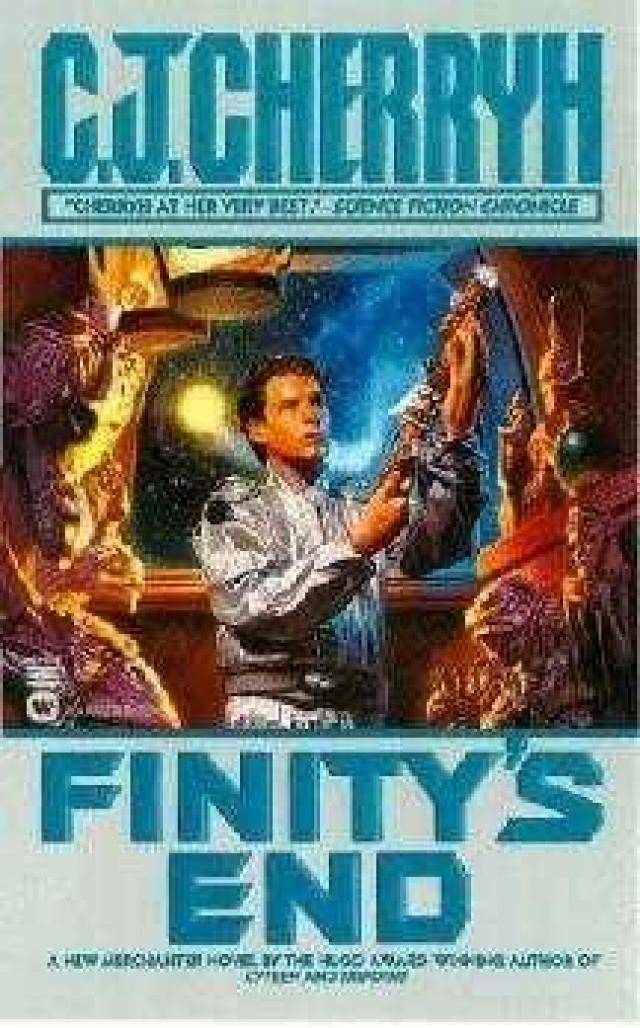
Finitys end, p.54
Finity's End, page 54
part #7 of Company Wars Series


Now titled with the captaincy, at a time when, just perhaps, they’d been thinking the famous captain couldn’t last much longer and that they knew his successors.
Now they knew nothing.
“Gentlemen,” JR said. “Ladies. My pleasure.”
There was a moment of paralysis. That was the only way to describe it. They didn’t know what to do with him. They didn’t know what his position was, how much he knew, or why. In short, what they thought they knew had changed.
“We,” the first-shift stationmaster said, trying to seize hold of what had no handles, “we weren’t informed. Is it recent, this fifth captaincy? We hope it doesn’t signal a crisis in the captain’s health.”
Vile man, JR thought. He’d never found a person snake so described on sight. And, completely, coldly deadpan, he made his reply as close a copy of the Old Man as he could muster.
“We aren’t our apparent ages. Recent in whose terms, sir?”
Conversation-stopper. Implied offense—within the difference between spacer perceptions and stationer perceptions.
And he’d asked a question. It hung in the charged air waiting for an answer as a dozen faces down the long table hoped not to be asked, themselves, directly.
There was one gesture the senior captain had made his own. JR consciously smiled the Old Man’s dead-eyed, perfunctory smile. And at least the two seniormost stationers looked far from comfortable.
“There is a succession,” JR dropped into that silence. He’d thought he’d be terrified, sitting at this table. He’d thought he’d conceive not a word to say. Maybe it was folly that took him to the threshold of real negotiations, knowing that the Old Man’s arrival might be further delayed. It might be dangerous folly. But the Old Man had taught him. “There always was a succession. It’s our way to shadow our seniors, so there’s no transition. There never will be a transition. But Mazian can’t say the same. They went on rejuv back during the War—to ensure no births. Those ships have no succession.” A second, deliberate smile. “We left only one of our children ashore. And at Pell we got him back. Another Fletcher Neihart, as happens. Looks seventeen. Unlike me, he is.”
For a moment the air in the room seemed dead still, and heavy. There was no way for them to figure his real age. The face they were looking at was a boy’s face. But now they knew he wasn’t.
Then a set of steps sounded in the hall outside. A good many of them. The Old Man was arriving with his escort.
He was aware of body language, his own, constantly, another of the Old Man’s lessons. He deliberately mirrored calm assurance, to their scarcely restrained consternation, and when Alan and Francie rose in respect to the Old Man and Madison coming into the room, so did he. Four of those at the conference table, in their confusion, rose, too.
“So you’ve met the younger James Robert,” James Robert, Sr. said, and JR would personally lay odds someone’s pocket-com had been live and the feed going to the Old Man for the last few minutes. “A pleasure to reach Esperance. I was just in communication with the Union Trade Bureau. Very encouraging.” James Robert sat down as they all resumed their seats. “Delighted to be here,” James Robert said, opening his folder. He looked good, he looked rested, not a hair out of place and the dark eyes that remained so lively in a sere, enigmatic mask swept over the conspiratory powers of Esperance with not a hint of doubt, not of himself, not of the Alliance, not of the force he represented.
“Welcome to Esperance,” the senior stationmaster said.
Thank you.” James Robert let him get not a word further. “Thank you all for rearranging your schedules. You’ve doubtless received partial reports on the trade situation and the pirate threat. I’ve just come from the edges of Earth space, and from consultation with our Union allies on matters of security and trade, and on the changing nature of the pirate activity hereabouts.” This, to a station that fancied its own private agreements with Union: it suggested Union shifting positions: it suggested things changing; and JR very much suspected the Old Man was going to follow that theme straight as a shot to the heart of Esperance objections.
There were cautions out, in the instructions from Bucklin. Champlain being in port. The crew was supposed to confine themselves to Blue Dock, and to go in groups constantly, in civ clothing. Fletcher wore his brown sweater. So did Jeremy, and now Linda said she wanted one.
“We can all have the same sweaters,” Linda said.
“The idea,” Fletcher objected, “is that civvies look different.”
“So we look different,” Linda said.
He was doubtful that Linda comprehended the idea at all. Linda understood unity, not uniqueness. Linda wanted a sweater. Then Vince did. The notion that they should look like a unit appealed to them, and protests that they might as well put on ship’s colors fell on deaf ears. So they shopped. Found exactly the right sweaters, which the juniors insisted on putting on in the shop.
Next door to the clothing store was a pin and patch shop, a necessity. Esperance patches and pins were in evidence, along with patches and pins from all over… but the ones from Earth and the ones from Cyteen were the rarities, priced accordingly.
It was obligatory to acquire pins or patches, for a first trip to a station, and the junior-juniors, getting into the spirit of the merchanter and trading idea, traded spare pins from Sol for theirs and then bought an extravagant number of extras. The merchant was happy.
Then Vince fished up a Jupiter from his pocket and got a cash sale.
A first-timer to everything, however, had to buy, and Fletcher bought a couple of high-quality Esperance pins. One for luck, Linda urged him, and at least one for trade.
Then he bought another, telling himself he’d… maybe… give it to Bianca when he got back to Pell. She’d like it, he thought. At least she’d know he’d thought of her, at the very last star of civilized space.
It was a fairly rare pin. Worth a bit, back at Pell.
Hell, he thought, after he’d left the shop… after he was walking the dockside with a trio of ebullient juniors… well, two, and an unnaturally glum Jeremy, who sulked because nobody wanted to go look for an Esperance snow globe, which Jeremy said he’d seen once, and wanted.
“They had one at the pin shop,” Linda said.
“Not the same,” Jeremy said sourly. “I know what I want, all right?”
“Tomorrow,” Fletcher said. “There’s a whole two weeks here, for God’s sake.”
“Tomorrow morning,” Jeremy said.
“Deal.” He should have gotten a pin for the Wilsons. He didn’t think the Wilsons would know what it was worth, and any pin would do… but he could get one before he left, anyway. They’d be bound to drift past another shop, in two weeks confined to Blue Sector.
Bianca, though, might know what a pin like that represented. She knew a lot of odd things. If she didn’t know, at least she wanted to know. That was what he’d liked most about her.
And at Esperance, he finally realized he missed her. Missed her, at least, in the way of missing a friend, after all the uproar of almost-love and maybe-love and the feeling of desertion he’d felt, being ripped loose from everything.
So she’d talked to Nunn. He would have, too, in her situation. He’d been angry, he’d been hurt. He hadn’t been able to be sure what he felt about her, just specifically about her, until he’d had been this long on Finity and into the hurry and hustle of a sprawling family that made him mad, and swept him in, and spun him about, and fought with him and said, like Jeremy beside him, like all the juniors and the seniors, Fletcher, don’t go…
Maybe he’d had an acute attack of hormones on Downbelow. He was in doubt now, after this many temper-cooling jumps, about the reality of all he’d ever felt. He’d been from nowhere in particular. Now he was someone, from somewhere. But all the distance that had intervened and all the change in his own understandings hadn’t altered the fact that he’d liked Bianca a lot.
Maybe the hormone part came back if you got close again. Maybe when they met they’d resurrect all of it, and be in love again—
He missed her—he knew that.
But there was less and less they had to tie them together. She hadn’t seen the sights he’d seen. She was locked into the circular cycles of a planet and its seasons. She hadn’t flung off the ties of a gravity well and skimmed the interface faster than the mind could imagine, living out of time with the rest of the human species. She hadn’t stood in an arch of water on Mariner and watched fish the size of human beings swim above her head.
He had so, so much to tell her when they met.
If they ever met.
He’d have to mail her the pin. He couldn’t go back to the Program. He’d fractured all the rules. He’d lost that for himself, in the perverse way he had of destroying situations he knew he was about to be ripped out of and taken away from. Especially if you almost loved them, you broke them, so you didn’t have them to regret. Sometimes you broke them just in case.
That was what he’d always done. He could see that now, too… how he always managed the fight, always provoked the blowup, so he could say he’d left them, and not the other way around. He had that definitely in common with Jeremy: the quick flare of anger, the intense passion of total involvement—followed by angry denial, total rejection. Go ahead. Move out. Don’t speak to me.
Silly Fetcher. He could hear Melody saying it, when he’d been too kid-like stupid even for her downer patience.
Silly Jeremy, he wished he knew how to say. Silly Jeremy. Be happy. Cheer up.
Change, to a prosperous station, was a frightening prospect.
Change and new information meant that those here who thought they knew how the universe was stacked might not know what was in their own future.
Change in the Alliance and Union relationship might abrogate agreements on which Esperance seemed secure. They stalled. They argued about minutiae. There was a long stall regarding an alleged irregularity in the customs papers. That evaporated. Then they discussed the order of the official agenda for an hour.
Madison was ready to blow. The Old Man smiled benignly, seated at the table, while the Esperance stationmaster absented himself to consult with aides.
And came back after a half hour absence, and finally took his seat
“The legal problems,” the stationmaster said then.
“Third on the agenda,” Alan said.
“We cannot talk and discuss matters pertinent to a pending suit…”
“Third,” Alan said.
“We’re vastly disturbed,” the Esperance stationmaster insisted, “by what seems high-handed procedure regarding a ship against which no charges have been made, sir. I want the answer to one question. One question, sir.”
“Not one question,” Madison said. “As agreed in the agenda.”
“We can not agree to this order. We can’t talk beyond a pending suit. We wish to move for a meeting after the court has ruled.”
“You can have that, with Finity’s trade officer. In the meantime… you’re not meeting with Finity’s trade officer.”
Madison, at his inflammatory best. JR tucked his chin down and listened to the shots fly.
“I cannot accept Alliance credentials from a ship in violation of Alliance guarantees.”
“This is Alliance business, which you may not challenge, sir.”
“I ask one question. One question. On what authority do you pursue a ship into inhabited space?”
“What ship?” James Robert asked, interrupting his idle sketching on the conference notepad—looking for that moment as if he had no clue at all, as if he’d been in total lapse for the last few minutes, and JR’s heart plummeted. Is he ill? the thought came to him.
Outrage mustered itself instantly on the other side. Outrage perfectly staged. “Champlain, captain.”
James Robert looked at Madison on one side, and at Francie, Alan, and him, on the other. Blinked. “Wasn’t that ship docked when we entered system?”
“Final approach to dock, sir,” JR said, and all of a sudden knew the Old Man had been far from oblivious. “As we came into system. Days ahead of us.”
“And what was its last port?”
“Mariner.”
“While our last port was Voyager.” It was dead-on focus the Old Man turned on the Esperance officials. “Hardly hot pursuit. They’d passed Voyager-Esperance before we got to that point. Our black-box feed will have the latest Voyager data. Theirs won’t. Ours will have an official caution from Mariner on their behavior. Theirs won’t reflect that. They undocked before we or Boreale left Mariner. Seems a case of flight where no man pursueth, stationmaster. Boreale might have had a dispute with them we know nothing of. We didn’t chase them in. And I invite anyone with doubts to examine the black-box record Esperance now has from the instant we docked. It will show exactly the facts as I’ve given them, including a stop at Voyager.”
Bravo, JR thought, and watched the expressions of station officials deeply divided, he began to perceive, between pro-Union and pro-Alliance sentiments… and those who simply wanted to go on playing both ends against the middle. And unless he missed his guess the stationmaster hadn’t accessed their records yet to know where they’d been. Careless, in a man leveling charges.
Careless and impromptu.
“But a military ship can access a black box on its technical level,” the stationmaster said. “And your turnaround at Voyager must have set a record, Captain Neihart, if you stopped there.”
That man was their problem. William Oser-Hayes. There was the chief source of the venom. JR wanted to rise from the table and wipe the look from the man’s face.
The Old Man did no such thing. “Necessarily,” the Old Man said calmly “The military does have read-access. And can delete information. But black boxes… and you may check this with your technical experts, do show the effects of military access. Ours wasn’t accessed. Check it with your technical experts.”
“Experts provided by Pell.”
Oh, the political mire was getting deeper and deeper. Now it was all a plot from Pell. And the Old Man was playing cards from a hand they had far rather have reserved for court, for the lawsuit. It gave their legal opposition a forecast of the defense they had against the charges, even if it was a very good defense—an unbreakable defense in a port where the judiciary was honest.
The way in which certain members of the conference looked happier when the Old Man seemed to win a point indicated they were not facing a monolithic administration and that there was sentiment on Finity’s side. But the fact that Oser-Hayes did all the talking and that all the ones who looked happy when Oser-Hayes seemed to score sat higher up the table indicated to him that they had a serious problem—one that might well infect the judiciary on this station. That the attack from the opposition had come from the Esperance judiciary and not from, say, the Board of Trade or the other regulatory agencies clearly indicated that the judiciary was their enemies’ best shot, the branch most malleable to their hands.
Not a fair court, JR said to himself. The legal deck was stacked, and they might lose the suit even if the other side was a no-show and the evidence was overwhelming. That they’d bullied their way into this meeting indicated Oser-Hayes wasn’t absolute in his power, that he regarded some appearances, and had to use some window-dressing with some of his power base to avoid them bolting his camp.
He was learning, hand over fist, that precisely at the moments one wanted to rise out of one’s seat and choke the life out of the opposition, one had to focus down tightly and calmly and select arguments the same careful way a surgeon selected instruments. Oser-Hayes was no fool: he meant to provoke the choke-him reaction, which might get the Old Man to make a tactical error—if the Old Man weren’t one of the canniest negotiators alive. One time Oser-Hayes had thought he was dealing with a drowsing elder statesman a little out of the current of things: one time the Old Man had let him stumble into it, and start the meeting. They were into the agenda, after balking for hours. A parliamentary turn would see them handle it, and revert back to the top of the list before Oser-Hayes could think how to avert it.
They were talking. They had accomplished that much.
But this talk of technical experts provided by Pell as a source of suspicion… this talk of deliberate sabotage by agents from the capital of the Alliance—as if the Alliance government and Alliance-certified technicians would likelier be the source of misinformation and duplicity, not some scruffy freighter running cargo in the shadow market and most probably spying for Mazian—that was a complete reversal of logic. The black boxes on which the network that ran the Alliance depended were of course suspect in Oser-Hayes’ followers’ minds; the word of Champlain against them was of course enough to stall negotiations and tangle them up in the issue of universal conspiracy, which Oser-Hayes insisted on discussing.
Whatever the Old Man’s blood pressure was doing at the moment, there was no sign of it on his face. And the Old Man came back with perfect calm.
“Would you prefer those experts provided by Union, sir? I don’t think we can access them. But Boreale can certainly attest every move we’ve made. And the next ship arriving in this port from the Mariner vector will most assuredly reflect exactly the same information, as surely the stationmaster of Esperance knows as well as any ship’s captain—unless, of course, our technical experts have gotten in and altered the main computers on Mariner, then accomplished the same with seamless perfection on Voyager in ways that would withstand cross-comparison for all future ship-calls at any station in the Alliance—”
“Sufficient time to have gotten signatures on documents is all you need.”
“Ah. Is that your fear?”
“Apprehension.”
“Apprehension. Well, in respect of your prudent apprehensions, we have the precise case number that will pull up previous complaints on Champlain, including those that will have different origins and dates than any ship-call we’ve made. To save your technicians, I’m sure, weeks of painstaking effort…”