Cyrano, p.15
Cyrano, page 15
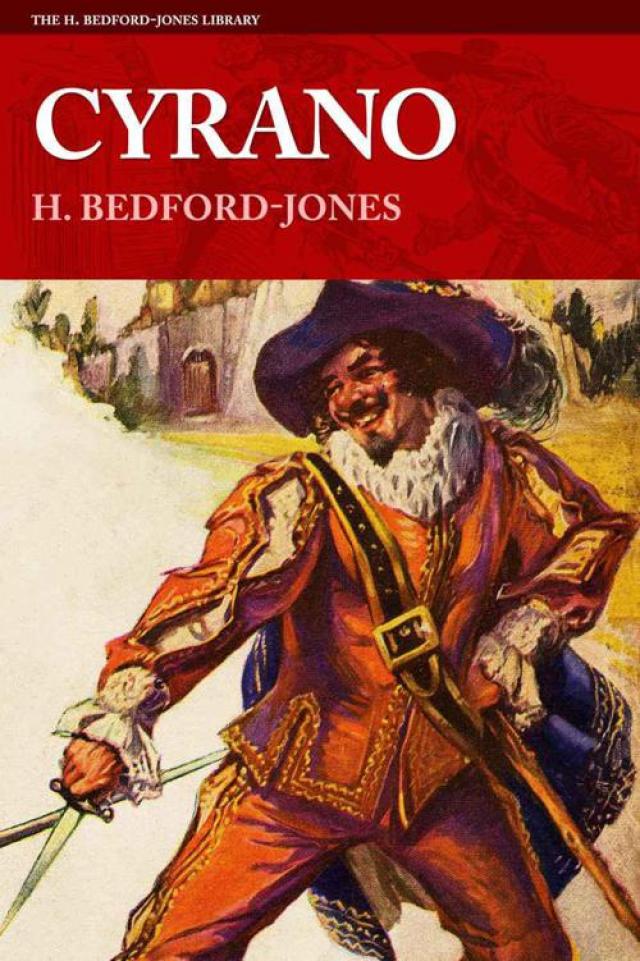


“I cannot do that,” murmured the astonished Englishman.
Cyrano bowed again.
“Then, monsieur—en garde!”
“Eh? You mean that I must fight you? That if you lose—”
“I cannot lose. En garde!”
“So be it, then!” exclaimed Sir John. His cloak fell to the sand, his blade leaped out in the moonlight. “I salute you, monsieur; it is a pleasure to cross swords with so true a gentleman!”
An ironic smile played about the lips of Cyrano as the rapiers met and clung together. He did not speak again.
A STRANGE meeting was this, in the limpid moonlight beneath the massy black rocks. Sir John was a finished master of fence, and almost at the first pass his point touched the velvet above Cyrano’s heart, but without breaking the skin.
“An inch farther, monsieur, and you’d have won your game!” and Cyrano laughed gayly. Then, as he fenced for position, his foot slid in the wet sand and he went to one knee. Sir John drew back and waited.
“Thank you, monsieur,” said Cyrano simply, and the steel slithered again.
Moment by moment heat grew upon the two men, personalities faded away. All that hung before their eyes was the issue of life or death as the slender blades drove in and out, with lunge and parry and riposte. In the moonlight, the features of the Englishman showed grimly earnest; the dark face of Cyrano was tense and cold, but his eyes blazed forth like glittering stars.
And now, for a little, neither man moved position; as though their bodies were stationary things, as though their blades citing magnetized together, they stood almost motionless, wrist playing against wrist, feet sinking ankle-keep in the sand. Of a sudden, Cyrano disengaged and drove in a deadly thrust. Sir John parried it desperately, but lost balance; unable to extricate his feet from the sand, he staggered, and Cyrano’s blade tore the rapier from his hand. With a quick spring, Cyrano leaped backward and saluted.
“Courtesy for courtesy, monsieur!”
Sir John, panting, retrieved his sword, saluted, and the blades crossed anew. But now sweat stood upon each man’s face, and their breath came in short gasps. Blood sprang abruptly on the neck of Cyrano.
“Touché!” he exclaimed, and laughed a little. “A good thrust, monsieur—but now beware—of this riposte in—tierce—”
He attacked, and before the savage fury of this attack Sir John was driven backward a pace or two. All the dazzling speed, all the concentrated intensity, which had made Guardsman Cyrano the most dreaded duelist in Paris, suddenly appeared before the eyes of the Englishman; desperately he parried, evaded, strove anew to meet wrist with wrist—but strength was failing him now.
“The riposte, monsieur—the riposte!” cried out Cyrano. “In God’s name guard yourself!”
His whole body uncoiled like a steel spring, and at the end of this steel spring was the rapier, darting like a silver snake in the moonlight. For one terrible instant Sir John stood as though paralyzed. Cyrano leaped back.
Then the arms of the Englishman fell, and his rapier dropped on the sand, and a slow smile crept into his weary, drawn features.
“Well fought—well lost.” His gasping words ended in a rush of black blood, and he quietly collapsed.
Cyrano flung down the rapier, came forward, dropped to one knee; his hand rested upon the heart of the Englishman for a moment, then lifted, dark in the moonlight. He crossed himself, and raised his face to the sky, silent with emotion.
And strangely, the scarred face framed in sweat-dank hair was at this moment singularly beautiful—for beauty is not a physical thing, but an expression of the spirit. Then the dark and liquid eyes of Cyrano closed, and upon his cheeks, on either side of that keen hawk-nose, sparkled a tear. Again, more slowly, he signed himself, and his head drooped and his voice came thick and husky:
“Ave Maria—pleni gratia—”
Chapter XIII
—BECOMES A GUEST.
TWO dark, unlighted shapes drew in across the face of the waters, now but thinly lit by the moon; for a scud of cloud had crept across the heavens, and morning was not far away. The two shadowy blots were apparently heading for Avranches, until they tacked in the light wind and stood back for Tombelaine.
In the rocky cove at the northern side of this island appeared a feeble glimmer of light—a lantern set there to guide their landing. The tide was nearly at flood, and a waste of waters surrounded the two islands in the night.
Slowly the two bluff-bowed St. Malo luggers drew in, the wind freshening by degrees. A rift in the clouds displayed the dark Tombelaine clearly. With a creak of sheaves the canvas fluttered down and anchors plunged. The lantern in the little cove showed no one to meet them, no voice cried a greeting. The rear of the cove, studded with huge rocks, ended in a grotto. Men called from the ships, called to Sir John, but there was no reply.
“Send in a boat,” commanded the voice of a St. Malo man. “Take a sounding or two. No use letting ourselves go ashore on these cursed sands!”
A skiff was dropped into the water, and amid a low-voiced discussion a number of men got into her, and the oars dipped. They could see a tall figure ashore now; he was lighting a cresset placed on a high rock, as though to illumine the sands. Half a dozen Englishmen were in the skiff, with two oarsmen, and they called again to Sir John.
“He is here,” responded the man on shore, in French. Then, as the cresset caught and blazed up, he withdrew from their sight.
The boat came into the little cove, whose sandy nose was well lighted now by the cresset. Her keel grounded. The men leaped outboard, pulled her up, advanced a few paces; one of them called Sir John again, another called Courtney. These men were the leaders of the English force.
“There he is!” called one of them. A sitting figure, on a slab of rock, had come into their vision. They pressed toward it. At the next instant a terrible cry broke from them.
Courtney lay half behind a jutting rock, in a curiously awkward position; beside him sat Sir John Ottery. But both were dead.
The half dozen Englishmen crowded around the two bodies, then looked up as a mocking laugh and a voice came reverberating with uncanny effect from the grotto.
“You’re betrayed, Englishmen!” it cried. “Fire, my friends! No quarter!”
And a pistol roared, sending a bullet into the breast of the nearest man. A second and a third pistol spoke; two more Englishmen fell. Cries of dismay burst from them all. The two seamen were shoving at the boat, in panic. The three remaining Englishmen ran to aid them. Another and another pistol vomited smoke and flame, and to the reëchoing crashes a fourth man fell. The fifth spun about, clapped hand to his side, fell over the gunnel of the boat, and sat up again.
Now into the full light of the cresset darted the tall figure of Cyrano, the last loaded pistol in his hand. From the two luggers came a pandemonium of cries, oaths, orders; the anchors were being jerked up, the canvas was lifting; panic was upon all those men. Cyrano laughed and leveled his pistol at the boat, whose oars were plunging frantically at the water.
“Take this message back to your friends, Englishmen!” he cried, and pressed the trigger.
The one unhurt man cried out and fell backward into the lap of his wounded companion. Cyrano stood there, shaking his fist, laughing wildly. Then came a ragged volley of shots from the luggers. Bullets struck all around him; one of them cut the plume from his hat. He swept off the beaver and bowed ironically.
“Poor shooting, messieurs!” he shouted mockingly. “A pleasant journey home!”
Then he was gone from sight. In all haste the boat came alongside the nearer lugger, which was already turning. The brown canvas rattled up, caught, filled. The two shadowy shapes drew away, heading out into the bay.
One man had repulsed sixty.
FOR an hour Cyrano was extremely busy, working by lantern light in the loose sand above high-water mark. He had only swords and poniards for tools, and his bare hands; but these sufficed. When he had finished, dawn was at hand and the tide was going out. He dropped to his knees, said an Ave and a Paternoster, and then rose wearily, for he had not slept all this night.
“An ill job well done,” he reflected aloud, watching the swiftly departing water, the swiftly growing waste of wet sand. “And now, to get back to the Mont with my tidings for Salignan! Then to arrest Effiat when he returns. Thus it is all ended like any honest theatrical episode; and the Marquis de Bergerac is ended, likewise, his little day drawn to its close, his little game played out and won. What lies in the future, with Marianne—who can say?”
It seemed indeed to Cyrano in this moment that his masquerade was ended, his game won and finished; but he forgot that his destiny had ever been an awkward jade, an ironic and cantankerous jade, decorating him with laurel wreaths in the same moment she smote him across the cheek.
He rested a little; he was tired in body, more tired and sad in mind, for gallant gentlemen had died that night by his hand. He had Père Carré’s purse intact, and had taken no little gold from English pockets; but wealth gave him no pleasure. It was in a gloomy and bitter frame of mind that he finally led out the three horses, mounted his own, and started in the dawn light across the sands toward the high-looming mass of the Mont, half a league distant.
Evidently, he reflected, those pistol shots had passed unobserved in the night, unheard. The astonishing spectacle of a cavalier and two empty saddles coming from Tombelaine before sunrise created no alarm or confusion that he could see. He was forced to skirt the Mont in order to reach the gate below the town, and as he passed along beneath the walls he saw wains on their way thither, and men far above at the great wheel which would pull up nets of produce and supplies for the abbey, straight up to the opening in the side of the Great Inner Degree.
He saw a horseman, too, spurring hard from Pontorson and reaching the entrance far ahead of him, but thought little of it. When at length he had rounded the angle of the island and was drawing into the gate, he saw this same cavalier emerge, speak with the guards, and turn toward him. Reaching the paved entrance, Cyrano dismounted, and the cavalier came up to him. He was weary with hard riding; his horse, at one side, was exhausted.
“Monsieur,” he said, “I perceive that you have extra horses. Mine is spent. I must have one of yours, in the king’s name.”
“With all my heart,” said Cyrano.
Upon the instant, with a brief word of thanks, the cavalier climbed into one of the empty saddles, struck in his spurs, and departed in the direction of Pontorson. Cyrano turned, to find at his elbow two of Salignan’s soldierly lackeys.
“M. de Bergerac,” said one of them, “M. le Commandant wishes your presence immediately. Will you have the goodness to accompany us?”
Cyrano shrugged and assented, smiling to himself at the news he would have for Salignan.
MEANWHILE, in his large room in the King’s Tower, in the lower town, M. de Salignan sat at a table. He was hastily dressed; two candelabra lighted the room, for the sun was not yet up. With astonishment and a fierce excitement in his eyes, he read anew the brief dispatch which had just arrived from the south of France.
Monsieur:
The conspiracy is at an end. Cinq-Mars and de Thou are in our hands; ere this reaches you, Orleans and Bouillon will be arrested. Seize M. d’Effiat; send him to Tours. We need all possible evidence; therefore, spare no effort to obtain and forward to us any documents bearing on the case. May God preserve you!
Mazarin.
“So!” A thin, cruel smile touched the lips of Salignan. One of his lackeys entered and saluted stiffly. “Well?”
“Monsieur, the prisoner is here.”
Salignan gestured. The door opened, and into the room came Effiat’s lackey Mervaut, between two guards. He was not, however, frightened. Instead, he regarded Salignan with sullen effrontery.
“You are a prisoner, Mervaut,” said Salignan curtly. “Before you go to a cell, tell me what you know of your master’s movements in—”
“Pardon, monsieur,” said Mervaut, one hand slipping to his pocket. “Will you have the goodness to look at this paper?”
He gave a folded paper to a guard, who laid it before Salignan.
The latter read it, and looked up, startled.
“From Avillon! Then you have been betraying your master, you rogue? You’ve been a spy, have you?”
“If you call it so, monsieur,” said Mervaut composedly. “One man serves the king in the uniform of a soldier; another, in that of a lackey.”
Salignan sniffed. “Have you any further information you should impart?”
“Nothing, monsieur.”
“Very well; you are free.” Salignan signed to the guards, who stepped back. “Do not leave the Mont without my permission. What do you know of M. le Marquis de Bergerac?”
A malicious smile touched Mervaut’s lips, and was gone.
“Little, monsieur, but I do not believe he is a marquis. I have heard tales of one M. Savinien de Cyrano, called Bergerac, who is a gutter bravo of Paris. I believe this to be the same man.”
Salignan started. “Ah! He is, I understand, an accomplice of M. d’Effiat?”
“His chief aid, monsieur.”
“Very well. You may go.”
Mervaut bowed. On a chair by the door was Avillon’s little whip, where it had been carelessly thrown. In passing, Mervaut quietly, openly, stooped and picked it up and took it with him; in so unconcealed and natural a manner was the thing done, it passed unobserved.
Another lackey-soldier entered and saluted.
“M. de Bergerac, M. le Commandant!”
SALIGNAN gestured, and Cyrano swaggered into the room. He tendered Salignan a deep bow, to which the other smiled ironically, and returned curt words.
“M. de Cyrano, called de Bergerac, you are under arrest.”
“I, monsieur?” Cyrano smiled scornfully, despite the manner in which he was addressed. He attempted no denial of his real personality. “That is but natural.”
“Eh?” Salignan’s brows lifted, “Natural?”
“Of course. That, after saving France, I should be arrested?”
“Oh! You have saved France, monsieur?”
“Assuredly. Last night I killed M. de Frontard, a Huguenot leader; certain Englishmen; and drove off two ships filled with English who were landing on Tombelaine. This place was to have been turned over to them to-night by M. d’Effiat—”
Salignan threw back his head and broke into an amused laugh.
“Come, come, M. de Bergerac! You should have assumed the name and title of Roland, or of Bertrand du Guesclin, at the least! You have, of course, proofs of your prowess?”
Cyrano was so dumfounded at this reception of his news, that he could only stand and stare, a dull flush rising into his face. Proofs! In any case, he had none to hand.
“You gutter bravo!” snapped Salignan, suddenly in heated anger. He took the silver-hilted poniard from a drawer and threw it on the table before Cyrano’s astonished gaze. “You vile assassin! You slew Sieur d’Avillon yesterday with this weapon—this poniard which bears the arms of my good friend the Comte de St. Méloir, and which you have had the audacity to wear, doubtless to bolster up your assumed title. Dare you deny it?”
“Eh?” Cyrano was overwhelmed by all this. “But I did not kill him—it was Effiat.”
“With your poniard? Liar!” Salignan gestured, and a man stepped forward from either side, seizing the arms of Cyrano; next instant, his wrists were drawn behind his back and bound. He attempted no struggle. A sort of paralysis was upon him, and utter despair.
“Monsieur,” he exclaimed in a choked voice, “I have told you that Père Carré—”
“Be silent!” snapped Salignan. “You have told lies enough, my fine rascal. Where you got the blank order of arrest, I know not; but I shall make use of it. Guard, give me the papers from his pocket.”
One of the guards searched him, found the lettre de cachet, and handed it to Salignan. Cyrano had no further papers. Salignan ordered his other effects left untouched, despising the money which loaded his pockets, and bent a stern eye upon him.
“Sirrah, you go into a cell as a murderer, and for having falsely assumed the title of a nobleman. You, indeed, acting as the escort of a noble lady! And you’ve filled her ears with your fine stories. Bah!”
A mortal pallor had overspread the features of Cyrano.
“Monsieur,” he said, “if you will listen to me, I can afford you proof of what I have said. What was done last night, was done for France, as my duty, not of my own will.”
“Oh, insufferable rogue! Where learned your tongue this prating of duty?” cried out Salignan. “On the contrary, rascal, I am an officer of the king, with special powers to act here; and I am doing my duty.”
“Will you not let me warn you, monsieur—”
“Be silent! I’ll listen to no more of your lies. Men, place him in that barred chamber down below here. Raoul, remain as guard at his door.”
Cyrano drew himself up with a certain strange and impressive dignity.
“Monsieur,” he said quietly, “paradise is full of fools who have done their duty. Me, I prefer—”
Salignan leaped to his feet and struck him across the face. “Take him away!”
WHEN the men had gone with their captive to the lower prison-room of the tower, however, Salignan dropped into his chair again, frowning.
“That was a coward’s blow,” he muttered unhappily. “Why did I let the fellow’s prating so goad me? But he dared aspire to Marianne! Well, no matter.”
He looked again at the dispatch from Mazarin, with its order to send Effiat to Tours as a prisoner. Then he picked up the lettre de cachet.
“Excellent! This fits in admirably,” he murmured. “When Effiat arrives, I fill in his name, in his presence. Hm! Perhaps there was some truth in this rascal’s story about the English; is that why Effiat went to the mainland? And that name—M. de Frontard! Yes, there is a Huguenot gentleman of that name; I recall, he was in the light cavalry of M. de Nemours. The same man, perhaps! Well, once affairs are settled, I can get the truth out of the rogue Cyrano; a touch of the rack will wring him dry. And meantime, no harm in using his story when Effiat comes. Now, as to dispositions—”