Cyrano, p.4
Cyrano, page 4
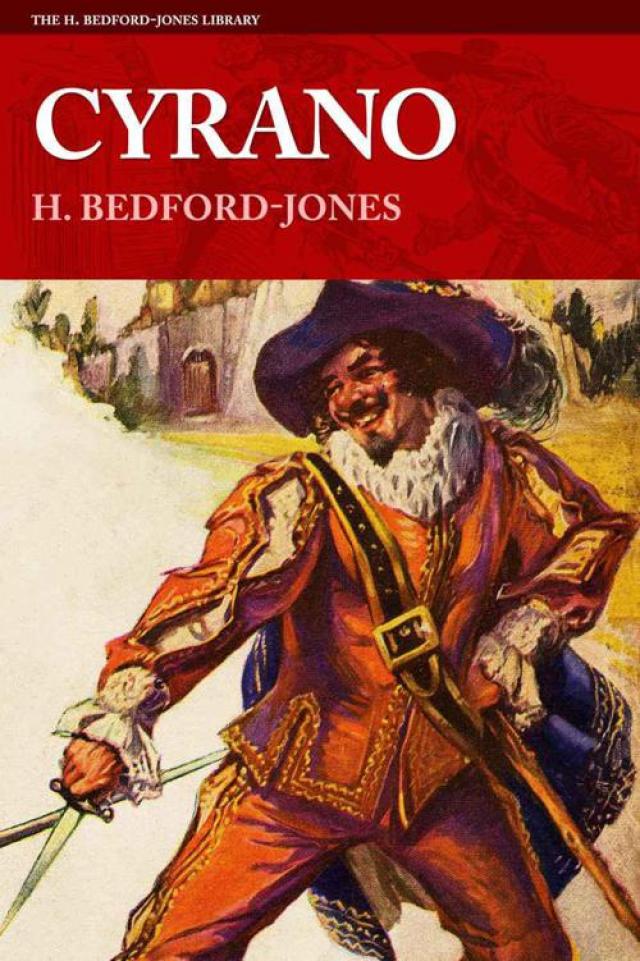


NOW, fiercely exultant over the fortune which had brought him here at such a moment, the Marquis of Seven Stars strode up and down a somber room whose walls were adorned with tattered tapestry and old portraits. The furniture in the room consisted of but a large table, loaded down with books, and a few chairs. Laughing suddenly at some thought, Cyrano strode to the table, seized on the topmost book, and whistled amazedly when he had opened it. Then, fumbling under his doublet, he produced a folded letter.
When Marianne came into the room, Cyrano was standing at the window, and swung about to meet her.
“Monsieur, I owe you deepest gratitude,” she said earnestly. “Pray consider yourself and your lackey as my guests. He must help us with the service, for we live simply here, but we can make shift. Sieur d’Effiat—”
“Has been called to his fief of Mont St. Michel,” said Cyrano. “I am also bound thither, with pilgrimage in mind—and other things more important. But what’s this I see?” He broke off, took a step to the table, and opened a book there. His astonished gaze went to Marianne. “The ‘Clavicule’ of Solomon! And beneath it the work of Rabbi ben Chomer. Ha, a miracle, no less! To find these books of witchcraft and magic—”
Marianne looked a trifle startled. “There is much of interest in them, and no witchcraft,” she said, and watched him turning over the leaves of the book.
“Aye, interesting,” said Cyrano. “Nicetas mentions it in his life of Comnenus, and—”
She put out a hand and checked him. “There is something between the pages; what is it? A paper? A letter? Strange!”
Cyrano carelessly removed the letter and she turned it over in her hand, with an air of puzzled wonder.
“Addressed to me—and I never knew it was there! Your pardon, monsieur.”
She broke the seal, opened the letter, glanced swiftly through it. A little color came into her face, then she looked up and smiled.
“It is nothing. Pray be seated, monsieur; we shall have food and wine shortly. So you go on pilgrimage to the Mont?”
“Well,” said Cyrano, when he had placed a chair for her and taken another himself, “I go on pilgrimage, of a sort.” His gaze was whimsical, his dark eyes were laughing. “My real aim is less worthy. Look at the books there on the table; each book represents a man, you comprehend? A legacy to the world. Well, if Cyrano were to write a book, what then? Look you! These many months I’ve been studying with Gassendi in the College of Lisieux, and what’s the end of it all, of these learned doctors and professors? Talk, talk, talk! A man can make no impression on the world by talking. Either he creates, or he vanishes utterly!”
“Why make an impression?” Marianne regarded him amusedly. “Vanity of vanities!”
“True, yet the urge is in us,” said Cyrano soberly. “What good in talking, scribbling, philosophizing? A man has hands and brain. If he can combine them, whether in book or painting or what not, he leaves something in the world he found not there. Did you ever hear of Lady Tiphaine of Brittany?”
Marianne shook her head, watching the ardent, impulsive Cyrano with thoughtful gaze.
“She was wife to Bertrand du Guesclin,” he went on. “While Bertrand was fighting the English, and was prisoner in Spain for five long years, Lady Tiphaine sat in her house atop Mont St. Michel and studied the stars, and wrote books about them. Her manuscripts are all in the library of the monks. Well, I go to see what she left to the world.”
“What?” Marianne’s eyes widened. “She studied the stars—and left manuscripts?”
“Aye, one of the monks told me,” said Cyrano. “Does this interest you, who also study the stars? Well, well, go on pilgrimage, too! Simple enough. I’ll have a coach at Palaiseau, and you shall share it with all my heart.”
Marianne made no response to this. The old crone hobbled in, bearing a tray which she set on the table.
WHEN the wine was poured, the Lady of Gisy studied Cyrano, appraising him with her quiet eyes, those eyes so gravely kind, so wise, yet so filled with a girl’s laughter. As they sipped the wine and sat in talk, Cyrano was aware that she was searching out the depths of him, weighing him in the balance of her mind. And he was aware of the subtle power that emanated from her, wakening his pulses.
So, abruptly, being a man of no tact and great impulse, he brought up the question of Sieur d’Effiat. In reply to his query, Marianne scrutinized him thoughtfully.
“What do I think of him? A strange question, monsieur. He is your friend.”
“He is not,” said Cyrano flatly. “I’d put sword into him with pleasure. He means you no good, let me tell you.”
“Oh! I know that already,” said she, and looked at him all smiling. Now he was confused, perceiving that there was a great deal this woman knew. “Cyrano—a singular name! And a singular device, if those stars are a device!” And she indicated the seven stars on his cloak.
“Ah, mademoiselle!” said Cyrano. “You, who study the stars, know not this device?”
“Not I, indeed.”
“Why, look you!” With his long finger, Cyrano followed the design of those seven stars until he had connected them in lines. “They are my device indeed and my symbol, but more, they show the fate of all France, of this great kingdom! There is the word, Caah in the Hebrew,” he went on swiftly, eagerly. “It signifies a man struck down, ill, without hope. Well, that is my own case! But look at the astrology of it, at the inner meaning read by Rabbi Chomer in that very book on the table there! The letter Aleph, in the center, is given numerically the number one, or one thousand; the first letter in this word is numbered twenty, the third, five. Thus we have one thousand and twenty-five years which this Realm of France will endure from its foundation. And granting it was founded in 768 A.D., then in the year 1793 the kingdom will fall—”
Marianne de Gisy broke into laughter so unassumed that it silenced Cyrano.
“My dear marquis, do you expect to live another hundred and fifty years to prove your astrology true? Surely you place no faith in this sort of star-divination, in this superstitious mummery? Why do you indulge in such foolish nonsense?”
Cyrano grimaced, then broke into a frank laugh. “Oh, it is amusing at times,” he said with his air of naïve gayety. “Besides, those stars stand for many other things, dear lady.”
“Who are you?” she demanded, quietly persistent. “Come, tell me. From what part of France are you; where did you learn your wizardry?”
Sudden misery leaped into the dark eyes—misery so acute, so terrible, that the sight of it blanched the cheeks of Marianne.
“Dear lady,” said Cyrano in a low voice, “ask me that question again, some day—but not to-day. Lie to you I cannot and will not, yet I would know you for a little day or two, be your friend if I might, help you if it lies in my power; I do not want to tell you the truth lest the cup of sweetness be taken from my lips.”
“Very well,” she said quietly. “At least you are a true magician, since your touch brings unguessed letters to light! But you have interested me with your mention of Dame Tiphaine. I study the stars in my own poor way, having a taste for it. If it be true that the wife of Bertrand du Guesclin left manuscripts—”
“True, indeed,” broke in Cyrano. “The monks have a house in Paris, in Rue Etienne-des-Grecs, and I have talked with them at times. These Benedictines of St. Maur are historians and writers; they delve into old matters and ancient books. Yes, I assure you it is true.”
“And you go to the Mont? I am indeed tempted,” she returned thoughtfully. “However, I have the feeling that behind all this is something you have not told me; some purpose you have left unsaid. Is it so, my dear marquis?”
FOR an instant Cyrano hesitated; then, as though her kindly, quiet eyes stripped away all defenses, he flung caution to the winds and burst forth in swift mad impulse.
“Yes, it is true. This rascal Effiat is behind it! Figure the thing for yourself, dear shining lady! He had certain intents, certain plans all laid. He told me of them. ‘Nonsense!’ I said. ‘Leave the matter to me. If you desire this lady at the Mont, then I’ll fetch her there to you! I will bring her.’ I told him this to throw him off the track, dear lady. You will not go there, of course—oh, I had fine dreams about it! I thought I might escort you there, preserve you, lay down my life for you. Bah! All folly. Rank madness. Better for me to tell you the truth, thus, and then bid him to the devil if he asks why you did not come.”
Her eyes, resting steadily upon his face, showed no astonishment at this disclosure.
“The truth is always better, my friend,” she said softly. “I think that I may go with you to Mont St. Michel.”
“Eh?” Cyrano opened his eyes wide. “But no—not at all! You misunderstand. I have told you the truth. Do not be tempted, dear lady, by my talk of manuscripts—oh, I am a fool, a bitter fool! Let us be sane. Sieur d’Effiat is lord of the Mont, a great noble, a powerful man.. You would run risks with the rascal.”
“I? You do not know me,” and Marianne laughed softly. “I would run risks with most men, though I do not like this man Effiat. When balked, he would not be a man but a devil. Still, there is the old dispute over lands, which might be settled. Then, the manuscript of Dame Tiphaine.”
“Do not go,” said Cyrano curtly. She eyed him for a moment.
“Perhaps I shall go,” she said. “If so, then what?”
“Then you go against my advice and warning.”
“What I do, I do of my own advice,” said she, calmly. “Besides, you have promised Effiat to fetch me to the Mont.”
“Bah! That is nothing,” broke out Cyrano earnestly. “Now that I have met you, it is another thing entirely. You are more than I ever dreamed you could be. My promise to him meant nothing.”
“I really think that I shall go,” said Marianne de Gisy. “This Effiat has no real love for me; he does not know the meaning of the word. His pride is the only emotion involved. Because I refused him my favor, he is resolved to conquer me; like many of these court gentry, he considers a woman an inferior being. Perhaps he may learn a lesson! So, then; supposing I do go with you—would you be my friend?”
Cyrano read in her eyes that she would indeed go, that his protests were unheeded, that his warnings were less than the winds of heaven to her calmly poised spirit. So, being the man he was, he instantly swung over to the other extreme. If she would go, good! Why not? He warmed to the thought.
“Would I, indeed!” he exclaimed eagerly. “Excellent! It is settled! I am more than friend, dear lady—a very troubadour who would lay his devotion before you, who would gladly die in your service! Let us go adventuring, then. You, to run your risks, settle your dispute with the monks, get the manuscripts of Dame Tiphaine. I, to protect and watch over you.”
Laughter shone in her eyes suddenly. “But,” she said, flinging back his own words at him, “this Effiat is lord of the Mont, a great noble, a powerful man.”
“Bah!” Cyrano twirled his mustache. “What is that to me? I am—Cyrano! And you are the daughter of the Sun. Such as we accept risks to gain our ends. You have lands and wisdom to gain; I, the honor of being near you for a little while. So—it is settled?”
“Not quite.” She laughed a little at his eagerness. “Let us seek advice from the stars to-night, my dear marquis-astrologer! If the sky be not overcast, we shall see. And Pierre must be buried in the morning. May I send your lackey to seek the priest?”
SO it was arranged, and neither of them showed any surprise at this very surprising conversation. Marianne de Gisy had few contacts with the artificially polite world, and, like Cyrano, was a person who spoke with slight pretense or concealment. They had known each other a scant hour, and were at ease.
That night, however, Marianne sought no advice from star-calculations. Alone in her own chamber, she opened the letter so magically produced from the “Clavicule” of Solomon, and spread it in her candle-light. The writing was large, scrawled, filled with character. The words were singular in the extreme:
Madame:
I stood in the street and saw you pass, a daughter of the Sun. And you will never know me.
Should I weep, should I write, should I die? Better to write; my ink-horn will supply more ink than mine eyes would furnish tears. Did I seek solace in death, it were vain; Paris is closer to Gisy than is Gisy to the Elysian Fields! But what can I write you? Nothing, Goddess of the Flaming Hair—nothing and everything! Despair flows from my quill; you looked at me there in the street, and in your eyes I saw that were I of your world you would know me—but there are seven stars, and I have drowned them all.
Good! Let me serve you. Send me your commands; address your letters to the St. Jacques cemetery. Your messenger will always have news of me there. He may learn my lodging from the grave-digger or from my epitaph. He will there read that, as I had no hope of meeting and knowing you in this world, I have departed for the other—being well assured that you will come there. It may serve as some consolation, that to guarantee you from the impertinence of the Devil, you will there find this poor devil
Your Servitor
Marianne lifted puzzled eyes.
“Strange words—yet a certain something glitters through them!” she murmured. “Written by a madman, or by a genius. ‘Seven stars, and I have drowned them all!’ And he, down below, with his odd whimsical talk about seven stars—of course he put the letter there and uncovered it. Queer, impulsive man! What is his purpose behind all this nonsense? Why did he come here? Did he tell me the truth about Effiat, that cold, debauched, crafty creature?”
So she pondered the letter of Cyrano, and Cyrano himself, and the “adventure” to which he called her; yet she did not reread Effiat’s letter, urging her to come to Mont St. Michel and adjust the land dispute, and introducing the Marquis de Bergerac. There was nothing in his letter to demand rereading.
But for a third time she read the letter of Cyrano, and then stared into the candle-light, and her eyes were very sweetly thoughtful, and smiling.
Chapter IV
—IS ELSEWHERE.
EVENTS of considerable bearing on the distant Cyrano were transpiring in the south of France, in ancient Narbonne, whence the rabble army of France was driving the Spaniards back beyond the Pyrenees.
Armand Jean du Plessis, Cardinal and Duke de Richelieu, minister and virtual ruler of France, was closeted with one of the secretaries of state, Chavigny.
“How much time have we, Chavigny?” asked Richelieu, weary of dictating letters. His sharp, ascetic features were wan and worn with suffering, and the gray hair fell lank and sweat-thick about his head. His right arm, covered with ulcers, was useless.
“His majesty will not arrive before an hour, monseigneur.”
“Good. Will you have the kindness to send M. de Mazarin to me?”
Chavigny gathered up his papers, bowed, and withdrew.
Richelieu lay in his great traveling-bed, whose scarlet curtains were drawn back for air. These curtains were embroidered with the cardinal’s hat and arms, as though in mockery of the wasted figure on the pillows inside. Since the minister at this time dreaded assassination, and with good reason, the doors were guarded and the antechambers were filled with his adherents and guards.
Dying, Richelieu might be; but to the dismay of those who thought him moribund, his will was unshaken. As though to deny approaching dissolution, never had his genius been so savagely alert to the peril surrounding him. He himself, and all France, were approaching a crisis with each fleeting moment; and he was preparing to meet it undismayed.
Louis XIII had left the court in Tarascon and had come to Narbonne, himself carried in a litter. The king, also dying by slow degrees, had no suspicion of the intrigues, the gathering treachery, the rising menace threatening to overwhelm minister, king and country. Richelieu kept grim silence about these things; he must first have conclusive evidence before he attempted to bring the greatest nobles in France to scaffold and exile.
At this period Richelieu was enjoying one of those brief respites from physical torture which enabled him to keep in his own hands all the threads of statecraft. From Narbonne he ruled France, conducted the war with Spain, menaced all Europe, and kept his finger on the pulse of the court in Tarascon, where his bitterest enemies were centered.
The door opened. The implacable gaze of Richelieu fell upon the sleekly handsome figure of the Italian secretary who alone possessed his entire confidence, and the cold eyes warmed a little.
Four years previously, at the age of thirty-seven, Giulio Mazarini had become a naturalized Frenchman. With this act he opened his very simple campaign—to make himself so indispensable that, when Richelieu died, Mazarin must take his place. He possessed a perfect poise, a shrewdness which nothing could disturb, an ambition which nothing could satisfy, and an ability which none could equal. Richelieu trusted him.
Bowing profoundly, Cardinal Mazarin came forward and arranged his papers on the table beside the great bed.
“The Paris courier has arrived?” asked Richelieu.
“Yes, your eminence,” lisped Mazarin. He had never rid himself of the soft Italian accent which infuriated so many people. Now, settling himself at the table, he took up the papers and began to go through the reports.
“OF the utmost importance, monseigneur; our London agent states that two ships have been secretly outfitted at Falmouth and are on the point of sailing. It is supposedly a private enterprise for the New World, backed by certain Puritan leaders, among them a M. Cromwell. That is all.”
A savage gleam lighted the cold gaze of Richelieu.
“Ah, these Puritans!” he murmured with distaste. “I knew it, I knew it. You comprehend, M. Mazarin? Two ships—more than enough to seize the fortress! Cinq-Mars has arranged with Montgommery, the Huguenot chief. A private enterprise can always be disclaimed by London. But go on.”
Mazarin proceeded with the reports already summarized in barest details by Père Carré—reports which covered the world and touched on all the politics of Europe. When he had finished, he waited in silence, caressing the goatee which he wore in imitation of his master.