Cyrano, p.6
Cyrano, page 6


One of the two men with swords drove in at her from the side; a deadly stroke dealt by a brutal-faced ruffian. The woman screamed once as the steel went into her, then twisted about, trying to strike as she reeled against the wall.
A wilder, terror-stricken note suddenly shrilled up from the men around, for the silver hilt of Cyrano’s poniard flashed in the sun and flashed again. The man with the sword pitched down upon his face, and Cyrano swung upon the others, his voice roaring at them.
“Canaille; To your kennels, dogs! Vile scum that you are! Cowards and murderers!”
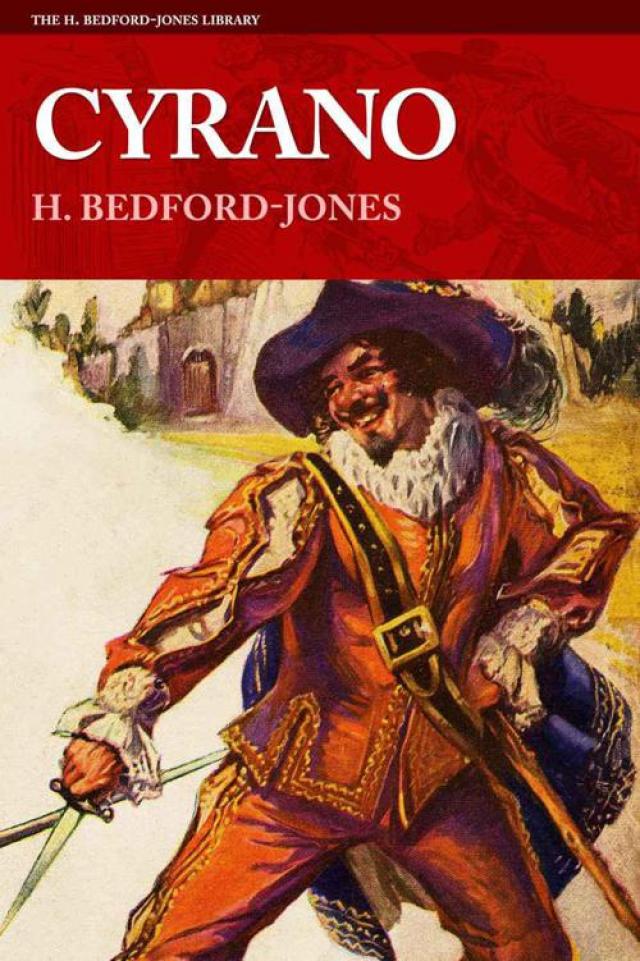
He advanced upon them, transfigured by fury, in his whole aspect all the terrible savage blood-lust which had aforetime made him so dreaded a swordsman. They were, for an instant, appalled by his action, by his wild and terrible look. He seized a stick from the nearest peasant and swept at them; they broke in terror, deeming him some noble, swift to punish them. All, that is, save one.
The companion of the dead man threw up his sword, and with an oath bore in upon Cyrano. Laughing, Cyrano engaged the blade with the poniard in his left hand, and looked into the eyes of his furious opponent.
“Oh, fool that you are!” he cried. “Thrice fool, to draw steel upon Cyrano!”
And suddenly the sword was wrenched from the man’s grip, to fly away and fall clattering. The stick in Cyrano’s right hand lashed in a blow that stretched the swordsman senseless in the dust. The others had fled hastily from the scene. Turning to the Egyptian, Cyrano swung off his hat; it had remained on his head, although the lute was broken.
“Mademoiselle, or madame,” he began, “if—if—”
His voice faltered. The woman was leaning against the wall, her eyes fastened upon him; blood was streaming from where the sword had bitten her side, and a deathly pallor was in her swarthy face. Then Cyrano was aware of Marianne de Gisy passing him, running to the woman, catching her in strong arms. He flung himself to her aid, and they let the woman down gently, Marianne holding her head. She was dying, as Cyrano now perceived.
There was a moment of dread silence. The sunlight was hot, the dust-laden air was stilled. The two dead men lay with blood black upon the ground, the senseless man stirred not, the horses were cropping at the wayside grass. The Egyptian woman opened her eyes, looked from Cyrano to Marianne, and her gaze held on the latter’s face; but this gaze was wild as the faint words that came from her lips.
“Folly, mad folly—I tell you, they know that we carry it! Here, take it quickly—keep it from him!”
HER hand lifted, her fingers tore at the string of a small leather scapulary about her neck—strange object to be worn by a woman of the Egyptians—and she thrust the thing into the hand of Marianne. Wonderingly, Marianne accepted it. Then the woman’s hand flashed out, pointing to Cyrano, and a shrill laugh came to her lips.
“Ah, gros-bec!” she said, speaking in the argot of Paris, which Cyrano comprehended readily enough. To Marianne the words meant nothing. “Leave her, fool, leave her! Beware of him—he brought death—he carries death perched upon his shoulder.”
“Beware of whom?” exclaimed Cyrano sharply. “Quick!”
“Of him—the cleft chin—the cleft chin!”
A shiver passed through the body of the woman. Her head fell back. Marianne let her rest gently on the ground, and looked up at Cyrano, perplexed.
“What was it she said? The poor creature.”
“Nothing; warnings—warnings against some man,” said Cyrano, and rising, gave Marianne his hand and brought her to her feet. “I did not understand it all. These Egyptians of Paris have no business wandering about the countryside.”
“It is terrible,” Marianne glanced around, moved a little away from the dead woman. “If we go on quickly?”
“No hurry,” said Cyrano. “I sent that accursed Mervaut to fetch the coach; he’ll bring it soon. I think I’ll look at these two gentlemen.”
He regarded the man whom he had poniarded, the murderer of the Egyptian woman. Yet this dead face did not correspond to her description. It was rather the face of a servant, of a lackey. Cyrano looked at the horses of the two men, and saw that they were very good animals indeed, of some value. He was about to approach the second man, when there was a shout, and with a whirl of dust their coach appeared, Mervaut riding before it.
“So, we start!” exclaimed Cyrano. “Dear lady, you will occupy the coach now?”
Marianne assented. “Yes. Where do we stop for the night?”
“At Versailles, and then to the western highway. I’ll send you ahead and catch up in a few moments; I want a word with that rascal of a lackey.”
With the coach had come a driver and a groom. The latter dismounted and, with Mervaut, was excitedly looking over the scene; Cyrano gave the coachman his orders, and then, taking the reins of his horse, watched the coach depart. Marianne, he perceived, was glad to be gone from this place of death.
Almost at his feet, Cyrano perceived something in the dust—a whip, and a very handsome one, of leather braided with gold and silver wire. He picked it up; some one in the throng must have dropped it, but no peasant would bear such a thing as this.
The butt was a round disk of gold, in which was chiseled the initial “A.” Cyrano inspected it curiously, then shrugged.
“It perhaps belongs to the rogue who drew sword on me,” he reflected, and glanced around. Somewhat to his surprise, he saw that Mervaut and the groom were now kneeling beside that same unconscious man, attempting to revive him. Cyrano approached, and caught a look of scornful contempt from Mervaut which quite infuriated him.
“Come, come, sirrahs, are you robbing the dead?” Cyrano asked ironically.
“No, monsieur,” rejoined Mervaut. “We are succoring the injured.”
The tone was insolent, and Cyrano, who did not love lackeys at all, turned slightly pale.
“This injured man is a friend of yours, Mervaut?” he demanded in a low voice. The lackey rose and met his eyes boldly enough.
“I think, monsieur, that he is a gentleman,” was the response. “I have seen him in Paris.”
CYRANO looked down at the face of the man, who was just opening his eyes. Then he started. Here was the face the Egyptian woman had described—a strong, wide face with a prominent and deeply cleft chin. What did her warning mean; could it have meant anything? Did she, in the very grip of death, have some prevision of things to be?
“You know this man’s name, Mervaut?” he asked.
“I think he is the Sieur d’Avillon, monsieur.” The lackey was about to say more, when he turned, saw that the coach was gone, and swung upon Cyrano with hot anger in his eyes. “Monsieur, did you send the coach away?”
“What is it to you?” Cyrano was astonished by the man’s boldness.
“My master has ordered me to watch over the safety of Mlle. de Gisy,” said Mervaut, and scowled. “She is in my care, and—”
“You insolent dog!” said Cyrano, disdainfully, forgetting that the servant doubtless set great store by the estate of his master. “Do you want a whiplash over your shoulders?”
Mervaut gave him a sour and impudent grin.
“Come, come, M. le Marquis,” he said. “You forget that a woman is a woman the world over! It is true that my master has certain pressing need of your services, but do not impose upon the trust he reposes in you. I’ve observed your looks and actions with mademoiselle, and I’m warning you—”
“Those who warn me are usually paid,” said Cyrano.
His eyes gave the lackey no hint; the little whip lashed and Mervaut staggered back with a red weal springing across his face. The whip was heavy enough, meant for service; and for the second time, with astonishing effect, it lashed the face of Mervaut. Then Cyrano, in the midst of his contemptuous laugh, felt a hot breath on his neck—the groom was in the very act of driving a dagger into his side.
A sheer miracle of agility saved him from the blow. He leaped sidewise, as a cat leaps, and caromed full into Sieur d’Avillon, who was just rising. Flung off balance, he stumbled, fell to hands and knees—then caught up the whip in his hand and threw himself to one side, and came upright.
“Kill!” rasped the voice of Mervaut. “Kill him!”
Cyrano glanced around. Mervaut had rapier out, the groom was plunging in with his long poniard, and Avillon, likewise gripping a dagger, was rising to attack him from the other side. For a breath Cyrano stood motionless—then, swift as light, he became a thing of flowing action. Disdaining to use steel against such adversaries, he trusted instead to the footwork which had helped make him the first swordsman in Paris.
The groom screamed and fell writhing in the dust as the whip smote him square across the eyes, blinding him. Avillon lunged in, but Cyrano’s riding boot caught him under the chin, and for the second time he plunged down into the dust and lay quiet. At this instant a thin tongue of steel drove between Cyrano’s side and arm, touching the skin yet not breaking it. Mervaut was upon him, recovering, leaning in for another and more deadly thrust.
At the instant of lunging, Mervaut stumbled across the writhing body of the blinded groom. The whip slashed across the wrist of his outflung arm, and the sword fell from his hand.
“Now for your punishment, rascal!” exclaimed Cyrano. “When you are next tempted to be insolent to a gentleman, remember this!”
A terrible cry burst from Mervaut as the bloody whip lashed him across the face. He attempted to rush in upon Cyrano, but the latter kept his distance, and time after time drove home his biting weapon. Streaming with blood, helpless, cursing, Mervaut flung his arms across his face and dashed away at a blind run.
He had not, however, begged for mercy, as Cyrano later recalled.
LEFT master of the field, Cyrano laughed and picked up his hat from where it had fallen. Then he paused, as something recurred to him.
“What ‘certain pressing need’ does M. d’Effiat have of my services, eh? Come, there’s something to ponder! He doesn’t need me to take the lady to the Mont—this rascal was ready enough to fling me in the ditch and conduct her himself. My faith, it looks as though there were far more in this affair than I suspected. Ah, here is our good Sieur d’Avillon! Good day to you, monsieur, and kindly leave your sword alone, since you don’t know how to use it.”
He beamed genially upon the dazed and bewildered Avillon, as the latter rose. Mervaut had disappeared; the groom was groaning and holding his eyes as he writhed. Cyrano was under no illusions as regarded Sieur d’Avillon, whom he knew all too well by reputation as one of the most dreaded Cardinalist agents.
Richelieu’s man, in truth, did not inspire dread at this moment. Avillon was dusty, his mouth was bleeding, and he seemed anything but certain of his whereabouts. He stared at Cyrano.
“Ah!” he exclaimed suddenly. “I have seen you before!”
“Very likely, since I am no dwarf,” and Cyrano chuckled. “The Marquis de Bergerac, very much at your service, Sieur d’Avillon. May I have the impudence to inquire why you were so lustily engaged in murdering two Egyptians?”
“Devil take you!” said Avillon, blinking and coming somewhat to himself. He seemed jerked to life by mention of the luckless pair, and his eyes swept around and came to rest upon the body of the woman. “Ah! She is dead!”
“Thanks to you, murderer,” said Cyrano.
Avillon turned and looked at him as though perceiving him for the first time.
“So, M. de Bergerac!” he said slowly, putting a hand to his bleeding mouth. “You’ve interfered with me, have you!”
“No; you’ve interfered with me,” said Cyrano coolly, “and you’ll answer to Père Carré for it when you see him.”
Avillon started. His eyes widened.
“You?” he exclaimed. “You, rake-hell, alley cat, bretteur of the gutters—you speak of him?”
Cyrano realized that Avillon knew him for what he was, had perhaps met or seen him in Paris. However, he was too full of contempt and disdain for the man. He shrugged, turned his back on Avillon, and went to the hapless groom.
“Rogue, take your master’s horses and go home,” he said, kicking Effiat’s groom to his feet. “If you meet that scoundrel Mervaut, tell him to hide his face from me henceforth or I’ll have him flawed alive. Up with you!”
Cyrano turned to his own horse, swung up into the saddle, and set forth in the wake of the vanished coach. His smashed lute was tossed aside. Dusting off his hat and plume, Cyrano twirled his mustache, put in his spurs, and passed through Palaiseau with all speed.
“So that rascal Avillon knew me!” he thought, as he cleared the town and discerned the dust cloud left by the coach. “I forgot what the woman said; I should have killed him. Yet, to what end? I put a handsome flea in his ear, and if he goes to Père Carré he’ll learn a thing or two. Why did that rogue Mervaut presume so far? Strange! There’s something behind his impudence; he seemed to know Avillon, too. What could lie between the lackey of Sieur d’Effiat and the confidential agent of Richelieu? And I should like to know just why Avillon should be drawing the blood of two Egyptians in the highway!”
Had he been back at the bend in the road where the two Egyptians lay, at this moment, Cyrano might have wondered still further. For Sieur d’Avillon, going to the body of the dead woman, had fallen upon his knees and was searching it swiftly. He rose, with an oath, and went to the man, and searched his ragged garments with the same ill luck. Then, suddenly, he began to scan the road for his own whip, and found it not—since it was being carried by Cyrano. Avillon kicked up the dust, searched hither and yon, and finally, realizing that the whip was gone, shook his fist at the sky with passionate despair in his dark face.
Truly, very singular actions to be indulged in by a gentleman and a confidential agent of the great cardinal!
Chapter VI
—HAS AN ADVENTURE.
A SINGLE man riding posthaste, with change of horses at every stop, and ample authority, can certainly travel much faster than any coach. This very simple and obvious fact might be the explanation of many puzzling things.
It might, for example, explain why the coach in which Marianne de Gisy was riding suddenly broke down two days after leaving Palaiseau. The breakdown occurred during their noon halt at a roadside tavern—a pleasant Norman inn with the not uncommon name of the White Horse. The whole front of the coach, springs and all, was certainly unfit to go a mile farther without repairs, and there was no other vehicle to be had. The innkeeper, however, stated that repairs might be made if men were summoned from Morthange, a village some five leagues distant. Cyrano, accordingly, sent on the coachman, disposed his charge in very comfortable quarters above the tavern, and made the best of a bad affair.
“We shall certainly be here until to-morrow,” he said as he handed Marianne de Gisy to her room. “That rascal will take his time about bringing men or another coach, be sure of it!”
She stood smiling at him, in a way she had.
“Time was made for slaves, my dear marquis,” she responded. “I shall sleep for an hour or two, and then rejoin you. Why worry?”
Why, indeed? Cyrano had not a worry on earth; he was filled with a joyous bursting happiness that took no heed to actualities. When Marianne smiled at him thus, he saw only her eyes, and they gripped his very soul.
“Dear lady,” he said earnestly, as he bent over her hand and then looked again into her eyes, “remember only one thing of me, I pray you. Do not say: ‘Cyrano loves me!’ for this is not true. Say this: ‘Cyrano worships the Queen of Heaven, for whom I was named—a dear shining lady so far above, so far away, that her presence is a sacred thing, a glorious revelation of beauty to his poor starved spirit.’ Au revoir, my lady. Rest, and when you talk with the angels, say a little prayer for Cyrano.”
So he left her and sat in the stone-paved wine room over a bottle, and wondered what it was in this woman which so drew him. Why was Effiat, that cold debauchee, so drawn to her in like manner? Not for mere beauty—there were others more beautiful by far in the externals—but for the spirit which lay behind and above all beauty; the spirit which Cyrano himself could not define, yet felt so deeply.
“Shining lady—aye, there it is!” he muttered. “Her eyes speak of peace, of happiness, of a high surety. And I, a poor monk, wandering aimless about the cloister, look to her as my Madonna.”
Three cavaliers came stamping into the place, stopped short at sight of Cyrano, and exchanged a word among themselves. One of them stepped forward and bowed.
“Monsieur,” he said—he was a young man, a provincial noble from his appearance—“may I have the impertinence to request a favor? I am M. des Essarts; my two friends are M. le Baron d’Yvert and M. de Frontard. We find ourselves at a point of disagreement. It becomes important to find a fourth gentleman, one who may accompany us to a quiet spot and assist us by his presence to untangle our knot of discord. We find you here; excellent! If you will have the goodness?”
Cyrano rose, bowed magnificently, gave his name, and called for more wine.
“With all the pleasure in the world!” he declaimed. “I am under a vow not to bear sword, my friends, but that assuredly does not hinder me from assisting a gentleman not under vow. And I may claim some little experience in the niceties of the duello, by my faith! Come, let us drink together, and I am at your service with all my heart!”
THE other two gentlemen joined them, emptied a bottle apiece, and in ten minutes all four went out to the courtyard. Cyrano obtained a horse, and they rode forth in great gayety upon their errand. Frontard and Yvert were at odds over some lady, it seemed; and if the matter had singular aspects, Cyrano was in mood to overlook them all.
A couple of miles from the tavern they came upon a grassy roadside glade, and the spot being approved, Cyrano swung out of the saddle. It was the last act of which he had any memory. Frontard’s horse sidled in upon him, and next instant there was a crash—the pistol butt in Frontard’s hand came down, and Cyrano knew no more.