

A large anthology of sci.., p.48
A Large Anthology of Science Fiction, page 48
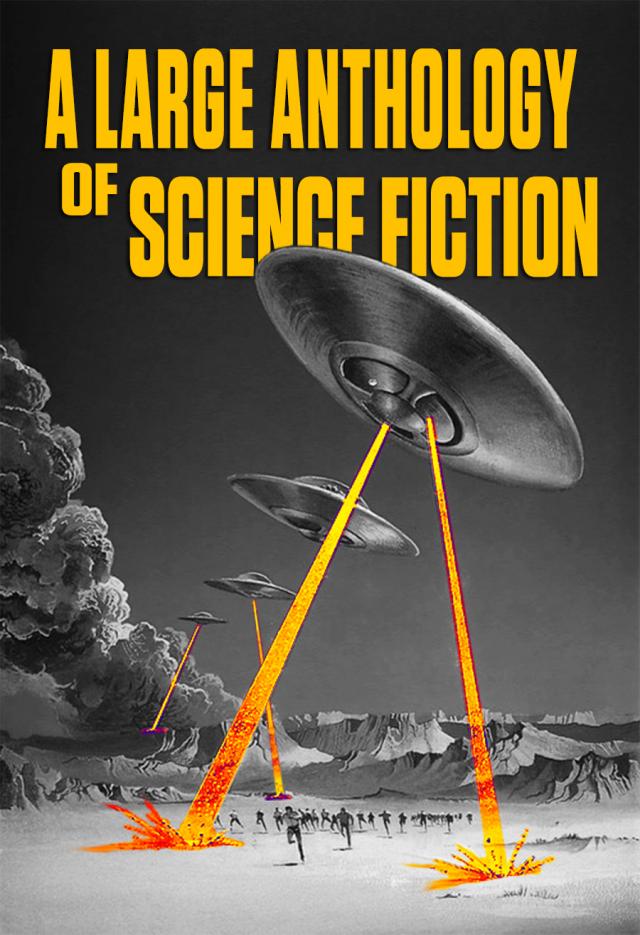


“During them days I really got fond of Nelson Smith. He was a companionable body, and brave, or he wouldn’t have been a professional aeronauter, a job that was rightly thought tough enough for a woman, let alone a man. Though he was not so well educated as me, at least he was quiet and modest about what he did know, not like some men, boasting most where there is least to brag of.
“Indeed, I misdoubt if Nelson and me would not have quit the sea and the air together and set up housekeeping in some quiet little town up in New England, maybe, after we had got away, if it had not been for what happened when we went. I never, let me say, was so deceived in any man before nor since. The thing taught me a lesson and I never was fooled again.
“We was all ready to go, and then one morning, like a parting gift from Anita, come a soft and favoring wind. Nelson and I run down the beach together, for we didn’t want our floater to blow off and leave us. As we was running, our arms full of coconuts, Nelson Smith, stubbed his bare toe on a sharp rock, and down he went. I hadn’t noticed, and was going on.
“But sudden the ground begun to shake under my feet, and the air was full of a queer, grinding, groaning sound, like the very earth was in pain.
“I turned around sharp. There sat Nelson, holding his bleeding toe in both fists and giving vent to such awful words as no decent sea-going lady would ever speak nor hear to!
“ ‘Stop it, stop it!’ I shrieked at him, but ’twas too late.
“Island or no island, Anita was a lady, too! She had a gentle heart, but she knowed how to behave when she was insulted.
“With one terrible, great roar a spout of smoke and flame belched up out o’ the heart of Anita’s crater hill a full mile into the air!
“I guess Nelson stopped swearing. He couldn’t have heard himself, anyways. Anita was talking now with tongues of flame and such roars as would have bespoke the raging protest of a continent.
“I grabbed that fool man by the hand and run him down to the water. We had to swim good and hard to catch up with our only hope, the floater. No bark rope could hold her against the stiff breeze that was now blowing, and she had broke her cable. By the time we scrambled aboard great rocks was falling right and left. We couldn’t see each other for a while for the clouds of fine gray ash.
“It seemed like Anita was that mad she was flinging stones after us, and truly I believe that such was her intention. I didn’t blame her, neither!
“Lucky for us the wind was strong and we was soon out of range.
“ ‘So!’ says I to Nelson, after I’d got most of the ashes out of my mouth, and shook my hair clear of cinders. ‘So, that was the reason you up and left sudden when you was there before! You aggravated that island till the poor thing druv you out!’
“ ‘Well,’ says he, and not so meek as I’d have admired to see him, ‘how could I know the darn island was a lady?’
“ ‘Actions speak louder than words,’ says I. ‘You should have knowed it by her ladylike behavior!’
“ ‘Is volcanoes and slingin’ hot rocks ladylike?’ he says. ‘Is snakes ladylike? T’other time I cut my thumb on a tin can, I cussed a little bit. Say—just a li’l’ bit! An’ what comes at me out o’ all the caves, and out o’ every crack in the rocks, and out o’ the very spring o’ water where I’d been drinkin’ ? Why snakes! Snakes, if you please, big, little, green, red and sky-blue-scarlet! What’d I do? Jumped in the water, of course. Why wouldn’t I? I’d ruther swim and drown than be stung or swallowed to death. But how was I t’ know the snakes come outta the rocks because I cussed?’
“ ‘You, couldn’t,’ I agrees, sarcastic. ‘Some folks never knows a lady till she up and whangs ’em over the head with a brick. A real, gentle, kind-like warning, them snakes were, which you would not heed! Take shame to yourself, Nelly,’ says I, right stern, ‘that a decent little island like Anita can’t associate with you peaceable, but you must hurt her sacredest feelings with language no lady would stand by to hear!’
“I never did see Anita again. She may have blew herself right out of the ocean in her just wrath at the vulgar, disgustin’ language of Nelson Smith. I don’t know. We was took off the floater at last, and I lost track of Nelson just as quick as I could when we was landed at Frisco.
“He had taught me a lesson. A man is just full of mannishness, and the best of ’em ain’t good enough for a lady to sacrifice her sensibilities to put up with.
“Nelson Smith, he seemed to feel real bad when he learned I was not for him, and then he apologized. But apologies weren’t no use to me. I could never abide him, after the way he went and talked right in the presence of me and my poor, sweet lady friend, Anita!”
Now I am well versed in the lore of the sea in all ages. Through mists of time I have enviously eyed wild voyagings of sea rovers who roved and spun their yarns before the stronger sex came into its own, and ousted man from his heroic pedestal. I have followed—across the printed page—the wanderings of Odysseus. Before Gulliver I have burned the incense of tranced attention; and with reverent awe considered the history of one Munchausen, a baron. But alas, these were only men!
In what field is not woman our subtle superior?
Meekly I bowed my head, and when my eyes dared lift again, the ancient mariness had departed, leaving me to sorrow for my surpassed and outdone idols. Also with a bill for macaroons and tea of such incredible proportions that in comparison therewith I found it easy to believe her story!
1920
THE MAD PLANET
Murray Leinster
CHAPTER I.
A WORLD INSANE.
IN all his lifetime of perhaps twenty years, it had never occurred to Burl to wonder what his grandfather had thought about his surroundings. The grandfather had come to an untimely end in a rather unpleasant fashion which Burl remembered vaguely as a succession of screams coming more and more faintly to his ears while he was being carried away at the top speed of which his mother was capable.
Burl had rarely or never thought of the old gentleman since. Surely he had never wondered in the abstract of what his great grandfather thought, and most surely of all, there never entered his head such a purely hypothetical question as the one of what his many-times-great-grandfather—say of the year 1920—would have thought of the scene in which Burl found himself.
He was treading cautiously over a brownish carpet of fungus growth, creeping furtively toward the stream which he knew by the generic title of “water.” It was the only water he knew. Towering far above his head, three man-heights high, great toadstools hid the grayish sky from his sight. Clinging to the foot-thick stalks of the toadstools were still other fungi, parasites upon the growth that had once been parasites themselves.
Burl himself was a slender young man wearing a single garment twisted about his waist, made from the wing-fabric of a great moth the members of his tribe had slain as it emerged from its cocoon. His skin was fair, without a trace of sunburn. In all his lifetime he had never seen the sun, though the sky was rarely hidden from view save by the giant fungi which, with monster cabbages, were the only growing things he knew. Clouds usually spread overhead, and when they did not, the perpetual haze made the sun but an indefinitely brighter part of the sky, never a sharply edged ball of fire. Fantastic mosses, misshapen fungus growths, colossal molds and yeasts, were the essential parts of the landscape through which he moved.
Once as he had dodged through the forest of huge toadstools, his shoulder touched a cream-colored stalk, giving the whole fungus a tiny shock. Instantly, from the umbrella-like mass of pulp overhead, a fine and impalpable powder fell upon him like snow. It was the season when the toadstools sent out their spores, or seeds, and they had been dropped upon him at the first sign of disturbance.
Furtive as he was, he paused to brush them from his head and hair. They were deadly poison, as he knew well.
Burl would have been a curious sight to a man of the twentieth century. His skin was pink, like that of a child, and there was but little hair upon his body. Even that on top of his head was soft and downy. His chest was larger than his forefathers’ had been, and his ears seemed almost capable of independent movement, to catch threatening sounds from any direction. His eyes, large and blue, possessed pupils which could dilate to extreme size, allowing him to see in almost complete darkness.
He was the result of the thirty thousand years’ attempt of the human race to adapt itself to the change that had begun in the latter half of the twentieth century.
At about that time, civilization had been high, and apparently secure. Mankind had reached a permanent agreement among itself, and all men had equal opportunities to education and leisure. Machinery did most of the labor of the world, and men were only required to supervise its operation. All men were well-fed, all men were well-educated, and it seemed that until the end of time the earth would be the abode of a community of comfortable human beings, pursuing their studies and diversions, their illusions and their truths. Peace, quietness, privacy, freedom were universal.
Then, just when men were congratulating themselves that the Golden Age had come again, it was observed that the planet seemed ill at ease. Fissures opened slowly in the crust, and carbonic acid gas—the carbon dioxide of chemists—began to pour out into the atmosphere. That gas had long been known to be present in the air, and was considered necessary to plant life. Most of the plants of the world took the gas and absorbed its carbon into themselves, releasing the oxygen for use again.
Scientists had calculated that a great deal of the earth’s increased fertility was due to the larger quantities of carbon dioxide released by the activities of man in burning his coal and petroleum. Because of those views, for some years no great alarm was caused by the continuous exhalation from the world’s interior.
Constantly, however, the volume increased. New fissures constantly opened, each one adding a new source of carbon dioxide, and each one pouring into the already laden atmosphere more of the gas—beneficent in small quantities, but as the world learned, deadly in large ones.
The percentage of the heavy, vapor-like gas increased. The whole body of the air became heavier through its admixture. It absorbed more moisture and became more humid. Rainfall increased. Climates grew warmer. Vegetation became more luxuriant—but the air gradually became less exhilarating.
Soon the health of mankind began to be affected. Accustomed through long ages to breathe air rich in oxygen and poor in carbon dioxide, men suffered. Only those who lived on high plateaus or on tall mountaintops remained unaffected. The plants of the earth, though nourished and increasing in size beyond those ever seen before, were unable to dispose of the continually increasing flood of carbon dioxide.
By the middle of the twenty-first century it was generally recognized that a new carboniferous period was about to take place, when the earth’s atmosphere would be thick and humid, unbreathable by man, when giant grasses and ferns would form the only vegetation.
When the twenty-first century drew to a close the whole human race began to revert to conditions closely approximating savagery. The low-lands were unbearable. Thick jungles of rank growth covered the ground. The air was depressing and enervating. Men could live there, but it was a sickly, fever-ridden existence. The whole population of the earth desired the high lands and as the low country became more unbearable, men forgot their two centuries of peace.
They fought destructively, each for a bit of land where he might live and breathe. Then men began to die, men who had persisted in remaining near sea-level. They could not live in the poisonous air. The danger zone crept up as the earth-fissures tirelessly poured out their steady streams of foul gas. Soon men could not live within five hundred feet of sea level. The low-lands went uncultivated, and became jungles of a thickness comparable only to those of the first carboniferous period.
Then men died of sheer inanition at a thousand feet. The plateaus and mountaintops were crowded with folk struggling for a foothold and food beyond the invisible menace that crept up, and up—
These things did not take place in one year, or in ten. Not in one generation, but in several. Between the time when the chemists of the International Geophysical Institute announced that the proportion of carbon dioxide in the air had increased from .04 per cent to .1 per cent and the time when at sea-level six per cent of the atmosphere was the deadly gas, more than two hundred years intervened.
Coming gradually, as it did, the poisonous effects of the deadly stuff increased with insidious slowness. First the lassitude, then the heaviness of brain, then the weakness of body. Mankind ceased to grow in numbers. After a long period, the race had fallen to a fraction of its former size. There was room in plenty on the mountaintops—but the danger-level continued to creep up.
There was but one solution. The human body would have to inure itself to the poison, or it was doomed to extinction. It finally developed a toleration for the gas that had wiped out race after race and nation after nation, but at a terrible cost. Lungs increased in size to secure the oxygen on which life depended, but the poison, inhaled at every breath, left the few survivors sickly and filled with a perpetual weariness. Their minds lacked the energy to cope with new problems or transmit the knowledge which in one degree or another, they possessed.
And after thirty thousand years, Burl, a direct descendant of the first president of the Universal Republic, crept through a forest of toadstools and fungus growths. He was ignorant of fire, or metals, of the uses of stone and wood. A single garment covered him. His language was a scanty group of a few hundred labial sounds, conveying no abstractions and few concrete things.
He was ignorant of the uses of wood. There was no wood in the scanty territory furtively inhabited by his tribe. With the increase in heat and humidity the trees had begun to die out. Those of northern climes went first, the oaks, the cedars, the maples. Then the pines—the beeches went early—the cypresses, and finally even the forests of the jungles vanished. Only grasses and reeds, bamboos and their kin, were able to flourish in the new, steaming atmosphere. The thick jungles gave place to dense thickets of grasses and ferns, now become treeferns again.
And then the fungi took their place. Flourishing as never before, flourishing on a planet of torrid heat and perpetual miasma, on whose surface the sun never shone directly because of an ever-thickening bank of clouds that hung sullenly overhead, the fungi sprang up. About the dank pools that festered over the surface of the earth, fungus growths began to cluster. Of every imaginable shade and color, of all monstrous forms and malignant purposes, of huge size and flabby volume, they spread over the land.
The grasses and ferns gave place to them. Squat footstools, flaking molds, evil-smelling yeasts, vast mounds of fungi inextricably mingled as to species, but growing, forever growing and exhaling an odor of dark places.
The strange growths now grouped themselves in forests, horrible travesties on the vegetation they had succeeded. They grew and grew with feverish intensity beneath a clouded or a haze-obscured sky, while above them fluttered gigantic butterflies and huge moths, sipping daintily of their corruption.
The insects alone of all the animal world above water, were able to endure the change. They multiplied exceedingly, and enlarged themselves in the thickened air. The solitary vegetation—as distinct from fungus growths—that had survived, was now a degenerate form of the cabbages that had once fed peasants. On those rank, colossal masses of foliage, the stolid grubs and caterpillars ate themselves to maturity, then swung below in strong cocoons to sleep the sleep of metamorphosis from which they emerged to spread their wings and fly.
The tiniest butterflies of former days had increased their span until their gaily colored wings should be described in terms of feet, while the larger emperor moths extended their purple sails to a breadth of yards upon yards. Burl himself would have been dwarfed beneath the overshadowing fabric of their wings.
It was fortunate that they, the largest flying creatures, were harmless or nearly so. Burl’s fellow tribesmen sometimes came upon a cocoon just about to open, and waited patiently beside it until the beautiful creature within broke through its matted shell and came out into the sunlight.
Then, before it had gathered energy from the air, and before its wings had swelled to strength and firmness, the tribesmen fell upon it, tearing the filmy, delicate wings from its body and the limbs from its carcass. Then, when it lay helpless before them, they carried away the juicy, meat-filled limbs to be eaten, leaving the still living body to stare helplessly at this strange world through its many faceted eyes, and become a prey to the voracious ants who would soon clamber upon it and carry it away in tiny fragments to their underground city.
Not all the insect world was so helpless or so unthreatening. Burl knew of wasps almost the length of his own body who possessed stings that were instantly fatal. To every species of wasp, however, some other insect is predestined prey, and the furtive members of Burl’s tribe feared them but little as they sought only the prey to which their instinct led them.
Bees were similarly aloof. They were hard put to it for existence, those bees. Few flowers bloomed, and they were reduced to expedients once considered signs of degeneracy in their race. Bubbling yeasts and fouler things, occasionally the nectarless blooms of the rank, giant cabbages. Burl knew the bees. They droned overhead, nearly as large as he was himself, their bulging eyes gazing at him with abstracted preoccupation. And crickets, and beetles, and spiders—
Burl knew spiders! His grandfather had been the prey of one of the hunting tarantulas, which had leaped with incredible ferocity from his excavated tunnel in the earth. A vertical pit in the ground, two feet in diameter, went down for twenty feet. At the bottom of that lair the black-bellied monster waited for the tiny sounds that would warn him of prey approaching his hiding-place (Lycosa fasciata).
Burl’s grandfather had been careless, and the terrible shrieks he uttered as the horrible monster darted from the pit and seized him had lingered vaguely in Burl’s mind ever since. Burl had seen, too, the monster webs of another species of spider, and watched from a safe distance as the misshapen body of the huge creature sucked the juices from a three-foot cricket that had become entangled in its trap.


