The silver skull soa 1, p.15
The Silver Skull soa-1, page 15
part #1 of Swords of Albion Series
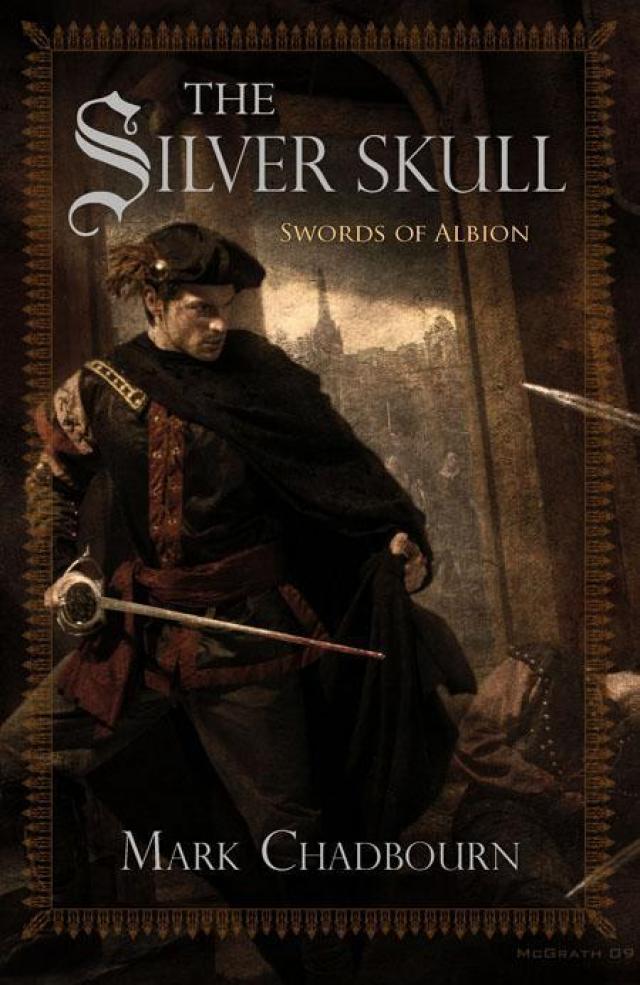


The carriage careered to the left as the road followed the contours of the hill. Once again the left wheels lifted, this time so high it seemed the carriage was going over. Bags and cases flew around the interior, and Nathaniel crashed across the leather seats. As the wheels went down, it threw him back the other way.
"Damnation!" he shouted. "I could drive this carriage better myself!" Exhausted and hungry, his temper had deteriorated during the long journey from London, on which they had stopped only briefly to change horses and eat, sleeping in the carriage as it bounced north along the lanes of England.
"We will soon be in Edinburgh, Nat, where there will be all the wine, women, and hot food you desire."
"You think about yourself. All I want is a good bed and a long sleep."
Always a hairbreadth away from a disastrous crash, the carriage plunged on, around the steep sides of hills, through dense woodlands, where it felt as if they were floating in a sea of black, and then across the valley floor where the moon painted a silver trail ahead of them. Finally they began the ascent of the hills that rimmed Edinburgh.
The deafening storm of the horses' hooves had become the familiar music of their journey, so they were acutely aware when the note changed: the disturbing syncopation of more hooves had joined the steady beat.
From the space beneath the seat, Will removed a length of rope from among the tools the driver stored within the carriage and tied one end to his wrist, leaving the other to trail free.
"Nat, I ask this of you now: whatever happens, do not look out of the windows," Will said.
"Why? You are afraid I will see you fall like a jester upon your bony rump?"
"Heed me now, Nat. This is important."
Nathaniel recognised the tone in his master's voice and nodded. "Whatever you plan, take care."
"Those who take care never experience all the wonders life has to offer." Will pushed his head outside where the wind tore at his hair and made him deaf. The nearest rider was just behind the rear wheels of the carriage and to one side. Though the face was lost to shadows, Will could see the fire of the eyes burning through the dark. He had noted the strange, shifting quality of the eyes' inner light before-sometimes green, sometimes gold, sometimes red like now-and though he had no idea what it meant, it confirmed their unnatural nature.
As the rider drew nearer still, he leaned down across his saddle and reached out an arm towards the wheel. Will couldn't see what he was holding, if anything, but as his fingers closed on the rapidly spinning wood, sparks danced around the iron sheath and the wheel began to wobble from side to side. Already leaping wildly, the carriage vibrated as if it would tear itself apart. Inside, Nathaniel cursed loudly.
Grimacing, the driver cast a glance back, his knuckles white on the reins. "The axle will break," he bellowed. "At this speed, we will all die."
Grasping the roof rail, Will hauled himself out of the window, placing one foot on the sill to push himself onto the roof. The carriage bounced so furiously that only the strength in his arm prevented him from being torn off.
The other two riders were close on the other side of the carriage, riding so effortlessly it appeared they were exerting no energy.
Gripping until his knuckles hurt, Will crashed repeatedly on the carriage roof, or was dragged back down the side by the ferocious winds buffeting him.
The carriage rattled into another area of dense woodland, the branches so low overhead that Will had to press himself against the carriage roof to avoid impact. The trees were so tight that the nearest rider was forced to break off from exerting his influence on the wheel and to drop behind the carriage.
Taking advantage of the brief respite, Will gained purchase with the toes of his boots and held himself fast within the area defined by the rail. With an effort, he tied the free end of the rope at his wrist to the rail, an anchor that would keep him from being thrown off the carriage. But he knew that if he fell it would drag him into the wheels.
When the carriage burst out of the wood, Will hooked his toes under the rail and carefully raised himself upright. The wind tore at him even more fiercely, and although the rope allowed him to steady himself, he had to keep shifting his weight to maintain his balance.
As the rider closed in on the wheel again, Will drew his sword. Gripping the rope with his left hand, he hung out over the void and sliced down. The rider dropped back to avoid the blow.
Within a second, the rider had drawn his own sword. Pulling his mount alongside, he launched a series of duelling strokes, attempting to slash through the rope that held Will fast.
Will adapted quickly to his new situation. The rope allowed him the kind of mobility he could never achieve on solid ground, so that he could lean out almost horizontally to the carriage or swing around in a half circle to strike from another angle. His sword became an arc of reflected moonlight flashing back and forth to parry every blow the rider made.
Recognising his inability to break through Will's defence, the rider dropped back a way before stepping up easily to balance on the saddle. Still clutching the reins in one hand, he drove the horse forwards before leaping for the carriage, slashing as he flew through the air.
Stumbling back on one knee, Will brought his sword up high to take the brunt of the attacker's blow. Even up close, the attacker's face was lost in shadow as if it drew all light from the vicinity.
Driving back upright, Will attempted to concentrate his attack before the Enemy swordsman could gain a foothold. Yet despite the carriage's velocity across the rutted road, his opponent kept his balance with ease. His sword darted towards Will's heart, his throat, the supporting rope, switching his attack rapidly as they roved round and round the carriage roof.
Just as Will thought he was gaining the upper hand, the carriage crashed over a fallen branch in the road and all four wheels left the ground. When it slammed back down, Will was thrown onto his back.
Seizing the moment, the Enemy swordsman thrust down with his sword. Will tore his head to one side at the last moment, the blade driving a fraction past his ear and through the carriage roof. Nathaniel's cry of surprise rang out.
Before the Enemy could withdraw his sword, Will thrust his weight onto his shoulders and jabbed his feet into his opponent's gut. The impact flipped the Enemy swordsman over the end of the carriage into the road.
Will had no time to catch his breath. One of the other riders was preparing to leap at the terrified driver, who lashed out frantically with his whip. The final rider was ready to jump onto the carriage roof from his saddle.
As Will threw himself towards the driver, another severe lurch knocked him off balance. When he next looked up, the Enemy was on the seat, fighting with the driver. Even with his whip, the driver didn't stand a chance. His attacker caught a hand in the neck of his cloak and wrenched him up with ease. Holding the screaming man over his head for a second, the Enemy flung him from the racing carriage.
At that moment, the third rider leapt onto the carriage roof.
Will didn't wait for him to land. With his sword, he slashed through the rope holding his wrist and in the same fluid movement propelled himself forwards. The momentum almost took him over the driver's seat and down among the horses' driving hooves, but at the last he caught the flailing reins. His head and shoulders dipped below the level of the seat, but Will brought his left foot up to kick the Enemy assailant from the seat. Plunging down the side of the carriage, he flew under the rear wheels.
Dragging himself up into the seat, Will gripped the reins with one hand to slow the horses, while turning with his sword raised to face the final rider, who was prowling towards him across the carriage roof.
They thrust and parried, but Will was hamstrung by his lack of mobility. The Enemy swordsman took full advantage of his uncanny balance, ducking and darting along the entire width of the roof.
In the full glare of the moon, the carriage crested the top of the hills and began the long descent towards Edinburgh. Will smelled smoke on the wind.
Slashing back and forth, the Enemy swordsman made the most of the carriage's sudden career downhill to press his attack on Will, who fought to stay upright on the seat.
At the last, the Enemy was distracted by a loud cry. Hanging half out of the window, Nathaniel brandished the long iron needle the driver used to repair the horses' bridles.
"Nat, inside!" Will yelled-too late.
As the swordsman fixed his gaze upon Nathaniel, a haunted expression slowly crossed Nathaniel's features.
Will thrust his sword into the distracted Enemy and used his weapon to lever the attacker off the side of the carriage. With relief, he turned all his attention back to the horses, refusing to slow the pace further until he was sure any Enemy survivors were far behind.
"Nat, inside, now!" he shouted, afraid his friend had already seen too much. After the devastation he felt at Miller's suicide, Will could not bear for Nathaniel to be infected by the same creeping despair. The words he had spoken to Nathaniel's father all those months ago were still heavy on him. He would keep Nathaniel safe.
After another mile, he reined in the horses and called for Nathaniel to sit with him. Will could see clearly in his assistant's subdued demeanour how greatly he had been affected.
"What was that, Will?" Nathaniel asked quietly once they had set off again.
"What kind of question is that, Nat?" Will replied lightly.
"The face-"
"Did not have the ruggedly handsome features of my own, but that is no reason to pour scorn on a poor, afflicted highway robber. Perhaps those same unsavoury features were what drove him to a life of crime. Why, perhaps we should pity him, Nat! Were he not now a bloody smear 'pon the road."
Will's tone eased Nathaniel a little. "I felt I saw my own face looking back, though frozen in death ..." He gave a humourless laugh at how ridiculous that sounded.
"Exactly," Will affirmed. "An illusion. The mind plays strange tricks, especially when it is jolted free of its moorings by a runaway carriage ride."
"Then it was a highwayman I saw? Nothing more?"
"Nat-"
"Yes, I am a fool! I am sure you will find great humour at my expense when you are in your cups." Nathaniel feigned annoyance, but his relief was palpable.
Cracking the reins to urge the horses on, Will hid his own relief. At times, it felt like he was attempting to hold back a torrent that would wash away everything he held dear if he failed for a moment. Every word was a lie designed to create a world that did not exist. It was not surprising that the members of Walsingham's crew rarely survived long. Will was convinced many reached a point where they simply gave up, let themselves die, because they were worn down by the lies, and by the harshness of the reality that lay behind the fiction they created.
He put on a grin and showed it to Nathaniel. "Wine and women are within our grasp, Nat," he said. "Let us make haste so we can enjoy the night before it is gone!"
Nathaniel grumbled quietly, but sat back to watch the last of the countryside flash by.
Will let his own thoughts drift to what lay ahead. Whatever threat they had faced there on the road paled into insignificance compared to what waited for them in Edinburgh.
CHAPTER 20
dinburgh was a slash of forbidding grey against the soaring, craggytopped heights that ranged behind the city. Running along the top of -a granite spine from the ancient fort of Castle Rock in the west down the gentle slope of the king's High Street to the Netherbow Port, the east gate to the city, it consisted of little more than one broad, mile-long street of large houses, kirks, and shops, and hard against it jumbled, stinking rat-runs of alleys and side streets, the wynds and closes, all of them poorly constructed, dark, narrow, and filthy, and packed to the brim with the poor. Often several generations of a family were crammed into a single room. Beyond Netherbow Port, the street continued through the burgh of Canongate to the king's Palace of Holyroodhouse.
During the time of Elizabeth's rule south of the border, Edinburgh's population had soared, like London's, by more than a quarter to nearly seventeen thousand people, all of them constrained within the walls of a city little more than a mile square in area. With no new room for building, the only way to go was up. Newer residents added precarious, poorly constructed stories on top of tenements-known as the "lands"-designed to carry less than half their new height. Barely a week passed without a new collapse, plunging the occupants to their deaths on the cobbles far below. From the top of these teetering towers, a constant rain of excrement and urine fell at morning and night, as the uppermost residents cried out "Guardez-1'eau!" and emptied their chamber pots from the windows.
All Edinburgh society mixed in the lands, from lawyers and judges to merchants, nobility, and commoners. There was no space to breathe; no peace.
After the unsettling dark of the wild Scottish countryside, Will was comforted by the candlelight and lanterns glinting as the carriage rattled through the city gates and onto the cobbles of the main street. The boom of the closing gates behind, too, was oddly reassuring.
Though filled with high art, scholarship, and religious thought, Will could see Edinburgh was a world away from London. It was a city of shadows, still attached to the old world while London was scrambling into the bright modern future. In the claustrophobic gloom among the dour stone buildings, the overcrowded, filthy streets were a breeding ground for disease and crime, where cutthroats and murderers preyed upon their own and hope was thin. It was the perfect hunting ground for the Enemy.
No Dee here to keep the people safe, he thought. Only the harshness of daily life.
Will was not blind to the irony that the city's brooding aspect reflected his own state of mind. Miller's death lay heavy upon him. He would never reveal it to Nathaniel, or anyone else, for that matter, but he felt the world slipping under his feet as it had after jenny's disappearance, only this time the stew of emotions was infected with guilt and a sense of his own personal failure in defending Miller's life.
A cold anger seethed beneath the surface, demanding retribution, and answers. Nothing was going to stand in his way.
They left the carriage near Cowgate, where the noblemen, ambassadors, and rich clergy made their homes, and slipped quietly to the address Walsingham had given them, a three-hundred-year-old three-story house of solid stone with a fine oaken door and an iron knocker. Will gave the coded rap, and after a moment they were admitted by a man carrying a candle. He was in his early fifties, almost six foot six, thin and elegant, with a hooked nose and swept-back white hair.
"Alexander Reidheid?" Will said.
"Master Swyfte!" Reidheid shook his hand furiously. "It is an honoursuch an honour!-to have the great hero of England in my home!"
Nathaniel sighed loudly.
"Lord Walsingham speaks highly of you," Will said. "He claims you know the comings and goings of every man in Edinburgh, and that your understanding of the subtle moods of this city is beyond peer."
"He flatters me." Reidheid's cheeks flushed, but he was pleased with the compliment.
Primping her hair, a woman of around twenty-five entered shyly. She was pretty, with delicate, upper-class features, brown hair in ringlets, and green eyes that flashed when she saw the guests.
"My daughter, Meg," Reidheid said. She curtsied as her father introduced Will and Nathaniel. Will noticed Nathaniel about to register his tart weariness at another woman fawning over England's great hero when Meg's eyes skittered quickly across Will and settled on Nathaniel himself. Nathaniel was clearly taken aback by the attention and did not know how to respond.
"Perhaps Meg could show Nathaniel our quarters while we discuss more important matters," Will said. "And I would be grateful if your servant could also make arrangements to collect the body of our driver who met with misfortune on the way here. Nat will provide directions."
Shuffling with baffled discomfort at this new predicament, Nathaniel followed Meg to the rear of the house while Reidheid led Will into the drawing room where a fire roared in the grate.
"I apologise if you find the temperature unpleasant," he said. "Increasingly, I struggle to get warm. It appears to be an affliction that affects all our kind sooner or later, as though those damnable things suck the life and warmth from us."
"And you would have more experience of them here in Scotland than we south of the border." Will took a seat next to the fire, while Reidheid poured two crystal glasses of amber whisky.
"They torment the countryside as they have always done, haunting the glens and the lochs, and they move freely through our city. But here they have chosen to play a quiet game in recent years. They can pass for mortals, if they so choose, and they slip between the cracks of everyday life, causing mischief and misery in subtle ways and only intermittently."
"Their attention has been elsewhere," Will said, "on the search for a key to a great weapon, which had been hidden in the city. Now they hunt for the final thing they need to complete their plan."
Reidheid handed Will the glass. "Uisge beatha, in the native tongue. The Water of Life. It keeps me warm when there is no fire in the grate." He pulled his chair close to the hearth. "The poor and rich alike have long learned to protect their homes with salt and herbs and cold iron, and to watch where they walk after dark has fallen."
"You have seen new activity from them in recent days?"
"They call them the Unseelie Court here. It is an old name, coloured by centuries of torment." He sipped his whisky reflectively. "There is a place in Edinburgh not far from the castle that is known as the Fairy House. The local people understand it to be haunted, or cursed. It is said that anyone who ven tures within never comes out. No one is ever seen inside, although the lights blaze intermittently. The downstairs rooms are said to be guarded by a demonic black dog."
"They have a house they call their own within the city?" Will ruminated. "And no one has raided it?"
"We have an uneasy relationship with the Unseelie Court in Edinburgh." There was a rueful note in Reidheid's voice. "A black carriage stood outside two days ago. No one was seen leaving it, or entering the house, and it left shortly after."