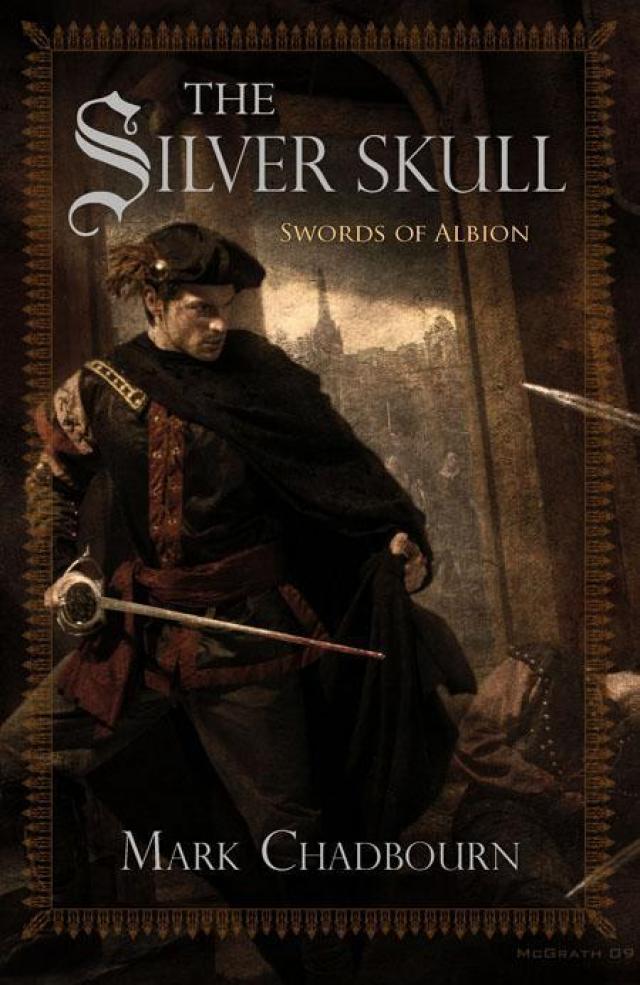
The silver skull soa 1, p.38
The Silver Skull soa-1, page 38
part #1 of Swords of Albion Series


That night, while the crew members slept on their filthy blankets, he crept up into the salty night air, ready to mount vigil for the grey-sailed ship pulling aside. They were sailing under a bank of low cloud, drizzle coming in sheets. The Rosario bucked across a choppy sea, and with visibility poor the night crew were occupied. Across the water, Will occasionally glimpsed the lamps of the other ships in the fleet.
Huddled against the elements, he waited. Finally, he caught sight of the silhouette of a lightless galleon ploughing across the waves on a slanting path in the channel between ships. Its speed told him it was the grey-sailed vessel.
As he went for the grapnel, he caught sight of someone emerging from below deck. Ducking down at the rail, Will watched, stock-still, as the figure searched slowly while trying to keep out of view. At the foot of the steps to the poop deck, the swinging lantern revealed Hawksworth's profile, sword drawn, but kept low at his side.
"Prowd?" he growled.
Cursing under his breath, Will peered over the rail to where the greysailed ship had now moved alongside, keeping an exact pace with the Rosario. Although dark, Will could see there was no movement on deck, no one on the poop deck or forecastle, no lookout, no sound of orders being barked. To the casual eye, it could have been abandoned and drifting with the current if not for the purposeful way it had been steered alongside. An illusion, Will decided, like the Fairy House in Edinburgh, which always appeared empty from the street.
The ship was close enough to reach with the grapnel, but Will couldn't risk trying to move between ships with Hawksworth prowling around not far away. Nor could he risk a sword fight on deck, which would quickly draw attention and awkward questions.
After a moment's thought, he left the hook where he had hidden it and pulled himself onto the rail. Fleet-footed, he bounded up the rigging, the oily rope slick beneath his fingers. Away from the shelter of the deck, the wind tore at him and the rain lashed as the ship rolled across the swell. Hooking his arm through the rigging, he waited in the knowledge that Hawksworth would probably not think to look up.
In frustration, he accepted the moment had passed for the night. As he watched the grey-sailed ship, the hairs on his neck tingled as if someone was looking back at him. He wondered what really stood on that seemingly empty deck.
Below him, Hawksworth continued to prowl, sword ready to repel any attack, with all the balance and poise of a master swordsman. It appeared he had decided to eliminate Will himself, rather than hand Will over to the Spanish commanders. Will couldn't understand Hawksworth's thinking. The capture of a live spy who could be tortured to provide vital information was a prize that could be traded for a high reward. One dead body was proof of nothing.
Will drew his knife and waited.
Hawksworth moved steadily around, clearly puzzled that Will was nowhere to be seen. He'd obviously observed Will leave his sleeping space, and had decided he was either up to no good or that it was the best time to dispatch him quietly.
Edging around to the back of the rigging, Will held on in the face of the harsh wind. When Hawksworth was beneath, he dropped. Hawksworth's cry was lost to the gale as Will smashed him to the deck, and before the traitor could recover, Will propelled him into the rail, winding him. Lunging with his knife just at the moment when the ship bucked over a large wave, Will skidded on the wet boards, and he half went down, one hand keeping his balance.
Eyes blazing, Hawksworth brought up his sword with a skill that surprised Will. "Prowd," he snarled, "or should I say `Swyfte'?"
Will couldn't wait for Hawksworth to raise the alarm. Using the momentum of the rolling ship, he threw himself forwards and plunged his knife into Hawksworth's gut. Hawksworth's eyes bulged with shock as if he was not expecting any attack. Blood splattered from his mouth.
"No!" he gasped.
Will whipped the knife out and sliced it across the artery at Hawksworth's neck. As the blood arced into the rain, the traitor slumped down against the rail, desperately trying to stem the flow, knowing it was already too late.
"You fool!" he said. "I am a spy, like you!"
"Lies at the last?" Will knelt next to Hawksworth so they would not easily be glimpsed, ready to use his knife again if Hawksworth attempted to call out.
"I worked both sides, but gave the last to Walsingham." Hawksworth's clothes were now sodden with the blood.
"He said nothing-"
"Walsingham never says anything!" More blood ran from his mouth. "The Spanish were close to uncovering me. My time was short, and I needed your aid. Together, we both could have escaped when we engage the English fleet. I have details of Parma's invasion force ... locations . . . numbers ..." He coughed, grew weaker.
"You are the fool! Why did you not identify yourself?" Will demanded.
"I had to be certain. And now it is too late! We spend so long pretending ... we waste our lives on lies ... we are always slain by our own deceit. All of us."
His final breath rattled from his throat, and his chin slumped onto his chest. Briefly, Will bowed his head too, so that they resembled reflections of each other, one alive, one dead. His guilt quickly turned to anger at the stupidity of the confusion, both of them hiding behind masks, both mistrusting each other.
When Will was sure no one was watching, he lifted Hawksworth to the rail and pushed him over into the sea. In the wind, and the crash of the waves against the hull, the splash was not audible. The body went under and was gone.
The grey-sailed ship still kept apace with the Rosario, but as he watched, it gained speed, pulled ahead, and then sailed across the prow and away into the dark towards the San Martin. Will stifled the bitter sting of failure with the knowledge that he no longer risked discovery, and could return the following night to try again.
But as he walked towards the steps that led below deck, he thought he glimpsed a dark shape waiting there, quickly disappearing down as he neared. Had someone seen him dump Hawksworth's body? Worse, had someone overheard their exchange?
He hurried in pursuit, but when he reached the sleeping quarters, no one stirred. There was only the sound of the waves on the hull, a steady, deathly beat like the slow tick of a clock.
CHAPTER 48
he time of reckoning has come," Launceston said as dispassionately as if he were preparing for a saunter along the shore. Eerily motionless, he looked out to sea where the ships waited.
Beside him on the quayside at Plymouth, the setting sun warmed Carpenter's face, the brassy light blazing across the jumbled rooftops cascading towards the sea. "Call it what you will," Carpenter replied. "We are likely sailing to our deaths, and death at sea is not like death on dry land, the brief, honourable pain of a sword thrust or the creak of old age. It is lungs bursting with water, and madness as breath is sucked away, or roasted alive in hellish fires, or limbs left splintered by cannon, your blood leaking into your shit and piss."
"Death is death," Launceston said simply.
Everywhere was unnaturally quiet at the end of the working day as the doors of the warehouses clattered shut and the merchants bid each other a quiet farewell, hurrying away with the workers from the sail-lofts and the other businesses that served the great ships. The delivery carts rolled off lazily amid the fruity aroma of horse dung. The taverns and stews around the harbour were deserted, most of their regular drinkers now aboard the ships, others hiding away in their homes in case they were pressed into service.
"If these are our last days, Robert, we should live them to the full," Carpenter mused. "Be the men we want to be, or dream we are, or give voice to the whispers in our hearts. What say you?"
Launceston considered this for a moment, and then nodded. "You speak sense, but for some of us that is not such an easy task."
Clouds of midges danced in the lazy heat, and as the shadows lengthened, the sounds of boots clattering at a steady pace over the cobbles drew towards them from the direction of the dark, mazy streets descending the steep hill to the dock. A confident, upright man emerged, striding purposefully, his hands clasped behind his back, his chest puffed out, and his head held high as if he was being watched by everyone he passed. His brown moustache and beard were carefully trimmed for the occasion and his hair swept back from his forehead. His features would have been familiar to almost all Englishmen and Englishwomen from the surfeit of pamphlets in circulation to mark the great successes of England's bravest adventurer, navigator, and sea captain.
"Sir Francis Drake," Launceston said, adding, "Does `vice admiral' fit him better than `privateer' these days?"
"No one can doubt what he has done for England, whatever his title."
Drake had dressed in his finest clothes, a new doublet in deep brown with gold stitching at the shoulders, a high white collar, and a black collarbone protector held in place by a gold chain. He walked up to them with a pronounced swagger and enquired, "Walsingham's men?"
"Yes, sir," Carpenter replied. "We are to accompany you aboard the Revenge in case the knowledge we have gained of the Enemy ..." He corrected himself. "... the Spaniards, may be of some use in the coming battle."
"Very good," Drake replied. "Good men are always welcome aboard my ship."
"It is true, then," Carpenter enquired. "The Armada has been sighted."
"Fifty Spanish ships, off the Scilly Islands this very dawn, seen from the lookout of the Golden Hind, assigned to patrol the western approaches to England. The captain, Thomas Fleming, raced to tell me himself. This day, July twenty-ninth, will never be forgotten, for it is the day that the sleeping beast of England was woken."
"As we had heard," Launceston said. "The Spanish race up the Channel to engage us at their leisure."
With pride, Drake looked to his ship, the Revenge, resting elegantly on the gleaming waves amid the other great ships. "I have spent the afternoon at Plymouth Hoe, studying the weather for any change in the direction of the wind. I have said my goodbyes to my Elizabeth, and now I am ready."
"Should there not be more haste?" Carpenter ventured.
"More haste?" Drake repeated superciliously. "Nothing could be done until the tide had turned. Besides, these are Spaniards and we are Englishmen. I could put out tomorrow morning and still whip them like dogs."
News of Drake's arrival at Sutton Harbour spread quickly in whispers along the narrow streets. Soon groups of old women and men gathered to see the great hero, shooing the clutches of excited children racing and playing along the harbour's edge.
Drake briefly moved among them, bragging about the natural prowess of Englishmen, and by the time he left they were all cheering and pumping his hand.
"He plays his part well," Launceston observed, "like Will."
"I am not so sure it is a role with Drake," Carpenter replied. "He believes his own legend."
A rowboat took them out from the quay to the Revenge in the lee of St. Nicholas' Island. Drake's eyes never left his ship as they neared. "How can the Spaniards even hope to win this war?" he said. "They circulated full details of the strength of their Armada, hoping it would strike fear into us and encourage the powers of Europe to support them. All it did was give us a tactical advantage." He waved his hand towards his ship. "Thirteen years old, forty-three guns, firing shot of nine pounds to sixty pounds in weight. What fine firepower for an Englishman! Thanks to the Spanish, we now know that their most heavily armed vessel, the San Lorenzo, has forty guns, and sixteen are but sakers or minions firing only four or six pound a shot." He laughed, his eyes gleaming.
Carpenter watched him closely. He'd heard the stories but had never encountered Drake before, and he wondered if his bravado rang true. Whether it did or not, Drake's confidence was infectious. The black mood that had gripped him since he had disembarked the Tempest lifted slightly.
A hundred feet long at the keel, but appearing even larger, the Revenge grew more imposing as they neared. It was weather worn and its green and white chevrons had faded slightly, but that only gave it the appearance of a seasoned warhorse. Carpenter could smell the sticky bitterness of the fresh tar that turned the keel a shining black.
On deck, the crew waited in small groups to greet Drake. Drake never met their eyes, but Carpenter could see they were comforted by his presence. The great cannon gleamed, the gun crews standing at the ready. As if in silent prayer, he glanced up the mainmast to where the sails were furled at the yards, gave an approving nod, and then began his final inspection.
As the last glimmer of the setting sun lit the waters ablaze, the wind from the sea turned, and with the tide on the ebb, the signal gun fired. Slowly but steadily, the Revenge and the other great English galleons began their journey down Plymouth Sound. Night fell.
Once they were in open water, the crew scaled the rigging like monkeys to unfurl the sails. Carpenter knew this was a crucial time. The Spanish could have been waiting to bear down on them, but the topmen reported no ships ahead, though the danger would remain until first light. Drake gave the order for all lanterns to be extinguished, and they moved forwards as part of the night.
Launceston stood at the rail, his deathly pallor unnerving some of the crew who bowed their heads and muttered prayers as they passed. Carpenter thought a strange mood had come upon him.
"Will they strike now, coming out of the dark before our journey has even begun, like the death we spoke of ashore?" he mused.
Carpenter didn't know what to say, and left him there to watch Drake as he strode proudly across the still-warm deck, the master of his world.
When dawn came, the seas were still empty and the tense mood lifted slightly. The fleet of fifty-four ships led by Lord Howard of Effingham sailed out into mist and squalls.
At three p.m. that day, an exuberant Drake summoned Carpenter to the poop deck. "Would you like your first sight of our enemy?" he said gleefully.
Carpenter peered into the drizzle, but could see nothing, even when the rain cleared briefly. He eyed Drake to see if he was finding humour at the expense of a man who had not earned his sea legs. He was surprised to see Drake watching him deferentially.
"I, and all England, owe you a great deal," he said. "You have turned the tide of this war."
Carpenter was lost for words. From behind his back, Drake handed him a long tube of shaped beechwood, bounded by brass hoops. A second tube slid in and out of it, and there was glass in the end.
"What is this?" Carpenter asked, still unsure if he was to be made a joke.
Drake pressed the tube to Carpenter's eye and positioned him. Spanish sails loomed up in Carpenter's vision, shocking him so much he almost dropped the device. He lowered it, but could no longer see the sails.
"They are far away," he stuttered, "beyond my natural sight. Yet this device lets me see them. Is this some of Dee's magic?"
Drake laughed. "It is Dee's magic, but not in the way you mean. It is called a tele-scope. This arrangement of glass draws closer that which is distant. No supernatural power there, only human ingenuity."
Admiring the tele-scope, Carpenter said, "I never knew we had such a thing. How is that?"
"No one knows. No one will know, for many years to come. It is a secret, and you would know about those things. There is plenty that never reaches the ears of the common man, am I correct?"
Carpenter nodded. "But what has this to do with me?"
"As I heard it from Lord Walsingham, Dee worked upon a type of this very device, in years gone. He heard whispers and talk among his kind ..." Drake smacked his lips in disapproval. ". . . that some Italian painter had drawn designs for this tele-scope many centuries past, and so he set about building one. He struggled to find the right glass, until word reached him of another similar design, being studied by the tsar's magicians."
Carpenter's brow furrowed. "In Muscovy?"
"The tsar's device did not work either, but he had a different part of the puzzle. And so two brave spies were sent to retrieve his invention-"
"This is what Will brought back!" Carpenter said, examining the simple tube. "I thought it was some great weapon."
"You do not understand its importance," Drake said. "Only a true seaman would. This tele-scope will turn the tide of battle. We can study the Spanish ships from afar, watch their preparations, their direction, and we can be upon them at the point of our choosing."
Carpenter was too stunned to speak.
"I heard you paid a great price for the recovery of the item that led to this great thing Dee has made," Drake continued. "Know you, then, that every scar you bear marks a thousand ... nay, ten thousand English lives that have been saved this day. Saved by you, Master Carpenter. Your sacrifice will keep England free."
Dumbfounded, Carpenter could barely respond to Drake's praise. He made his way down the steps from the poop deck, his mind struggling to reconcile the bitterness that had encysted his heart since Will had abandoned him with the new knowledge of what had been won.
As he gathered his thoughts by the rail in the salty spray, he decided this new information had to be conveyed to Launceston, whom he had not seen since dawn had broken. He searched the length of the deck, and then plunged into the stifling, near-deserted confines below, his puzzlement growing by the moment. Eventually, he had exhausted all possibilities apart from the sec tion of the hold containing the sail stores, timber, carpenters' tools, and all the items necessary to keep the great ship afloat.
When he called out, his voice was lost beneath the symphony of sound that filled every ship, the constant boom of waves against the hull and the chorus of creaking as every board flexed to cope with the pressures upon them. His view obscured by canvas hanging like drapes amid piles of timber, he worked his way through the obstacles, pulling back sheet after sheet.
As he drew back the final covering, he was convulsed with shock. Had he suddenly stepped into hell? As red as the Devil, Launceston loomed over a sticky mess, his knife still dripping. When he looked at Carpenter, fires blazed in his eyes, and it took a second for him to focus. With a faint, dreamy smile, he said softly, "What wonders to behold."