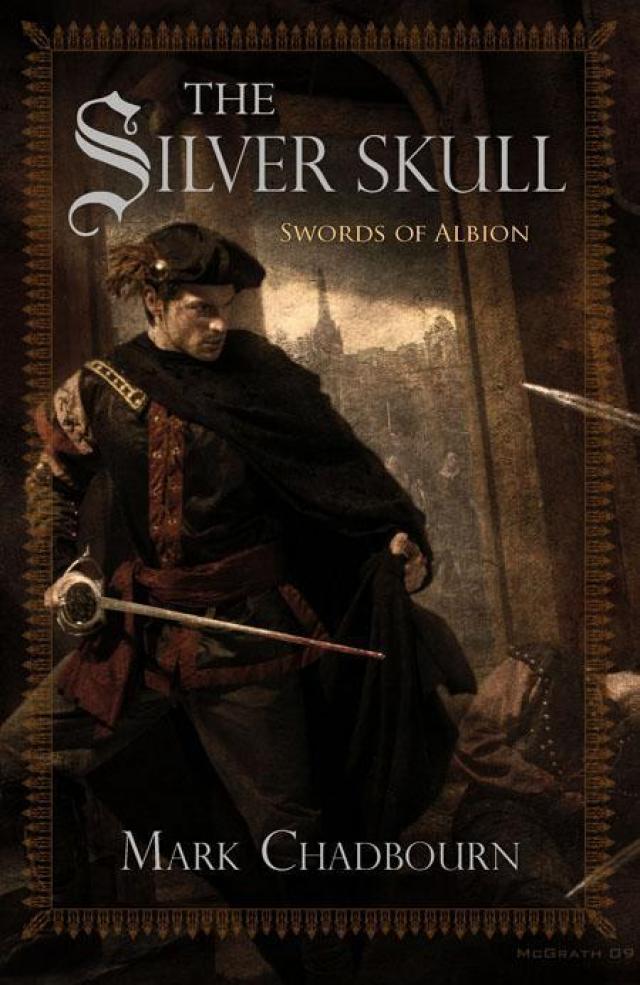
The silver skull soa 1, p.29
The Silver Skull soa-1, page 29
part #1 of Swords of Albion Series


Dee waited outside, his hood pulled up to hide his identity from unwelcome eyes.
"Any news?" Walsingham asked.
Dee shook his head. "The Enemy's true plans remain hidden. They move pieces here and there to distract us, but I can find no guiding principle."
"Except our destruction."
"Except that."
"You have heard all the prophecies circulating in Europe?"
"Of course. Things do not look well for any of us." Dee took a deep breath. Walsingham could see the strain in his features. "I have cast Elizabeth's horoscope," he continued. "The second eclipse of the moon this year arrives when her ruling sign is in the ascendant, twelve days before her birthday. That is a powerful portent. Momentous events lie ahead, and all that stands is at risk. The Enemy may finally destroy our defences and achieve their goal."
"Do not tell Elizabeth this."
"Why, I planned to tell her this very moment," Dee said tartly. "I cannot wait to have my head on a pole above the gates of London Bridge for such high treason. So we put our faith in Swyfte?"
"We do. Unless you have another plan?"
Dee said nothing.
Walsingham left him studying his astrological charts, and Walsingham made his way to the gardens to be alone with his thoughts. Deep in conversation on the bench beside the lavender were Marlowe and Nathaniel. Walsingham read the concern etched in the face of Will's assistant and recognised the cause immediately. It brought back a rush of memories and feelings still raw after all the years.
His mother telling him the circumstances of his father's death. "They haunted him until his heart failed him. They had noticed him, you see."
His dreams of following his father into the legal profession when he enrolled as a student at Gray's Inn, dashed by the thing that sat in the corner of his room and told him cruelly that his mother would be next.
At her graveside near thirty years ago, watching the figures hiding among the yews, sensing their jubilation at his mother's final suffering, at his own suffering.
We have long memories, and our punishment reaches down the years, down the generations. "
His mounting sense of injustice, tempered always by the hope that soon the misery would stop. His wedding to Anne. Her funeral just two years later. The coils of the Enemy drawing tighter and tighter around him.
His two stepsons, dying in a conflagration when a barrel of gunpowder blew up in the gatehouse where he had sent them to be safe.
So many deaths, so many tears, and all because of an act committed before he was even born. His father's crime? To help a young boy the Enemy were tormenting.
Over the years, through all the pain, they had driven him to be the man he was. And they would pay the price.
At Walsingham's curt summons, Marlowe came over, trying to hide his sheepish expression. Walsingham would have preferred him to stay out of sight-he had too many weaknesses, too many cracks for the Enemy to prise open-but more important matters pressed.
"He has been touched by the Enemy?" Walsingham said, nodding towards Nathaniel.
"Lightly." Marlowe was pleased Walsingham did not have stern words for him. "He still has many doubts, and searches for ways to dismiss what his heart knows to be true."
"Then help him in that task. Do not let him onto the path we walk. He deserves a better life."
"I will lead him down a garden path filled with sunshine and flowers."
"Good. We must never forget why we fight." He fixed an eye on Marlowe. "And why are you here?"
"Will has charged us both with keeping watch upon the Lantern Tower. The Enemy have shown how badly they require the Shield, and he fears they will attempt to steal it."
"The Lantern Tower has many, many defences. But still ... you do good work."
Marlowe beamed. It was a small act of kindness, but Walsingham felt pleased that he had done it; he was allowed little opportunity to be kind these days.
But as he moved away, the shadow fell over him quickly once again. He could see the Enemy's hand everywhere. No one was wholly trustworthy, not even those closest to him. He had made so many sacrifices, and it was all on the brink of being for naught. On any given day, Swyfte was the best man he had, but he was afraid the Enemy had found Will's weakness-the girl, Grace-and would use that to destroy him.
CHAPTER 35
ow long do we have?" Mayhew asked.
"An hour. Perhaps two," Will replied. In the garb of Levantine sailors, he led the others away from the crack of rope and the slap of billowing sails at Seville's harbour. De Groot's carriage had dropped them off at the waterside after the two-day journey across the dusty tracks of Andalusia, in the shade of undulating hills awash with olive trees and vines. With the loop of cloth from their headdress pulled over their lower faces to disguise their identities, they quickly merged into the thick flow of people milling along the dockside, merchants barking orders or haggling over prices, swarthy workers unloading bales and urns, sailors lounging in the shade, drinking and playing cards as they waited for their ships to sail.
"That does not give us much time," Carpenter growled.
"Time enough to cut off the Spaniard's ears if he is still here, and to encourage him to tell us the whereabouts of the Silver Skull and the girl," Launceston mused.
"Any more talk of the removal of body parts and I will start to think you consider it more entertainment than encouragement," Will murmured.
"One cannot escape the fact that it is entertaining," Launceston replied, and has been since I was a child, cutting up cats and dogs to see how they work."
No one spoke for several minutes.
Beneath an azure sky, Seville carried its age with great dignity and sophistication. Gleaming white walls and spicy Moorish domes of orange and brown and gold, straight lines from the Romans and horseshoe arches from the Visigoths, faded Phoenician carvings on the old stones torn out during the rebuilding of the busy port along the slow-moving Rio Guadalquivir, where the ships backed up for miles laden with produce bought with New World riches. On the streets, under the swaying palms, people moved at a lazy pace, their faces betraying the heritage of two thousand years of invaders. Though the Christian rulers had tried to drive out the Moors and the Jews, they could not eradicate the subtle influences of North Africa and the Holy Land that had burrowed into the features of the residents over the centuries.
It was a city where anything could be found: silver and gold from the Spanish Main, silk and spices from the distant East, rare books and telescopes from Constantinople, secrets from the four corners and the answers to age-old mysteries.
They headed east through the sweltering stores and clattering shipyards of El Arenal towards their destination. Mayhew appeared to have regained much of his equilibrium since they had left Cadiz, although his face still showed the stress of surviving in the heart of enemy territory.
Continuing east, they soon spied the soaring bulk of the Gothic cathedral. It was dominated by La Giralda, the Moorish bell tower, its geometric stone patterns lining the tier of arched windows that revealed its origins as a minaret where the muezzin called the faithful to prayer during the long occupation. The cathedral stood just beyond the solid walls of the Barrio de Santa Cruz, erected, according to the city fathers, to protect the Jewish inhabitants, but which made the quarter seem more like a sprawling prison.
Passing through the arched gates into the warren of whitewashed alleys and patios, they saw that New World wealth had already flowed into the redevelopment of the ghettos. The architecture here had a different flavour, with tiny grilled windows on tall, plain-fronted buildings, simple next to the ornate designs of the Moorish structures that dominated the rest of the city.
In the Barrio the streets were quieter, and they could move faster towards the Real Alcazar. Its spacious gardens soon came into view, lush rows of palms, terraces, fountains, and pavilions. The sprawling, ornate complex of buildings with the Palacio Pedro I at its heart was like a jewel box with its blend of Islamic and Christian styles on a soothing geometric design of patios and halls. It had a grandeur that dwarfed the more stoic and shadowy Palace of Whitehall.
They avoided the guards at the gates and headed north until they found Susona Street, a narrow route between larger thoroughfares with tiny, dark shops like caves, goods and produce piled high on tables beneath awnings gleaming brassware, pots and pans, fruit and spices-and an inn where old men with long, white moustaches and snowy beards drank wine and talked quietly about the old days.
Their destination stood out from the other stores with a simple painted sign of yellow stars and a crescent moon on a deep blue background. The window was filled with chalices, swords, and other items of dubious use but clear ritual intent. The door stood open and the heavy, spicy scent of incense drifted out. It was too dark inside to see much, but Will could make out strange objects hanging from the rafters and piles of large books.
He ordered Launceston to keep watch and slipped inside. Carpenter and Mayhew pretended to browse the books near the door while he pushed his way into the gloomy depths through a series of heavy drapes, where the only light came from intermittent candles. Here were stored items of a more obvious occult nature-balls of crystal, scrying mirrors, human skulls, knives with obsidian handles, jewels, wall coverings marked with arcane symbols, and books so big they looked impossible to lift. Shadows swooped with every flicker of the flames so that the jumble of treasures appeared to move of their own accord. The breeze from the open door shifted hanging columns of colourful beads glistening in the faint illumination and stirred wind chimes, so the senses were continually stimulated and the thoughts distracted.
A whiff of sweat beneath the disguising incense. Whirling, Will saw white eyes in the corner next to the drapes through which he had entered; he had passed within a foot of the watcher without even knowing he was there.
"You are Abd al-Rahman?" Will asked, in Spanish.
A North African man stepped into the candlelight. His shaven head was covered with swirling tattoos made by a needle with ashes rubbed into the wounds. One tooth was missing. Will noticed his fingernails were excessively long and filed like an animal's claws.
"I am Abd al-Rahman," he replied in English, noting Will's slight accent, and added with a faint sibilance, "You search for something in particular?" He was a big man, strong and muscular. One hand rested on the hilt of a curved knife at his belt.
"I hear you are a wise man, and knowledgeable in the ways of the ancients."
Al-Rahman brought his hands together slowly and gave a faint bow, although he showed no pleasure. "You honour me."
"I am surprised the Christian leaders of Seville allow a practitioner of the Devil's arts in their midst."
"They drive out only those who are not useful to them."
"You help them?"
"I help all, for the right fee."
"Then you may come to my aid, for I am a weary traveller in search of information. And I can provide all the gold you need."
Al-Rahman wryly indicated a table for Will to make his payment, but it was clear he knew Will had no gold.
Will shrugged. "Perhaps I can find another inducement."
Faintly smiling, al-Rahman partially drew the knife at his belt.
With a weary shake of his head, Will said, "One day things will go as smoothly as I imagined them before I opened my mouth." He snapped his fingers.
Bursting through the drapes, Carpenter and Mayhew each caught an arm, and with his free hand Carpenter brought his knife to al-Rahman's throat.
Will propped himself against a table and folded his arms. "Sadly, we are desperate men. Who knows to what depths we will stoop?"
"Do not threaten me," al-Rahman replied. "I make a dangerous enemy."
"Then we are evenly matched. I seek a Spanish nobleman-Don Alanzo de las Posadas. You know him?"
His eyes heavy-lidded, his features impassive, al-Rahman shook his head.
"He has not been here?"
Al-Rahman shook his head again.
"My assistant Nathaniel always says I am too trusting, but in this instance I believe you are not wholly at ease with the truth. Don Alanzo left Cadiz in search of you several days ago. It is inconceivable that he has not yet called at these premises."
Al-Rahman's eyes darted from side to side. Before Will could alert the others, al-Rahman tore himself free, plucked a handful of powder from a pouch at his belt, and threw it into the air. As the white powder swirled into Carpenter and Mayhew's faces, they couldn't help but inhale, and a second later they jacked forwards at the waist and began to vomit uncontrollably.
Will pressed the cloth from his headdress tighter across his face, but some of the powder had already worked past the protection. His vision swam and his gorge rose. Through watering eyes, he saw al-Rahman lunge forwards with his knife drawn.
Will threw himself to one side, upending a table piled high with bones and crystals. They clattered across the floor noisily and brought more artefacts crashing down. Flinging himself upon Will, al-Rahman stabbed viciously and it was all Will could do to hold him off. He tried to reach his own knife, but al-Rahman wielded his blade back and forth in a blur of slashes, drawing closer to Will's throat with each arc.
Glass exploded at the back of al-Rahman's head with a loud crash and he pitched forwards across Will, unconscious. Launceston had entered silently during the fight and now stood over them holding a broken bottle.
"Quickly," the ghost-faced earl urged. "A carriage approaches. It is Don Alanzo."
"Go," Will gasped, throwing al-Rahman off him. "Take the others."
"You?"
Looking around quickly, Will replied, "I will find somewhere to hide so I can observe events. I will meet you later at the arranged place. And if I do not join you, you know what to do next."
Will and Launceston exchanged a brief look of understanding before the earl fled the room, followed by Carpenter and Mayhew, still retching. Will stumbled to the back of the shop where a purple drape covered a door to a flight of stone steps. Behind him, al-Rahman stirred. Will staggered up the steps to a large room that covered the entire floor of the house, with brick pillars supporting the ceiling where the walls had been removed. Occult symbols were painted on the floor inside a ritual circle, and all across the walls, which were the dark blue of the night sky. In one corner stood a seven-foothigh, three-faced hinged mirror with a gilt-covered iron frame.
Silently, Will slipped back down the steps and listened at the drapes. Peeking through the gap, he saw Don Alanzo burst in, accompanied by a man in a thick cloak and cowl that plunged his entire face into darkness. The Silver Skull, Will suspected.
Don Alanzo helped al-Rahman to his feet. "I saw men running from this place."
"Englishmen. They were looking for you." Shaking his head, al-Rahman recovered quickly. "I told them nothing."
"They are gone now. I will alert my men to begin a search, but the other matter is more pressing. Have you all you need?"
"I have both items. But I warn you: the red dust is in short supply. It is fresh off the ship today, from the high land near my home. If we fail, there will be no other opportunity."
"Then we do not fail!" Don Alanzo said vehemently. "Make sure you succeed, or as God is my witness ..." Don Alanzo caught himself. Will was puzzled to see his edgy mood; even in the danger of the bear pit, he had retained his composure. "What time?" Don Alanzo pressed.
"This business can only be conducted under cover of the night."
"Thank God, there will finally be an end to it." The note of desperation in lion Alanzo's voice was palpable. He turned to the Silver Skull and said in a more measured tone, "Do you hear-an end to it?"
The dark cave of the cowl was turned to lion Alanzo, but the Silver Skull's posture gave no sign that he had heard, or even cared. Will thought of him, a prisoner inside his mask, and then a prisoner in the Tower, and now a prisoner of the Spanish, for all those years, and wondered if the Skull could bring himself to care about anything anymore.
They were interrupted by one of lion Alanzo's men: word had arrived from Cadiz that an English spy was en route to see al-Rahman. Don Alanzo sent an order to mount a guard at both ends of Susona Street until his business was done, and that a messenger should be sent to the Real Alcazar so that a citywide search could be mounted for the English spies.
Once he had departed, al-Rahman intoned, "The preparations will take some time and you must both be involved."
"In the room upstairs?" Don Alanzo asked.
"The space has been prepared," al-Rahman replied.
Will quickly mounted the stairs and squeezed behind the mirror in the dark room with its unsettling atmosphere. It was too late to wonder if it was the wrong decision; there was no way out for him.
On the dusty floor, he made himself comfortable as he listened to the sound of al-Rahman and lion Alanzo beginning their preparations. The sound of scraping across the floor as objects were dragged into position. Flints being struck, and candles lit. The smell of tallow smoke and sickly-sweet incense. A brazier ignited, bitterly sulphurous, and the loud exhalation of bellows.
Don Alanzo and al-Rahman barely spoke, and when they did it was only to proffer or request instructions; it was clear no love was lost between them, their relationship based on need and gold.
Enclosed in his constricting hiding space, cut off from the world, the background noise became a hypnotic susurration, lulling him into a state where his thoughts roamed free. Time passed without him knowing it, interrupted only by the presence of new aromas, subtly different sounds, the murmur of voices rising and falling. From his restricted vantage point, he watched the shadows grow along the walls and the gloom fold around him.
From the open window, the sounds of the working city slowly died away, the shouts of workers, the dense conversations passing beneath, the bang and rattle from the shipyards, the back and forth prattle of merchant and buyer. For a brief while it grew still. Then came the music drifting from different windows, fiddles and voice and harpsichord, rhythmic songs from Africa and the Orient colliding with the passionate whirl of Spain, and the noise swelling from the inns, voices raised in celebration of another hard day passed, in song and in love. It was hot and muggy, the cooling breeze long gone. It felt like a storm was coming.