

Abortionist, p.23
Abortionist, page 23
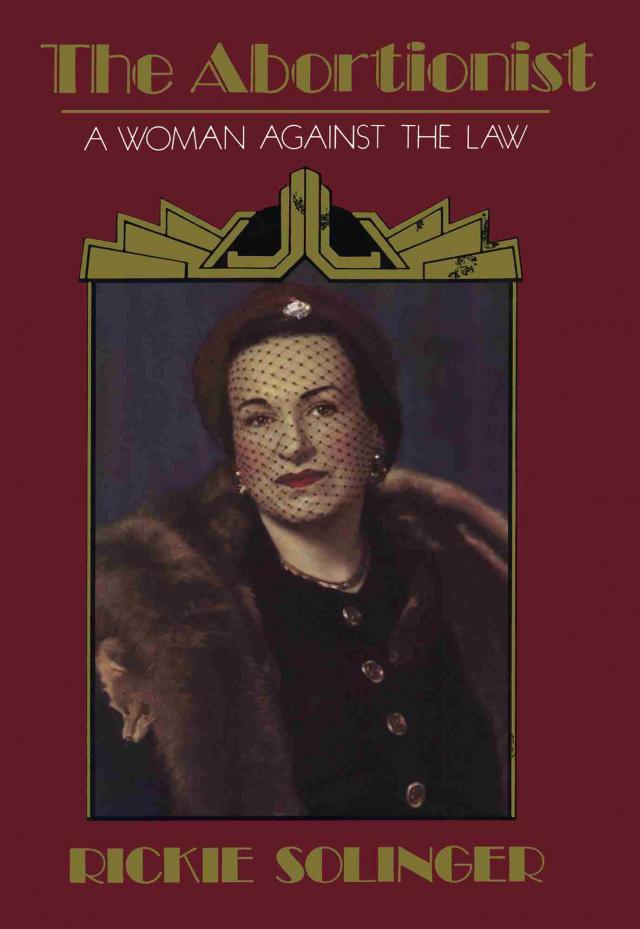


The most important qualities of Ruth’s story as it was shaped for the public was her stunning success and her personal style. They said she ran “the most elaborate abortion parlor” in town, in the Pacific Northwest, maybe anywhere. When the police swooped down on the Stewart Clinic, they found not merely one or two pathetic, cowering women, but at least eight or ten “unclad girls in cubicles,” some shrieking, some trying to escape, and staff all over the premises. This was an enterprise of an altogether different magnitude and tone than the others: up-to-date, antiseptic, and luxurious at the same time, an utterly successful concern. There is no question but that the Stewart Clinic, as it appeared in the newspapers, severely challenged the popular back-alley demonology that cast the woman abortionist as an old witch, a harridan who relied on toxic brews or a steel hatpin. Whatever she used, the common wisdom had it that the female abortionist worked over the woman, as one demonologist put in, “in wanton disregard of the health of the victim.”
In a touch that heightened the drama and appeal Ruth lent to the crackdown, the premier abortionist managed to be absent at the crucial moment. All the other abortionists were in situ when the raids came, but Ruth had special resources in this as in every other regard that it was hard not to admire. The fact is, the accounts of the scene the cops and reporters found at the Stewart Clinic are admiring. Ruth’s clinic was a fantasy achieved, her postwar American Dream. Medically, financially, aesthetically, personally, it was a triumph, and that came across. Wally Turner, Rolla Crick’s counterpart on the morning paper, gushed, “Both the clinic premises downtown and the ‘hospital’ at the Ramona Motel were lavishly furnished with thick rugs and fancily-carved massive furniture. The clinic has a one-room apartment with a tiny kitchen, furnished in deep pile rugs and expensive draperies and furniture.” Turner and the others would have agreed with Maggie that the little girl from Hood River was indeed living high on the hog. Ruth’s surgery, pictured on day one in the paper, was spotless and professional, her surgery table notably distinct from the old midwife’s kitchen table.
Many decades later, Rolla Crick wondered how the cops and the press would have behaved if Dr. Ed Stewart had still been the proprietor on the eighth floor of the Broadway Building when abortion became a crime in Portland. It was a good question because, along with their admiration for Ruth Barnett, reporters transmitted other messages about the woman abortionist, and those messages were about her sex. As the stories appeared day after day in the aftermath of the raids, Ruth’s elegance slid into a vain sensuality, her medical prowess was recast as a perverse willingness to prey on women’s bodies. Her lucrative practice became a vehicle for transforming the wages of women’s sex into a cash crop. In the transition, Ruth’s power became the venal power of the Seductress, the bloody power of the Lady Vampire, the lewd power of the Madam. In this way, the female abortionist lent levels of new meaning to the crime, exactly what was called for to keep the story hot.
It also helped that, to a surprising degree, the “victims” themselves—the unwillingly pregnant girls and women—could be ambiguously rendered for public consumption. In deference to ideas about the sexual shame attached to abortion, and about the victimized status of women who went into the back alley, some of the reports sidestepped evoking the clients in any vivid, flesh-and-blood way. In Dr. Buck’s office, for example, the patients on tables remained hidden to cops and reporters who knew they were there but accepted the fact that Dr. Buck stood between their desire to see them and the women’s need to be protected. In fact, almost all the male abortionists managed to shield the women under treatment in their offices. Even the “pretty blond wife” on a table at Dr. Elliott’s office was a device; none of the observers on the scene actually laid eyes on her. It was as if the simple fact that these abortionists were male was sufficient to give both their business and their clients a veneer of legitimacy.
At the Stewart Clinic, of course, it was another story. Nobody was a “wife.” Nobody had a husband or boyfriend along for protection or support. The females at the Stewart Clinic on July 6th were on their own. They were “unclad,” shrieking, “waiting in cubicles” like prostitutes, then resisting, escaping, sexual. There was no hint anywhere that these naked, eroticized women were potential mothers. Instead, the coverage hints that although Ruth Barnett’s power (even in absentia) was in part predatory, these females were not real victims. Rather, they were offering themselves up as snacks.
One Portland chiropractor suggested in print during the first week of July that he and his colleagues were really upset about the abortion mills and felt their profession had gotten the “blackest eye” when blame should have been assigned to the women involved. The president of the Oregon Chiropractic Association issued a statement the day after the raids claiming the entire association believed that “women who submit to and pay for abortions are equally guilty with the doctors.” It was they, he said, whom the law should punish.
In line with this view that associated guilt with the women who sought out abortions, many doctors claimed that any woman who wanted to end a pregnancy was an aggressor against her mate. She was using abortion, according to a psychiatrist, to castrate her husband, “usually emotionally, but occasionally even in actuality.”
Knowing that the public was naturally curious about what sort of woman would get herself into a fix like that (and maybe also curious about how far the papers would go in supplying that sort of information), both dailies featured a set of what they called “nurse’s notes.” The Oregonian, the morning paper, was coy: “The exact meaning of the notes is obscure, but it appears they are the nurse’s descriptions of patients.” The nurse’s notes constituted, in fact, a most illuminating typology of an abortionist’s clients, and deepened the moral ambiguity surrounding these women. The nurse described visitors to the abortion clinic, one by one:
Gullible woman has two children by ex-husband. Became pregnant by boyfriend who committed suicide and now she puts her faith in another man who says he’ll marry her. Living in trailer park.
Very dramatic mother of young, husky patient from California. Pleading for her daughter whose boyfriend ran out on her on their wedding day.
Doped patient 49 years old. Has daughter and son in college.
Very young patient. Only 14. Self-assured and very outspoken. Cute, hair done on top of head. Who fought and swore.
Patient with three children whose husband came back periodically for her forgiveness and got her pregnant again. On relief. Would beat her up. Cried all the time.
Patient thumbing ride to California for money and will thumb her way back.
Man brings in 14 different girls and thinks nothing of it.
Stubborn youngster only 14 who wanted her baby and was badly spoiled by parents.
Arguably, the nurse’s set of thumbnail sketches taken together created an association between abortion and disorganized lives—women seeking to end pregnancies in this particular clinic were victims of abandonment, violence, the suicide of a lover. But weren’t there a great many readers, glued to the news of the raid, who could recognize some aspect of their own ordinary lives in this litany of poor, resourceless women? Weren’t there many who read the nurse’s notes and knew that their own lives were also touched by irresponsible or violent men, by some version of these desperate situations? Just how many readers pictured the traffic through all those abortion clinics, exposed for the first time to public consideration, and thought, “There but for the grace of God …”?
Amidst all the bizarre sensationalism of the raids, no reporter dared to name the most obvious and shocking news of all. No one mentioned that the events of July 6th made the abortion business in Portland visible, with all its multiple offices, its multiple practitioners (almost all of whom were doing abortions on a random morning), and its multiple patients from all walks of life.
Now that everyone knew, indubitably, that abortion was occurring all over town, it would be hard to deny the corollary, that ordinary women all over town had secrets, that anybody’s wife or daughter might harbor the dangerous secret that she had been unwillingly pregnant and had resisted. The big secret now revealed, though still unstated, was that these women had taken their reproductive lives into their own hands, the law be damned. As one commentator who’d seen those screaming headlines put it at the time, “Criminal abortion has swept over the entire country! It happens all around you, down your street, across from your place of business, and it may even be happening right in the building where you live or work.” In other words, it might be happening to your own wife. That message, too, leaked through the headlines in Portland, and gave a ludicrous cast to the whole business because it multiplied the layers of hypocrisy Portlanders had to penetrate in order to reach the moral indignation that the headlines demanded.
If neither the “doctors,” the “victims,” nor the “crime” itself was quite as it seemed at first glance, neither, finally, were the cops, who in the purge climate of the cold war did not have a straightforward job. Besides fulfilling their traditional “protective” function, law enforcers in the 1950s were called upon to serve functions that were politically profitable, explicitly titillating, and morally bracing all at once. When the police broke through the doors to abortionists’ chambers, they were not only enforcing the law, they were also creating an opportunity for heroics and for making political capital.
Yet sometimes the problem was a surfeit of opportunity, and the abortion situation in Portland was apparently one of those times. The cops and the deputies who appeared heroically in the newspapers in early July, staging the raids, looked somewhat different the next day when one of the abortionists told the press a story about cops who had offered to protect him for the sum of ten thousand dollars. The abortionist told the Journal that he had gone to the D.A. and to the chief of police with his evidence in hand. At this point, he said, “he was at a loss to know why the detectives are still on the police force.” Now the headlines screamed, “ABORTION RAIDS LAID TO SHAKEDOWN TRY,” and the moral terrain looked murkier than ever.
The two cops in question recognized the contagious properties of guilt when they promised to “exonerate [themselves] and law enforcement in general.” The Oregonian had no trouble whatever believing that the cops could have an interest in responding to abortionists on the basis of something other than professionalism and heroism. After all, just a few years earlier, when one of San Francisco’s most prominent abortionists, Inez Burns, was arrested, the news got around that this practitioner had regularly paid off the cops to the tune of three hundred thousand dollars a year in exchange for protection. When Burns’s clinic was closed down after World War II, it was a sign that arresting an abortionist could win the authorities political capital that was more valuable even than the money they collected for protection.
The Oregonian editorialized in July 1951, that extortion in cases like these was to be expected: “This sort of thing is the logical byproduct of illegal business which is immensely profitable when operated in mass production, as was the far-famed and notorious Stewart Clinic over a period of many years.” The editorial concluded on a harsh note that unexpectedly shifted the public’s gaze and its opprobrium onto the police. “The practice of abortion on a large scale almost inevitably leads to corruption of law enforcement … and perversion of justice and government. There is less excuse for those who fill their pockets with graft from such a racket than there is for the abortionists.” Thus the men who shaped the news and packaged it continued to underscore the difficulty of defining the crime, the criminals, and even the victims with certainty.
By the time Ruth Barnett and her husband, Earl Bush, arrived at the sheriff’s office on Saturday afternoon, it was not yet clear how the press would cast the proprietor of what everyone had begun calling Portland’s “swankiest abortion parlor.” The headlines of the Sunday Journal trumpeted the news of Ruth’s surrender over a portrait of the abortionist, who had a knack under any circumstances for striking marvelous, elegant poses. Now that the authorities finally had their most important suspect in custody—an event for which they could take no credit—they treated her like a glamorous movie star, albeit one touched by a scandal that only served to make her all the more fascinating to the reading public. “The fashionably dressed Dr. Barnett,” Rolla Crick wrote (using no quotation marks to sully the honorific), “who had been the object of a police search since 11 a.m. Friday, greeted reporters affably, but refused to discuss the abortion business. She said she wanted to be identified as Ruth Barnett, but that she was ‘happily married’ three years ago to Earl M. Bush.” If she wouldn’t talk about abortion, Ruth quite comfortably entertained questions regarding her racehorses (“bragging,” said Crick, “that her horses had won six times recently at Portland Meadows”), her cattle ranch, her dude ranch, her breeding farm for racehorses and white-faced Herefords. Allowing Dr. Barnett yet another touch of careless glamour, Crick reported that Ruth did not say where she had been during all the time the police were hunting her. She said she left the Suntex ranch Friday afternoon, but “had some errands to run and shopping to do” before she surrendered. And then Crick conveyed his final take on the essence of the stylish abortionist, that is, on her wry poise and defiance. “At one point,” wrote Crick, “while newsmen were photographing her, [Deputy D.A. Charles] Raymond asked, ‘Why have you been doing this?’ She smiled and said, ‘Are you kidding?’ ”
In an accompanying column, Crick himself acknowledged that many people in town besides Ruth found the dumb earnestness of the authorities a bit incredible, even in the midst of all the high melodrama. The whole investigation has been “highlighted with cloak-and-dagger-type experiences,” he wrote, “but many persons contacted wondered why all the fuss about abortionists. Many believe the only crime in the abortion business is getting caught.”
The strange thing—and Crick knew this, too—was that as the details piled up about the abortion business, about the abortionists themselves, and about Ruth Barnett in particular, the moral ambiguity gave way to moral condemnation. The ambiguity faded because at its heart, the story of the abortion raids contained elements that resonated deeply with the story of being an American, a Portlander, and a woman in 1951. The fact was, no matter how difficult it may have been for the police, the press, and even the citizenry to define the principals and the crime, the larger narrative was familiar.
One-half of the big story, after all, was the shocking part that revealed the instability and vulnerability of the community. It was the part that told about how yesterday’s secure hometown was today under threat from an enemy within. It was an immoral and clandestine enemy. In 1951, Americans knew about the very thin and often broken line between subversion and its twin infiltrator, perversion. These were the insidious strains that flourished in secret cells and “nests” and seeped out aggressively, infectiously, attacking all that was good and strong and true. The underground abortionist, not unlike the Red it turned out, could be anywhere and everywhere, unmarked and apparently normal, like you and me.
It required real heroism to ferret out this criminal, because no ordinary citizen was equipped to recognize the danger. Only the experts—the cops and the press, and the authorities behind them—could expose the hidden places where evil forces did their dirty work. These were the places where the purveyors of perversion undermined community morality and safety in order to satisfy their own gross appetites, particularly their appetite for the alchemy of changing the living wages of sex into cash. The headlines, the mug shots, the photos of plush interiors and dusty surgeries exposed this hidden danger. It was lurid, familiar, and exotic at the same time, and it was good to be able to see what it looked like.
Any American could appreciate this morality tale. But perhaps you had to be a Portlander to appreciate the local angle. Perhaps you had to have lived through the Riley era, when a cop was only good for a wink and a nod, and through the humiliation of the Vollmer Report, which called the police force a sham, and then suffer through the recent ineffectuality of Dottie Do-Good to really appreciate the hometown pride that surged when the cops caught a whole industry red-handed in one morning. There was something very satisfying about splashy front-page evidence that the Portland police department could still perform and, in the process, make the community a safer place to live.
The other half of the big story was, of course, about sex. It was about criminal practitioners who positioned themselves between the legs of prone women to insert god knows what up into those women, for cash. It was about presumptively lewd women who wanted sex but not babies. And it was about semi-secret places where many women at a time took their clothes off in cubicles, in defiance of femininity and maternity. And the raiders said NO! But not without making abortion and the naked women visible at last.
That is what the raids accomplished first and foremost. A few people, Ruth included, eventually did go off for brief jail terms after the raids, only to get out and start up their businesses again. A far more important outcome was that abortion was made visible, and women’s sex lives were put on the table, so to speak. Of course it didn’t always look that way at the time. Ruth and her colleagues were the ones in handcuffs. Their pictures were in the paper. They were the ones on trial. The letter of the law, together with the journalistic ethics of the day, protected the faces of the girls and women in the abortionists’ offices on July 6th. But this was a case where the most arresting function of the spotlight was its ability to draw attention to the shadows beyond the circle of its glare. After July 6th, an observer did not have to peer too deeply into the darkness to see that it was thick with female forms.
What the fertile girls and women of Portland must have recognized in the midst of the raids, and certainly afterwards, was that the terms of their fertility had changed, virtually overnight. It wasn’t only Ruth and Maggie who remembered the halcyon days between the wars and the constant wartime traffic through the clinic. Thousands of women in town, who at one time or another had been unwillingly pregnant, remembered too. In spite of the law, thousands of women had made the choice to either continue with a problematic pregnancy or make the trip downtown to the Stewart Clinic or the Times Building. They had chosen, unimpeded by the cops or the likes of Rolla Crick, for as long as anyone could remember. And apparently those days were over.


