

The confederacys last hu.., p.1
The Confederacy's Last Hurrah, page 1


EARLY BIRD BOOKS
FRESH EBOOK DEALS, DELIVERED DAILY
LOVE TO READ?
LOVE GREAT SALES?
GET FANTASTIC DEALS ON BESTSELLING EBOOKS
DELIVERED TO YOUR INBOX EVERY DAY!
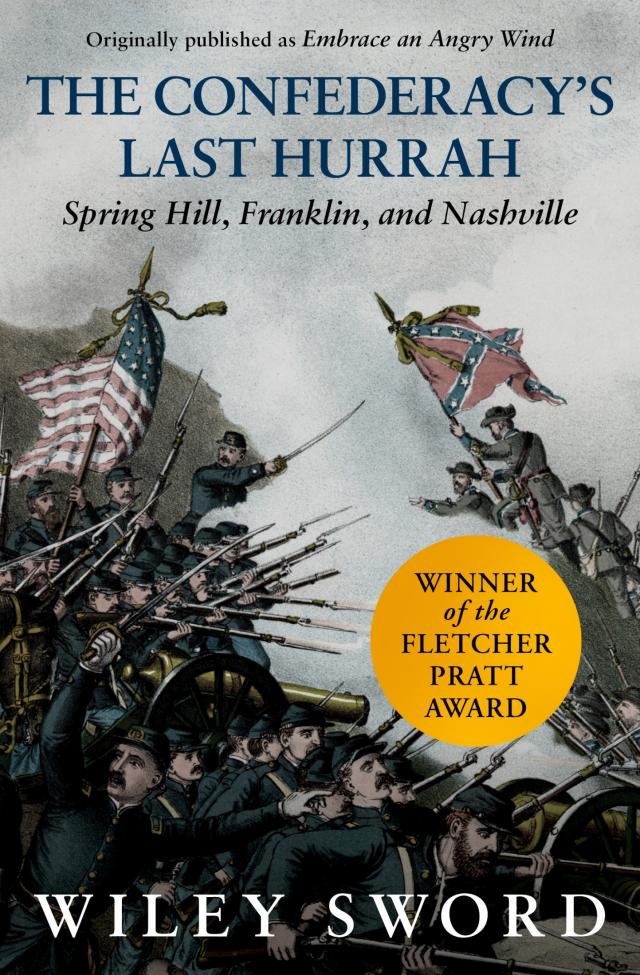
The Confederacy’s Last Hurrah
Spring Hill, Franklin, and Nashville
Wiley Sword
In memory of my father,
Winfield E. Sword, 1905–1985
Within his soul tossed a certain restlessness, like the gathering ripple of a morning breeze across the meadow grasses.
For he endeavored, by climbing that one additional step, to see what was beyond—and how far two uncertain legs might carry him.
Despite life’s hard knocks he remained a compassionate man, as beneath that worldly facade he understood our common clay.
He was considerate and giving, knowing that all want of others, if only for understanding.
Although his flesh is gone, his spirit endures. It burns brightly within me, and will remain with my children and in their offspring for time eternal.
CONTENTS
Preface
I. A Sharp Wind Is Blowing
II. A Cupid on Crutches
III. Dark Moon Rising
IV. The President’s Watchdog
V. Too Much Lion, Not Enough Fox
VI. Affairs of the Heart
VII. Courage versus Common Sense
VIII. Words of Wisdom
IX. Who Will Dance to Hood’s Music?
X. Old Slow Trot
XI. In the Best of Spirits and Full of Hope
XII. Playing Both Ends Against the Middle
XIII. The Spring Hill Races
XIV. Listening for the Sound of Guns
XV. A Hand Stronger than Armies
XVI. Do You Think the Lord Will Be with Us Today?
XVII. One Whose Temper Is Less Fortunately Governed
XVIII. Tell Them to Fight—Fight like Hell!
XIX. The Pandemonium of Hell Turned Loose
XX. Glorified Suicide at the Cotton Gin
XXI. Where Is the Glory?
XXII. There Is No Hell Left in Them—Don’t You Hear Them Praying?
XXIII. The Thunder Drum of War
XXIV. Forcing the Enemy To Take the Initiative
XXV. Gabriel Will Be Blowing His Last Horn
XXVI. The Sunny South Has Caught a Terrible Cold
XXVII. Let There Be No Further Delay
XXVIII. Matters of Some Embarrassment
XXIX. Now, Boys, Is Our Time!
XXX. I Shall Go No Farther
XXXI. Mine Eyes Have Seen the Glory
XXXII. Where the Grapes of Wrath Are Stored
XXXIII. Crying Like His Heart Would Break
XXXIV. A Retreat from the Lion’s Mouth
XXXV. The Cards Were Damn Badly Shuffled
XXXVI. The Darkest of All Decembers
XXXVII. Epilogue: The Twilight’s Last Gleaming
Image Gallery
Order of Battle, Confederate Army of Tennessee
Order of Battle, Federal Army
Reference Notes
Bibliography
Acknowledgments
About the Author
Index
PREFACE
The American Civil War, long recognized as perhaps the nation’s supreme crisis, endures today in the minds of many, reflecting a fascination that recalls past glory and manliness; it was an adventure of the greatest magnitude. In large measure, the great disunion crisis has been extensively portrayed as a heroic war, the first of the modern and last of the romantic conflicts. It freed the slaves and saved the Union. There was an abundance of brilliant leaders on both sides; Robert E. Lee, “Stonewall” Jackson, U. S. Grant, and William Tecumseh Sherman are household names, even today. If many of their men fought and died, it was in essence a worthy death, suffered in the cause of liberty or a cherished ideal.
Popular history has a way of obscuring some of mankind’s ugliest scars, as a matter of both perspective and proportion.
Perspective reflects little more than the interpretation of reality. Yet perspectives generally vary from reality, because they incorporate attitudes, largely influenced by the extent of our experience and knowledge. Historical proportion is equally difficult to grasp. It involves somewhat of a refined perspective, incorporating balanced judgment, knowledge, and perception.
Today we endure as a society extensive tragedy much as a daily routine. We despair at the death of several hundred persons in the crash of a commercial airliner, or the loss of individuals in a fatal fire or gruesome highway accident. The pages of newspapers are filled with accounts, and countless hours are devoted to investigating, reporting, and explaining these varied disasters. It is entirely proper that much public attention is focused on such incidents, if only to learn from particularly calamitous mistakes. Yet as a matter of proportion all such tragedies pale in comparison with the American Civil War. Then it was not hundreds of casualties that lay stricken on various sites across the nation, it was thousands.
Of the more than 2.5 million men who fought in the Civil War, about 620,000 lost their lives. As statistics, these numbers are so intimidating that the essence of the personal meaning is often missed. Imagine one of our largest football stadiums—the Rose Bowl, for example—filled to capacity. If every single person in the crowd represented an American who died in the war, it would take more than six entirely full Rose Bowl Stadiums to hold the extent of our Civil War dead. Or, if each dead American from the Civil War were laid end to end, theoretically they would stretch beyond the distance from Chicago, Illinois, to Atlanta, Georgia.
Yet even these figures are misleading as a full measure of tragedy, for beyond these deaths were the more than 500,000 additional men who were shot but survived, many suffering the amputation of arms or legs. The proportion of tragedy is staggering. It was the costliest war as measured by American deaths in our nation’s history. In fact, the total of American military deaths from all other wars combined barely exceeds the total of our Civil War dead.
As a matter of perspective, however, these grim statistics are perhaps the less important part of the story. It has been estimated that within the Confederate army the average individual was shot, stricken with disease, or otherwise disabled six times during his term of service. In personal terms, this meant suffering of unprecedented levels. To the common soldier, often in his early twenties with his health at its most vigorous peak, participation in the Civil War was really a continual test of survival. It was an arduous task just to cope with the ongoing challenges of the battlefield, unsanitary camp conditions, and infectious outbreaks of disease. Moreover, due to the difficult communications of the era, these men often endured their ordeal without full public awareness or understanding of their extraordinary plight. Even their own leaders often failed to grasp the personal meaning beyond the military results. That is why many veterans, both blue and gray, who saw and suffered were drawn together after the war in a common bond; only they truly knew what it was like. They were the ones who had paid in pain and torment. This was the hidden side of the war, the personal insight that came only from experience. Try as one might, there was no way to adequately convey in personal terms to another who was not there the full meaning.
At Franklin and Nashville, two of the most devastating personal experiences of the American Civil War, the superficial accounts both contemporary and in later memoir form were inadequate to fully depict one of the most extraordinary and compelling of human experiences. Lost forever was the full experience as witnessed by the participants. Today we can only approximate their ordeal and estimate their emotions. Yet, from a technical perspective, the historian has the advantage of utilizing source material not readily available at the time, and relating the part to the whole in analytical context. What emerges is an approximation of the reality, as carefully reported and crafted with as much verisimilitude as the recorded facts allow. Were any of the veterans alive today to read this account, they would undoubtedly learn of events and incidents which as individual participants they had missed.
Fortunately, the story that emerges today through comprehensive research is quite clear and detailed. It is a powerful tale, one worthy of being remembered as a particularly revealing episode of the sacrifices endured in our nation’s past. Though long obscured and often overlooked, it is a tragic and important story, one of the most dramatic of the American experience.
In fact, the invasion of Tennessee in the winter of 1864 may have been the dramatic pinnacle of the American Civil War. To draw a historical parallel, the battles of Franklin and Nashville may well represent the Civil War equivalent of the World War II atomic bombing of Hiroshima and Nagasaki. As surely as the nuclear devastation of these two Japanese cities led to the surrender of Japan, the destruction of the Confederate Army of Tennessee became the real basis for the demise of the Southern Confederacy. With the devastating loss of the Confederacy’s second most formidable army, not only was one of the most vital productive regions of the Deep South stripped of essential military protection, but thereafter an overwhelming concentration of Northern armies was imminent against Robert E. Lee’s Army of Northern Virginia. The Confederacy had suffered a fatal wound. It was an end to reasonable hope for Southern independence. What had begun as a bold campaign, an invasion to restore a disastrously lost military balance, had instead become an ultimate disaster.
Beneath the surface of this all-perva
Today these compelling events reflect a uniquely astounding American story. More than 125 years after the tragedy it is as yet difficult to write about—not in recounting the events, but in conveying an essence of the full meaning, from the emotion of the moment to the anguish that followed.
May we therefore consider the uneasy silence of the long-ago dead and remember with understanding their deeply moving ordeal, one that forever changed a generation and its legacy.
WILEY SWORD
Birmingham, Michigan
CHAPTER I
A Sharp Wind Is Blowing
I
The weather, noted a longtime resident of mid-Tennessee, was absolutely “wretched.” It began to snow briskly by midmorning. At least half an inch of snow carpeted the frozen ground before noon. Adding to the misery was the wind, sharp and cutting, which blew directly from the north. The freezing temperatures, the rough, nearly impassable roads—rutted and scarred by nearly two weeks of rain—and the icy wind made for a vicious, cruel day to travel, this November 21, 1864.1
Yet it was a day long anticipated, and later so well remembered. To the officers and men of the Confederacy’s Army of Tennessee this day was as much as a new beginning. That morning at dawn the men had been called to arms. Their regimental commanders had told them of the forthcoming offensive: they were going into enemy-occupied country, into Tennessee, they said. The army would leave its present camp near Florence, Alabama, and march in the direction of Nashville. There would be a lot of hard marching and some fighting ahead, so it was presumed. Yet their commanding general had assured them that there would be little risk of defeat. He would not choose to fight a battle in Tennessee unless the advantage was all on their side—where the numbers were no worse than equal, and the choice of the ground was theirs. If only they could at times endure short rations they might earn a redeeming victory over the despised enemy.2
The great invasion thus had begun. Slowly, ponderously, the army had arisen from its scattered camps and pushed north. By sunrise that frigid morning most of the regiments and artillery batteries were in motion. A spirit of confidence prevailed throughout the army. “The ground is frozen and a sharp wind is blowing,” noted an observer, “but as my face is towards Tennessee, I heed none of these things. God in mercy, grant us a successful campaign.”3
Soon thereafter the state line between Alabama and Tennessee was reached. Here there was a sign, crudely made, that some soldier had fashioned and hung over the road. It read: TENNESSEE, A GRAVE OR A FREE HOME. Nearby, the exiled Confederate governor of Tennessee, Isham G. Harris, shook hands with the army’s commander and bade him a formal welcome to the state. Everybody seemed to agree that it was an affecting scene, and optimism prevailed among the men, many of whom were once again returning to their former homes.4
Less than fifty miles away at Pulaski, Tennessee, an apprehensive and fretful Federal private, noting the forbidding and ominous weather, wrote in his diary: “This is a very rough day, [it has] snowed and blowed all day.” He had spent the morning on picket duty, and in the afternoon there was word of an impending move. Said one of his division’s brigade commanders at the time: “The Rebels have been threatening for some time to transfer the war to the banks of the Cumberland and Ohio [rivers], and I should not be surprised if they attempted it. They seem disposed to cross the [Tennessee] river now, but … if they try this new move they will find it hard to get back to Georgia and Alabama.” Noting that the Union army had been at Pulaski for about two weeks and was well fortified against attack, he concluded that the enemy might think “that he will catch us now with a small force, and try to carry out a favorite purpose to transfer the war to the [Kentucky] border.” Should this happen, he continued, the Rebels would be greatly mistaken, for the Union forces would soon have “an army of 70,000,” enough to whip the Rebels “and have something to spare.”5
II
The Confederate genesis was desperation. By the autumn of 1864, the Civil War was nearly lost for the Southern Confederacy. The great hope of Southern independence burned ever lower, flickering like a solitary candle in the gathering breeze.
Despair in the South had progressively risen to full tide. Prospects for a negotiated peace had died aborning. The Lincoln administration had denied the Confederacy’s peace initiative by declaring that the only basis for negotiations would be an unequivocal return to the Union and the emancipation of slaves, both unacceptable conditions to Southern leaders. Any beneficial foreign recognition of the Confederacy was stalled in the resolutions of neutrality that had followed the failure of “cotton diplomacy,” and military reverses such as Antietam and Gettysburg. Even the prospect of Abraham Lincoln’s defeat by the “Peace Democrats” in the general election of 1864 had proved unrealistic. Heavy recruitment of new Union soldiers to replace the veteran regiments whose three-year term of enlistment was expiring was in full swing.6
The South’s politicians thus seemed more outspoken, and talked increasingly of the North’s overwhelming resources in manpower and materials. Nearly three million men comprised the North’s total military strength; little over one million might be counted on to serve for the South. On the actual rolls at the beginning of 1864 there were about 860,000 Union soldiers, whereas the South had only 481,000 military men. Now, in November 1864, the disparity was even greater—about 950,000 Federals, and perhaps 450,000 Confederates.7
In material resources the perspective was equally grim. Prior to the war, almost 90 percent of the United States’ industrial firms were located in the North. Two states, New York and Pennsylvania, each had more industrial capacity than the entire South. More than 92 percent of the prewar nation’s gross national product of $1.9 billion originated in the Northern states. The agrarian South had too much cotton and too few guns in 1861. In 1864 the circumstances had changed. Said Confederate President Jefferson Davis in an impassioned speech that year: “Once we had no arms, and could receive no soldiers but those who came to us armed. Now we have arms for all, and are begging men to bear them.” The North’s overwhelming numbers, their seemingly inexhaustible resources, even their technology—repeating rifles and ironclad warships—after more than three exhausting years of warfare seemed to be an insurmountable obstacle. Or were they? Davis and various other war leaders still exuded optimism.8
The essential basis of survival for the Southern Confederacy in late 1864, the Southern military leaders foresaw, was not military conquest, it was at best a prolonged standoff. Demonstrating to the Northern public their government’s folly in maintaining an unwinnable and unpopular war, exacerbating its costliness and catering to the profound longing for the war to cease—this was the sole remaining practical means of independence for the South.
The will to win, or at least to persevere until the object was gained, combined with dwindling if yet adequate resources in men and materiel, might yet enable the South to weary the populace of the North into abandoning the struggle. “This Confederacy is not yet … ‘played out,’” intoned Davis. “Say not that you are unequal to the task.… I only ask you to have faith and confidence.”9
It was an interesting thought: that the will of the people, unless broken, could see the Confederacy safely through all of the imposing obstacles. “Brave men have done well before against greater odds than ours,” said Davis in urging a heightened effort. Stating that “two-thirds of our men are absent [from the army]—some sick, some wounded, but most of them absent without leave,” the president admonished, “If one-half the men now absent without leave will return to duty, we can defeat the enemy.” It was the battle for the minds and will of the Southern people that Davis foresaw as the key to overcoming the present adversity. The resolve of the populace at large, their morale and perspectives, would be either the means of sustaining the cause or the basis for ultimate defeat. How the Southern people saw the war would determine the further effort they would make.10




