Alien hostiles, p.13
Alien Hostiles, page 13


He’d long since decided he didn’t care how it worked, so long as it did. It would have been unfortunate indeed if the Big-H’s crew had become old men and women by the time they decelerated into the alien system.
“Another star . . .” Dr. Dennis McEwan said, his voice betraying the emotion he was feeling.
“You weren’t on board when we visited Zeta Retic, were you?” Groton asked.
“No. I was attending a conference at Darkside.”
“First time out of the solar system?”
McEwan nodded.
“You’ll get used to it.”
“I doubt that. I doubt it very much. I’m an astronomer . . . and to actually see what I’ve been studying close-up for the first time in my life . . .”
Groton had already gone through the stats for this star. Aldebaran was a red giant somewhat cooler than Sol, a class K5 III star. Its diameter was some forty-four times greater than Sol’s, with a luminosity shining four hundred times brighter.
Groton and McEwan watched the hot-glowing ember of a star from Hillenkoetter’s forward observation deck. They were still a considerable distance out from the star—about a hundred AUs—and Aldebaran was a dazzlingly bright orange point of light, its disk only just barely discernable at this distance.
“So I gather there’s at least one planet?” Groton asked.
“One that we know about,” McEwan replied. “It’s a real monster of a gas giant at one point five AUs out. That’s one and a half times the distance from Earth to the Sun.”
The man had a tendency toward didactic fussiness which made Groton smile. “I do know what an astronomical unit is, Dr. McEwan.”
“Oh, yes. Of course.”
“How big is . . . Aldebaran b, is it?”
“Yes . . . at least until someone gets around to giving it a real name. It’s about eight times the mass of Jupiter.”
Groton pursed his lips in a low whistle. “That’s big, alright.”
“Yes, a real giant. An orbital period of 629 days. And it’s hot; its temperature of equilibrium is estimated at something over 2,200 degrees Fahrenheit, definitely not a good place for life-as-we-know-it.”
“So you don’t think that’s a candidate for Daarish?”
“Not unless your space Nazis brought their refrigerated underwear and plenty of ice for their schnapps.”
“So how do we find the planet the Talis told us about?”
“The astronomy department is working on it now, Captain. We’re taking photos of the background star fields, thousands of them. As the ship moves deeper in-system, we take repeat shots of the same areas, covering the entire sky, and then let a computer match them all up. Any point of light that appears to shift or jump a bit from one image to the next is a planet or an asteroid, moving because of parallax. Anything that stays put is a star.”
“That’s how they first spotted Pluto, wasn’t it?”
“More or less. Percival Lowell compared hundreds of photographic plates, but he didn’t have a computer back in 1930 to do the drudge work. He did it all by eye.”
“Just so we find it.”
“You sound worried, Captain.”
Groton shrugged. “I’m concerned that we haven’t picked up transmissions from the ships that are already here. That should already be here.”
Three Solar Warden cruisers—Samford, Carlucci, and Blake—had been sent on ahead to Aldebaran to await Hillenkoetter’s arrival.
“Space Nazis?”
“Ha. I doubt it. We might just have beaten them here. What I’m worried about is the possibility that for some reason those ships didn’t complete the trip. Something could have happened to them on the way.”
“To Samford, Carlucci, and Blake?”
Groton shrugged. “Don’t know. Or maybe their time distortion was just out of sync.”
“You’re saying we might have passed them on our way here?”
“It’s possible. We were cranking along pretty good. It’s even possible that we arrived here before they left from Zeta Retic.”
“That’s a bit spooky, thinking that right now, this instant, the Hillenkoetter is still at Zeta Reticuli.”
“Welcome to the wonderful world of time travel,” Groton said, his face sour. “Of course, words like now don’t really apply in relativistic considerations. And time travel scrambles things even more.”
“I am aware of the intricacies of basic relativity, Captain. It’s part of my job description.”
“Touché.”
They stood together a moment more, watching the orange gleam of the giant star. In the distance, the cruiser McCone hung against a splash of stars. That roughly V-shaped asterism was the open star cluster called the Hyades, the nearest such cluster to Earth, and one of the best studied. From Earth, that cluster appeared to include the bright star Aldebaran, but that was an accidental alignment. The Hyades were 153 light-years from Earth . . . but only eighty-eight light-years from Aldebaran, so they appeared considerably brighter here, and covered a larger swath of the sky.
Sol lay in the opposite direction, at his back . . . dimmed by distance to naked-eye invisibility. The thought left Groton empty. At Zeta Reticuli, the Sun had still been visible as a star in the sky . . . albeit a very faint one.
Groton shook off the mood. “I gather we’re going to be searching for our target planet in Aldebaran’s habitable zone,” he said. “That’s gonna be . . . what? A couple of billion miles out?”
In the Sol system, the Earth orbited within the Goldilocks zone, a band stretching roughly between eighty-million out to a hundred forty-million miles from the Sun, a region neither too hot nor too cold and where water remained liquid. At Aldebaran, this habitable zone would be broader, and considerably more distant from its star than was Earth.
“Anywhere from one and a half out to three billion miles, Captain. Those’re very roughly the distances of Uranus and Neptune back home.”
“Wow.”
“But the habitable zone doesn’t tell the whole story. We know, from the video the Talis showed us, that this inhabited planet is a Mars-sized moon orbiting a gas giant. That giant can’t be Aldebaran b of course. The temperature there is high enough to melt solid granite, okay? But a gas giant a couple of billion miles out would be in temperate surroundings . . . and we’ve also learned in the past few years that the moon of a gas giant can be kept warm by tidal flexing with its primary. Europa, one of Jupiter’s moons, is a good example. The surface is frozen solid, but there’s a huge ocean underneath the ice, kept liquid because of the shape of Europa’s orbit and the strength of Jupiter’s gravity. So the Goldilocks zone isn’t the whole story. We could find habitable satellites even farther out.”
“That Talis video showed a rocky planet in the background,” Groton said. “And there were clouds and open oceans. No ice.”
“So it’s probably smack in the Goldilocks sweet spot,” McEwan conceded. “But we should keep an eye out for the unexpected.”
“Always, Doctor,” Groton said with feeling. “Always.”
Eventually, the astronomy department picked out a total of ten planets among the background stars. Closing in, there were three small, rocky worlds baked under that hellish sun. The rest were gas giants ranging in size from a little smaller than Neptune up to the titanic Aldebaran b. Two of those gas giants appeared to lie within Aldebaran’s habitable zone, though the outer of the two was on the very edge and was expected to be locked in ice.
Hillenkoetter and her escorts moved toward the nearest of those two worlds, the outer one, a planet slightly larger than Jupiter with broad, bright rings. Telescopes on board the Hillenkoetter could easily discern a swarm of moons about the world, strung out like pearls along a tight-stretched string. And some of those moons clearly had atmospheres.
Duvall, however, had little interest in the planet or its coterie of satellites. He was on his knees in his cabin’s small head, worshipping, as the expression had it, the great porcelain god. His head was pounding, his stomach cramping, and his bowels in such an uproar that he wasn’t sure, from moment to moment, which end to point at the toilet.
“Jesus, Double-D,” Lieutenant Barnes said from behind him. “How the fuck did you get so messed up?”
For answer, Duvall retched several more times over the toilet, but nothing was coming up. He was, he decided, flat-out empty.
Barnes had come over to find out why Duvall had missed inspection that morning, a minor ritual carried out from time to time to remind one and all that they still were part of the US military. Missing it meant being written up unless you were dead or in sick bay. Duvall, however, had not been able even to think about sick bay. He wasn’t dead . . . not yet . . . but at the moment, he fervently wished that he was.
“You want me to get a corpsman?”
“No,” Duvall managed to say. “No . . . I’ll be . . .”
He started retching again.
“Ri-i-i-i-ight,” Barnes said. “Anderson wrote you up, you know. You’re gonna have to go up to see the Man.”
Duvall continued to worship the interior of the toilet bowl as Barnes turned and left.
Never again. . . .
That starshine whiskey had gone down real good a few weeks earlier, at the start of this deployment . . . good enough that Duvall had gone down to engineering and purchased another quart. He and Cotter had shared it last night; Bucky had opted out, and clearly she was leading a charmed life because nobody deserved to be fucking hungover like this.
He didn’t remember being this hungover last time. Had those bastards done this batch up differently? Maybe tapped off from the first batch through, with plenty of methanol for seasoning? Well . . . he wasn’t blind and he wasn’t dead. Not yet.
Again, he just wished he were.
The door to his quarters chimed again, but he couldn’t get up to answer it. A moment later, someone entered the bathroom.
“Double-D!”
It was Bucknell.
“Hey . . . Bucky,” he managed.
“What the hell happened to you?”
“Little . . . too much to drink last night.”
“That’s what I heard.”
“Glad you weren’t . . . here.”
“You and me both. Here. I brought you something.”
“Whazzat?”
“Doc Marlow gave it to me. Here . . . put this on.”
She placed a plastic and rubber mask over his mouth and nose. He held it in place as she turned the wheel on a small silver bottle under her arm.
“Breathe deeply.”
Unwilling, or unable, to argue, Duvall did as he was told. He felt the cool pressure of gas, and took it in. Miraculously, his pounding headache faded to a dull roar almost at once.
“What is this?”
“Pure oxygen,” Bucknell replied. “Doc said it’s absolutely the best thing for a hangover. He, ah, kind of assumed that that’s what the problem was.”
“Doc is psychic,” Duvall said. His stomach was still knotted, but the violent nausea was fading with the headache. His eyes were focusing better, too.
“This is some kind of miracle cure, right?”
“No . . . and we don’t want you to loop out on oxygen.” She turned the wheel, shutting off the flow. “But that should at least get you on your feet again.”
“Okay. Why?”
“Because we’re being scrambled, flyboy. We’re going out on a mission. And we need you. Now.”
Thirty minutes later, Duvall and Bucknell were tucked into their F/S-49 Stingray fighter, a wingless, tailless diamond just forty feet long equipped with a sleekly streamlined hellpod slung beneath the matte-finish belly. They’d slipped out through the double magnetokinetic induction screens that maintained atmosphere inside the ship’s hangar bay and now were falling into line with eleven other fighters from SFA-05, the Starhawks. Stars wheeled across an endless black sky as they rotated into the assigned alignment; to one side, Hillenkoetter filled much of that sky, a thousand-yard-long dark gray cylinder, featureless save for five geodesic blisters around the nose, five more at the tail, plus the wide, flat opening amidships of the hangar bay.
Duvall was still cranking along at less than a hundred percent, but at least he was where he needed to be.
“Okay, chicks,” the voice of Lieutenant Commander Hank Boland called over the squadron’s tactical channel. “They’re downloading course and nav data into your systems now. We’re on ROE Yellow. Don’t leave formation, and don’t shoot at anything unless it shoots at you. Acknowledge.”
“Five, copy,” Duvall said as soon as Starhawk Four had checked in. He checked the data coming in over his main screen; he’d missed most of the damned preflight—another ding on his combat status board—and was playing catch-up.
“You okay, Duvall?” Boland called over a private channel. The fact that he used Duvall’s name rather than his handle meant that he was pissed, and then some.
“Doing okay, sir. Thanks for asking.”
“Not doing it for you, mister. You let the squadron down this morning, and trust me, it’s gonna come out of your hide.”
“Copy that.”
There was no sense in arguing . . . or in making excuses. When caught in especially egregious behavior, it was always best to reply with a taut and professional “No excuse, sir.”
He was under no illusions about the seriousness of his position. Being written up meant he would get to explain himself to Hillenkoetter’s CAG, the CO of all aerospace assets on board. He would be charged, at the very least, with being AWOL, negligence, and being drunk while on duty . . . and possibly with dereliction of duty as well.
He could very, very easily lose his flight status, and it might go worse than that.
Hell, they might even nail him with destruction of government property . . . meaning, by that, his own body, which technically belonged to the government for the duration of his career.
Shit . . .
That government property was actually doing fairly well now, though he was still feeling pretty muzzy. Doc Marlow’s miracle cure had indeed worked wonders. Duvall had heard of using pure oxygen to clear up a bad hangover, but never experienced it for himself. He was going to have to look Marlow up later and thank the guy. He still had a headache, but it had faded into the background and now was little more than a dull throb. The nausea was gone . . . well, mostly. So was the diarrhea, thank God. He didn’t want to even think about that while bundled up in a vac suit.
By now, his system was pretty empty, so he was good to go.
But where were they going?
According to the flight plan, the squadron was to make a close pass to a gas giant a dozen astronomical units ahead. They were to be alert for any sign of intelligence—ships, radio signals, anything indicating that the system was occupied—and they were to watch for a particular moon of the gas giant, called Daarish. There was a description of the satellite. It sounded pretty dull.
Which was fine. Duvall wanted dull at this point.
“Hey, Skipper!” Lieutenant Ann Tomlinson called. “I’ve got contacts. Lots of ’em!”
“What’s the bearing, Tommy?”
“Zero-one-zero relative. Range . . . call it fifty million miles. Closing at twelve hundred mps.”
“That’s confirmed,” Bucknell called from the back seat. “I’ve got bandits on my screen now, too. I estimate thirty bandits, repeat, three-zero bandits.”
At that speed, they would be in the middle of that swarm of targets in a bit less than ten seconds.
“Execute Plan Alfa,” Boland called. “Everyone stay tight with your wingman.”
Plan Alfa was the standard response when facing a larger number of opponents. The squadron of twelve fighters would split up into six groups of two, scattering in order to confuse and disrupt the enemy formation.
But with ROE Yellow running, they couldn’t fire until they were fired at, which sucked in Duvall’s considered opinion.
Well . . . the targets hadn’t declared themselves as hostiles. Not yet . . .
“Two more squadrons are coming up astern,” Boland told them. “Careful of your targets.”
Good. That would even up the odds a bit. But Duvall wondered what capabilities these oncoming aliens might have. A single Reptilian ship would make short work of Hillenkoetter’s entire fighter complement.
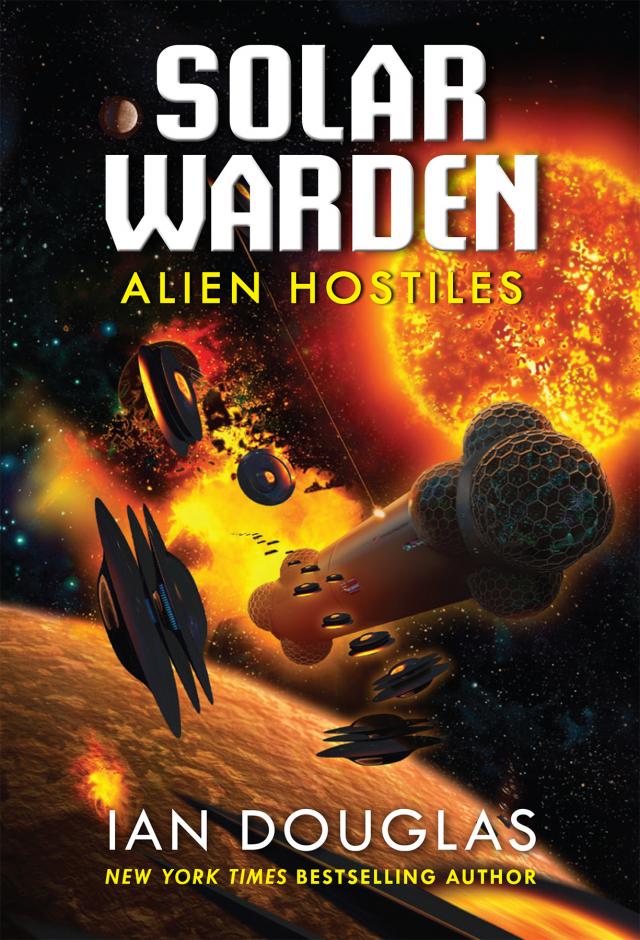
And then the alien ships were decelerating hard, matching course and speed with the Starhawks with graceful ease. One of the alien ships passed only a few hundred yards in front of Duvall’s Stingray.
“Shit!” Kolinsky yelled over the squadron channel. “Will ya look at that!?”
Months before, the Starhawks had been briefed on the possibility of German bases or colonies at Aldebaran, as unlikely as that seemed. They’d been shown possible designs for German fighter craft based on plans and blueprints captured at the end of World War II, and these matched. They even bore the Balkenkreuz roundels of WWII Nazi aircraft and armored vehicles . . . and they were reminiscent of the old Haunebu saucers supposedly built with alien help almost eighty years before.
Nazi spacecraft . . .
The whole idea was so ludicrous that Duvall almost laughed out loud. It would have been hilarious, he thought, if the situation wasn’t so deadly serious. The squadron was outnumbered by spacecraft that appeared to be at least as maneuverable as the human Stingrays.
“Hey, Skipper?” That was Kolinsky. “They’re not shooting at us!”
“Hold your fire, people. Let’s see what they do.”
The saucer pacing Duvall’s Stingray swerved suddenly, cutting directly in front of him, forcing him to cut his velocity to avoid a collision. “Shit! One just tried to ram me!”
“Fuck, they’re everywhere!” Tomlinson called out.
“I get the idea they don’t want us here,” Lieutenant Rodriguez added.
“Yankee go home,” Kolinsky said.
You come with us . . .
Duvall blinked. Who’d said that?
You come with us . . .