Alien hostiles, p.14
Alien Hostiles, page 14


He tapped the side of his helmet, wondering if his receiver was screwy. Or had the damned hangover left him hearing voices . . . ?
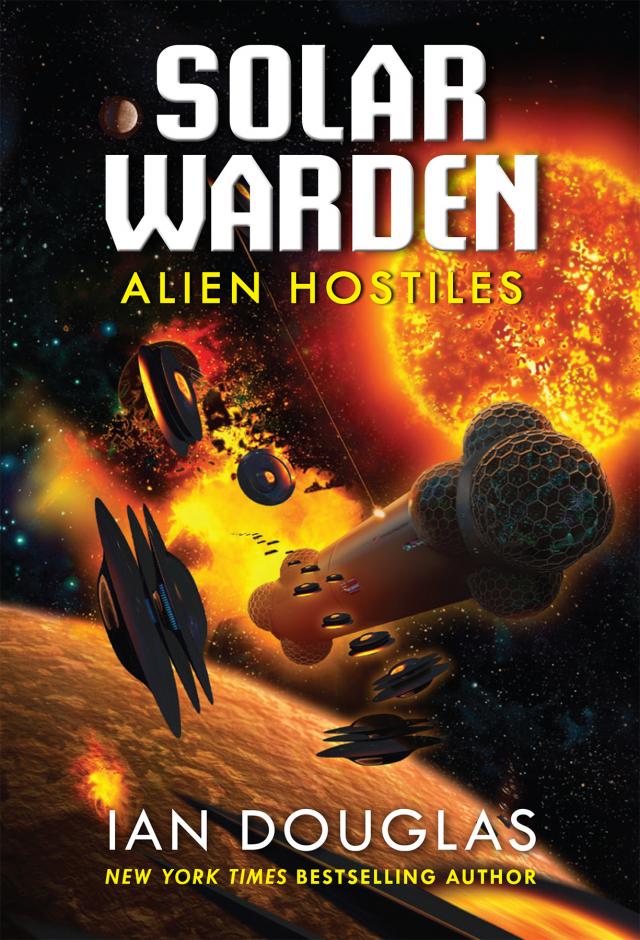
Two by two, the Stingrays of Starhawk Squadron were dropping onto a new heading, one plunging straight toward a bright planet in the distance.
“We’re following them to the planet,” Boland said.
What the hell? Duvall was still a bit foggy from the aftereffects of his drinking binge. He could feel something entering his mind, something cold and sharp and metallic . . . but then it kept sliding away, as though it was trying to get hold of him, and failing.
He’d heard that the Saurians spoke with humans through telepathy. Commander Hunter had discovered that during his op on Zeta Retic, and he’d heard the briefing afterward. Could they also exert some kind of compulsion, mind to mind? Make humans do things they wouldn’t normally do . . . ?
You come with us . . .
“The hell I will.”
An alien saucer was flying just a few hundred yards in front of him, as though trying to force him off course. A tone sounded in his ear, indicating a solid lock . . .
Duvall pressed the firing button on his control stick, loosing an AMRAAM at near point-blank range. “Fox Three!” he yelled, the NATO code for the launch of a radar-guided missile.
Twelve feet long and massing 335 pounds, the AIM-120 missile was due to be phased out of service soon, but it was still both efficient and deadly. Sliding off his launch rails, the missile arrowed into the alien spacecraft. The fifty-pound warhead detonated in complete silence, a brilliant flare of yellow and orange light blossoming against the saucer’s rim. The blast flipped the enemy ship end for end, putting it into an out-of-control tumble as Duvall accelerated past it. Bits of debris pinged off his Stingray’s hull . . . and then he was past, changing course to put him on the tail of another enemy vessel.
Tone . . .
“Fox Three!”
The second saucer broke apart under the violence of the AMRAAM’s touch.
Another enemy ship crowded close, mounting weapons turrets on top of its dome and underneath as well. Streams of fire, like tracer rounds, reached out for Duvall across the intervening gap, and he rolled his Stingray hard to the left, dodging the volley. Had that been some kind of laser, he would have been dead now. The enemy saucers were packing some sort of projectile weapon in top and bottom turrets.
He didn’t want to find out what those rounds did when they hit.
A general firefight had broken out across the sky, the sort of close-in knife fight fighter pilots called a furball. The saucers had opened fire when the unofficial truce had collapsed, and the human pilots were fighting back now with every weapon in their arsenal. Two more of the enemy craft exploded . . . but three Stingrays were hit as well, hulls ripped to pieces by high-explosive Gatling barrages from the enemy gun turrets.
And the enemy’s superiority in numbers was starting to tell. The human Stingrays had been strung out in a long line, making them vulnerable to attack from every side. It wouldn’t be long, Duvall thought, before the human squadron was utterly overwhelmed.
“Fox Three!” He shot another AIM-120. Only one left in his missile bay now. He watched his shot closing with the target . . . then at the last moment veer wild and miss. His cockpit instrumentation was no longer registering target locks; somehow, the enemy was managing to make themselves invisible to radar.
He switched to lasers.
The Stingray mounted two side-by-side high-energy pulsar laser weapons in its nose, designed to fire either microsecond pulses or single, continuous beams. However, this method came with complications—to do any real damage, Duvall needed to hold the beam on the target long enough for thermal shock to blow out a chunk of hull, and that was damned near impossible in the twisting, turning furball of a space dogfight.
Engaging with rapid-fire pulses was a little better. He still needed to land several shots in the same target area, though, to cause enough damage to achieve a burn-through, and that was damned hard to do.
“Targeting!” Duvall called. He lined up on an alien saucer and fired, sending a long stream of light pulses toward the target. White light dazzled off the alien’s rim just above a prominent Balkenkreuz, but the craft tipped over and accelerated, sliding clear of the volley.
Damn, how were they supposed to play this?
“Watch it, Double-D!” Cotter, his wingman, called. “You’ve got two on your six!”
He twisted in his seat, trying to see. His “six” was the area directly behind his craft, the firing line for any opposing force trying to get on his tail.
He flipped his ship end for end and there they were, two saucers with Nazi German markings a couple of hundred yards away. Since they were coming straight toward him, he didn’t need to worry about them sliding out from under his fire. He switched to beam and triggered a long lance of invisible light, watching as one of the two aliens grew suddenly brighter then exploded in wreckage and plasma.
But the other was already firing, and Duvall felt his Stingray jolt hard under multiple impacts. He tried to twist clear, but his ship was coming apart. “Eject, Bucky! Eject!”
There was a roar of escaping atmosphere . . .
And dark silence.
Chapter Nine
“I appreciate the time and effort spent in producing valuable insights into the proposal to find ways of advancing our technology and national progress and in coming to grips with the reality that our planet is not the only one harboring intelligent life in the universe.”
President Franklin D. Roosevelt, 27 February 1944
1 March 1942
Colonel Caldwell pecked away at the aging Underwood typewriter in his office, the click-click-click-ding blending with identical typewriter noise from the outer office. He was writing the report for Henry Stimson in his capacity as intelligence officer.
“We can say categorically,” he wrote, “that the object or objects seen above the city of Los Angeles on the night of February twenty-fifth were not Japanese aircraft. Additionally, we can state that they were not weather balloons or barrage balloons, given their ability to hover for long periods over the city, their ability to withstand intense antiaircraft fire, and their size. Additionally, at least one witness reports seeing a large circular object crash into the ocean a few miles south of Point Fermin, raising the possibility that the object or objects were in fact related to the crash reported at Cape Girardeau, Missouri, in 1941—”
His office door opened without a knock, and two men entered. They were identically dressed in dark suits and fedoras, and both wore sunglasses despite being indoors.
“Who are you? What is the meaning—”
One of the men held up an ID holder with a card that might have been anything, flashing it and returning it to his jacket pocket so quickly that Caldwell didn’t have a chance to read it. “Special Agent Jones, Special Agent Johnson, FBI,” the man said, his voice a monotone. “Colonel Caldwell, we would like to talk to you about the other night.”
Caldwell stood, furious. “You have no right to just barge in here and—”
“We do have the right, Colonel Caldwell. National security. Sit down, please.”
Somewhat to his own surprise, Caldwell did so. There was a distinct air of menace about these two . . . and one of intimidation.
“We understand you’re writing a report,” the second agent said. He indicated the Underwood. “Is that it?”
Before he could answer, the first man reached out and yanked the page from the carriage, read it, and handed it to his partner.
Caldwell stood up again. “Hey! That’s classified!”
“We know. How do you know about Cape Girardeau, Colonel?” the first man asked.
Caldwell very nearly said “I was there,” but he managed to stop himself. That entire matter was classified top secret. “Look, I don’t know what this is about, but—”
“We know you were at Cape Girardeau, Colonel. We have your testimony . . . and your oath of secrecy.” Very slowly and deliberately, the man crumpled the report in his hands. “And breaking that oath would be very, very bad for your career. Do we understand one another?”
Caldwell’s impulse was to argue. Who the hell did these clowns think they were?
At the same time . . .
“I was writing to the secretary of war, who has top-secret clearance. He already knows about Cape Girardeau. He brought it up, asked me about it.”
“Witnesses have testified that they saw aircraft over Los Angeles that morning,” the second agent said, abruptly changing direction. “Fifteen aircraft, probably off a Japanese carrier. Your report should reflect that . . . reality.”
“And I suggest you not discuss this so-called crash,” the other man said. “There were witnesses claiming that Japanese planes were shot down. Every such report has proven false.”
“But . . .”
“Every report. Do I make myself clear . . . ?”
In the end, Caldwell went along with the two. The fact that they seemed to know about his visit to Cape Girardeau last year, that they had the documents he’d filled out and signed at the time, convinced him that they did have authority here, even over the US Army. It seemed that someone didn’t want the more sensational aspects of this incident getting out.
But by now, Caldwell was convinced that whatever he’d seen the other night was somehow linked with Cape Girardeau.
Only later did something else occur to him.
How the hell had those two known he was writing a special report to the secretary of war . . . or that at that moment he’d been referencing the events of last April?
The Present Day
Five of the twelve Starhawks had been destroyed, though three of the pilots and two RIOs had been rescued by work/utility vessels off the Hillenkoetter. The casualties would have been much higher had the two reserve squadrons not arrived, putting the remaining alien saucers to flight.
For several hours now, work ships had been moving through nearby space, recovering debris. There were two almost complete saucers on Hillenkoetter’s flight deck now, along with several large pieces of wreckage.
“In a sense, I suppose,” Wheaton was saying, “Solar Warden began early in 1941, just before America entered the war.”
“Forty-one,” Captain Groton said, surprised. “Not forty-seven?”
They were on Hillenkoetter’s flight deck, standing in front of one of the German saucers. Beyond the bay’s force field, Aldebaran gleamed in the distance. Wheaton was there as senior intelligence officer, with Captain Groton and the ship’s CAG, Captain Andrew Macmillan, along with Doctors Brody and McClure, and Commander Hunter.
“No, sir. This was six years before Roswell. A silver disk came down in a field near Cape Girardeau, Missouri, on April 12th of forty-one. There were three beings on board—classic alien Grays—two dead and one injured. A local Baptist minister, a guy named Huffman, was called in by the town’s sheriff to give last rites. He said the Army moved in, confiscated all photos and records, and swore the witnesses to secrecy. Huffman reportedly talked about it with his family, but never told anyone else.”
“Sounds pretty par for the course,” Hunter said. “They already had their cover-up protocols in place back then?”
“Apparently so. Several deathbed confessions came out over the years, though. The crashed saucer was supposedly hauled off to Wright Field, and attempts began then to reverse engineer the thing.
“Less than a year later, six weeks after Pearl Harbor, came the so-called Battle of Los Angeles. The incident was publicly dismissed as ‘war nerves,’ but the city’s antiaircraft defenses hammered at something for three hours that morning, and there were reports of the object then moving south and falling into the ocean near Catalina.
“According to some sources, a joint Army-Navy team searched that area . . . and might have recovered something. We have several letters from Roosevelt himself discussing captured alien technology that might help with the Manhattan Project.” Wheaton grinned at them. “He didn’t want to share it with the Soviets.”
“Okay, so Solar Warden started before the war,” Groton said. “And more saucers were captured after the war. Roswell.”
“Yes, sir.”
“But these saucers are German,” Macmillan said. He banged on a section of torn silver hull for emphasis, thumping right beneath the craft’s prominent Balkenkreuz.
“Apparently so,” Wheaton said. He pointed at a line of small shapes covered by blankets a few yards away. “But so far all of the bodies have been Saurians. No humans.”
“So what the hell is going on?” Brody wanted to know. “Do we have space Nazis out here or not?”
Wheaton shook his head. “Dr. Brody, I wish I could tell you, but I’m in the dark, too. Our best guess as of right now . . . there might well have been a German colony out here at Aldebaran, probably dating back to the late 1930s. Germans would have been brought out here in Saurian ships . . . or in Haunebu craft built with Saurian help. They could have established what we refer to as a breakaway civilization, one completely cut off from Earth.”
“But that was seventy years ago, right?” Brody sounded exasperated. “All of those original colonists would be long dead by now. If the colony is still going, it will consist of the children and the grandchildren of the original colonists.”
“So?” Hunter asked. “The original bunch would have passed on their ideology to their kids.”
“Maybe,” Wheaton conceded. “But totalitarian states need a nearby enemy to keep the ideological fires burning hot. For the Nazis on Earth, that role was played by the Jews, by the Slavs, by Communists, by Poles, by pretty much everybody else on the planet once they got going full tilt. Out here? I can’t see them importing enemies. After seventy years, Earth would be damn near mythological to the newer generations who never saw the place. After a few decades, I think Nazism would have fallen by the wayside.”
“Any totalitarian state demands a lot of sacrifice and discipline of its members,” Groton said, “and that’s hard to maintain when you don’t have a clear reason to do so.”
“Interesting point, Captain,” Hunter said. “Of course . . . we are dealing with time travel here. Maybe the original generation isn’t dead after all.”
“One way to find out,” Brody said. “We go in and check out the planet.”
“That’s hardly advisable, Doctor,” Groton said. “Given that they were trying to kill us just now.”
“There is that, yeah.”
“How about a high-speed scouting run?” Macmillan said. “We load a fighter with instrumentation and cameras and send it zipping past the planet at high speed. Swing around and come back home, where we check out what it saw.”
“Might be better to send a couple of your squadrons along for cover,” Hunter said. “One ship won’t escape notice. Those saucers are fast and they’re maneuverable. I don’t think a lone ship would stand much of a chance if the bad guys saw you coming.”
“That might work,” Macmillan agreed. “And we give them orders to break off and run for home if there’s a hostile response near the planet.”
“Put together an opplan for me, Mac,” Groton said. “We’ve got to find out what’s waiting for us down there, but I will not take Big-H into harm’s way.”
“Right, Captain.”
“And I greatly wish our missing cruisers were here . . .”
“Maybe our recon run will turn something up,” Macmillan suggested.
Groton made a face. “There’s a cheerful thought.”
“Given the presence of these Haunebu-style saucers,” Brody said, touching one of the silver disks curiously, “can we assume that this system is where the Germans got their alien help in the 1930s? Saurians from Aldebaran?”
“Hardly,” Wheaton said. “The Saurians could have come in from anywhere . . . even from secret bases on Earth. We don’t know that Aldebaran is important to them at all.”
“Like Zeta Retic,” Hunter put in. “All that hype about the place being the home world of the Grays . . . and when we get there, all we find is a tiny Saurian base.”
“That’s true,” McClure said. “The Saurians—the Grays, too, for that matter—are very old civilizations. They may not even have home planets anymore, at least not as we think of the term.”
“Citizens at large of the Galaxy, huh?” Hunter said. “How very cosmopolitan.”
“I think we have to accept that both the Grays and the Saurians are everywhere throughout this part of the Galaxy,” Wheaton said. “Probably the Talis as well. And they’re not only spread out in space, but in time.”
“A Galactic empire that trades goods and ideas across time as well as space,” Hunter said. “Puts a whole new spin on the idea of trading pork futures, doesn’t it?”
McClure laughed. “It does kind of emphasize the reason that they don’t want to start a time war, though. If they already know the future and they like how it turned out, they wouldn’t want things to change.”
“Which might mean,” Wheaton said, thoughtful, “that young, ignorant, upstart species like us terrify them. We’re the bulls loose in their china shop.”
“Right now,” Groton said, “that might be our very best asset. Let’s put the fear of God in these bastards.”
When Duvall regained consciousness, he was in what felt like a hospital bed in an extremely clean, bright compartment.
“What the hell happened?”
“We got shot,” Bucknell said. She was sitting on the side of his rack, holding his hand. “We ejected. I think you hit the canopy coming out of the cockpit.”
“And how did we end up back here?” He looked around. “I assume this is the Big-H?”
“Sick bay. That’s right. I put out a distress signal, and about an hour later a work/utility boat came and picked us up.”
“An hour, huh?” Their flight suits served as space suits in an emergency, but the small O2 tanks carried only enough oxygen to keep them breathing for about ninety minutes. “Plenty of time.”