Alien hostiles, p.7
Alien Hostiles, page 7
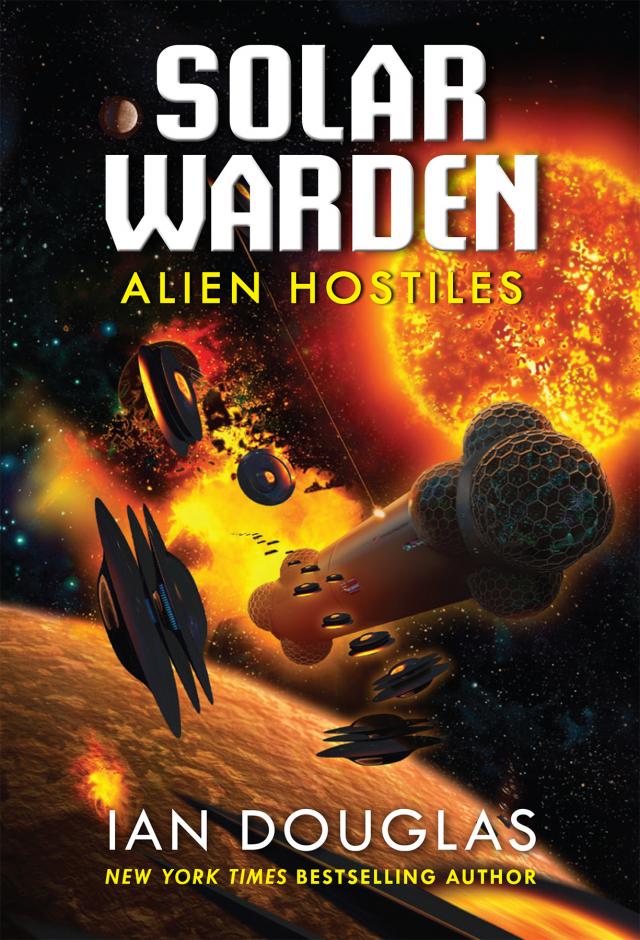


It was hard to get an idea of the thing’s size, but it felt huge . . . ponderous and massive, a mountain in space.
“It really is cigar shaped, isn’t it?” McClure said. “I didn’t think that would be possible. Not naturally, anyway.”
“It is, pretty much,” Brody observed. “There were several ideas about its shape, based on the changes in brightness as it rotated. It could have been a flattened disk . . . but that thing really is a giant cigar. I’d guess . . . what? Maybe nine hundred feet long, and maybe fifty thick.”
Hunter studied the object closely. “It isn’t natural. It couldn’t be. . . .”
“No,” Brody said. He sounded reluctant to admit it. “No, it isn’t. I can’t imagine a natural process that would create a shape like that. It could be a fragment of a collision . . . but those rounded ends just don’t look like what you would expect from an impact.”
“It does look manufactured,” Hunter pointed out.
“You know . . . an astronomer at Harvard, a Professor Loeb, suggested that it might actually be a light sail. It would have to be on the order of a few millimeters thick, and several tens of meters across. The notion was dismissed because something that thin wouldn’t tumble.”
“That thing is tumbling, Doctor?” Hunter said. “I don’t see it.”
“It’s making a complete rotation in about seven and a half hours,” Brody explained. “On two different axes. One reason we don’t think it’s . . . inhabited.”
“Maybe it’s derelict,” Hunter suggested.
“Possible.”
“Maybe the occupants don’t care,” McClure said. “Or they’re using rotation to create artificial gravity.”
“It wouldn’t generate much in the way of spin gravity,” Brody said. “Maybe a few hundredths of a G.”
“Why is it so red?” Hunter wanted to know. The rock was a dark, almost brick red, and the color appeared in uneven patches.
“Tholins,” McClure said. “We’ve found them on Pluto, on Europa, in Titan’s atmosphere, lots of places in the solar system out beyond the frost line. They’re organic molecules.”
“Life?”
“Not life, no. But possible precursors. Put them in water and it becomes a prebiotic soup that might lead to life. The stuff is synthesized by ultraviolet radiation from simpler organic compounds like ammonia and methane.”
“Cool,” Hunter said. “Surprised?”
“Uh-uh. We actually were expecting to see this. Spectral analyses of the light from Oumuamua showed the presence of organics.”
“Well, prebiotics don’t build spaceships,” Brody said. “Not until a few billion years have passed, anyway, and critters like us come along. We need to find a way to get our noses inside that thing.”
“I don’t see any way in,” McClure said.
“No. I think we’ll have to wait to see what our soothsayers have to say.”
In a darkened room somewhere within Hillenkoetter’s maze of lower decks, Julia Ashley sat alone, a pad of paper and a computer keyboard before her. She’d been given a slip of paper with a set of the target’s coordinates, somewhere in the vast emptiness outside the ship.
Her fingers flicked across the keyboard, recording . . . impressions.
Darkness . . .
She had no idea what she was “looking” at, and her training enjoined her to not analyze, not make judgments about the target.
Cold . . .
She shivered. The cold was piercing . . . biting. . . . She wondered if she was simply picking up on the bitter cold of space itself, this far out from the Sun, then cut the thought short. That was analysis. No . . . simply experience.
Wet . . .
No, not wet. Water. She had the distinct impression that she was under water. And there was a taste—strong and bitter—associated with it.
Ammonia . . .
There was something claustrophobic about the place she was in. Crushing, as though the walls around her were pressing down on her, squeezing the air from her lungs. Reaching out, she encountered hard walls all around her . . . steel . . . no, not steel.
Rock . . .
She had the impression of a huge mountain, but how did that line up with water and ammonia? No matter. She recorded the impressions and moved on. Shifting to the pad of paper, she began drawing, moving her hand almost randomly across the page as she sketched what flitted through her mind. A mountain . . . an island . . . no, that wasn’t quite it. The mountain was taller, taller, no even taller. Like a skyscraper in overall shape, but made of dark, dark rock. Red rock.
She drew what might be a skyscraper . . . but the ends were wrong. More rounded . . . like this . . . tapering at both ends. And it wasn’t in water. Water was inside it. Cold water, under a lot of pressure.
She tried again to see inside, within the wet, frigid darkness. There was something. . . .
She saw it.
No, she saw them. Millions upon millions of specks, sand grains, with legs. . . .
Specks . . . like spiders . . . billions of them. And they were flowing like water, flowing together, joining together, growing and growing and growing into a black mountain of glistening, writhing matter.
And she felt the something watching her.
She screamed.
The 1-JSST was standing to inspection, lined up in neat blocks on Hillenkoetter’s main hangar deck as Hunter and Billingsly slowly walked down each rank. They were in full kit—meaning all wore their Mark VII Space Activity Suits, or Seven-SAS, with Kevlar armor closely fitted over the metallic pressure shells. Weapons included bulky RAND/Starbeam 3000 laser rifles hooked by a power cable to their PLSS backpacks, and holstered Sunbeam Type 1 laser pistols.
Hunter noted that some of the men had unauthorized weaponry as well, picked up, evidently, during their recent liberty on Earth. Master Sergeant Bruce Layton, the senior NCO of Charlie Platoon, was holding a Mark 18 CQBR, or Close Quarters Battle Receiver, an assault weapon used by several spec-ops forces in close combat. Master Chief Arnold Minkowski, senior NCO of Alfa Platoon, had chosen a door-kicker, a Benelli M4 Super 90 tactical shotgun. He’d seen two M249 machine guns in the ranks as well.
Hunter wasn’t entirely sure yet how to respond to this rather blatant display of armaments. On the one hand, he was pretty sure Captain Groton and Hillenkoetter’s senior officers would take a dim view of slug throwers on board their vessel. After all, the JSST had been issued the laser weapons specifically to avoid punching holes in pressure hulls or delicate machinery . . . though the lasers would do plenty of damage in their own right. Also, a laser wouldn’t send the shooter spinning backward with each shot.
On the other hand, though, Navy SEALs and the other US special ops teams traditionally had a lot of latitude in their choice of weaponry. It was not unknown for team members to quietly replace their government-issued M9A1 pistols—widely viewed as lacking stopping power—with something better, like the Sig Sauer P226.
For the moment, so long as the men were careful about carrying safed or empty weapons, and so long as they could use them effectively with their bulky Seven-SAS gear, he didn’t care what kind of heat they were packing.
But he was well aware that he would need to justify that to his superiors if anyone screwed up and put a hole through something delicate.
With his inspection complete, Hunter took his position in front of the ranks. The losses inflicted on the 1-JSST at Zeta Retic still hadn’t been completely replaced. The unit currently was at a strength of forty-one men with one man, Billingsly, wearing two hats—serving as Hunter’s XO and leading the platoon. Alfa Platoon consisted of fifteen men, including himself and Minkowski.
Hunter was not in his combat suit, so he stood there with his hands behind his back. “Company . . . at ease!” he said in his best parade-ground voice. “Men, we are now on action alert. The ship has encountered the asteroid we’re supposed to check out, but we don’t yet know if we’re going to have to pull a VBSS: Visit, Board, Search, and Seizure.
“Alfa Platoon will have point,” he continued, “should a boarding action be necessary. I want all of you, however, to remain in the duty lounge, weapons and full kit handy, in case we need a full company insertion. Any questions?”
“Sir!” Marine gunnery sergeant Grabiak raised a hand.
“Grabiak?”
“Sir . . . how the hell are we supposed to get over there? What’ll we use as an AAV?”
“An amphibious assault vehicle won’t get you very far in space,” Hunter replied. “We’ll be using a 3S.”
Where the TR-3B personnel and cargo shuttle was capable of ferrying three hundred personnel at a time, the smaller, more nimble, and newly introduced TR-3S, informally called the Trash or Trash-3, was more like a high-capacity helo, carrying up to thirty men, their armor, and their weapons. Hillenkoetter carried three of them on board, and Hunter planned to have one section in each, ready to be deployed if necessary.
“Other questions?”
Another hand went up.
“Nielson?”
“Sir . . . are we gonna be fighting more lizards?”
“I don’t have the slightest idea. We’ll just take it as it comes. Others? No? Very well. Atten . . . hut! Dismissed.”
He decided to talk privately to Vic Torres, Hillenkoetter’s chief of supply. If his men were going to pack unauthorized weapons, he would need to make sure they had ammo for them—9-millimeter and 45-caliber rounds for the pistols, 5.56-mil for the CQBRs and M249s. Chief Torres was a good guy, and Hunter was pretty sure he could bring him on board with the JSST’s supply needs . . . if Billingsly or one of the others hadn’t done so already.
And until the Powers That Were told him otherwise, he would just have to hope that his men had the common sense and the discipline to keep from shooting holes in the ship.
Thoughtful, he made his way to the supply locker where his own SAS and PLSS were stowed.
“Julia? Julia! Can you hear me?”
Andrew Hargreaves bent over the still form of Julia Ashley, deeply worried. They were in Hillenkoetter’s sick bay, and she’d been strapped into a bed to keep her from hurting herself. She appeared to be unconscious, had been so since her piercing scream had brought Hargreaves into her room.
Ashley had been with the program for eight years now, and she was one of his favorites. He’d personally recommended that she be given Level 16 clearance so she could be brought into Solar Warden.
A moan sounded, but not from Ashley. It had come from a sick bay bed across the room, where Lassiter was also strapped down. Unlike Julia, he appeared to be conscious, more or less . . . but he was babbling incoherently. What had they seen inside Oumuamua, anyway?
“Black! Black! Deep in the cold water! Kitchen cleaner. Huge . . . huge . . . shrimp and nexus . . . thousand fingers . . . fingers . . . grab and squirm . . . cold . . . that horrible blind mouth. . . .”
The medical techs who’d talked to Hargreaves earlier had called it word salad, a run-on mishmash of random thoughts and images that might have something to do with what he’d experienced . . . and might not.
The doctor who’d examined them hadn’t been able to tell him if Julia would wake up, if Lassiter would recover his sanity ever again.
Julia’s eyes suddenly snapped open.
“Julia?”
“Cold,” she said. “Freezing cold and black. Black! Dots . . . specks . . . millions and millions of little specks . . . crawling . . .” “Get out! Get out of my head!”
Captain Groton steepled his fingers and looked at the others across the conference room table. What he’d just heard was disturbing. “Will they be okay?”
Dr. Carter gave a sad shrug. “I don’t know, Captain. They’ve both been severely traumatized. I think that they’re reliving whatever they encountered inside Oumuamua, like they’re trapped reliving an endless loop. It’s going to take time before we can get much sense from them.”
“Which leaves us with the question,” Groton said. “Do we try to board that thing or not?”
Seated around the table were the ship’s department heads and key personnel. The enormous ship carried only 615 crew members, but she was still a tightly knit and tightly run city in space, and close coordination among her officers was vital to the ship’s smooth functioning.
Dr. Brody shook his head. “I honestly don’t see why we should, Captain. We can take accurate and detailed measurements from here. We don’t need to go traipsing around a floating alien mountain.”
One wall of the conference room was showing real-time imagery from an external camera, watching Oumuamua outside. Somehow, it seemed to embody both mystery . . . and menace.
“Sitting out here,” Dr. McClure said, “will not help us identify the life-forms inside. Or tell us anything about their mission. Our orders, I would remind you, are to make contact with new species whenever possible.”
“Do we even know that thing is inhabited?” Commander William Haines, the XO, asked.
“My people touched something inside,” Hargreaves said. “I don’t know what . . . but they saw something, reacted to something, and judging by what happened to them, it’s something pretty damned scary.”
“Is that a vote for investigating?” Dr. Ellen Michaels said with a nervous laugh. “Or a vote for staying away?”
“I’m not sure,” Hargreaves told her with a wan smile. “I wouldn’t want to go inside that thing.”
“Could you make anything out of what your colleagues saw?” Groton asked.
“Not really, Captain. Julia seemed to be reading water over there, liquid water filling some sort of labyrinth or cavern network. She saw something. It might be large, large and dark. Lassiter has been talking about something enormous. But then, Julia is also fixated on something tiny. Little dots, little specks, all moving. And lots of legs.”
“Doesn’t sound like the same critter,” Hunter pointed out.
“No. No it doesn’t. But whatever it is, her reaction suggests that it was aware of her.”
“Is that even possible?” Haines wanted to know. “She wasn’t really over there, you know. Not physically.”
“We’ve had some Grays and Saurians become aware of our people when they were being, ah, spied on. They are telepathic, though we still don’t know exactly how that works. Maybe the Oumuamuans are the same.”
“Stargate actually spied on the aliens?” Hunter asked.
“Of course. They have several bases on Earth, underwater structures on the sea floor. They’ve had them for years . . . and they use them to spy on us. Fair’s fair, right?”
“The Saurians, especially,” Dr. Franklin Meyers pointed out. He was the ship’s xenoculturalist, the guy tasked with trying to understand alien societies. Privately, Groton wondered if humans could ever understand the culture and worldview of beings light-years removed from humankind. “Some of them seem to have an agenda, one that doesn’t necessarily have humanity’s best interests at heart.”
“The lizards?” Hunter said in mock amazement. “An agenda? Them? Nah . . .”
“What are the chances that Oumuamua represents some sort of Saurian technology?” Groton asked. “We don’t want to escalate things with them.”
“Our Talis relatives wouldn’t like that, certainly,” McClure said.
“It seems extremely unlikely, Captain,” Joshua Norton said. He was Hillenkoetter’s senior xenotech expert, fresh from the RAND Corporation offices at Santa Monica, and the man in charge of the ship’s xeno department. “Oumuamua seems to represent rather primitive technology, actually.”
“I’m not sure I would call an interstellar probe primitive,” Michaels said.
“Compared to the Saurians?” Norton snorted. “Don’t be an idiot. They have faster-than-light tech, dimensional travel, and can phase in and out of solid matter. They have time travel, for God’s sake. That’s sheer magic compared to a sublight rock drifting through space for a hundred thousand years just to make it from one solar system to another!”
“‘Any sufficiently advanced technology’ . . .” Hunter murmured.
Groton looked at him. “Arthur C. Clarke, Commander?”
“Yes, sir. His most famous aphorism.” Hunter looked thoughtful. “But it’s reminding me of Rendezvous with Rama.”
“What’s that?”
“A book Clarke wrote back in the early ’70s. Prescient, really. Astronomers on Earth pick up what they think is an asteroid, but it’s on a hyperbolic path that indicates it must be from another solar system. They visit it, and it turns out to be this cylinder fifty kilometers long, with an inside-out world inside. It swings around the Sun and heads back toward interstellar space without stopping or saying hello.”
“Sounds very familiar,” McClure said.
“Yes, well,” Norton continued, “the Saurians don’t have to muck about with spending millennia traveling from one star to the next. If I were a betting man, I’d put my money on the Oumuamuans being something completely other. Truly alien.”
“I think it’s important to remember,” Meyers pointed out, “that the Grays’ species is very old. They’re us, extending a million years into the future. They’ll have experimented with many different technologies, a million different ways of doing things. Oumuamua could be a Gray probe from some lost age within that million-year span.”
“Which doesn’t explain what the Stargate people seem to have felt over there,” Norton replied.
“Commander Hunter?” Groton said. “You want to weigh in on this? Your people are the ones on point here.”
“They’re set to go, Captain. I’m not sure how we’re supposed to get inside that thing, but we’re ready.”
“I really must protest,” Norton said, “this . . . this introduction of the military into the equation. Making contact with a new species will be tough enough without these people.”
“And if the Oumuamuans are hostile?” Groton said. “How will you protect your team?”
“Any truly advanced civilization,” Norton said, “will have evolved beyond mindless hostility.”
“You might want to take that up with the Xaxki,” Hunter said. Groton knew he was referring to the godlike—and distinctly hostile—aliens they’d encountered out at Zeta Retic. “Or the Saurians, for that matter.”