Alien hostiles, p.23
Alien Hostiles, page 23
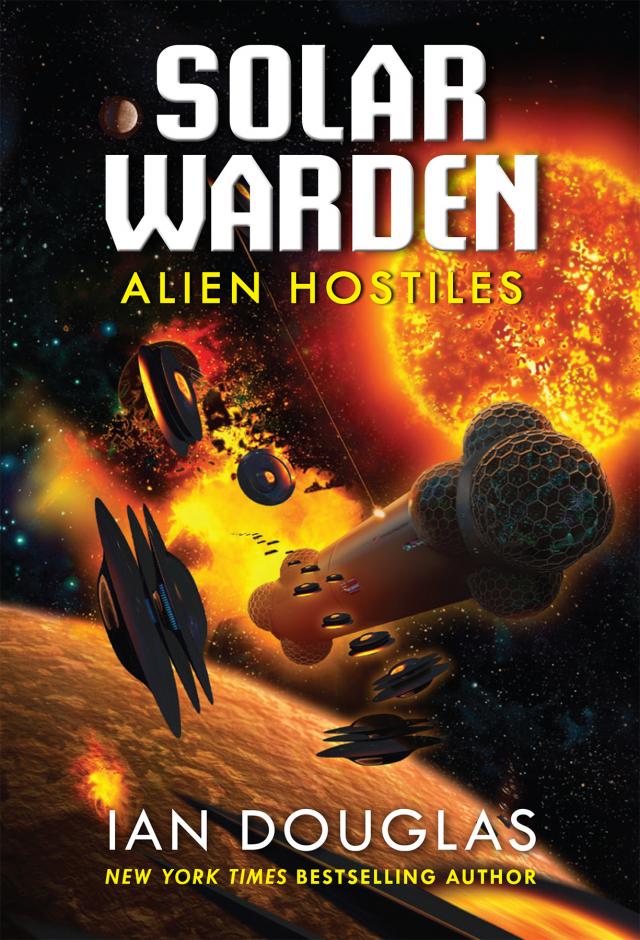


It crashed on the plain with a bright yellow flash.
“Great shooting, Skipper!” Nielson cried.
“You nailed the bugger!” Moss added.
Hunter could only stand there for a moment, his legs trembling and threatening to fold. He was no stranger to combat . . . but battling one of these things toe-to-toe went way beyond his Navy career designator code.
“What’s the bill, Doc?” he managed to ask.
Marlow was kneeling beside Grabiak. “Eight down, sir,” he said. “No KIAs. Looks like three seriously hurt. We need to get them back to the ship stat.”
“Right. Okay, people, listen up! Set up a perimeter, wounded in the middle. Watch the skies in case we get more company. Colby? See if you can raise the transport.”
“Yes, sir.”
Their trek south had brought them within a mile or two of where they’d left Duvall and the TR-3S. The transport would still be submerged to hide it from the enemy . . . but Duvall had an antenna extended above the water’s surface, listening for the team’s call. With eight people wounded, it would be a lot easier bringing the transport here for dust-off than trying to drag them all to the water’s edge . . . then trying somehow to get them on board under twenty feet of water without a personnel carrier to take them there.
“Dust-off’s on the way, Skipper,” Colby told him. “He’s homing on me.”
“How far were we off?”
“Not far. Three miles.”
“Okay.” Hunter took a long, hard look at the northern sky, looking for more flying disks coming in against the looming crescent of Charlie. Had those three that had attacked them sent a message to their base? It was quite possible they were scrambling reinforcements at this moment. Everything depended on how many flying craft they had ready for liftoff, and whether or not they knew the positions of the downed saucers.
“Black triangle inbound, sir!”
The TR-3S came in from the southeast, hugging the terrain before flaring up, hovering as its landing gear unfolded, then settling to the ground, all in complete silence. The forward ramp lowered, and the JSST troopers began carrying their wounded up and into the waiting airlock. Water was still draining from the upper deck and from the airlock, splashing into the hard sand.
“Watch for incoming, Duvall,” Hunter called over his radio. “I expect the airspace here to be pretty crowded anytime now.”
“Copy, Commander. Scope is clear right . . . uh-oh. No, it’s not. You guys better hustle. I have ten bogies coming in from the north.”
“Move it, people!” Hunter bellowed over the tactical channel. “Hostiles inbound!”
Herrera, carrying Grabiak, was moved up the ramp, and Hunter, the last man on, followed.
“Ramp up!” he called to Duvall. “Hit it!”
The TR-3S was already lifting, the ramp still down but grinding up and sealing as the transport accelerated. The inner hatch unsealed, and the team made it the rest of the way into the passenger bay, putting the most seriously wounded on the deck between them. There was a lot more room without the ARVX parked aft. Marlow continued to move among the wounded, as Moss and Nielson helped him remove helmets and peel off armor.
Grabiak looked bad. “How is he, Doc?”
“First- and second-degree burns, Commander. The gash on his chest hit his ribs but didn’t go deeper, thank God. But it looks like he got a bad dose of rads.”
“Radiation poisoning?”
“Until we get to look at him back on the Big-H, that’ll do as a preliminary diagnosis.” Marlow looked into Hunter’s visor. “How are you feeling, sir?”
He had to think about it. He’d been so focused on his team. “I’ve felt better, Doc,” he said. “Pretty bad nausea . . .”
“Well get your helmet off before you drown in your own vomit. Sounds like mostly everybody has radiation exposure to some extent.”
“Charlie’s radiation field?” His thinking was fuzzy, slow . . .
“If I had to guess, I’d say we all got zapped by a hefty dose of X-rays.”
“I thought those were harmless. People get—”
“Medical doses are too small to hurt anything, Commander. We got hit by a lot more.”
“The green light . . .”
“Yessir. Now let me work. Sir.”
Several of his people had already vomited onto the deck. Fighting his own queasiness, Hunter made his way up to the flight deck. Duvall and Zack Connors were squeezed in, side by side, working the controls.
“Thanks for the lift, Lieutenant,” he said, clenching his teeth against the nausea.
“Anytime, Commander.” Duvall indicated one of his console screens. “We have ten bogies on our tail.”
“Can you outrun them?”
“We’ll sure as fuck see.”
The sky through the forward viewscreen darkened rapidly; then a brilliant red-orange light burst through from the port side monitor as the transport’s climb brought Aldebaran above the horizon. Clear of the thicker portion of Daarish’s atmosphere, the TR-3S accelerated rapidly, turning to lock onto a green icon at the center of one of Duvall’s screens.
“They’re closing on our six, Double-D,” Connors reported. “Range six hundred.”
“I see ’em.”
Hunter sat down in the cockpit jump seat behind the pilot and strapped in. He was feeling dizzy as well as nauseated, and his skin was prickling all over his body, as if from a bad sunburn. He didn’t feel like making the long trek all the way back down to the cargo bay right now.
The sky ahead turned strange, and Hunter realized that Duvall was pushing the transport to the very limits of its capabilities, fast enough that their velocity was distorting the stars ahead. They seemed now to be hurtling toward a black void in space, with a doughnut of close-crowded stars encircling it, defining it, and taking on just the hint of a rainbow glow.
Would that be enough, however? The TR-3S could not travel faster than light, while the saucers astern almost certainly could. If the bad guys wanted, they could zip right past the TR-3S and meet them coming back from the other direction . . .
“Lieutenant!” Connors called out.
“I see ’em! It’s about damned time!”
“What is it?” Hunter asked.
“Friendlies!” he replied. “Friendly cruisers! And five of them!”
The transport was decelerating sharply now, and in another moment, Hunter could see five ships spread out on the forward screen in a broad, flattened pentagram. IFF codes flickered next to each ship—the Inman and the McCone, but there were three more as well: the Samford, the Carlucci, and the Blake.
Those last three finally had made it to Aldebaran, after weeks of being missing.
Hunter felt an overwhelming wave of relief wash through his body . . .
. . . and got explosively sick all over the deck.
“Transport is inside the defensive perimeter, Admiral,” the comm officer reported. “Captain Layton requests permission to engage alien forces.”
“Tell him negative,” Winchester replied. He looked at Groton, standing nearby. “We need the recon team’s report.”
“Yes, sir.”
Groton and Winchester were in Hillenkoetter’s CIC, along with their staff officers, several members of the science department, and Elanna, who’d finally come up from her quarters at Groton’s request. A large monitor against one bulkhead showed the five cruisers and, beyond them, Charlie and Daarish. The saucers that had been pursuing the transport were not visible.
Groton wondered what Hunter’s recon team might have found out there.
The late arrival of the three cruisers had turned out to have been somewhat anticlimactic. Samford had developed a fault in her electrogravitics at high space-time transition levels. The problem had not been serious, but it was worrisome enough that Captain Holcomb had decided to reduce the space-to-time ratio of the drive, in effect taking considerably longer to travel from Zeta Retic to here. The other two ships had reduced their temporal compression factors as well, keeping pace with the damaged vessel.
So far as Groton was concerned, the timing of the three ships had been perfect. He didn’t want to put Hillenkoetter into a major ship-to-ship engagement and risk getting stranded out here. With the cruisers in support, they had a better chance of surviving an encounter with whatever assets the Saurians possessed in this system.
There was also the small matter of weaponry. The Hillenkoetter was twelve hundred feet long and massed over 68,000 tons—about the same as an American supercarrier. Each of her escorts was closer to a Ticonderoga-class guided-missile cruiser, just under six hundred feet long and massing 8,000 tons.
But as with surface-Navy carriers, Hillenkoetter’s primary offensive power lay in her fighter squadrons. She carried lasers and particle beam weaponry, but it was designed more for perimeter defense against fighters or incoming missiles, not for slugging it out with other vessels her size. Each of the five cruisers, though only half Hillenkoetter’s length and a mere eighth of her mass, carried bigger, more powerful beam weapons as well as batteries of both space-to-space and space-to-ground missiles—AIM-120s, as well as Tomahawk cruise missiles outfitted with electrogravitic propulsion systems instead of conventional air-breathing jet engines.
He looked at Elanna, who was standing next to Winchester and engaged in sotto voce conversation with him. What did the Talis think of this face-off with the Saurians? The humans of futurity had provided tremendous help to the twenty-first-century space force, but they’d also dropped obstacle after obstacle in Solar Warden’s path, usually without explanation. When pressed, they tended to withdraw; he’d not seen Elanna since they’d left the solar system for Aldebaran over a week ago. Requests to see her, to consult with her, had been politely ignored. Groton understood that she wanted to avoid the possibility of contaminating the twenty-first century—and possibly destroying her own timeline ten thousand years on—but it was reaching the level of the absurd. If she couldn’t help Hillenkoetter’s mission, then why was she here?
And by helping modern humanity as far as they had so far, hadn’t the Talis already contaminated it?
Elanna swiftly turned and looked at him with those deep, impossibly large and expressive eyes.
You know the reason for our reticence, Captain. You will simply have to trust that we have a . . . wider view of the situation than do you.
Groton blinked. Had he . . . had he just heard Elanna’s voice in his head?
That the Grays and the Saurians were telepathic, he knew all too well. But the Talis as well? He’d not experienced telepathic links with them before this, though he supposed it made sense. The Grays communicated directly mind to mind, so perhaps this was an ability picked up long, long before Homo sapiens evolved into tiny gray-skinned elves with enormous heads.
He wondered, though, if Talisian mental powers were something evolved naturally, or created or enhanced through some sort of subtle biotechnology.
“Our Talis liaison,” Winchester said, addressing the group, “has agreed that our best course of action is to stay put and not press the Malok . . . the Saurians. She recommends that we wait until we hear Commander Hunter’s report about conditions on the planet.”
Dr. Brody laughed. “The way our recon team was hauling ass with ten Saurian saucers on their tail,” Brody said, “kind of suggests our commander found trouble!”
“We should wait and see what kind of trouble, Doctor,” Groton said. “And just how much of it.”
“How do we know the Saurians aren’t bringing in reinforcements?” Commander Wheaton asked. “They must have bigger and better warships than those Haunebu saucer things.”
Groton was still looking at Elanna. “How about it, Elanna?” he asked. “We’ve not seen any Saurian ships as big as the Big-H. Why can’t we just wade in there and blast them?”
“The Malok possess ships as much bigger than your Hillenkoetter,” the Talis replied, “as your Hillenkoetter is bigger than one of its Stingray fighters. You may count yourselves fortunate that you’ve not encountered any of them.”
“They’re also not likely to employ them,” the ship’s xenoculturalist said. “Remember, the Malok like to stay in the shadows, pulling strings.”
“We understand that, Dr. Meyers,” Wheaton said. “But if their major assets are threatened, we don’t know how far they’ll go to protect them.”
And that, Groton thought, is why the Talis don’t want to go too far in helping us. They’re afraid of military escalation.
Well done, Captain, Elanna’s voice whispered in his mind. You grasp the essence of it. We will not risk triggering a time war.
“How about it, Elanna?” Meyers asked. “How important is Daarish to their plans?”
“We do not know, Doctor. The fact that they seem to be employing your Nazis here certainly connects Daarish with the Malok plans for Earth.”
“They’re not our Nazis, miss,” Winchester said. “If what I’ve heard is true, the Malok themselves are at least partially responsible for the Nazis. For their technology, at any rate.”
“Keep in mind that you Americans have benefited from Malok technology as well. Some was recovered from crashes, true, but much was given to you through secret treaties and agreements, yes?” Elanna replied,
“If you say so,” Winchester said with a heavy shrug. His gaze swept the assembled officers. “Whatever the . . . the culpability, wherever the blame lies, we’re here to investigate Nazi interest in Aldebaran. If we are attacked, this squadron will defend itself. Clear?”
“Admiral . . . the transport requests permission to come aboard,” the comm officer, Lieutenant Toland, announced. “They report casualties.”
“Permission granted,” Groton snapped. “Alert sick bay and get a medical team down there.”
“Aye, aye, Captain.”
“Casualties,” Meyers said quietly. “Sounds like they found that trouble you were talking about, Larry.”
“Unfortunately, yes,” Brody said. “Damn it, I hate being right all the time. . . .”
Moments later, a camera mounted on the Hillenkoetter’s starboard side showed a black triangle drifting into the huge, brightly lit maw of the hangar bay. The image appeared on a small monitor in front of the communications officer. “They’re coming on board,” Toland said.
“Good,” Groton said. “Pass the word to the hangar bay. I want an immediate debrief for all recon personnel, Briefing One.”
“Aye, aye, sir.”
Groton gave Elanna a simmering look. “You know, Elanna, if you people would be more forthcoming with information, we wouldn’t have to risk people on the ground.”
“We have been over this before, Captain,” the Talisian said. She drew herself up straighter. “If we openly help the people of your time, we open the possibility that the Malok will retaliate in some serious, possibly catastrophic way.”
“Nukes?” Groton said, angry now. “We have nukes. . . .”
“And we have been at great pains to prevent you people from using them ever since you destroyed two cities with them in Japan.”
“Yes . . . I’ve heard. Deactivating our missile silos. Once, initiating a launch sequence that could have started World War III?”
“That would be the incident at Malmstrom Air Force Base in 1974 you’re referring to,” Elanna said. “But that wasn’t us.”
“The Lizards?”
“They want you to destroy yourselves in a nuclear holocaust, as I’ve told you before. My people have indeed deactivated your missile silos on a number of occasions, simply to send a message, as I believe you would put it. ‘Don’t use your nuclear weapons; we are watching.’ But at Malmstrom, the Malok activated the launch sequence twice and overrode the inhibit procedures. I might point out that they did much the same thing at a Soviet launch facility in the Ukraine in 1982, and there have been other incidents as well.”
“So how did we survive? Luck?”
“Our people saw what was happening and intervened. Quietly.”
“Sounds like the Lizards have been in all-out intervention mode.”
“To a certain extent, perhaps. Sometimes they . . . how do you say it? ‘Push the envelope,’ to see how we will respond. We intend to give them no reason to exterminate you and, by extension, us.”
“Is that why you people don’t let us have nukes in space?” Meyers asked.
“Of course. Your use of nuclear weapons would immediately trigger massive Malok retaliation, and there would be nothing we could do to block it. We will not let that happen.”
“I thought you said they wanted us as slaves,” Groton said, grim.
“They do. If their plans on Earth succeed, they will put themselves in control of your entire civilization. But if they have to reduce Earth to a radioactive cinder in order to secure its resources for themselves, they will do so. Without qualm. Without equivocation.”
“Okay,” Groton said. “No nukes. I get the message. But if they attack my ship, I will kick their asses clear from here to Andromeda.”
“If you can, Captain,” Elanna said. “If you can. But I would not be sanguine about your chances of doing so.”
Chapter Sixteen
“I think we’re property.”
Charles Fort, The Book of the Damned, 1919
2 April 1942
“Don’t think that the Visitors have unconditionally promised us absolute victory,” Maria Orsic told him. “They have told us that the government’s policies may have doomed Germany.”
“I thought you said they’d promised us victory!” Kemperer said. “The Wunderwaffen . . .”