

Collected works of eugen.., p.1
Collected Works of Eugène Sue, page 1


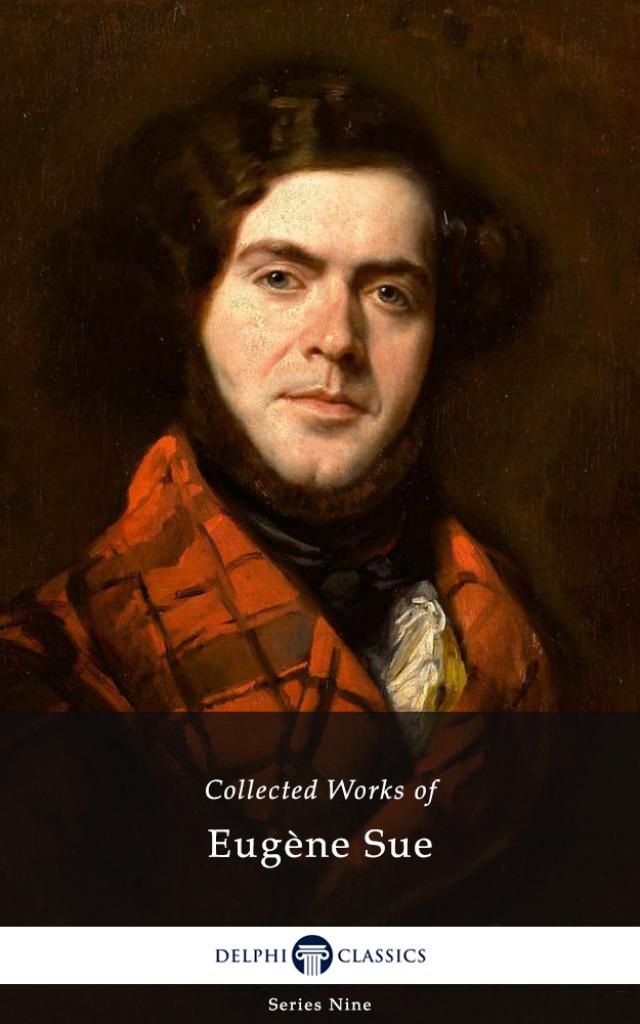
The Collected Works of
EUGÈNE SUE
(1804-1857)
Contents
The Mysteries of Paris
The Mysteries of Paris
The Mysteries of the People
The Gold Sickle
The Brass Bell
The Iron Collar
The Silver Cross
The Casque’s Lark
The Poniard’s Hilt
The Branding Needle
The Abbatial Crosier
The Carlovingian Coins
The Iron Arrow-Head
The Infant’s Skull
The Pilgrim’s Shell
The Iron Pincers
The Iron Trevet
The Executioner’s Knife
The Pocket Bible
The Blacksmith’s Hammer
The Sword of Honor
The Galley Slave’s Ring
The Seven Cardinal Sins
Pride
Luxury
Gluttony
Envy
Indolence
Avarice
Anger
Other Novels
Arthur
The Knight of Malta
The Wandering Jew
A Romance of the West Indies
The Delphi Classics Catalogue
© Delphi Classics 2018
Version 1
Browse our Main Series
Browse our Ancient Classics
Browse our Poets
Browse our Art eBooks
Browse our Classical Music series
The Collected Works of
EUGÈNE SUE
with introductions by Gill Rossini
www.gillrossini.com
By Delphi Classics, 2018
COPYRIGHT
Collected Works of Eugène Sue
First published in the United Kingdom in 2018 by Delphi Classics.
© Delphi Classics, 2018.
All rights reserved. No part of this publication may be reproduced, stored in a retrieval system, or transmitted, in any form or by any means, without the prior permission in writing of the publisher, nor be otherwise circulated in any form other than that in which it is published.
ISBN: 978 1 78877 921 0
Delphi Classics
is an imprint of
Delphi Publishing Ltd
Hastings, East Sussex
United Kingdom
Contact: sales@delphiclassics.com
www.delphiclassics.com
Parts Edition Now Available!
Love reading Eugène Sue?
Did you know you can now purchase the Delphi Classics Parts Edition of this author and enjoy all the novels, plays, non-fiction books and other works as individual eBooks? Now, you can select and read individual novels etc. and know precisely where you are in an eBook. You will also be able to manage space better on your eReading devices.
The Parts Edition is only available direct from the Delphi Classics website.
For more information about this exciting new format and to try free Parts Edition downloads, please visit this link.
Interested in French literature?
Then you’ll love these eBooks…
Discover a wealth of French art, literature and philosophy at Delphi Classics.
Explore French Themed eBooks…
The Mysteries of Paris
‘Place du Chatelet, Paris’ by Etienne Bouhot, 1810 — Sue was born in Paris in 1804, the son of a distinguished surgeon in Napoleon’s army, Jean-Joseph Sue, and is said to have had the Empress Joséphine for his godmother.
Portrait of Eugène Sue by François-Gabriel Lépaulle, 1835
The Mysteries of Paris
Anonymous 1845 translation, published by Chapman and Hall
Illustrated by Mercier, Bicknell, Poiteau and Adrian Marcel
Published in French as Les Mystères de Paris, this novel began as a long, 150-part serial, appearing in the conservative periodical Journal des Débats. It appeared from 19 June 1842 until 15 October 1843 and was one of the first serial novels to be published in France. Les Mystères de Paris was also produced as a ten volume set and appeared in many other abridged and translated formats. A contemporary encyclopaedia claimed Sue was encouraged to write the novel after noting the great success of Frédéric Soulié’s 1842 novel, Memoires du Diable; however, Sue’s reasons for embarking on this project were primarily pragmatic — the inheritance he had received from his father in 1830 had all been spent and he needed a steady source of income. In contrast to his previous endeavours – surgeon’s assistant and author of nautical and adventure novels – the series was an immediate success and may have single-handedly increased the periodical’s circulation, even saving it from bankruptcy.
As was common practice at the time, each instalment was placed on the front page, in the bottom quarter of the sheet. The novel is classed as a ‘city mystery’, a genre many authors imitated, including Emile Zola (Les Mystères de Marseille) and George Lippard (The Quaker City). The complexities of plot and the many characters have also been credited with inspiring Victor Hugo to write Les Misérables – it was Hugo that gave Sue the accolade of ‘The Dickens of Paris’. However, some commentators have detected in the plot and choice of scenes elements from previous Gothic fiction and other authors had already explored the theme of social realism in their stories – George Sand, Honoré de Balzac and Restif de la Bretonne. Nevertheless, the scale and complexity of Sue’s work brought together many more threads than theirs.
Present day readers may see in the hero, Rodolphe, a prototype for the ‘avenger’ or ‘justice figure’ hero in modern thrillers, as Rodolphe walks the squalid streets of Paris seeking a raw justice for those that transgress his own moral code. The grand sweep of the novel, with its large cast of characters from all walks of society, is essentially a struggle between good and evil, but although well intentioned, it did not appeal to the intellectuals of the day — Karl Marx (writing in The Holy Family in 1845) claimed it was more a pastiche of the misery of the poor people that Sue intended to portray sympathetically and that the characters were mere caricatures. By contrast, others saw the story as dangerously socialist in tone and partly responsible for the whipping up of dissent prior to the 1848 revolution.
However, such criticisms were very much a minority and the thousands that awaited each new episode in the Journal were gripped by the length and complexity of the tale. The novel has been put forward for the accolade of the most successful novel of all time, with a vast readership that cannot even be quantified – apart from those who bought the journal each time, the instalments were read aloud in cafés and village squares, to those who could not read or afford the journal and it was discussed on a daily basis in the same manner as people would discuss a modern television soap opera today. Apart from financial security (in 1980 prices, the story earned Sue approximately $100,000), the story catapulted Sue to the position of expert on the genre of the roman-feuilleton (“newspaper serial”). From the 1850’s, it has been suggested periodically that Sue had started out writing a story focussing on the squalid nature of working class life in Paris, but his working class fans wrote him so many letters urging him to emphasise the nobility of the working man that he soon changed tack. Now he made the peasant character people of the highest moral calibre, thus almost accidentally becoming a champion of the people. Some modern academics have seen the story as an early champion of laissez-faire bourgeois liberalism – sometimes scathingly referred to as ‘bleeding heart liberalism.’ Possibly the truth is somewhere in the middle; Sue never challenges the existing social structure, but does try to encourage the middle classes to use their power and income to help and support those less fortunate, noblesse oblige, rather than revolution; yet the journal Le Courrier de l’Europe, in an article about Sue and his work, stated of his portrayal of Chorineur: ‘there is not a more profound study… which exposes more wisely the vice of existing society.’
Another less appealing criticism levelled at the story is that it titillated the middle class readership of the Journal, readers who did not encounter such vile conditions in their everyday lives. Later in the century such forays into the lives of the lowest classes was known as ‘slumming’, visiting such areas as the Ile de la Cite and the East End of London, to witness the abjectly poor and brutalised, living their lives, almost as one would a freak show, yet doing little to help. Undoubtedly of the many readers of Sue’s story, some would have felt this vicarious thrill, but it is unlikely to have been a driving force in the plotting of the series. Sue does distinguish however between the ‘deserving’ and the ‘undeserving’ poor, not directly, but in his depiction of leading peasant characters as having a code of honour of their own, as opposed to lesser characters that seem irredeemably bad and are taken away by the police or come to a bad end.
From the very beginning, the story takes us into the dangerous and low class side of Parisian life in 1838, among the squalid taverns and haunts of prostitutes of the Ile de la Cite, ‘that labyrinth of obscure, narrow and winding streets which extends from the Palais de Justice to Notre Dame.’ It is a dark, windy night and we follow a well-built man in peasant garb along the narrow streets lined with decrepit and rotting buildings, some of which are low-class drinking establishments known as tapis-franc. Despite this description of a poor and dangerous district, Sue lays down his first challenge to our preconceptions of social norms, labelling the local gentry as the people that ‘infested the vicinity’.
The man in peasant clothing is Le Chourineur (the butcher), a violent ex-prisoner, who is soon challenged for his brutish behaviour towards La Goualeuse (also known as Fleur de Marie, a sixteen year old girl of the streets), by a mysterious young man in his thirties. Chourineur is soundly beaten and in the manner of the criminal fraternity, now declares the mysterious assailant as his master; the unlikely trio then walk to the White Rabbit bar, a haunt of criminals and drunkards, where the as yet unnamed man buys them all a supper. The bar is as rough and threatening as the streets of the Ile and it is here that La Goualeuse’s rescuer is named as La Rodolphe, ‘a young man of slight and graceful make’ and ‘elegant shape and carriage’ with ‘grace suppleness and power’, whose delicate good looks belie his strong physique and determined, honourable character. He tells his guests that he is of peasant stock and a fan painter by trade, but what he does not reveal is that he is really an aristocrat, the Grand Duke of Gerolstein, who is living incognito amongst the poor of Paris so he can better understand their problems and the overall social structure of a society that oppresses them — he has even perfected the dialect of the streets so he fits in completely. Chourineur and La Goualeuse, however, have had genuinely turbulent existences, both orphans with an uncertain, even abusive start to life, followed by spells in detention, encounters with violence, exploitation, deep poverty and brutalisation – yet there is a humour in them still and a unique moral code; for instance, Chourineur is violent and confrontational, but prides himself on never having stolen in his life. As Rodolphe says of his unlikely dinner companion, Chourineur has ‘heart and honour.’ They do not realise that Rodolphe also experienced an unconventional upbringing at the hands of Polidori, a dysfunctional tutor, who in effect attempted to brainwash his charge.
To Rodolphe’s annoyance, a figure from his true past appears at the bar – the Countess Sarah MacGregor, to whom he was briefly married and with whom he had a daughter. Sarah is cold hearted and ambitious and is obsessively in pursuit of Rodolphe to the extent that she has disguised herself in male attire to pursue him, but on this occasion he has been warned of her arrival by the watchfulness of his friend and associate, an Englishman named Murphy (also disguised as a peasant) and has escaped. Sarah is accompanied by her brother, Thomas Seyton — they make a haughty and unlikely pair of visitors to the bar, where fights and brutality are the norm. Meanwhile, the conspicuous affluence of Lady Sarah and her brother makes them easy prey for footpads, but Sarah has courage and bribes one of the villains to help her track down her former lover, Rodolphe. What she fails to notice is that she is observed by Chourineur, who is now fiercely loyal to Rodolphe, revealing her plan to his new friend.
In the meantime, charmed and intrigued by the destitute young woman, Rodolphe determines to save Goualeuse from her distressing and chaotic lifestyle, but not for the reasons one might think of a fictional older man that encounters a vulnerable young woman. He leaves her in the maternal care of Madame Georges, another woman whom Rodolphe has helped in the past. La Goualeuse is not the only poor person Rodolphe helps in the story; his generosity and determination to do good benefits numerous characters throughout the narrative. However, at this point, satisfied that he has saved La Goualeuse and ensured her a happy and comfortable future, Rodolphe must now turn his attention to the two villains that are in league with his ex-wife – a man known as Schoolmaster and the disreputable old woman who so cruelly raised La Goualeuse, Chouette. He persuades his two new associates to join him in a robbery on a rich household in Paris, as part of a plot to bring about their downfall. His plan is dangerous and he finds the astute Schoolmaster difficult to dupe, but must go ahead with the alliance if he is to triumph. Does Rodolphe have his own personal agenda in walking these squalid streets? Can this young aristocrat really get the better of these seasoned criminals? Will his devoted allies protect him from certain peril? Can he stay on in Paris, fighting for the justice for the poor people who have intrigued and befriended him, or will his true destiny as an aristocrat be too compelling to resist?
Although a pioneer in terms of scope, genre, length and format, to the modern reader some aspects of the story will seem rather familiar. Rodolphe is almost impossibly perfect, at least for much of the story and La Goualeuse is somewhat stereotypical with her blue-eyed, rosy-lipped beauty, humility, child-like innocence and religious faith, even in the face of a brutalised life; however, it would be unfair to label the work any more sentimental than many nineteenth century melodramas. The descriptions of the murky side of Parisian life and its characters are vivid and gripping. Although Sue digresses periodically to lecture the reader on such moral issues as prison reform, these are rarely truly inflammatory and do not distract too much from the action of the plot. This immense adventure will appeal to readers with a wide range of interests – those who love a long and involving tale; stories with an element of social realism (leaving Marx’s critique aside); stories that focus on a battle between good and evil; and anyone who relishes in a complex Victorian novel with charm, adventure and vivid descriptions of life in the gutters of one of the great metropolitan centres of the nineteenth century.
Frédéric Soulié, a French popular novelist and playwright, who wrote over forty sensation novels. His ‘Mémoires du diable’ (1837-8) influenced Sue’s ‘Les Mystères de Paris’.
Poster announcing the publication of ‘Les Mystères de Paris’ in 1843
CONTENTS
VOLUME I.
CHAPTER I.
CHAPTER II.
CHAPTER III.
CHAPTER IV.
CHAPTER V.
CHAPTER VI.
CHAPTER VII.
CHAPTER VIII.
CHAPTER IX.
CHAPTER X.
CHAPTER XI.
CHAPTER XII.
CHAPTER XIII.
CHAPTER XIV.
CHAPTER XV.
CHAPTER XVI.
CHAPTER XVII.
CHAPTER XVIII.
CHAPTER XIX.
CHAPTER XX.
CHAPTER XXI.
CHAPTER XXII.
CHAPTER XXIII.
CHAPTER XXIV.
CHAPTER XXV.
CHAPTER XXVI.
VOLUME II.
CHAPTER I.
CHAPTER II.
CHAPTER III.
CHAPTER IV.
CHAPTER V.
CHAPTER VI.
CHAPTER VII.
CHAPTER VIII.
CHAPTER IX.
CHAPTER X.
CHAPTER XI.
CHAPTER XII.
CHAPTER XIII.
CHAPTER XIV.
VOLUME III.
CHAPTER I.
CHAPTER II.
CHAPTER III.
CHAPTER IV.
CHAPTER V.
CHAPTER VI.
CHAPTER VII.
CHAPTER VIII.
CHAPTER IX.
CHAPTER X.
CHAPTER XI.
CHAPTER XII.
CHAPTER XIII.
CHAPTER XIV.
VOLUME IV.
CHAPTER I.
CHAPTER II.
CHAPTER III.
CHAPTER IV.
CHAPTER V.
CHAPTER VI.
CHAPTER VII.
CHAPTER VIII.
CHAPTER IX.
CHAPTER X.
CHAPTER XI.
CHAPTER XII.
CHAPTER XIII.
CHAPTER XIV.
CHAPTER XV.
CHAPTER XVI.
CHAPTER XVII.
CHAPTER XVIII.
CHAPTER XIX.
CHAPTER XX.
VOLUME V.
CHAPTER I.
CHAPTER II.
CHAPTER III.
CHAPTER IV.
CHAPTER V.
CHAPTER VI.
CHAPTER VII.
CHAPTER VIII.
CHAPTER IX.
CHAPTER X.
CHAPTER XI.
VOLUME VI.
CHAPTER I.
CHAPTER II.
CHAPTER III.
CHAPTER IV.
CHAPTER V.


