

The complete works, p.1
The Complete Works, page 1
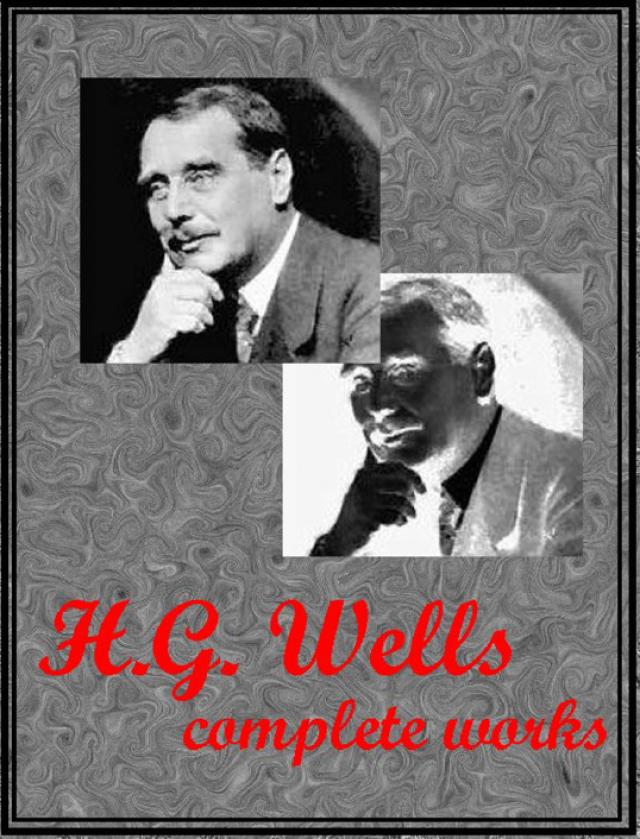


H(erbert) G(eorge) Wells (1866-1946)
BIOGRAPHY
English novelist, journalist, sociologist, and historian, whose science-fiction stories have been filmed many times. Wells's best known books are THE TIME MACHINE (1895), THE
INVISIBLE MAN (1897), and THE WAR OF THE WORLDS
(1898). Wells wrote over a hundred of books, about fifty of them novels.
"No one would have believed, in the last years of the nineteenth century, that human affairs were being watched keenly and closely by intelligences greater than man's and yet as mortal as his own; that as
men busied themselves about their affairs they were scrutinized and studied, parhaps almost as narrowly as a man with a microscope might scrutinize the
transient creatures that swarm and multiply in a
drop of water." (from War of the Worlds) Along with George Orwell's Nineteen-Eighty-Four and Aldous Huxley's Brave New World, which was an pessimistic answer to scientific optimism, Wells's novels are among the classical works of science-fiction, but his romantic and enthusiastic conception of technology later turned more doubtfull. His bitter side is seen early in the novel BOON (1915), which was a parody of Henry James.
H.G. Wells was born in Bromley, Kent. His father was a shopkeeper and a professional cricketer, and his mother served from time to time as a housekeeper at the nearby estate of Uppark.
His father's business failed and to elevate the family to middle-class status, Wells was apprenticed like his brothers to a draper, spending the years between 1880 and 1883 in Windsor and Southsea. Later he recorded these years in KIPPS (1905). In the story Arthur Kipps is raised by his aunt and uncle. Kipps is also apprenticed to a draper. After learning that he has been left a fortune, Kipps enters the upper-class society, which Wells describes with sharp social criticism.
In 1883 Wells became a teacher/pupil at Midhurst Grammar Scool.
He obtained a scholarship to the Normal School of Science in London and studied there biology under T.H. Huxley. However, his interest faltered and in 1887 he left without a degree. He taught in private schools for four years, not taking his B.S. degree until 1890. Next year he settled in London, married his cousin Isabel and continued his career as a teacher in a correspondence college.
From 1893 Wells became a full-time writer.
After some years Wells left Isabel for one of his brightest students, Amy Catherine, whom he married in 1895. As a novelist Wells made his debut with The Time Machine, a parody of English class division and a satirical warning that human progress is not inevitable. The Time Traveller lands in the year 802701 and finds two people: the Eloi, weak and little, who live above ground, and the Morlocks, carnivorous creatures that live below ground. Much of the realism of the story was achieved by carefully studied technical details.
The basic principles of the machine contained materials regarding time as the fourth dimension - years later Albert Einstein published his theory of the four dimensional continuum of space-time. The work was followed by such science-fiction classics as THE
ISLAND OF DR. MOREAU (1896), in which a mad scientist transforms animals into human creatures, The Invisible Man (1897), a Faustian story of a scientist who has tampered with nature in pursuit of superhuman powers, and The War of the Worlds (1898), a novel of an invasion of Martians. The story appeared at a time when Percival Lowell's "observations" of
"canals" on Mars arose speculations that there could be life on the Red Planet. Inspite of the technological superiority of the Martians, their plan fails - they start to die off because they have no immunity to the bacteria of Earth. THE FIRST MEN ON THE
MOON (1901) was prophetic description of the methodology of space flight, and THE WAR IN THE AIR (1908) was a hybrid that places Kipps-like Cockney hero in the context of a catastrophic aerial war. Altough Wells's novels were highly entertaining, he also tried to pave way for a wiser attitude about the future of the mankind.
Dissatisfied with his literary work, Wells moved into the novel genre, with LOVE AND MR. LEWISHAM (1900). He
strenghtened his reputation as a serous writer with Kipps, TONO-BUNGAY (1909), and THE HISTORY OF MR. POLLY (1909),
an ode to vanished England. He also published critical pamphlets attacking the Victorian social order, among them
ANTICIPATIONS (1901), MANKIND IN THE MAKING (1903),
and A MODERN UTOPIA (1905).
Passionate concern for society led Wells to join in 1903 the socialist Fabian Society in London, but he soon quarreled with the society's leaders, among them George Bernard Shaw. This experience was basis for his novel THE NEW MACHIAVELLI (1911), where he drew portraits of the noted Fabians. At the outbreak of war in 1914, Wells was involved in a love affair with the young English author Rebecca West, which influenced his work and life deeply.
"Nothing could have been more obvious to the people of the early twentieth century than the
rapidity with which war was becoming impossible.
And as certainly they did not see it. They did not see it until the atomic bombs burst in their fumbling hands." (from The World Set Free, 1914) After WW I Wells published several non-fiction works, among them THE OUTLINE OF HISTORY (1920), THE SCIENCE OF
LIFE (1929-39), written in collaboration with Sir Julian Huxley and George Philip Wells, and EXPERIMENT IN
AUTOBIOGRAPHY (1934). At this time Wells had gained the status as a popular celebrity, and he continued to write prolifically.
In 1917 he was a member of Reserch Committee for the League of Nations and published several books about the world organization.
In the early 1920s he was a labour candidate for Parliament.
Between the years 1924 and 1933 Wells livend mainly in France.
From 1934 to 1946 he was the International president of PEN. In 1934 he had discussions with both Stalin and Roosevelt, trying to recruit them to his world-saving schemes. However, he despaired of the whole business when the global war broke the peace for the second time.
"The professional military mind is by necessity an inferior and unimaginative mind; no man of high
intellectual quality would willingly imprison his gifts in such calling." (from The Outline of History, 1920) In THE HOLY TERROR (1939) Wells studied the psychological development of a modern dictator based on the careers of Stalin, Mussolini, and Hitler. In 1938 Orson Welles' Mercury Theater radio broadcast, based on The War of the Worlds, caused a panic which spread across the United States. Wells lived through World War II in his house on Regent's Park, refusing to let the blitz drive him out of London. His last book, MIND AT THE END OF ITS
TETHER (1945), expressed pessimism about mankind's future prospects. Wells died in London on August 13. 1946.
"Human history becomes more and more a race
between education and catastrophe." (from The Outline of History, 1920)
For further reading: The Invisible Man: The Life and Liberties of H.G. Wells by Michael Coren (1993); H.G.
Wells by Brian Murray (1990); H.G. Wells under Revision, ed. by Patrick Parrinder and Christopher Rolfe (1990); H.G. Wells by Brian Murray (1990); H.G.
Wells: A Comprehensive Bibliography, published by the H.G. Wells Society (1986); The Time Traveller: Life of H.G. Wells by N. and J. Mackenzie (1973); H.G.
Wells: The Critical Heritage, ed. by P. Parrinder (1972); H.G. Wells by L. Dickson (1969); The Early H.G. Wells by Bernard Bergonzi (1961); A Companion to Mr. Wells's "Outline of History," by Hilaire Belloc (1926); The World of H.G. Wells by Van Wyck Brooks (1915) - See also: Jules Verne, Edgar Rice Burroughs Selected works:
• TEXT-BOOK OF BIOLOGY, 1892-93
• HONOURS PHYSIOGRAPHY, 1893
• THE LORD OF THE DYNAMOS, 1894 - Voimakoneitten
herra ja muita tapauksia
• THE STOLEN BACILLUS AND OTHER STORIES, 1895 -
Varastettu basilli ja muita kertomuksia
• THE TIME MACHINE, 1895 - Aikakone - film 1960, dir, by George Pal
• THE WONDERFUL VISIT, 1895
• SELECT CONVERSATIONS WITH AN UNCLE, 1895
• THE STOLEN BACILLUS AND OTHER INCIDENTS,
1895
• THE RED ROOM, 1896
• THE WHEELS OF CHANGE, 1896
• THE ISLAND OF DOCTOR MOREAU, 1896 - Kauhun
saari - film 1932, dir. by Erle C. Kenton; film 1977, dir. by Don Taylor; film 1996, dir. by John Frankenheimer
• THE INVISIBLE MAN, 1897 - Näkymätön mies, suom.
Tapio Hiisivaara - film 1934, dir. by James Whale
• THE VALLEY OF SPIDERS, 1897 - Hämähäkkilaakso ja
muita kertomuksia
• THE PLATTNER STORY, 1897
• THIRTY STRANGE STORIES, 1897
• CERTAIN PERSONAL MATTERS, 1897
• THE WAR OF THE WORLDS, 1898 - Maailmojen sota -
Orson Welles's radio dramatization of it in October 1938
caused widespread panic in the U.S. - film 1953, dir. by Byron Haskin; Roland Emmerich's film Independence day ( 1996) sticks closely to the plot of Well's story
• TALES OF SPACE AND TIME, 1899
• WHEN SLEEPER WAKES, 1899 - Kun nukkuja herää,
suom. Jalmari Finne 1907
• A CURE FOR LOVE, 1899
• TALES OF SPACE AND TIME, 1899
• THE VACANT COUNTRY, 1899
• LOVE AND MR. LEWISHAM, 1900
• ANTICIPATIONS, 1901
• THE FIRST MEN IN THE MOON, 1901 - Ensimmäiset
ihmiset kuussa
• ANTICIPATIONS
OF THE REACTIONS OF
MECHANICAL AND SCIENTIFIC PROGRESS UPON
HUMAN LIFE AND THOUGHT, 1901
• THE DISCOVERY OF THE FUTURE, 1902
• THE SEA LADY, 1902
• TWELVE STORIES AND A DREAM, 1903
• MANKIND IN THE MAKING, 1903
• THE FOOD OF GODS, 1904
• A MODERN UTOPIA, 1905
• KIPPS: THE STORY OF A SIMPLE SOUL, 1905 - Kipps
käy seurapiireissä - film 1941, dir. by Carol Reed
• IN THE DAYS OF THE COMET, 1906
• SOCIALISM AND THE FAMILY, 1906
• FAULTS OF THE FABIAN, 1906
• THE FUTURE IN AMERICA, 1906
• RECONSTRUCTION OF THE FABIAN SOCIETY, 1906
• WILL SOCIALISM DESTROY THE HOME?, 1907
• THIS MISERY OF BOOTS, 1907
• TONO-BUNGAY, 1908
• THE WAR IN THE AIR, 1908 - Ilmasota
• FIRST AND LAST THINGS, 1908
• NEW WORLDS FOR OLD, 1908
• ANN VERONICA, 1909
• THE HISTORY OF MR. POLLY, 1910 - film 1948, dir. by Anthony Pelissier
• THE NEW MACHIAVELLI, 1911
• THE H.G. WELLS CALENDAR, 1911
• THE COUNTRY OF THE BLIND, 1911
• THE DOOR IN THE WALL, 1911
• MARRIAGE, 1912
• THE GREAT STATE, 1912 (ed. with G.R.S. Taylor and Frances Evelyn Warwick)
• KIPPS, 1912 (play, with Rudolf Besier)
• GREAT THOUGHTS FROM H.G. WELLS, 1912
• FLOOR GAMES, 1912
• THE LABOUR UNREST, 1912
• LIBERALISM AND ITS PARTY, 1913
• LITTLE WARS, 1913
• WAR AND COMMON SENSE, 1913
• THOUGHTS FROM H.G. WELLS, 1913
• THE PASSIONATE FRIENDS, 1913
• THE STAR, 1913
• THE WIFE OF SIR ISAAC HARMAN, 1914
• THE WORLD SET FREE, 1914
• AN ENGLISHMAN LOOKS AT THE WORLD, 1914
• THE WAR THAT WILL END WAR, 1914
• BOON, 1915
• THE RESEARCH MAGNIFICENT, 1915
• BEALBY, 1915
• THE PEACE OF THE WORLD, 1915
• THE ELEMENTS OF RECONSTRUCTION, 1916
• WHAT IS COMING?, 1916
• MR. BRITLING SEES IT THROUGH, 1916 - Mr. Britling pääsee selvyyteen
• GOD THE INVISIBLE KING, 1917 - Kuninkaitten kuningas
• THE SOUL OF A BISHOP, 1917
• GOD THE INVISIBLE KING, 1917
• INTRODUCTION TO NOCTURNE, 1917
• A REASONABLE MAN'S PEACE, 1917
• WAR AND THE FUTURE, 1917
• BRITISH NATIONALISM ANDF THE LEAGUE OF
NATIONS, 1918
• IN THE FOURTH YEAR, 1918
• JOAN AND PETER, 1918
• HE UNDYING FIRE, 1919 - Ikuinen liekki
• HISTORY IS ONE, 1919
• THE IDEA OF A LEAGUE OF NATIONS, 1919 (with
others)
• THE WAY TO THE LEAGUE OF NATIONS, 1919 (with
others)
• THE OUTLINE OF HISTORY, 1920; rev. ed. 1931 (see also Raymond Postgate) - Historian ääriviivat
• FRANK SWINNERTON, 1920
• RUSSIA IN THE SHADOWS, 1920
• THE NEW TEACHING OF HISTORY, 1921
• THE SALVAGING OF CIVILIZATION, 1921
• THE WONDERFUL VISIT, 1921 (play, with St. John
Ervine)
• THE SECRET PLACES OF THE HEART, 1922
• A SHORT HISTORY OF THE WORLD, 1922
• WASHINGTON AND THE HOPE OF PEACE, 1922
• THE WORLD, ITS DEBTS, AND THE RICH MEN, 1922
• SOCIALISM AND THE SCIENTIFIC MOTIVE, 1923
• contributor: THIRTY-ONE STOIES BY THIRTY AND
ONE AUTHORS, 1923
• MEN LIKE GODS, 1923
• TALES OF THE UNEXPECTED, 1922-23
• THE DREAM, 1924 - Uni
• THE P.R. PARLIAMENT, 1924
• THE STORY OF A GREAT SCHOOLMASTER, 1924
• WORKS, 1924 (28 vols.)
• A YEAR OF PROPHESYING, 1924
• A FORECAST OF THE WORLD'S AFFAIR, 1925
• A SHORT HISTORY OF MANKIND, 1925
• CHRISTINA ALBERTA'S FATHER, 1925
• THE WORLD OF WILLIAM CLISSOLD, 1926
• MR. BELLOC OBJECTS TO "THE OUTLINE OF
HISTORY", 1926
• WORKS, 1926-27 (24 vols.)
• IN MEMORY OF AMY CATHERINE WELLS, 1927
• WELLS' SOCIAL ANTICIPATIONS, 1927
• MEANWHILE, 1927
• DEMOCRACY UNDER REVISION, 1927
• THE SHORT STORIES OF H.G. WELLS, 1927
• MR. BLETTSWORTHY ON RAMPOLE ISLAND, 1928
• H.G. WELLS COMEDIES, 1928 (plays, with Frank Wells)
• THE OPEN CONSPIRACY, 1928
• THE WAY THE WORLD IS GOING, 1928 THE
COMMON SENSE OF WORLD PEACE, 1929
• IMPERIALISM AND THE OPEN CONSPIRACY, 1929
• THE KING WHO WAS A KING, 1929
• THE ADVENTURES OF TOMMY, 1929
• THE SCIENCE OF LIFE, 1929-30 - Elämän ihmeet
• THE AUTOCRACY OF MR. PARHAM, 1930
• DIVORCE AS I SEE IT, 1930 (with others)
• POINTS OF VIEW, 1930 (with others)
• THE PROBLEM OF THE TROUBLESOME
COLLABORATOR, 1930
• THE SCIENCE OF LIFE, 1930 (with Julian S. Huxley and G.P. Wells)
• SETTLEMENT OF THE TROUBLE BETWEEN MT.
THRING AND MR. WELLS, 1930
• THE WAY TO WORLD PEACE, 1930
• THE WORK, WEALTH AND HAPPINESS OF
MANKIND, 1931
• THE STOLEN BODY, 1931
• THE NEW RUSSIA, 1931
• SELECTIONS FROM THE EARLY PROSE WORKS OF
H.G. WELLS, 1931
• THE WORK, WEALTH, AND HAPPINESS OF
MANKIND, 1931-32
• THE BULPINGTON OF BLUP, 1932
• AFTER DEMOCRACY, 1932
• THE SHAPE OF THINGS TO COME, 1933
• EXPERIMENT IN AUTOBIOGRAPHY, 1934
• STALIN-WELLS TALK, 1934
• THE NEW AMERICA, 1935
• THINGS TO COME: A FILM STORY BASED ON THE
MATERIAL CONTAINED IN HIS HISTORY OF THE
FUTURE "THE SHAPE OF THINGS TO COME", 1935
• THE MAN WHO COULD WORK MIRACLES: A FILM
STORY, 1936
• IDEA OF A WORLD ENCYCLOPEDIA, 1936
• THE ANATOMY OF FRUSTRATION, 1936
• THE CROQUET PLAYER, 1937
• BRYNHILD, 1937
• THE CAMFORD VISITATION, 1937
• STAR BEGOTTEN, 1937
• THE FAVORITE SHORT STORIES OF H.G. WELLS,
1937
• WORLD BRAIN, 1938
• APROPOS OF DOLORES, 1938
• THE BROTHERS, 1938
• THE HOLY TERROR, 1939
• THE FATE OF HOMO SAPIENS, 1939
• TRAVELS OF A REPUBLICAN RADICAL IN SEARCH
OF HOT WATER, 1939
• ALL ABOARD FOR ARARAT, 1940
• BABES IN THE DARKLING WOOD, 1940
• TWO HEMISPHERES OR ONE WORLD?, 1940
• SHORT STORIES BY H.G. WELLS, 1940
• THE COMMON SENSE OF WAR AND PEACE, 1940
• H.G. WELLS, S. DE MADARIAGA, J. MIDDLETON
MURRY, C.E.M. JOAD ON THE NEW WORLD ORDER,
1940
• THE NEW WORLD RDER, 1940
• THE RIGHTS OF MAN, 1940
• YOU CAN'T BE TOO CAREFULL: A SAMPLE OF LIFE
1901-1951, 1941
• GUIDE TO THE NEW WORLD, 1941
• THE POCKET HISTORY OF THE WORLD, 1941
• THE CONQUEST OF TIME, 1942
• MODERN RUSSIAN END ENGLISH
REVOLUTIONARIES, 1942
• THE NEW RIGHTS OF MAN, 1942
• THE OUTLOOK FOR HOMO SAPIENS, 1942
• PHOENIX, 1942
• SCIENCE AND WORLD-MIND, 1942
• A THESIS ON THE QUALITY OF ILLUSION, 1942
• THE EMPIRE OF THE ANTS, 1943
• THE INEXPERIENCED GHOST, 1943
• THE LAND IRONCLADS, 1943
• THE NEW ACCELERATOR, 1943
• THE TRUTH ABOUT PYECRAFT, 1943
• CRUX ANSATA, 1943
• THE MOSLEY OUTRAGE, 1943
• '42 TO '44, 1944
• RESHAPING MAN'S HERITAGE, 1944 (with J.S. Huxley
and J.B.S. Haldane) )
• THE INEXPERIENCED GHOST AND THE NEW
ACCELERATOR, 1944
• MIND AT THE END OF ITS TETHER, 1945


